
Rider
A rider is an attachment to a contract or lease that adds or changes terms. It becomes part of the agreement and, if it says so, overrides conflicting terms in the main document.
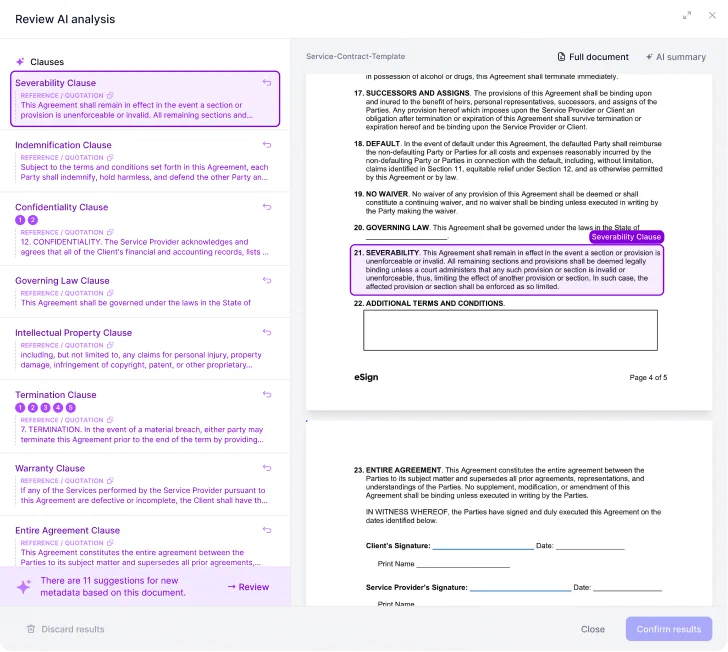
Analyze your contracts. Extract important clauses.
Try our AI contract analysis and extract important clauses and information from existing contracts.
Save your favourite clauses
Insert directly with a single click
Upload preferred precedents
Sample Rider clauses
Source
tw telecom inc.This Rider No. 1 is made and entered into by and between LBA REALTY FUND III-COMPANY II, LLC a Delaware limited liability company (“Landlord”), and tw telecom holdings inc., a Delaware corporation (“Tenant”), as of the day and year of the Lease between Landlord and Tenant to which this Rider is attached. Landlord and Tenant hereby agree that, notwithstanding anything contained in the Lease to the contrary, the provisions set forth below shall be deemed to be part of the Lease and shall supersede any inconsistent provisions of the Lease. All references in the Lease and in this Rider to the “Lease” shall be construed to mean the Lease (and all Exhibits and Riders attached thereto), as amended and supplemented by this Rider. All capitalized terms not defined in this Rider shall have the same meaning as set forth in the Lease.
RIDER
This Rider (“Rider”) is hereby incorporated into the agreement, and proposal for services entered into by and between Miami Dolphins, Ltd. (“Client”) and Altitude International Inc. (“ALTD”) dated March 21, 2019 (collectively, the “Agreement”). In the event there is any conflict or inconsistency between any term in this Rider and my term in the Agreement or any future document issued between the parties herein, the term in this Rider shall govern.
Source
PURA NATURALS, INC.SECURITY AGREEMENT RIDER
This Rider, amends The Security Agreement Dated April 7, 2017 between (the “Security Agreement”), between Mammoth Corporation (the “Holder”), and Robert Doherty and Robert Switzer (the “Company”), which remains in effect except as modified by this Rider, as follows:
·
The Security Agreement is being amended because the shares are being pledged by Robert Doherty are held by Advanced Materials Technology, Inc., rather than by Robert Doherty individually. By signing below Advanced Materials Technology, Inc. agrees to all terms and conditions set forth in the Security Agreement and makes all of the representations contained in the Security Agreement. The Security Agreement is modified to make Advanced Materials Technology, Inc. an Additional Pledgor in the Security Agreement.
What is a rider in a contract?
A rider is a separate document attached to a contract that adds terms, changes existing ones or deals with a specific topic. Once signed, it becomes part of the contract, which is also how Cornell’s Legal Information Institute defines a rider. In legislation, the same page notes, a rider is an amendment attached to a bill that is not directly related to it. Riders are common in leases, insurance policies, performance and event contracts, and loan and security documents.
Example: an office lease uses the landlord’s standard printed form. The tenant negotiates changes to the repair, assignment and termination terms. Instead of editing the form, the parties attach “Rider No. 1”, which says it is part of the lease and overrides anything inconsistent in the printed form. One sample above does exactly this.
The word comes from the idea of a page that “rides along” with the main document.
Rider vs. addendum vs. amendment
The terms overlap, and contracts do not always use them consistently. In common usage:
| Document | When it is made | What it does |
|---|---|---|
| Rider | Most often at the same time as the contract | Adds or changes terms from the start, often on a specific topic |
| Addendum | At signing or later | Adds information or terms to the contract |
| Amendment | After signing | Changes terms of an existing contract |
What matters legally is not the label but that the document is properly signed, clearly identifies the contract it belongs to, and says how it relates to it.
Common types of riders
- Lease riders: negotiated changes to a standard form lease, building rules, parking, signage or renewal options. Not every lease rider changes the deal, though. In New York City, owners of rent-stabilized apartments must attach the state’s lease rider for rent-stabilized tenants to every vacancy and renewal lease (leaving it out can bring a fine), and the form itself says it is informational only and does not modify the lease.
- Real estate purchase riders: extra terms added to a standard purchase contract, such as an inspection contingency or a home sale contingency.
- Performance and event riders: technical and hospitality requirements for artists and venues, such as equipment, staging and catering. A technical rider lists the equipment and staging an artist needs, and a hospitality rider covers catering and dressing rooms. A performance contract template is where those terms end up in the agreement.
- Insurance riders: endorsements that add or remove coverage, for example one that names an additional insured on a liability policy.
- Security and loan riders: adding a pledgor or collateral to a security agreement, as in another sample, or riders to mortgages for specific property types.
- Client-specific riders: terms a large customer requires on top of a vendor’s standard agreement, such as one sample where the customer’s rider governs over the vendor’s proposal.
What a rider should say
- Which contract it belongs to, by title, date and parties.
- That it forms part of that contract.
- Which document prevails if they conflict. Usually the rider does, since it reflects the negotiated deal.
- That defined terms have the same meaning as in the main contract.
- Signatures of the same parties, or initials on each page, so it cannot be disputed later.
The main contract should carry a matching rider clause, for example “The parties have signed Rider No. 1, which is incorporated into this Agreement,” so the incorporation works from both documents.
Rider clause example
Sample clause: Rider
Add this clause to a contract, send it and get it signed in fynk.
Use it in fynk for freeKeeping riders with the contract
A rider that gets separated from its contract causes exactly the disputes it was meant to prevent. With related files in fynk, riders, exhibits and annexes are attached directly to the contract they belong to, so the full agreement is always together.
Which contracts use riders?
Commercial and residential leases, insurance policies, artist and performance agreements, venue and event contracts, loan and security agreements, mortgages, and vendor agreements with customer-specific terms. This free template refers to riders:
Free templates with this clause
Related clauses
- Addendum An addendum is a separate document attached to an existing contract that adds new terms or clarifies existing ones. Once every party has signed it, it becomes part of the original agreement, and everything it does not touch stays in force.
- Amendment An amendment clause outlines the procedures and requirements for making changes or modifications to an existing contract. It specifies how amendments can be proposed, agreed upon, and documented by the parties involved to ensure that all modifications are legally binding and enforceable.
- Contract amendment A contract amendment is a formal alteration to the terms of an existing contract, agreed upon by all parties involved. It allows changes to specific provisions without voiding the original contract, ensuring that the agreement remains relevant and effective in addressing the parties' needs.
- Mutatis mutandis Mutatis mutandis is Latin for "with the necessary changes". Contracts use it to apply provisions written for one situation or agreement to another, adjusting the details that obviously differ.
- Incorporation by reference "Incorporation by reference" is a contractual mechanism that allows parties to include terms from an external document within the contract without restating them verbatim. By referring to the external document, the parties agree to abide by its terms as if they were fully set out within the contract itself.
- Entire agreement The "Entire Agreement" clause asserts that the written contract constitutes the complete and final agreement between the parties, superseding any prior discussions, negotiations, or agreements. It ensures that no other verbal or written agreements outside the contract will affect or modify its terms unless formally amended in writing.
Frequently asked questions
An attached document that adds or changes terms of the contract and becomes part of it once signed.
A rider agreement is a short signed document attached to a main contract, such as a lease or policy. It adds or changes terms and, once signed, is read together with the contract.
A contract rider is a page or set of pages that rides along with the main agreement. It sets out extra or changed terms, and it usually says it prevails if it conflicts with the main document.
Usage varies. A rider is usually signed with the main contract and changes or adds terms from the start; an addendum can be added at signing or later. What matters is that it is signed and clearly linked to the contract.
An office tenant and landlord sign the landlord's printed lease form and attach Rider No. 1 with the negotiated repair, assignment and termination terms, stating that the rider prevails over the printed form.
An attachment to a lease with additional or changed terms, such as negotiated changes to a standard form, building rules or required tenant notices.
Only where it says so or the context makes it clear. Most riders state that they prevail over conflicting terms in the main document, and the rest of the contract stays in force.
Yes, if all parties sign it. A rider added later works like an amendment, so follow what the contract says about changes, such as a requirement that they be in writing and signed by both sides.
It should be. Signing or initialing the rider shows that both parties agreed to it as part of the contract.
More clauses from the library
See allRight of first negotiation
The "Right of First Negotiation" clause requires a party to engage in good faith discussions with a specified party before negotiating with others, typically regarding a sale or partnership. This clause ensures the specified party has a preliminary opportunity to negotiate terms before the deal is offered externally.
13 example clauses
Right of first offer to purchase
A "Right of First Offer to Purchase" clause grants a party the initial opportunity to negotiate the purchase of a specified asset before the owner offers it to third parties. If the parties cannot agree on terms, the owner is then free to seek other buyers.
16 example clauses
Right of first offer
The "Right of First Offer" clause grants a party the opportunity to make an initial offer on an asset or business interest before the owner offers it to third parties. This ensures the holder of the right can negotiate terms without external competition, potentially securing a favorable deal.
20 example clauses
Analyze your contracts. Extract important clauses.
Try our AI contract analysis and extract important clauses and information from existing contracts.
Save your favourite clauses
Insert directly with a single click
Upload preferred precedents