
Mutatis mutandis
Mutatis mutandis is Latin for "with the necessary changes". Contracts use it to apply provisions written for one situation or agreement to another, adjusting the details that obviously differ.
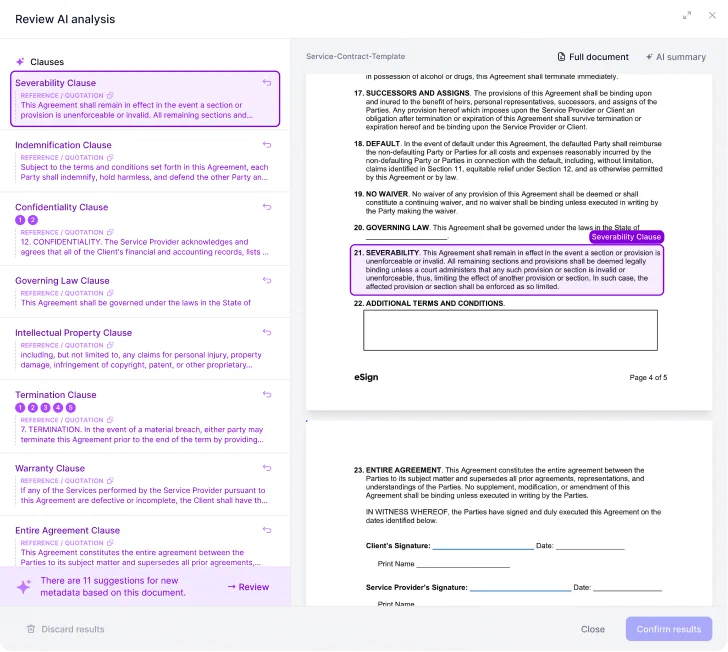
Analyze your contracts. Extract important clauses.
Try our AI contract analysis and extract important clauses and information from existing contracts.
Save your favourite clauses
Insert directly with a single click
Upload preferred precedents
Sample Mutatis mutandis clauses
8.No Other Modifications. Pursuant to Section 13 of the Employment Agreement (“Entire Agreement; Amendments; Counterparts”), the Employment Agreement is hereby deemed to be amended, mutatis mutandis, to effect the intent set forth in paragraphs 1 through 7 above, and other than as set forth above, the remaining provisions of your Employment Agreement shall continue in full force and effect without any amendment or modification thereto.
Section 8.15 Confidentiality. Each Lender shall be required to comply with the provisions of the Indenture, including Section 14.18 of the Indenture, with respect to Confidential Information and the provisions of Section 14.18 of the Indenture are incorporated by reference mutatis mutandis; provided that in no event shall any Lender or any Affiliate thereof be obligated or required to return any materials furnished by the Borrower.
To the extent not contrary to any specific term of the Put Option, the provisions of Sections 13 (Confidentiality), 14.1 (Further Actions), 14.2 (Sellers’ Agent), 14.3 (Notices and Communications), 14.4 (Costs and Expenses), 14.5 (Absence of third-party rights – Assignment), 14.7 (Entire Agreement), 14.8 (No hardship), 14.9 (Counsels and legal advisors), 14.11 (Explicit waivers of the Purchaser), 14.12 (Specific Performance), 14.14 (Intangibility of the Agreement) and 14.16 (Severability) of the SPA are incorporated by reference in this Put Option and shall apply mutatis mutandis as from the date hereof to this Put Option as if they were forming a part hereof, it being specified that, for the purpose of this Put Option, any reference to the “Agreement” in such sections of the SPA shall be construed as making reference to this Put Option, and any reference to the “Sellers” and the “Purchaser” shall be construed as making reference, respectively, to the Main Shareholders and the Purchaser.
Each party hereto agrees to maintain the confidentiality of this Amendment and the terms hereof, subject to the confidentiality provisions contained in the Commitment Letter. The provisions of the third paragraph of Section 9 of the Commitment Letter are incorporated herein, mutatis mutandis, as if the references to the Commitment Letter were to this Amendment. Each of the parties hereto (for itself and its affiliates) (a) waives, to the fullest extent it may legally and effectively do so, any objection that it may now or hereafter have to the laying of venue of any suit, action or proceeding arising out of or relating to the Commitment Letter, this Amendment, or the transactions contemplated thereby or hereby, in any such New York State court or in any such Federal court and (b) waives, to the fullest extent permitted by law, the defense of an inconvenient forum to the maintenance of such action or proceeding in any such court.
(b) Upon the execution of any supplemental indenture under Article VIII of the Indenture, any provisions of the Indenture that are incorporated by reference in this Agreement, mutatis mutandis, as if fully set forth herein, shall be modified in accordance therewith, and such supplemental Indenture shall form a part of this Agreement for all purposes; and every Lender theretofore and thereafter authenticated and delivered hereunder shall be bound thereby.
What does mutatis mutandis mean?
Mutatis mutandis is Latin for “once the necessary changes have been made”, usually shortened to “with the necessary changes”. In a contract, it means that a provision written for one situation applies to another, with the details adjusted to fit: names, defined terms, dates and references.
It is pronounced roughly “moo-TAH-tis moo-TAN-dis”.
Example: a loan agreement says, “Section 14.18 of the Indenture (Confidentiality) is incorporated by reference mutatis mutandis.” That means the confidentiality rules in the indenture now also apply under the loan agreement, but references to “Holders” are read as “Lenders”, “this Indenture” as “this Agreement”, and so on.
How contracts use mutatis mutandis
Typical uses, several of them shown in the sample clauses above:
- Incorporating clauses from another agreement: a put option or amendment imports the confidentiality, notice and governing law sections of the main agreement “mutatis mutandis”.
- Applying a clause to a parallel situation: “the provisions of Section 5 apply mutatis mutandis to the Buyer”, making one-sided obligations mutual.
- Amendments: an agreement “is deemed amended, mutatis mutandis” to give effect to a change, so related references are read consistently.
- Supplements and joinders: a new party or new premises is brought under existing terms with the necessary adjustments.
The risk: who decides what is “necessary”?
The phrase saves words, but it leaves the parties to work out later which changes are “necessary”. That is fine for obvious substitutions, such as reading “Seller” as “Licensor”. It becomes risky when:
- the imported clause refers to concepts that do not exist in the new agreement;
- it is unclear whether limits, caps or time periods should be adjusted;
- the clause was one-sided and it is unclear whether applying it “mutatis mutandis” makes it mutual;
- the source agreement is later amended or terminated.
Courts generally apply the phrase sensibly, making only the changes needed for the provision to work in its new context, but disputes over what those changes are can be expensive.
How to use mutatis mutandis safely
- Name exactly what is incorporated: specific sections, not “the relevant provisions”.
- Spell out the key substitutions, as one sample does: references to the “Agreement” mean the put option, the “Sellers” mean the main shareholders.
- Say which version applies: the source agreement as of today, or as amended from time to time. Another sample addresses this for supplemental indentures.
- Avoid it for important terms: liability caps, indemnities and payment terms are better written out in full.
- Watch for conflicts: say which agreement prevails if the incorporated clause conflicts with the new one.
Mutatis mutandis vs. related Latin terms
| Term | Meaning | Example use |
|---|---|---|
| Mutatis mutandis | With the necessary changes | Applying a clause from another agreement |
| Ceteris paribus | All other things being equal | Economic analysis, rarely in contracts |
| Inter alia | Among other things | “including, inter alia,” before a non-exhaustive list |
| Pari passu | On equal footing | Equal ranking of debts or shares |
| Ab initio | From the beginning | Void ab initio |
Mutatis mutandis clause example
Sample clause: Incorporation by reference
Add this clause to a contract, send it and get it signed in fynk.
Use it in fynk for freeWriting the clause out instead
When a clause matters, it is often clearer to write it out in full for the new agreement than to import it with “mutatis mutandis”. With AI draft in fynk, you describe in plain language what the provision should say for this contract, and it generates the full text as a first draft to adjust, so the agreement stands on its own.
Which contracts use mutatis mutandis?
Amendments and supplements, guarantees and security documents that import terms from a main agreement, put and call options, joinder agreements, lease extensions, credit agreements that incorporate indenture provisions, and international contracts drafted by civil law lawyers, where the phrase is especially common. These free templates use it:
Free templates with this clause
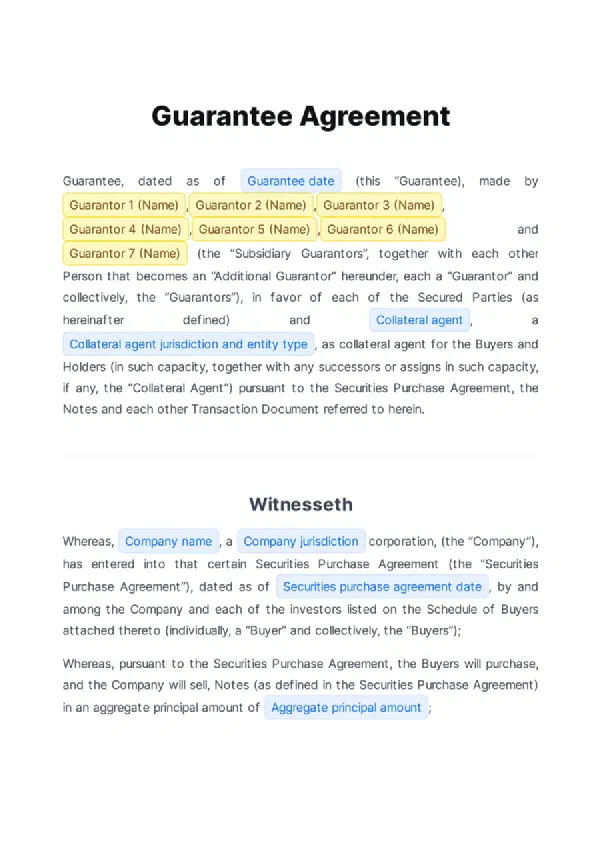 Guarantee agreement template (securities purchase and notes)
The guarantee is a transaction document subject to the terms of the securities purchase agreement, including its jurisdiction provisions, mutatis mutandis.
Use the free template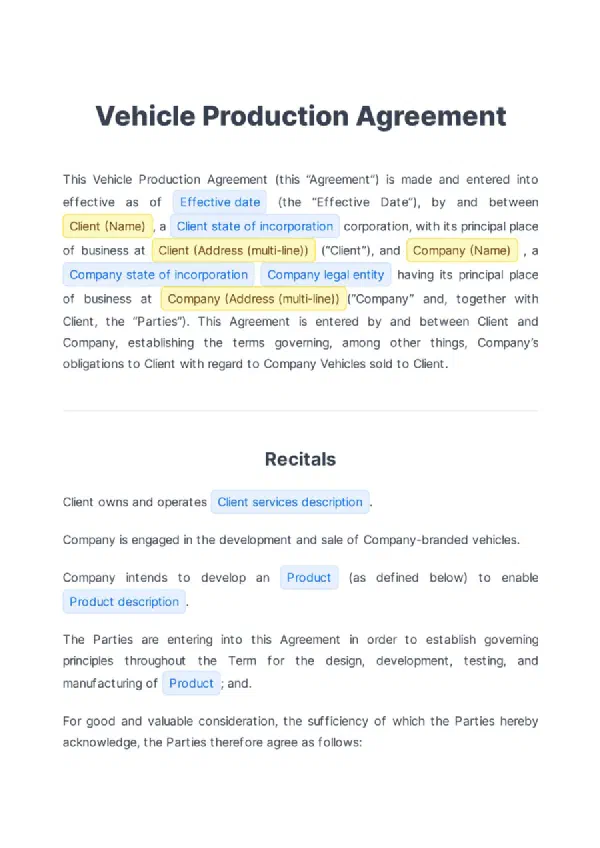 Vehicle production agreement template
The representations and warranties of the master framework agreement are incorporated into the production agreement mutatis mutandis.
Use the free template
Related clauses
- Incorporation by reference "Incorporation by reference" is a contractual mechanism that allows parties to include terms from an external document within the contract without restating them verbatim. By referring to the external document, the parties agree to abide by its terms as if they were fully set out within the contract itself.
- interpretation The interpretation clause in a contract provides guidance on how the terms and definitions within the agreement should be understood and applied. It helps prevent ambiguities by clarifying the meanings of specific words or phrases, ensuring that all parties have a consistent understanding of the contractual terms.
- Amendment An amendment clause outlines the procedures and requirements for making changes or modifications to an existing contract. It specifies how amendments can be proposed, agreed upon, and documented by the parties involved to ensure that all modifications are legally binding and enforceable.
- Miscellaneous provisions Miscellaneous provisions in a contract encompass a variety of clauses that address general or logistical aspects not covered in other sections, ensuring the overall functionality and enforceability of the agreement. These may include clauses related to governing law, dispute resolution, severability, amendments, and any additional terms necessary for the comprehensive operation of the contract.
- Notwithstanding the foregoing “Notwithstanding the foregoing” means “despite what was just said”. It introduces an exception that wins over the rule before it, for example an assignment ban followed by a carve-out for a buyer of the business. Its wider cousin, “notwithstanding anything to the contrary”, overrides every conflicting provision in the contract.
Frequently asked questions
“With the necessary changes.” In a contract, it means a provision written for one situation applies to another, adjusted for the obvious differences such as party names and references.
For example: “Section 9 of the Purchase Agreement applies to this Option mutatis mutandis.” It means Section 9 applies to the option, with references adjusted to fit.
Yes. It is an accepted drafting technique, and courts apply the incorporated provisions with the changes needed for them to make sense in their new context.
Incorporation by reference brings another document's terms into a contract. Mutatis mutandis adds that those terms are to be adjusted to fit, rather than applied word for word.
Not entirely, but use it for simple, obvious substitutions. For important terms, write the provision out in full or spell out the changes.
More clauses from the library
See allMutual agreement
A mutual agreement clause specifies that certain actions, changes, or decisions within a contract require the consent of all involved parties before implementation. This clause ensures that all parties have equal input and acknowledge any modifications to the original terms, promoting collaboration and fairness in the contractual relationship.
7 example clauses
Mutual confidentiality
A mutual confidentiality clause is an agreement between parties to protect each other's confidential information from unauthorized disclosure or use. It requires both parties to maintain the confidentiality of shared sensitive information and can outline the duration, scope, and any permissible exceptions to this obligation.
8 example clauses
Mutual general release
A mutual general release clause is a contractual provision where both parties agree to relinquish any existing or potential claims against each other, thereby freeing both from future legal disputes related to the subject matter of the release. This clause aims to bring closure to past grievances and facilitate a clean break, ensuring that neither party can pursue further claims or litigation over the issues covered by the agreement.
8 example clauses
Analyze your contracts. Extract important clauses.
Try our AI contract analysis and extract important clauses and information from existing contracts.
Save your favourite clauses
Insert directly with a single click
Upload preferred precedents