
Notwithstanding the foregoing
“Notwithstanding the foregoing” means “despite what was just said”. It introduces an exception that wins over the rule before it, for example an assignment ban followed by a carve-out for a buyer of the business. Its wider cousin, “notwithstanding anything to the contrary”, overrides every conflicting provision in the contract.
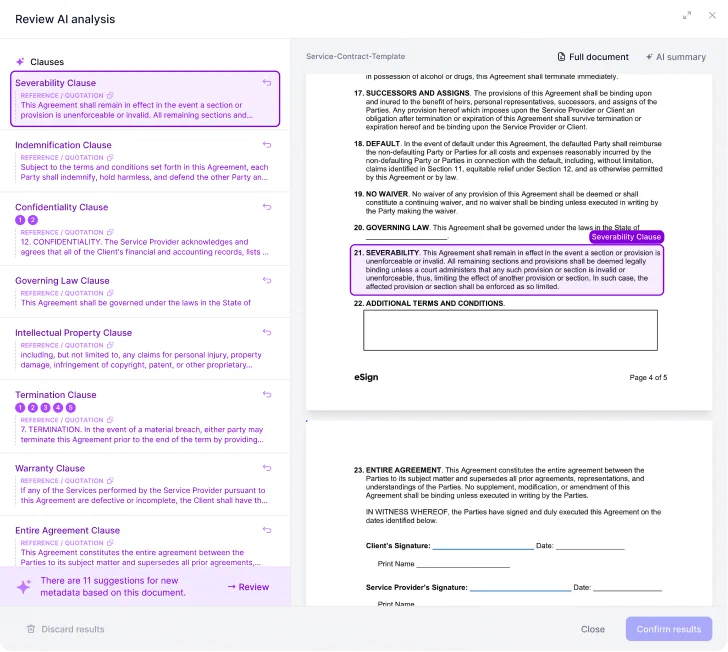
Analyze your contracts. Extract important clauses.
Try our AI contract analysis and extract important clauses and information from existing contracts.
Save your favourite clauses
Insert directly with a single click
Upload preferred precedents
Sample Notwithstanding the foregoing clauses
(a)This Agreement is personal to the Executive. Neither the Company nor the Executive may make any assignment of this Agreement or any interest herein, by operation of law or otherwise, without the prior written consent of the other party. For purposes of this Section, consent on the part of the Company means the written, signed consent of the Board. Notwithstanding the foregoing, the Company may assign its rights under this Agreement without any such further consent of the Executive to any successor in interest to the Company including in the event that the Company shall effect a reorganization, consolidate with or merge into any other corporation, limited liability company, partnership, organization or other entity, or transfer all or substantially all of its properties or assets to any other corporation, limited liability company, partnership, organization or other entity, in which event all references to the “Company” shall be deemed to mean the assignee or a designated affiliate of the assignee. The Executive hereby consents to such assignment as set forth in the immediately preceding sentence and further acknowledges and agrees that no further consent by the Executive is necessary to make such assignment. This Agreement shall inure to the benefit of and be binding upon the Company and the Executive, their respective successors, executors, administrators, heirs and permitted assigns.
Notwithstanding the foregoing, the Company shall not be obligated to indemnify the Indemnitee for expenses or liabilities of any type whatsoever (including, but not limited to, judgments, fines, ERISA excise taxes and penalties, and amounts paid in settlement) for which payment is actually made to or on behalf of the Indemnitee under a valid and collectible insurance policy of D&O Insurance, or under a valid and enforceable indemnity clause, by-law or agreement.
(d) Robotics Business Work Product. Notwithstanding anything to the contrary in Section 1.2(a) or any Statement of Work, all Intellectual Property and other work product created by or for Provider or its affiliates in performing Services relating to the Robotics Business (the “Robotics Business Work Product”) shall be owned exclusively by the Recipient, and the Provider hereby assigns, and shall cause its affiliates and personnel to assign, all right, title and interest in the Robotics Business Work Product to the Recipient.
Assignment. Notwithstanding anything to the contrary contained in this Lease, this Lease may be collaterally assigned by Tenant to a financial institution solely in respect of (x) the granting of a security interest in, and/or pledge of, Tenant’s interests in this Lease and/or (y) the exercise of such financial institution’s rights (whether in the manner of a foreclosure or otherwise) with respect to such security interests or pledge.”
Notwithstanding the foregoing, nothing in this Agreement prohibits Employee from discussing or disclosing information about unlawful acts in the workplace, including but not limited to harassment, discrimination, retaliation, wage and hour violations, or any other conduct that Employee has reason to believe is unlawful, or from making any disclosures protected under applicable law.
Survival of Indemnification Agreement. Notwithstanding anything to the contrary in this Agreement, the Indemnification Agreement by and between Agilent Technologies, Inc. and Bret DiMarco dated July 16, 2024, shall survive the execution of this Transition and General Release Agreement and shall remain in full force and effect, and nothing in this Agreement shall terminate, limit, or impair your rights thereunder.
What does notwithstanding the foregoing mean?
“Notwithstanding the foregoing” means “despite what was just said”. It introduces an exception: the sentence that follows wins over the rule that comes before it.
Example: “Neither party may assign this Agreement without the other party’s consent. Notwithstanding the foregoing, either party may assign it to a buyer of its whole business.” The first sentence is the rule. The second is the exception, and it applies even though the rule says otherwise.
“Notwithstanding” is an old word for “despite” or “even if”. “The foregoing” means the text that comes before. The phrase does not add a new obligation on its own. It only decides which of two provisions applies when they clash.
Notwithstanding the foregoing vs. notwithstanding anything to the contrary
Both phrases create an override. The difference is how far they reach.
| Notwithstanding the foregoing | Notwithstanding anything to the contrary | |
|---|---|---|
| What it overrides | The text just before it | Every conflicting provision in the contract (or in the place it names) |
| Typical reach | The previous sentence, paragraph or section | The whole agreement, sometimes other agreements too |
| Typical use | A narrow exception to a rule in the same clause | A provision that must win everywhere, such as a survival or carve-out |
| Main risk | Unclear how much text “the foregoing” covers | Two such clauses can conflict with each other |
“Notwithstanding anything to the contrary herein” and “notwithstanding anything to the contrary contained in this Agreement” mean the same thing: this provision applies, whatever the rest of the contract says.
Where the phrase shows up in contracts
The sample clauses above show the usual places:
- Assignment: a ban on assignment, then an exception for a successor or an affiliate.
- Indemnity and limitation of liability: a promise to pay, then the cases where it does not apply, such as amounts already paid by insurance.
- Confidentiality: a duty to keep information secret, then the information it does not cover, or disclosures the law protects.
- Intellectual property and leases: a general rule on ownership or transfer, then one asset or one transfer that is treated differently.
- Survival: a release or termination, then the rights that stay in force anyway.
How to use it without creating a dispute
The phrase works, but it is easy to get wrong. When you draft or review one, check:
- What “the foregoing” covers. The previous sentence, the paragraph, the section or everything above? If it is not obvious, name it: “notwithstanding Section 4.2”.
- Whether a plain “except” works better. “Neither party may assign this Agreement, except to a buyer of its whole business” says the same in one sentence.
- Whether two overrides collide. If two clauses both say “notwithstanding anything to the contrary”, the contract no longer says which one wins. An order of precedence clause or a precise cross-reference settles it.
- Whether the exception hides a big change. An override buried in a long clause can switch off a cap on liability or a consent right. Read every “notwithstanding” as if it were a separate clause.
For more old contract phrases and their plain-English versions, see legalese.
Notwithstanding clause example
Sample clause: Assignment with an exception
Add this clause to a contract, send it and get it signed in fynk.
Use it in fynk for freeWriting “the foregoing sentence” instead of “the foregoing” makes the reach of the exception clear.
Finding overrides before you sign
An override changes what the rest of the clause means, so it is the part of a counterparty’s draft to read first. In fynk, AI Review checks a draft against your playbook and flags an exception that switches off a position you need, such as a liability cap or a consent right. For contracts you have already signed, AI Search answers questions like “which supplier contracts let the other side assign without our consent?” across all of them, without opening each file.
Which contracts use notwithstanding?
Almost every long commercial contract: purchase agreements, leases, licenses, employment and separation agreements, loan agreements and service agreements. These free templates include the phrase:
Free templates with this clause
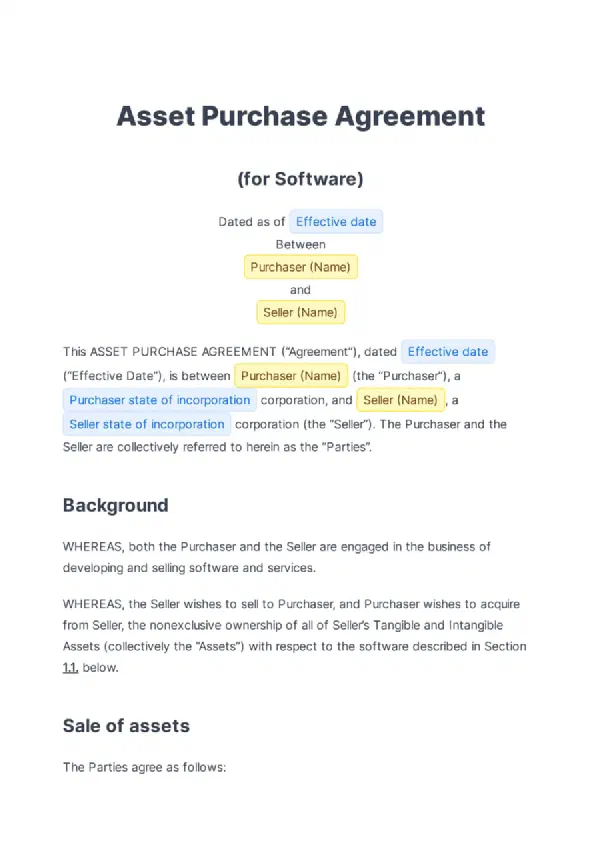 Asset purchase agreement (APA) template
Information is confidential, but notwithstanding the foregoing, public or independently developed material is not covered.
Use the free template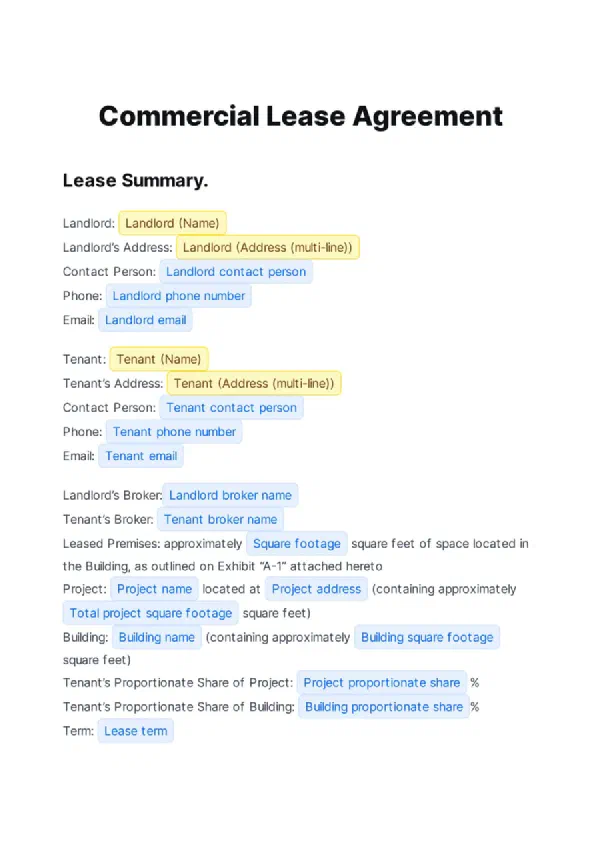 Commercial lease agreement template (office, retail and warehouse space)
Notwithstanding anything to the contrary, taxes passed on to the tenant include the state franchise or business tax.
Use the free template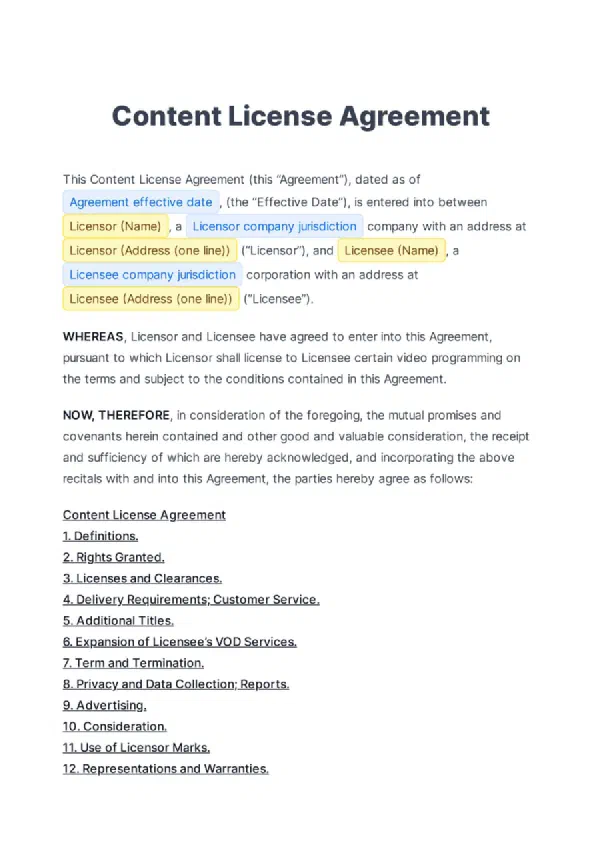 Content license agreement template
Notwithstanding anything to the contrary, either party may go to court for an injunction without first using the dispute process.
Use the free template
Related clauses
- Order of precedence The "Order of Precedence" clause establishes the hierarchy of contractual documents to determine which terms and conditions take priority in the event of conflicts or inconsistencies. This clause ensures clarity and reduces disputes by outlining the order in which documents and provisions should be interpreted.
- interpretation The interpretation clause in a contract provides guidance on how the terms and definitions within the agreement should be understood and applied. It helps prevent ambiguities by clarifying the meanings of specific words or phrases, ensuring that all parties have a consistent understanding of the contractual terms.
- Rule of construction A "Rule of Construction" clause in a contract establishes guidelines for interpreting the terms and provisions within the agreement. This clause can specify that the contract should not be interpreted against the party that drafted it, ensuring a fair and neutral interpretation.
- Entire agreement The "Entire Agreement" clause asserts that the written contract constitutes the complete and final agreement between the parties, superseding any prior discussions, negotiations, or agreements. It ensures that no other verbal or written agreements outside the contract will affect or modify its terms unless formally amended in writing.
- Successor in interest A successor in interest is a person or company that takes over the rights and obligations of another party and stands in its place, for example after a merger, the sale of a business or an inheritance. In contracts, the term decides who may take over the agreement without consent. In US mortgages, it gives heirs and divorced spouses who receive the home the right to deal with the servicer.
- Indemnification and hold harmless The Indemnification and Hold Harmless clause requires one party to compensate the other party for any losses, damages, or liabilities arising from specific events or actions. It also ensures that the indemnified party is protected from any legal claims or damages related to the indemnifying party's actions or negligence.
Frequently asked questions
Despite what was just said. The sentence that follows is an exception to the rule before it, and the exception wins.
Whatever the rest of the contract says. The provision that follows applies even if another clause says the opposite. It reaches the whole agreement, while “notwithstanding the foregoing” only reaches the text before it.
They work in opposite directions. “Notwithstanding X” means this provision wins over X. “Subject to X” means X wins over this provision.
“Despite the above”, “however” or a plain “except”. For a clear scope, name the provision: “Despite Section 4.2, …”.
No. “Foregoing” (with an e) means coming before. “Forgoing” means giving something up. Contracts use “foregoing”.
More clauses from the library
See allNovation
Novation replaces one party to a contract with a new party, or an old contract with a new one, with the consent of everyone involved. Unlike an assignment, the party who leaves is released from its obligations.
11 example clauses
Objectionable conduct
The "Objectionable Conduct" clause typically outlines behaviors or actions deemed unacceptable by a party within a contractual agreement. It serves to protect parties by allowing for the termination or renegotiation of the contract if such conduct is exhibited.
4 example clauses
Ofac certification
An OFAC certification clause is a provision in a contract that requires parties to confirm they are not on the U.S. Treasury Department's Office of Foreign Assets Control (OFAC) list of sanctioned individuals or entities. This clause ensures compliance with U.S. sanctions laws by preventing transactions with blacklisted parties.
11 example clauses
Analyze your contracts. Extract important clauses.
Try our AI contract analysis and extract important clauses and information from existing contracts.
Save your favourite clauses
Insert directly with a single click
Upload preferred precedents