
Successor in interest
A successor in interest is a person or company that takes over the rights and obligations of another party and stands in its place, for example after a merger, the sale of a business or an inheritance. In contracts, the term decides who may take over the agreement without consent. In US mortgages, it gives heirs and divorced spouses who receive the home the right to deal with the servicer.
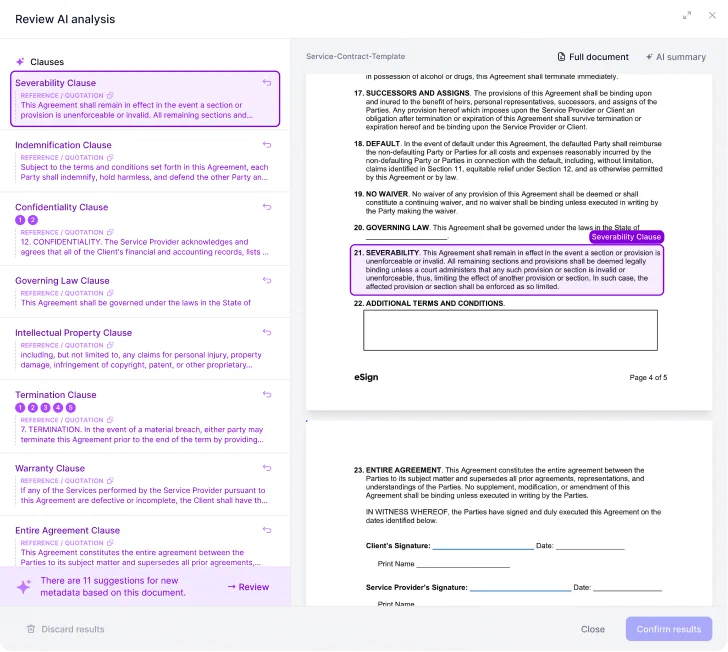
Analyze your contracts. Extract important clauses.
Try our AI contract analysis and extract important clauses and information from existing contracts.
Save your favourite clauses
Insert directly with a single click
Upload preferred precedents
Sample Successor in interest clauses
(h)Successors and Assigns; Assignment. Executive shall not assign this Agreement and any attempt by Executive to do so will be deemed null and void; provided that Executive’s rights to payments hereunder shall, upon Executive’s death or incapacity, inure to the benefit of Executive’s personal or legal representatives, executors, administrators, heirs, devisees, and legatees. This Agreement will be binding upon and inure to the benefit of the Company and the Company Entities and their successors, and assigns. This Agreement may be assigned by the Company to any Company Entity, or to any other person or entity, in each case which is a successor in interest to substantially all of the business operations or assets of the Company.
Source
U.S. GOLD CORP. (USAU)ASSIGNMENT. This Agreement shall not be assigned, pledged or transferred in any way by the Consultant without the prior written consent of the Company. Any attempted assignment, pledge, transfer or other disposition of this Agreement or any rights, interests or benefits herein contrary to the foregoing provisions shall be null and void. This Agreement may be assigned to any successor in interest to the Company without the consent of the Consultant.
By Sanofi. Sanofi may sell, transfer, assign, delegate, pledge or otherwise dispose of this Agreement, or any of its rights or obligations hereunder in whole or in part, (a) to one (1) or more of its Affiliates, (b) to Sanofi’s successor in interest in connection with any Change of Control, or (c) in connection with any sale or other disposition of all or substantially all of the assets of Sanofi to which this Agreement relates to one or more Third Parties in one transaction or a series of related transactions. Any attempted assignment, delegation or otherwise in violation of this Section 13.4.1 (Assignment By Sanofi) shall be void and of no effect.
10.2. Disclosure of Financial Information. Lender is hereby authorized to disclose any financial or other information about Borrower to any regulatory body or agency having jurisdiction over Lender and to any present, future or prospective participant or successor in interest in any loan or other financial accommodation made by Lender to Borrower, so long as there is a mandatory requirement to provide such disclosure. The information provided may include, without limitation, amounts, terms, balances, payment history, return item history and any financial or other information about Borrower.
Source
NVE CORP /NEW/ (NVEC)A.Landlord, as successor in interest, and Tenant, as successor in interest, are parties to that certain lease dated October 1, 1998, First Amendment to Lease dated September 18, 2002, Second Amendment to Lease dated December 1, 2003, Third Amendment to Lease dated December 17, 2007, Fourth Amendment to Lease dated August 2, 2011 and Fifth Amendment to Lease dated March 2, 2020 (collectively, the “Lease”) relating to approximately 21,362 square feet of space (the “Premises”) located in Bryant Lake Business Center, 11409 Valley View Road, Eden Prairie, Minnesota.
Attornment. Subject to the terms of Section 12.2 below, without the necessity of any additional document being executed by Tenant for the purpose of effecting a subordination, and at the election of Landlord or any Holder, this Lease will be subject and subordinate at all times to all Security Documents, which may now exist or hereafter be executed which constitute a lien upon or affect the Property or any portion thereof, or Landlord’s interest and estate in any of said items. Notwithstanding the foregoing, Landlord reserves the right to subordinate (or cause the subordination of) any such Security Documents to this Lease. Subject, in all events, to the terms of the applicable SNDA, in the event of any termination or transfer of Landlord’s estate or interest in the Property, the Building or the Tenant Space by reason of any termination or foreclosure of any such Security Documents (and notwithstanding any subordination of such Security Document to this Lease that may or may not have occurred), at the election of Landlord’s successor in interest, Tenant agrees to attorn to and become the tenant of such successor, in which event Tenant’s right to possession of the Premises will not be disturbed as long as Tenant is not in default under this Lease. Subject, in all events, to the terms of the applicable SNDA, Tenant hereby waives any right under any Applicable Law or otherwise to terminate or otherwise adversely affect this Lease and the obligations of Tenant hereunder in the event of any termination or transfer of Landlord’s estate or interest in the Property, the Building, or the Tenant Space by reason of any termination or foreclosure of any such Security Documents. Tenant covenants and agrees to execute and deliver, within ten (10) Business Days of receipt thereof, and in the form reasonably required by Landlord or any Holder (and reasonably acceptable to Tenant), any additional documents evidencing the priority or subordination of this Lease and Tenant’s agreement to attorn with respect to any such Security Document; provided, however, any such agreement subordinating this Lease to such lease, mortgage or deed of trust shall contain a non-disturbance provision that is reasonably acceptable to such Holder, Landlord and Tenant in accordance with Section 12.2, below.
What is a successor in interest?
A successor in interest is a person or company that takes over the rights and obligations of another party and stands in its place. The contract, lease or property does not end: it keeps running, and the successor is bound by it and benefits from it as if it had been a party from the start.
It happens when one party is replaced as a whole, not when it hands over a single right:
- A merger. The company that survives the merger is the successor in interest to the company that disappears into it.
- A sale of the business. A buyer of all or substantially all of a company’s business or assets is usually its successor in interest for the contracts that go with it.
- Death, divorce or a trust. A person who inherits a house, or receives it in a divorce, is the successor in interest to the previous owner.
Example: Acme Inc. has a five-year supply agreement with a vendor. Beta Corp. acquires Acme by merger. Beta is Acme’s successor in interest, and the supply agreement continues with Beta on the same terms. In a contract or a court filing, Beta then appears as “Beta Corp. (as successor in interest to Acme Inc.)”.
Successor in interest vs. assignee
Both take over something from an original party, but an assignee only gets what is assigned to it, while a successor in interest takes the original party’s place.
| Successor in interest | Assignee | |
|---|---|---|
| How it happens | Merger, sale of the whole business, inheritance or another transfer of everything the party held | An assignment of specific rights under a contract |
| What it takes over | All rights and obligations | Only the assigned rights. Obligations stay with the original party unless they are also transferred, for example by a novation |
| Consent of the other party | Often allowed without consent, if the contract says so | Needed if the contract requires it, see consent to assignment |
| Typical wording | “any successor in interest to all or substantially all of its business” | “may assign its rights under this Agreement to …” |
Whether a merger counts as an assignment that needs consent depends on the contract and on the law that governs it. Well-drafted contracts settle the question in the assignment clause instead of leaving it open.
How a successor in interest clause works in a contract
The phrase turns up in a few places in a commercial contract, as the sample clauses above show:
- In the assignment clause, as an exception to the ban on assignment: a party may transfer the contract without consent to a successor in interest, usually one that takes over all or substantially all of its business.
- In the binding effect clause: the agreement binds and benefits the parties and their successors in interest. The common short form is a successors and assigns clause.
- In the preamble or recitals, to name a party that took over from the one that originally signed: “Landlord, as successor in interest, and Tenant, as successor in interest, are parties to that certain lease”.
- In leases and loans, to say what happens when the landlord or the lender changes: the original landlord is released, the tenant looks to the successor, and on a foreclosure the tenant attorns to the new owner.
When you review one of these clauses, check:
- What counts as a successor. Only a merger, or also the sale of shares, the sale of assets, or the sale of one business unit? “Substantially all” of which business?
- Whether a change of control triggers anything. A change of control clause can give the other party a right to terminate even when the successor is allowed to take over.
- Whether the successor must assume the contract in writing, so you have a signed commitment from the new party and not only the old one.
- Notice. How soon after the transfer the other party has to be told, and in what form.
Successor in interest clause example
Sample clause: Successors in interest
Add this clause to a contract, send it and get it signed in fynk.
Use it in fynk for freeWhat is a successor in interest on a mortgage?
In US mortgage servicing, “successor in interest” has a defined meaning. Under the mortgage servicing rules of the Consumer Financial Protection Bureau (CFPB) in effect since April 19, 2018 (Regulation X and Regulation Z), a successor in interest is someone who receives an ownership interest in a home that secures a mortgage through one of these transfers:
- by will, inheritance or operation of law when a joint tenant or tenant by the entirety dies
- to a relative, as a result of the borrower’s death
- to the borrower’s spouse or children
- to the spouse, under a divorce decree, a legal separation agreement or a property settlement
- into a living trust in which the borrower is and remains a beneficiary and lives in the home
These are the transfers the Garn-St Germain Act of 1982 protects from a due-on-sale clause, so the lender cannot call the loan due just because the house changed hands.
Someone who says they are a successor in interest is a potential successor in interest until the servicer has checked their identity and ownership. The servicer has to tell them which documents it needs, such as a death certificate, a will or a divorce decree. Once the servicer has done that check, they are a confirmed successor in interest and are treated like a borrower under the servicing rules: they get periodic statements and notices, can ask for information about the loan and can apply for loss mitigation such as a loan modification.
Can a successor in interest sell the house or take over the mortgage?
Yes, they can sell. As the owner, a successor in interest can sell the house like any other owner, and the mortgage is paid off from the sale proceeds at closing.
They can also keep the loan and keep paying it. Because the transfer to them is protected, the lender cannot demand the full balance only because the property passed to them. Becoming personally liable for the loan is a separate step, called assuming the mortgage, and follows the lender’s own process. A confirmed successor in interest gets the servicing protections without assuming the loan.
Keeping track of successors in your contracts
When a customer, supplier or landlord merges or sells its business, you need to know quickly which of your contracts let it pass them on, which need your consent and which give you a way out. In fynk, AI Search finds every contract with that counterparty and the assignment and change of control clauses in them, in plain language, without opening each file. On the drafting side, AI Review checks a counterparty’s draft against your playbook, so an assignment clause that lets the other side hand the contract to any successor without notice gets flagged before you sign.
Which contracts mention a successor in interest?
Merger and acquisition agreements, asset purchase agreements, commercial leases and subleases, loan and credit agreements, licence agreements, executive employment agreements and long-term supply contracts. These free templates already include the term:
Free templates with this clause
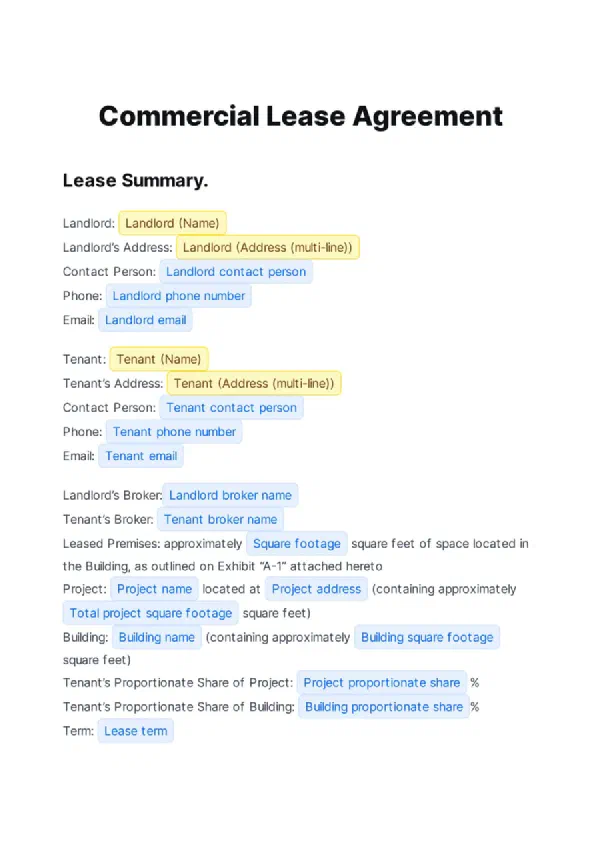 Commercial lease agreement template (office, retail and warehouse space)
If the landlord transfers the building, it is released and the tenant looks to the landlord's successor in interest for the landlord's obligations.
Use the free template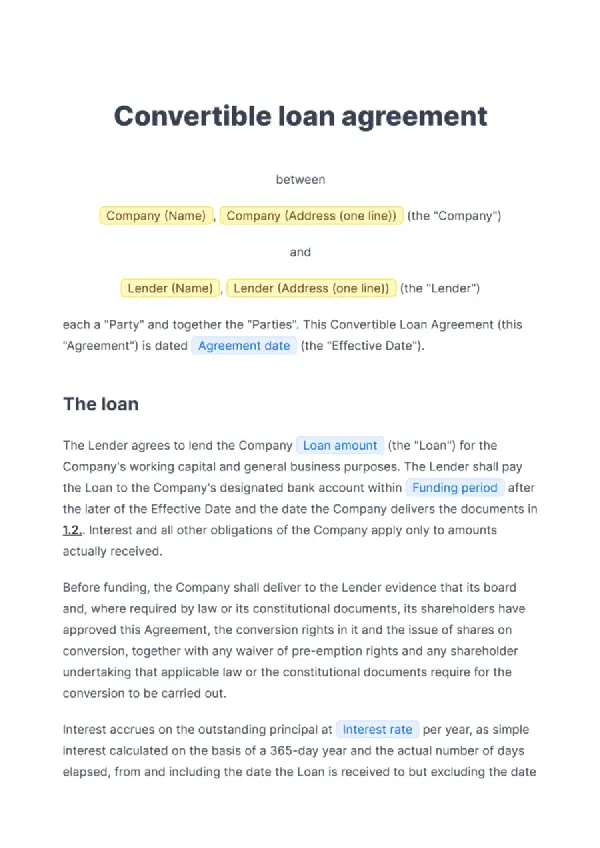 Convertible loan agreement template
Neither party may assign the agreement without the other's written consent, except to a successor in interest.
Use the free template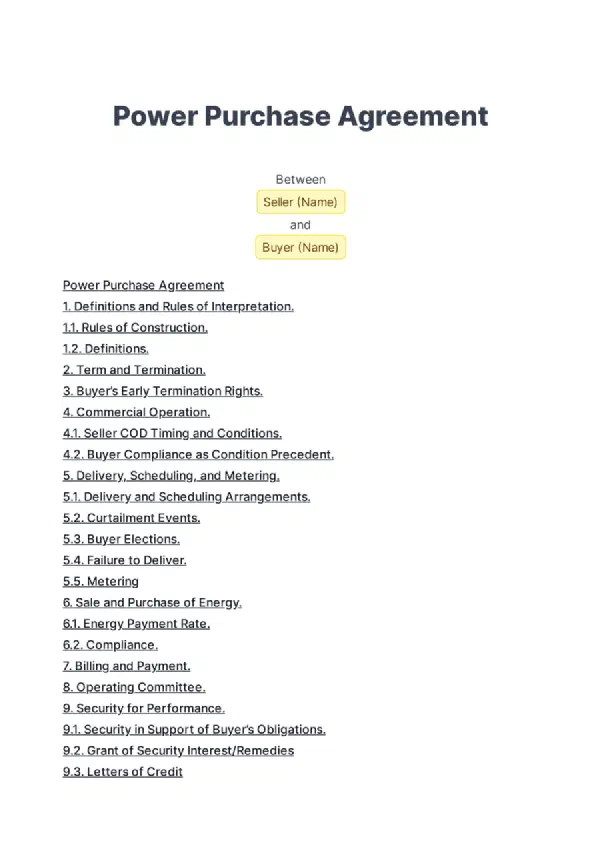 Power purchase agreement template
The agreement binds and benefits the parties and their successors in interest, legal representatives and permitted assigns.
Use the free template
Related clauses
- Successors and assigns The "Successors and Assigns" clause ensures that the rights and obligations of a contract are binding not only on the original parties but also on their successors, heirs, and any authorized entities they may assign these rights to. This clause provides continuity and enforceability of the contractual terms even if the parties undergo changes in ownership or structure.
- Assignment An assignment clause in a contract outlines the conditions under which one party may transfer its rights or obligations to another party. It typically specifies whether prior consent is required for such a transfer and identifies any exceptions to these requirements.
- Change of control A "change of control" clause in a contract is designed to protect parties by outlining specific terms and conditions that come into effect when there is a significant shift in ownership or control of one party involved in the agreement, such as through a merger, acquisition, or sale. This clause often permits the other party to terminate the contract, renegotiate terms, or take other defined actions if such a change occurs, ensuring transparency and continuity amid organizational transitions.
- Novation Novation replaces one party to a contract with a new party, or an old contract with a new one, with the consent of everyone involved. Unlike an assignment, the party who leaves is released from its obligations.
- Consent to assignment A "Consent to Assignment" clause stipulates that a party must obtain permission from the other party before transferring their rights or obligations under the contract to a third party. This ensures that the original party remains involved in decisions affecting the performance and continuity of the contract.
- Attornment Attornment is a tenant's agreement to recognize a new owner, or a lender that has foreclosed, as its landlord and to keep paying rent to them under the existing lease. It is the "A" in an SNDA (subordination, non-disturbance and attornment agreement).
Frequently asked questions
It names a party that took over the rights and obligations of another one, usually after a merger, an acquisition or an inheritance. “Beta Corp. (as successor in interest to Acme Inc.)” means Beta now holds the position Acme had in the contract or case.
In a merger, yes: the surviving company takes over the obligations of the company it absorbed. A buyer of assets is generally liable only for the debts it agrees to take on, although US courts make exceptions, for example when the deal is a merger in all but name. On a mortgage, a successor in interest is not personally liable for the loan unless they assume it.
It depends on the contract. Many assignment clauses allow a transfer to a successor in interest without consent, others require consent for any transfer. Whether a merger counts as an assignment at all depends on the wording and the governing law.
Not quite. An heir inherits from someone who has died, and an heir who receives property becomes a successor in interest to it. But successor in interest is wider: it also covers companies after a merger or the sale of a business, and spouses who receive a home in a divorce.
In US mortgage servicing, a successor in interest whose identity and ownership interest the mortgage servicer has confirmed. From then on the servicer treats them like a borrower under the CFPB servicing rules, with statements, notices and access to loss mitigation.
More clauses from the library
See allSuccessors and assigns
The "Successors and Assigns" clause ensures that the rights and obligations of a contract are binding not only on the original parties but also on their successors, heirs, and any authorized entities they may assign these rights to. This clause provides continuity and enforceability of the contractual terms even if the parties undergo changes in ownership or structure.
15 example clauses
Sunset provision
A sunset provision is a contract clause that sets an expiration date for certain terms or the entire agreement unless expressly renewed or extended by all parties involved. This clause is often used to ensure that outdated or unnecessary stipulations do not persist indefinitely, prompting periodic review and reconsideration.
5 example clauses
Supersedes previous agreements
The "Supersedes Previous Agreements" clause indicates that the current contract nullifies all prior agreements or understandings, whether written or verbal, related to the same subject matter. This ensures that only the terms and conditions set forth in the new contract are binding between the parties involved.
24 example clauses
Analyze your contracts. Extract important clauses.
Try our AI contract analysis and extract important clauses and information from existing contracts.
Save your favourite clauses
Insert directly with a single click
Upload preferred precedents