
Home sale contingency
A home sale contingency makes a purchase depend on the buyer selling their current home first. Sellers often accept it only with a kick-out clause: they keep marketing the property, and if a better offer arrives, the buyer must drop the contingency within a short deadline or let the contract go.
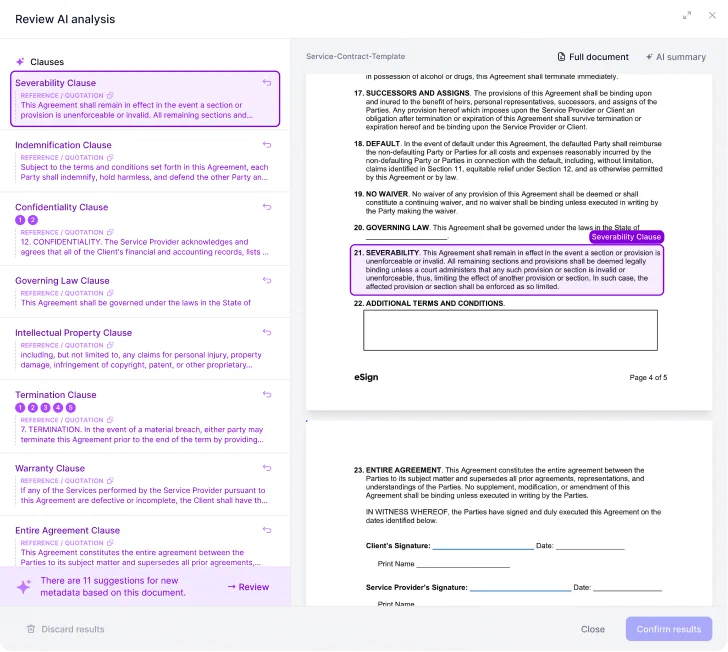
Analyze your contracts. Extract important clauses.
Try our AI contract analysis and extract important clauses and information from existing contracts.
Save your favourite clauses
Insert directly with a single click
Upload preferred precedents
Sample Home sale contingency clauses
Source
Nuvectra Corp3.7 In consideration of estimated relocation costs, Executive will be provided quarterly installments of $25,000, subject to state, federal, local and other mandated taxes not to exceed Two Hundred Thousand Dollars ($200,000.00) (the “Relocation Maximum”). Upon the sale and closing of Executive’s home located in Tucson, Arizona (the “Current Residence”), Executive will be provided a balloon payment for the balance of the Relocation Maximum less any quarterly installments already paid by Company. Estimated relocation expenses include reasonable expenses associated with house hunting visits with one other family member, temporary housing and transportation for up to 60 days, and occasional trips for purpose of family visits for the first six (6) months of employment. The relocation costs also include selling expenses, such as realtor and bank closing fees for the Current Residence plus the cost of packing, line haul transportation, warehouse handling, delivery, unpacking and insurance for the moving of personal property and automobiles. Executive shall submit reasonably requested documentation related to the sale and closing of Current Residence in accordance with Section 3.6 herein.
3.6 Subject to prior written approval by the Company, the Company shall pay or reimburse the following expenses that Employee may incur in connection with his relocation to the greater Boston, Massachusetts area within 12 (twelve) month anniversary of the Effective Date: (a) the reasonable direct out-of-pocket costs of transporting the Employee, the Employee’s immediate family and the Employee’s household items and two Motor Vehicles from the Employee’s current residence to a new residence in the greater Boston, Massachusetts area, including storage of such household items for a period of no more than 12 (twelve) months from the Effective Date; (b) the reasonable travel expenses for the Employee related to travel to and from the greater Boston, Massachusetts area during the temporary housing period described in the next clause, including up to two (2) trips for the Employee’s family; (c) the reasonable costs of rent and primary services associated with temporary housing for the Employee and his family at an approved location in the greater Boston, Massachusetts area for a period of no more than twelve (12) months from the Effective Date; and (d) except as described in the next succeeding sentence, the reasonable closing costs associated with the Employee’s sale of his existing residence, so long as the sale occurs prior to the first anniversary of the Effective Date, and purchase of a new residence in the greater Boston, Massachusetts area, so long as the purchase takes place prior to the first 12 month anniversary of the Effective Date. The following closing costs will not be paid by the Company: (i) real estate and other taxes; (ii) insurance premiums other than title insurance; (iii) brokerage fees and commissions in connection with the purchase of a new residence; and (iv) commitment fees and prepaid interest (i.e., “points”) in excess of two percent (2%).
(g) Company shall reimburse Executive for Executive’s reasonable expenses incurred due to the relocation from Executive’s present home to a location in reasonable proximity to Company’s executive offices. Included within the foregoing shall be all real estate broker’s commissions paid by Executive in connection with the sale of his current residence, and reasonable rental expenses incurred in connection with obtaining temporary residence in or around Tampa, Florida during Executive’s search for a new residence (up to three months). It is the intent of the parties that the Executive be “made whole” with respect to his relocating himself and his family to Tampa, Florida. Executive shall obtain three competitive bids.
What is a home sale contingency?
A home sale contingency is a condition in a purchase contract: the buyer only has to complete the purchase if their current home sells (or closes) by an agreed date. If it doesn’t, the buyer may cancel, and the deposit is refunded.
It exists because most people can’t carry two mortgages, or put a down payment on a new house while their equity is still tied up in the old one. For the seller it is a real risk: the property comes off the market while the deal depends on a sale the seller doesn’t control. That tension is why the contingency almost always comes with a kick-out clause attached.
A note on the samples above: home purchase contracts between private buyers and sellers aren’t filed with the SEC, so public filings hold almost no real home sale contingencies. Where companies do write about a home sale is in relocation terms for executives, and those show the same mechanics from the employer’s side: money that is paid only once the old home has sold and closed (Nuvectra), and a deadline for that sale (ARIAD). The clean residential version is in the example further down.
Sale contingency or settlement contingency?
The two get mixed up, and the difference matters to the seller:
| Sale contingency | Settlement (closing) contingency | |
|---|---|---|
| The condition | The buyer’s home must go under contract by a deadline | The buyer’s home is already under contract, and that sale must close |
| Risk for the seller | Higher: there may be no buyer for the first home yet | Lower: a buyer exists, the risk is that their deal falls through |
| Typical next step | Once the first home is under contract, it often turns into a settlement contingency | Satisfied at the first home’s closing |
A well-drafted contract says which one it is, and what happens if the first home’s contract collapses after the contingency counted as met.
What is a kick-out clause in real estate?
A kick-out clause is the seller’s answer to a home sale contingency. The seller accepts the contingent offer but keeps showing the property. If another acceptable offer arrives, the seller notifies the first buyer, who then has a short window to decide:
- Remove the home sale contingency and go ahead regardless of their own sale, usually with proof (such as a lender letter) that they can close without it, or
- Let the contract end, with the earnest money returned.
The window is the number people search for: a 72-hour kick-out clause gives the buyer three days, a 48-hour one two. Shorter windows favor the seller; longer ones give the buyer time to line up a bridge loan or talk to their lender. The clock should start on a defined event (receipt of written notice), not “when the seller gets another offer”, which the buyer can’t see.
For the buyer, a kick-out turns the contingency into a race: you get time to sell, until someone else shows up. For the seller, it caps the cost of waiting.
What to settle in the clause
- The deadlines: when the buyer’s home must be under contract, and when that sale must close. Practice varies by market, and the buyer can ask for an extension, which the seller is free to refuse.
- Listing terms: whether the buyer’s home must already be listed, at what price, and whether the seller can require a price cut if it doesn’t move.
- The kick-out mechanics: the window, how notice is given, and exactly what the buyer must deliver to remove the contingency.
- The earnest money: returned if the buyer is kicked out or the contingency fails in time; at risk once the buyer waives the contingency and then fails to close.
- The other contingencies: the financing contingency, the appraisal contingency and the inspection contingency still run separately. Waiving the home sale contingency after a kick-out notice waives only that one.
Deadlines in these clauses are strict, and many purchase contracts add a time is of the essence clause. Miss the window by a day and the contingency, or the deal, may be gone.
Home sale contingency clause example
Sample clause: Home sale contingency with a 72-hour kick-out
Sale of Buyer’s property. This Agreement is contingent on Buyer entering into a contract to sell Buyer’s property at [address] by [date], and on that sale closing on or before the Closing Date. If either condition is not met, Buyer may end this Agreement by written notice to Seller within three (3) days of the relevant date, and the Earnest Money shall be returned to Buyer.
Seller’s right to continue marketing. Until Buyer satisfies or waives this contingency in writing, Seller may continue to market the Property. If Seller accepts another written offer, Seller shall notify Buyer, and Buyer shall have seventy-two (72) hours from receipt of the notice to waive this contingency in writing and deliver written evidence that Buyer can close without the sale of Buyer’s property. If Buyer does not do so, this Agreement shall terminate and the Earnest Money shall be returned to Buyer.
Add this clause to a contract, send it and get it signed in fynk.
Use it in fynk for freeMaking an offer without one
In a busy market many sellers simply turn contingent offers down. Buyers who need to sell first then look at other routes: a bridge loan against the current home, a rent-back after selling first, or a relocation package where the employer covers the gap. The samples above show the employer version, with costs tied to the closing of the old home and a time limit on the sale.
Whichever route you take, the contract ends up with several dates that depend on each other: the contingency deadline, the kick-out window, the other contingency periods and closing. fynk keeps each of them as a date field on the contract (metadata) and sends reminders ahead of the kick-out window and the contingency deadline, so neither slips by over a weekend.
Related clauses
- Financing contingency A financing contingency is a contract clause that allows a buyer to cancel a purchase agreement without penalty if they are unable to secure the necessary financing within a specified timeframe. This provision protects the buyer by ensuring they are not obligated to complete the transaction if they cannot obtain a loan or suitable financing terms.
- Appraisal contingency An appraisal contingency lets a buyer renegotiate or cancel a purchase, with the deposit returned, if the property appraises below the agreed price.
- Inspection contingency An inspection contingency gives a buyer a set period to inspect a property and to negotiate repairs or cancel the purchase, with the deposit returned, if the results are unacceptable.
- Title contingency A title contingency makes a real estate purchase conditional on acceptable title: the buyer reviews the title commitment and survey, objects to problems such as liens or easements, and may terminate with its deposit returned if the seller does not cure them.
- Escrow An escrow clause in a contract specifies that certain assets, funds, or documents will be held by a neutral third party until specific conditions of the contract are fulfilled. This ensures that each party complies with the agreed-upon terms, providing security and trust for both parties involved.
- Time is of the essence "Time is of the essence" means the deadlines in a contract are an essential term. Missing one is not just a delay to be compensated: it is a serious breach that can let the other party end the contract and claim damages.
Frequently asked questions
Common wherever sellers accept home sale contingencies. Many sellers accept a contingent offer only with a kick-out clause, a short contingency period, or a buyer whose home is already under contract.
A kick-out clause where the buyer has 72 hours after the seller's notice of another offer to drop the home sale contingency. If the buyer does nothing, the contract ends and the earnest money goes back to the buyer.
Yes, if a contingency isn't met in time: for a home sale contingency, when the buyer's home doesn't sell or close by the deadline. The buyer cancels by notice and gets the earnest money back. Walking away for a reason the contract doesn't cover puts the deposit at risk.
Only on the terms the contract gives. With a kick-out clause, the seller can end the contract if the buyer doesn't remove the contingency within the window. Without one, the seller is bound until the contingency deadline.
Usually yes, under the standard wording. The buyer risks the deposit only after waiving the contingency and then failing to close.
More clauses from the library
See allHsse standards
HSSE (Health, Safety, Security, and Environmental) standards are contractual clauses that set out the specific requirements and practices that parties must adhere to in order to ensure a safe, secure, and environmentally responsible working environment. These standards are designed to mitigate risks, protect personnel and assets, and ensure compliance with relevant laws and regulations.
2 example clauses
Icc arbitration
The ICC arbitration clause refers to an agreement between parties to resolve their disputes through arbitration under the rules of the International Chamber of Commerce (ICC). This clause specifies that any disagreements will be handled by an impartial tribunal, ensuring a binding and enforceable resolution while providing a streamlined alternative to court litigation.
21 example clauses
In witness whereof
The "In Witness Whereof" clause is a traditional concluding statement in legal documents indicating that the parties have read, understood, and agreed to the terms outlined in the contract. It is followed by the signatures of the parties involved, serving as formal acknowledgment of their consent and commitment.
15 example clauses
Analyze your contracts. Extract important clauses.
Try our AI contract analysis and extract important clauses and information from existing contracts.
Save your favourite clauses
Insert directly with a single click
Upload preferred precedents