
Title contingency
A title contingency makes a real estate purchase conditional on acceptable title: the buyer reviews the title commitment and survey, objects to problems such as liens or easements, and may terminate with its deposit returned if the seller does not cure them.
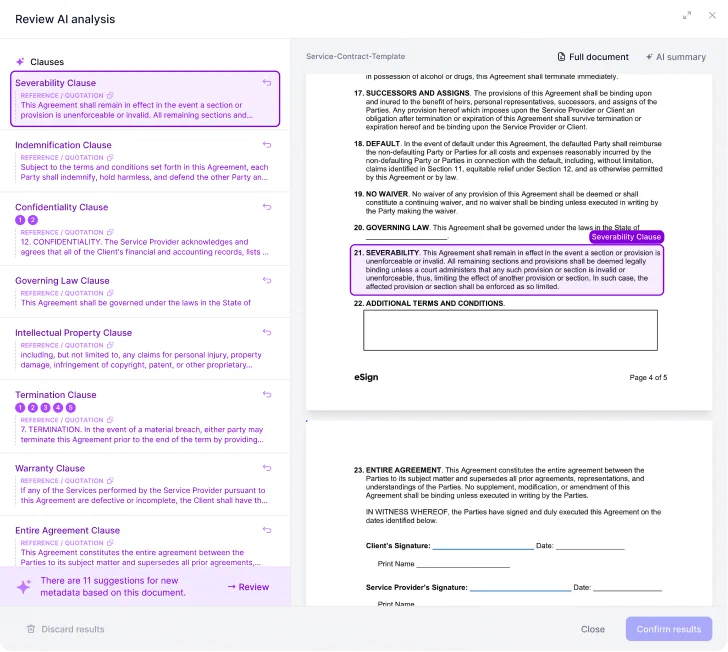
Analyze your contracts. Extract important clauses.
Try our AI contract analysis and extract important clauses and information from existing contracts.
Save your favourite clauses
Insert directly with a single click
Upload preferred precedents
Sample Title contingency clauses
(iv) Title Contingency. In the event Buyer fails to timely deliver Buyer’s Title Notice, then Buyer shall be deemed to have waived all title objections to matters shown in the Title Commitment, except the Rejected Exceptions. If Buyer has timely delivered Buyer’s Title Notice and Seller elects (or is deemed to have elected) to proceed (in whole or in part) in accordance with clause (B) of Paragraph 8(a)(ii) of this Agreement, then Buyer shall have until the Contingency Expiration Date to terminate this Agreement by delivering written notice thereof to Seller and Escrow Agent, in which case the Deposit shall be delivered to the Buyer and the provisions of Paragraph 9(c) of this Agreement shall govern. If Buyer shall fail to provide Seller and Escrow Agent with written notice of termination on or before the Contingency Expiration Date, then Buyer shall be deemed to have waived all of its title objections (except with respect to the Rejected Exceptions).
(b) If the Title Commitment or any Survey (as hereinafter defined) contains exceptions, restrictions, easements or any other matter that are not acceptable to Purchaser or if the Title Commitment is otherwise not acceptable to Purchaser, Purchaser may terminate the Agreement during the Inspection Period, and in such event and the Deposit shall be returned to Purchaser and this Agreement shall be null and void.
(b)If Seller has elected in writing to cure any Title Defects, Seller shall have thirty (30) days, or such longer period as Purchaser may grant in its sole and absolute discretion, following receipt of written notice of the existence of Title Defects in which to undertake a good faith, diligent and continuous commercially reasonable effort and, in fact, cure or eliminate the Title Defects which Seller has elected to cure to the satisfaction of Purchaser and the Title Company in such manner as to permit the Title Company to either endorse the Title Commitment or issue a replacement commitment to delete the Title Defects therefrom. Seller’s failure to cure any such Title Defect, including any Title Defect caused by Tenant, shall not constitute a default by Seller as long as Seller undertakes a good faith, diligent and continuous commercially reasonable effort to cure or eliminate same or to cause Tenant to cure or eliminate same, as the case may be.
3.1.2 Use of Proceeds to Discharge of Title Objections. If on the Closing Date there are any Required Clearance Exceptions, any title matter created by Seller or its agents and/or Affiliates after the date of this Agreement or any other Title Objections which Seller has elected to pay and discharge, then a portion of the Purchase Price shall be used to satisfy the same.
Source
SYMS CORP (TPHS)2.3. Title Objections; Cure of Title Objections. Purchaser shall have until the date which is five (5) days prior to the expiration of the Inspection Period (“Title Review Period”) to notify Seller, in writing, of such objections as Purchaser may have to anything contained in the Title Commitment or the Survey. Any item contained in the Title Commitment or any matter shown on the Survey to which Purchaser does not object during the Inspection Period shall be deemed a Permitted Exception (except as provided in the last sentence of this Section 2.3). In the event Purchaser shall notify Seller of objections to title as shown on the Title Commitment or to matters shown on the Survey prior to the expiration of the Title Review Period, Seller shall have the right, but not the obligation (except as provided in the last sentence of Section 2.3), to cure such objections at any time on or before 5:00 p.m. (local time at the Property) on the second (2nd) day prior to the end of the Inspection Period (“Cure Period”) (for purposes of this Section 2.3, the term “cure” shall mean either to have such items removed from the Survey or Title Commitment, as the case may be, or to have the Title Company insure over such items pursuant to title endorsements approved by Purchaser in its sole discretion, and in any case to deliver the revised Survey and/or revised Title Commitment to Purchaser evidencing such cure). Seller’s failure to deliver the revised Survey and/or revised Title Commitment to Purchaser, prior to the end of the Cure Period, evidencing such “cure” of Purchaser’s objections, shall be deemed an election by Seller not to cure such objections. In the event any objections are not so cured on or before the end of the Cure Period, then Purchaser shall have the option to either (x) waive such title objection not removed or cured (which waived title objections shall be Permitted Exceptions) or (y) terminate this Agreement in accordance with Section 3.2 below. Notwithstanding the foregoing, Seller shall be obligated to remove at Closing (and in no event shall such items be deemed Permitted Exceptions) any mortgage, security interest or other lien securing a monetary obligation which may burden the Real Property, and in addition, Seller shall also be obligated to remove at Closing any other lien, encumbrance or other title exception first arising or appearing on a revised Title Commitment after the date of the initial Title Commitment delivered to Purchaser hereunder, and the Title Policy (as defined below) shall reflect the absence of all such matters.
What is a title contingency?
A title contingency makes a real estate purchase conditional on the property having acceptable title. The buyer gets time to review the title report and survey, object to problems it finds, and walk away with its deposit if the seller does not fix them.
“Title” problems are anything that limits the seller’s ownership or the buyer’s use of the property: unpaid mortgages and liens, easements, boundary disputes, restrictive covenants, missing heirs, errors in old deeds or claims by third parties.
Example: a company agrees to buy a warehouse. The title commitment shows a recorded easement giving a neighbor the right to drive trucks across the loading yard. Under the title contingency, the buyer objects within the review period. The seller cannot get the easement released, so the buyer terminates the contract and gets its deposit back.
How a title contingency works, step by step
- Title commitment and survey. After signing, the title company issues a title commitment (or preliminary title report) listing what it will and will not insure, and a surveyor maps the property.
- Review period. The buyer has a set number of days to review them, often running alongside the inspection or due diligence period.
- Objection notice. The buyer sends written objections to specific items. Anything it does not object to in time usually becomes a “permitted exception” that the buyer accepts.
- Seller’s response. The seller decides whether to cure each objection, for example by paying off a lien, getting a release, or having the title company insure over the issue. In many contracts the seller has the right, but not the obligation, to cure.
- Buyer’s choice. If an objection is not cured, the buyer can terminate and recover its deposit, or waive the objection and close.
- Before closing. New issues that appear in an updated title report are often handled with a shorter, second objection round.
Some forms split the deadlines further. The Colorado Real Estate Commission’s standard contract, for example, sets separate deadlines for objections to record title and to off-record matters such as unrecorded easements.
What the seller must fix anyway
Most purchase agreements require the seller to remove certain items at closing whether or not the buyer objects:
- Monetary liens: mortgages, deeds of trust, judgment liens and mechanics’ liens. These are usually paid from the purchase price at closing.
- Items the seller created after signing, such as a new easement or lease granted without the buyer’s consent.
Title contingency vs. other real estate contingencies
| Contingency | What it protects against | Based on |
|---|---|---|
| Title contingency | Ownership problems, liens, easements, survey issues | Title commitment and survey |
| Inspection contingency | Physical defects in the property | Inspection reports |
| Financing contingency | The buyer failing to get a loan | Lender approval |
| Appraisal contingency | The property valuing below the price | Appraisal |
| Due diligence contingency | Anything the buyer’s investigation turns up | Broad review, common in commercial deals |
| Home sale contingency | The buyer’s current home not selling or closing | Sale of the buyer’s home |
In commercial purchases, title review is usually part of a broader due diligence period, but it keeps its own objection mechanics because the seller’s cure rights and the permitted exceptions need to be defined precisely.
How to negotiate a title contingency
If you are the buyer:
- Get enough time to review the commitment, the underlying documents and the survey, not just the summary.
- Make the seller remove all monetary liens at closing regardless of objections.
- Keep the right to object to new matters that appear in later title updates.
- Insist on deposit refund if you terminate under the contingency.
- Ask for title insurance endorsements where a defect can be insured over rather than removed.
If you are the seller:
- Order the title commitment early and fix obvious problems before listing.
- Keep cure optional, so a hard-to-fix objection does not become a breach.
- Set short, firm deadlines with deemed acceptance if the buyer stays silent.
Title contingency clause example
Sample clause: Title contingency
Add this clause to a contract, send it and get it signed in fynk.
Use it in fynk for freeKeeping contingency deadlines straight
A purchase agreement can run four or five contingency deadlines at once, each counted from a different date. In fynk, dates and durations track each deadline in the agreement and remind the right people before it passes, so an objection right is never lost to a calendar mistake.
Which contracts include a title contingency?
Residential and commercial real estate purchase agreements, land and development purchase contracts, purchase options and sale-leaseback agreements. This free template includes one:
Free templates with this clause
Related clauses
- Due diligence contingency A due diligence contingency clause in a contract allows a party, typically the buyer, to thoroughly investigate the property or asset in question before fully committing to the purchase. It provides the buyer with the option to terminate the agreement or renegotiate terms if the findings during the due diligence period are unsatisfactory.
- Financing contingency A financing contingency is a contract clause that allows a buyer to cancel a purchase agreement without penalty if they are unable to secure the necessary financing within a specified timeframe. This provision protects the buyer by ensuring they are not obligated to complete the transaction if they cannot obtain a loan or suitable financing terms.
- Due diligence period The due diligence period in a contract is a designated timeframe during which the buyer is allowed to thoroughly inspect and evaluate the property or assets involved in the transaction. This period aims to ensure the buyer can identify any potential issues and make informed decisions before finalizing the agreement.
- Warranty of title The "Warranty of Title" clause ensures that the seller guarantees they have the legal right to transfer ownership of the goods being sold and that the title is free from any encumbrances, liens, or other claims. This clause protects the buyer from any third-party claims on the title that may arise after the purchase.
- Escrow An escrow clause in a contract specifies that certain assets, funds, or documents will be held by a neutral third party until specific conditions of the contract are fulfilled. This ensures that each party complies with the agreed-upon terms, providing security and trust for both parties involved.
- Condition precedent A condition precedent is a contractual clause that specifies an event or action that must occur before a party is obligated to perform their duties under the contract. If the condition is not met, the contract may become void or the obligations are suspended until the condition is satisfied.
Frequently asked questions
A condition that lets the buyer review the title report and survey, object to problems such as liens or easements, and cancel with its deposit returned if the seller does not fix them.
The buyer sends a written objection. The seller can cure it, for example by paying off a lien or getting a release, or decline. If it is not cured, the buyer can usually terminate or accept the issue and close.
It is risky. Without it, the buyer may have to close on a property with defects it cannot use or resell easily. Title insurance covers some risks, but not everything a title review would catch.
Title matters the buyer has accepted, such as utility easements or recorded restrictions, which the seller does not have to remove and which the title policy will list as exceptions.
Whatever the contract says, often a few weeks after the buyer receives the title commitment and survey. Commercial deals often tie it to the due diligence period.
More clauses from the library
See allTotal operating revenues
The "Total Operating Revenues" clause typically refers to the total income generated from a company's primary business activities before any expenses or deductions are applied. It serves as a crucial financial metric, often used to assess a company's financial performance and growth potential.
11 example clauses
Transfer of ownership
The "Transfer of Ownership" clause outlines the conditions under which ownership rights and titles of a property or asset are conveyed from one party to another. It typically details the specific events or criteria that trigger the transfer, any obligations the parties must fulfill, and the effective date when the transfer becomes legally binding.
9 example clauses
Transfer
The "Transfer" clause in a contract outlines the conditions under which rights or obligations can be transferred from one party to another. It typically specifies whether consent is required for such a transfer and any limitations on the ability to assign responsibilities or benefits.
19 example clauses
Analyze your contracts. Extract important clauses.
Try our AI contract analysis and extract important clauses and information from existing contracts.
Save your favourite clauses
Insert directly with a single click
Upload preferred precedents