
Appraisal contingency
An appraisal contingency lets a buyer renegotiate or cancel a purchase, with the deposit returned, if the property appraises below the agreed price.
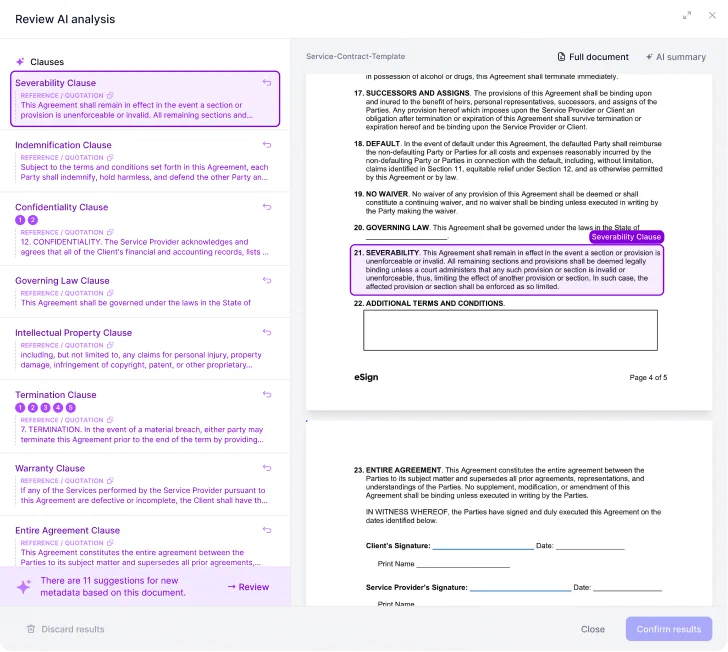
Analyze your contracts. Extract important clauses.
Try our AI contract analysis and extract important clauses and information from existing contracts.
Save your favourite clauses
Insert directly with a single click
Upload preferred precedents
Sample Appraisal contingency clauses
Source
TRI VALLEY CORPAPPRAISAL CONTINGENCY AND REMOVAL: This Agreement is (OR, if checked, [ ] is NOT) contingent upon the Property appraising at no less than the specified purchase price, if there is a loan contingency, at the time the loan contingency is removed (or, if checked, [ ] within 17 (or ) Days After Acceptance), Buyer shall, as specified in paragraph 17, remove the appraisal contingency or cancel this Agreement. If there is no loan contingency, Buyer shall, as specified in paragraph 17, remove the appraisal contingency within 17 (or 30 ) Days After Acceptance.
(c) In the event that a certified appraisal cannot be completed prior to the Closing Date, through no fault or cause by either the Purchaser or the Seller, then prior to the 30th day subsequent to closing, a certified appraisal as described in 1.06 (b) above, shall be provided to the Purchaser and the Seller, or, at the Seller’s sole option, may extend the period within which such appraisal may be concluded, and Purchaser agrees to any reasonable extension up to an additional sixty (60) days. In the event that the certified appraisal reports a dollar fair market value less than the amount purchased by the Purchaser at the Closing, then the Seller shall deliver to the Purchaser, within a commercially reasonable time, additional MTE, with appraised fair market value sufficient to correct such deficiency.
Source
CORNING INC /NY (GLW)(vii) The Executive may request the Company to purchase the Executive’s principal residence in the Corning, New York area. Such purchase must take place and be finalized in the calendar year following the year in which the Termination Date occurs. Such purchase shall be made at the residence’s appraised value at the Termination Date, as determined in accordance with the Company’s standard relocation policies in effect immediately prior to the Termination Date. The Company’s obligation under this section is solely limited to a purchase of Executive’s principal residence as described above at the appraised value and does not include any other costs that may be associated with Executive’s decision to relocate (e.g., movement of household goods).
What is an appraisal contingency?
An appraisal contingency makes a real estate purchase conditional on the property appraising at or above the purchase price. If the appraisal comes in lower, the buyer can ask the seller to reduce the price, pay the difference, or cancel the contract and get the earnest money back.
It exists mostly because of the loan. Lenders usually base the loan amount on the lower of the purchase price and the appraised value, so a low appraisal means a smaller loan and a bigger cash gap for the buyer.
Example: a buyer agrees to pay $500,000 with a 20% down payment, planning a $400,000 loan. The appraisal comes in at $475,000. The lender will now lend 80% of $475,000, which is $380,000. To close at $500,000, the buyer would need $120,000 in cash instead of $100,000. With an appraisal contingency, the buyer can renegotiate or walk away instead.
What happens when a home appraises low
The buyer usually has these options:
- Renegotiate the price down to the appraised value, or somewhere in between.
- Ask the seller to pay part of the gap through a price cut or seller credit.
- Pay the difference in cash and close at the original price.
- Challenge the appraisal through the lender, with comparable sales the appraiser missed. This is called a reconsideration of value.
- Cancel the contract under the contingency and recover the earnest money.
The contract sets the deadline for using the contingency. Miss it, and the contingency is usually treated as removed. One sample above, from a California purchase agreement form, ties the removal deadline to the loan contingency, or to a set number of days after acceptance.
Appraisal contingency vs. financing contingency
| Appraisal contingency | Financing contingency | |
|---|---|---|
| Protects against | A low appraised value | Not getting the loan at all |
| Trigger | Appraisal below the purchase price | Lender denies the loan or the terms are worse than agreed |
| Applies to cash buyers? | Yes, if they order an appraisal and the contract includes it | No |
| Typical outcome | Renegotiate, pay the gap or cancel | Cancel, with the deposit returned |
A low appraisal can also cause a loan denial, so the two often overlap. Having both gives the buyer the clearest way out.
What is an appraisal gap clause?
In competitive markets, buyers sometimes offer an appraisal gap clause, also called appraisal gap coverage or an appraisal gap guarantee. The buyer promises to cover a shortfall between the appraisal and the price, up to a set amount, in cash.
Example: the price is $500,000 and the buyer offers appraisal gap coverage of $20,000.
- Appraisal at $490,000: the gap is $10,000. The buyer pays it and the price stays at $500,000.
- Appraisal at $470,000: the gap is $30,000. The buyer covers $20,000. For the remaining $10,000, the contract usually lets the parties renegotiate, or the buyer can cancel under the remaining contingency.
An appraisal gap clause is a partial waiver: it keeps the contingency for big shortfalls and gives it up for small ones.
Waiving the appraisal contingency
Waiving the contingency makes an offer stronger, because the seller knows a low appraisal will not derail the sale. But the buyer then has to close at the agreed price no matter what the appraisal says, which means paying any gap in cash or risking the deposit.
Waiving makes sense mainly for buyers who pay cash or have enough cash reserves to cover a realistic gap.
FHA and VA loans
Government-backed loans have their own protection. FHA loans use an “amendatory clause” and VA loans an “escape clause”: if the property appraises below the price, the buyer can withdraw without penalty and recover the earnest money, or choose to proceed. These clauses are added to the purchase contract when the loan is FHA or VA, so an FHA or VA buyer has appraisal protection even without a separate contingency.
Appraisal clauses outside home sales
Appraisals also appear in business contracts, usually as a valuation mechanism rather than a contingency. The other samples above show two: an equipment sale where the seller must deliver more equipment if a later certified appraisal comes in below the price paid, and an executive relocation clause under which the company buys the executive’s home at its appraised value.
How to negotiate an appraisal contingency
If you are the buyer:
- Set a clear deadline that leaves time to order the appraisal and request a reconsideration.
- Keep the right to cancel with the deposit refunded if the appraisal is below the price.
- Cap any gap coverage at an amount you can actually pay in cash.
If you are the seller:
- Ask for a short contingency period with automatic removal if the buyer does not act.
- Prefer offers with appraisal gap coverage or a waiver, and check the buyer’s proof of funds.
- Get an appraisal or valuation before listing to price realistically.
Appraisal contingency clause example
Sample clause: Appraisal contingency
Add this clause to a contract, send it and get it signed in fynk.
Use it in fynk for freeWriting the right version into each contract
Some buyers keep the full contingency, some offer gap coverage, some waive it, and each choice needs different wording. With conditional logic in fynk, one purchase agreement template shows the full appraisal contingency, the gap coverage version with its amount, or the waiver, depending on the answers given when the contract is created.
Which contracts include an appraisal contingency?
Residential purchase agreements and offers, purchase addenda for FHA and VA loans, commercial real estate purchase agreements financed with a loan, and sometimes equipment and business asset sales where an appraisal sets or confirms the price.
Related clauses
- Financing contingency A financing contingency is a contract clause that allows a buyer to cancel a purchase agreement without penalty if they are unable to secure the necessary financing within a specified timeframe. This provision protects the buyer by ensuring they are not obligated to complete the transaction if they cannot obtain a loan or suitable financing terms.
- Inspection contingency An inspection contingency gives a buyer a set period to inspect a property and to negotiate repairs or cancel the purchase, with the deposit returned, if the results are unacceptable.
- Escrow An escrow clause in a contract specifies that certain assets, funds, or documents will be held by a neutral third party until specific conditions of the contract are fulfilled. This ensures that each party complies with the agreed-upon terms, providing security and trust for both parties involved.
- Condition precedent A condition precedent is a contractual clause that specifies an event or action that must occur before a party is obligated to perform their duties under the contract. If the condition is not met, the contract may become void or the obligations are suspended until the condition is satisfied.
- Closing costs Closing costs are the various fees and expenses incurred during the finalization of a real estate transaction, often including charges such as loan origination fees, appraisal fees, title insurance, and escrow deposits. These costs can be negotiated between the buyer and seller, with each party potentially responsible for certain expenses as outlined in the purchase agreement.
Frequently asked questions
A condition in a purchase contract that lets the buyer renegotiate or cancel, with the earnest money returned, if the property appraises below the purchase price.
With the contingency, the buyer can ask for a lower price or seller credit, pay the difference, challenge the appraisal, or cancel. Without it, the buyer must close at the agreed price or risk the deposit.
Only if you can pay any realistic gap between appraisal and price in cash. Waiving makes an offer stronger, but a low appraisal then becomes your cost.
The contingency lets the buyer exit if the appraisal is low. Appraisal gap coverage is a promise to pay a shortfall up to a set amount, which limits that exit to larger gaps.
No lender requires an appraisal, but cash buyers can still order one and make the purchase contingent on it to avoid overpaying.
More clauses from the library
See allApproval signatures
The "Approval Signatures" clause outlines the requirement for key stakeholders or designated authorities to provide their signatures as a formal indication of agreement or authorization for the contract. This clause ensures that all parties involved have reviewed and consented to the terms, making the contract legally binding and enforceable.
10 example clauses
Arbitration
An arbitration clause is a provision in a contract that requires the parties to resolve any disputes through arbitration rather than through litigation in court. This clause typically outlines the process for initiating arbitration, the selection of arbitrators, and the jurisdiction where arbitration will occur.
12 example clauses
As is purchase
An as-is purchase means the buyer accepts the property or goods in their current condition, with all faults, and the seller makes no repairs and gives no warranties about quality. It does not let a seller hide known defects or skip disclosures the law requires.
5 example clauses
Analyze your contracts. Extract important clauses.
Try our AI contract analysis and extract important clauses and information from existing contracts.
Save your favourite clauses
Insert directly with a single click
Upload preferred precedents