
Subscription cancellation
A subscription cancellation clause sets how a customer can end a recurring subscription: how and when to give notice, when the cancellation takes effect, and what happens to fees and access.
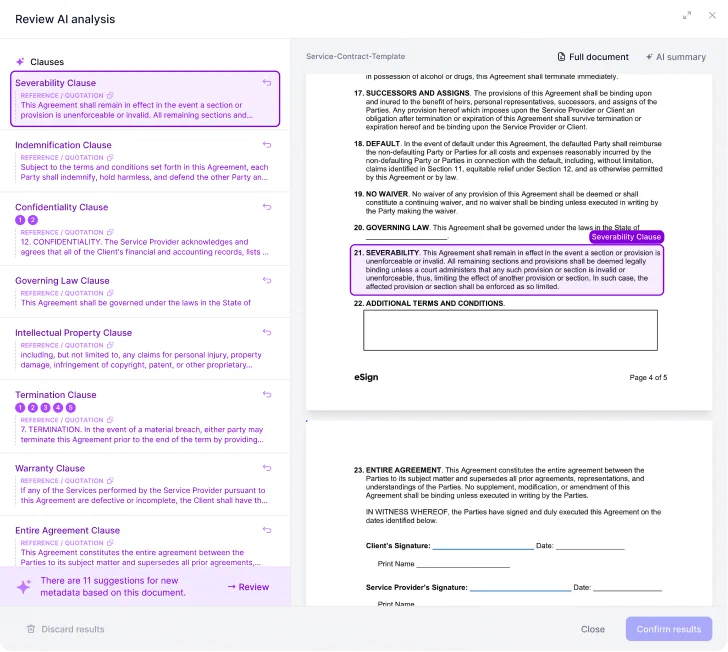
Analyze your contracts. Extract important clauses.
Try our AI contract analysis and extract important clauses and information from existing contracts.
Save your favourite clauses
Insert directly with a single click
Upload preferred precedents
Sample Subscription cancellation clauses
Source
Green PolkaDot Box Inc2.7 Cancellation of Club Membership by the Club Member. The Company agrees that the Club Member may cancel the Club Membership at any time, upon 30 days advance written notice using the Notice of Cancellation form on the Website. The Date of Cancellation is 30 days after the receipt of written Notice of Cancellation. The Club Member agrees that upon the Date of Cancellation the Club Membership will be terminated and that all benefits received and/or promised in accordance with this Agreement will be terminated. No portion of the Membership Fee will be refundable in the event of Cancellation of the Membership.
Source
Green PolkaDot Box Inc1.25 “Renewal” means the annual update of a Membership and payment of the Membership Fee by an Active Member, which is processed automatically by the Company unless it has received a Notice of Cancellation from a Member 30 days prior to the end of the annual Membership Term. The Renewal will be automatic and the Membership Fee charged to the Member’s authorized credit card on each anniversary of the Membership Commencement Date, subject to the Member’s right to cancel by transmitting a Notice of Cancellation to the Company.
Source
ENCORIUM GROUP INCx This agreement shall be in effect until further notice. The period of validity of the agreement may be continued by mutual agreement for a fixed-period or until further notice. Either party to the agreement may cancel the contract, to end one month from cancellation. The Bank will not refund any commission paid to the Bank by the Account Holder.
Source
CALLIDUS SOFTWARE INC9.4. Termination of Subscriptions. Upon expiration of the Term set forth in the Quote or upon termination of this Subscription Agreement or any license hereunder, Customer’s rights to the affected Software, Licensor Confidential Information, and other Licensor materials (collectively “Materials”) shall cease. Customer shall immediately stop using such Materials and shall return such Materials to Licensor, or destroy all copies thereof. In addition, Customer shall provide Licensor with written certification signed by an officer of Customer, that all copies of the Materials have been returned or destroyed and that no copies have been retained by Customer for any purpose whatsoever. Following termination, any use of the Materials by Customer shall be an infringement and/or misappropriation of Licensor’s proprietary rights in the Materials. Upon termination of this Subscription Agreement by Customer, Licensor shall have no further obligation or liability hereunder and all fees due under the Subscription Agreement shall become due and payable to Licensor immediately upon such termination.
Source
CALLIDUS SOFTWARE INC9.3. Termination by Customer. This Subscription Agreement may be terminated by Customer by giving prior written notice to Licensor if Licensor fails to perform any material obligation required of it hereunder, and such failure is not cured within thirty (30) days from Licensor’s receipt of Customer’s notice to cure such non-performance of material obligation.
What is a subscription cancellation clause?
A subscription cancellation clause explains how a customer ends a recurring subscription, for software, data, memberships, boxes or any other service billed again and again. It answers four questions: how the customer gives notice, by when, when the subscription actually stops, and what happens to fees already paid and to the customer’s access and data.
Example: a company has an annual SaaS subscription that renews every March 1. The cancellation clause requires written notice at least 30 days before the renewal date. The customer sends notice on January 20, so the subscription ends on February 28, no renewal invoice is issued, and the customer can export its data for 30 days afterwards. Had it sent notice on February 10, it would be bound for another year.
Cancel at the end of the term, or at any time?
Most clauses follow one of these models:
| Model | How it works | Typical use |
|---|---|---|
| Cancel at end of term | Notice stops the next renewal; the current term runs out and stays payable | B2B SaaS, annual plans |
| Cancel at any time, with notice | Ends a set period after notice, such as 30 days | Memberships, monthly plans |
| Cancel anytime, effective immediately | Access ends at once or at the end of the paid month | Consumer apps |
| Non-cancelable order, fixed term | No cancellation for convenience; only termination for breach | Enterprise orders, committed spend |
The difference between canceling and terminating for convenience matters. Canceling usually just stops future renewals. Termination for convenience ends the contract mid-term, often with a fee.
What the clause should say
- How to cancel: in the account settings, by email to a named address, through a form, or in writing. Say which methods count.
- The deadline: how many days before renewal the notice must arrive, and which date counts (sent or received).
- When it takes effect: at the end of the current term, at the end of the billing month, or a set number of days after notice.
- Fees: whether the current term stays payable and whether any part of prepaid fees is refunded. Many B2B contracts make fees non-refundable, while consumer law may require refunds in some cases.
- Access and data: how long the customer can still use the service and export its data, and when the provider deletes it.
- Confirmation: a written confirmation of the cancellation, with the end date.
- Provider cancellation: when the provider can cancel, for example for non-payment, and the notice it must give.
- Survival: which obligations continue, such as confidentiality and payment of amounts already due.
Consumer subscriptions: cancellation rules
When the subscriber is a consumer, the law limits what the clause can say. Some examples:
- United States, federal: the Restore Online Shoppers’ Confidence Act (ROSCA) requires sellers of online negative option plans to provide simple mechanisms for consumers to stop recurring charges. The FTC’s 2024 “click-to-cancel” rule, which would have added detailed requirements, was vacated by the Eighth Circuit on July 8, 2025 for a procedural reason: the FTC had skipped a required preliminary regulatory analysis. In March 2026 the FTC asked for public comment on a new rule; no replacement has been adopted yet.
- California: the Automatic Renewal Law requires that a consumer who signed up online can cancel online. Amendments that apply to contracts made or renewed since July 1, 2025 add, among other things, an annual reminder for yearly plans and rules for retention offers during cancellation. Other states have their own automatic renewal laws.
- Germany: since July 1, 2022, businesses that let consumers sign up for continuing contracts online must offer a cancellation button on their website. Since March 1, 2022, consumer contracts that renew tacitly may only continue for an indefinite period that the consumer can end with at most one month’s notice.
Business-to-business subscriptions are mostly governed by the contract itself, which is why notice periods and non-refundable fees are common there. The same mechanics, notice deadlines and renewal terms, are covered in more depth on the automatic renewal and notice period pages.
How to negotiate subscription cancellation terms
If you are the customer:
- Keep the notice period short, such as 30 days, and allow notice by email.
- Ask for a renewal reminder from the provider before the notice deadline.
- Cap price increases on renewal, or get the right to cancel if prices rise.
- Secure data export in a standard format for a set period after cancellation.
- Get pro rata refunds if you cancel because the provider breached the agreement or changed the service materially.
If you are the provider:
- Make fees for the current term non-cancelable in B2B contracts.
- Define the notice method clearly, so a message to a sales rep does not count as notice unless you want it to.
- Set a data deletion date after the export period.
- Follow consumer law for consumer plans, including online cancellation where required.
Subscription cancellation clause example
Sample clause: Cancellation
Add this clause to a contract, send it and get it signed in fynk.
Use it in fynk for freeNot missing the cancellation window
Cancellation deadlines fall weeks before the renewal date, which is why unwanted renewals happen so often: the date in the contract is the renewal, not the last day to cancel. For a company with dozens of software tools, that turns into a calendar problem, which is what SaaS renewal management is about. In fynk, tasks and reminders are linked to each subscription contract and alert the owner before the notice deadline, so the decision to keep or cancel is made on time.
Which contracts include a subscription cancellation clause?
SaaS and cloud service agreements, software subscription agreements, data and content licenses, memberships, subscription boxes, maintenance and support plans, and consumer terms of service. These free templates set the term and cancellation rules:
Free templates with this clause
- Cloud services agreement template Orders are non-cancelable and the sums paid non-refundable, except as provided in the agreement or the order. Use template
- Data license agreement template The license renews automatically for successive renewal terms unless terminated under the termination section. Use template
- Reseller agreement template The agreement renews automatically unless either party gives notice of its intention not to renew within the agreed notice period. Use template
Related clauses
- Automatic renewal An automatic renewal clause specifies that a contract will automatically renew for an additional term upon its expiration unless one party provides notice of termination within a designated period. This clause ensures continuity in the contractual relationship but requires parties to be vigilant about notification deadlines if they wish to terminate the agreement.
- Termination for convenience The "termination for convenience" clause allows one party to unilaterally terminate a contract without cause, typically requiring specified notice and potentially incurring a penalty or termination fee. This provision provides flexibility by enabling parties to exit agreements for strategic or unforeseen reasons without alleging breach or fault.
- No refunds A no refund policy says that once a customer has paid, they cannot get their money back, for example because they changed their mind. It is legal in many cases if the customer sees it before buying, but it cannot override consumer rights such as refunds for faulty goods or legal cooling-off periods.
- Renewal term The "Renewal Term" clause outlines the conditions under which a contract can be extended beyond its initial duration. It typically specifies the length of the renewal period, the notice requirements for opting into the renewal, and any changes in terms or pricing that may apply during the renewal period.
- Price changes A price change clause sets whether, when and how a supplier may change its prices during a contract, usually with advance notice and sometimes a right for the customer to cancel. "Prices subject to change" is the short disclaimer version used on quotes, price lists and websites.
- Termination of contract The "Termination of Contract" clause outlines the conditions and procedures under which either party can end the agreement before its natural expiration. It typically includes definitions of breach, notice periods, acceptable grounds for termination, and any associated penalties or obligations upon termination.
Frequently asked questions
The rules a provider sets for ending a subscription: how to cancel, by when, when access ends and whether any fees are refunded. In a contract, the same rules appear as a cancellation clause.
It depends on the clause. Many B2B subscriptions can only be canceled with effect from the end of the current term, while many consumer plans can be canceled at any time. Consumer laws may give additional rights.
No. The Eighth Circuit vacated the 2024 rule in July 2025, and the FTC asked for comments on a new rule in March 2026 without adopting one yet. Federal law such as ROSCA and state automatic renewal laws still require simple cancellation for many consumer subscriptions.
For consumer subscriptions, often yes. ROSCA requires a simple way to stop recurring charges for plans sold online, and state laws such as California's require online cancellation for online sign-ups and forbid obstructing it. Charging a fee just to cancel is risky under these laws unless it was clearly agreed. Between businesses, the contract decides.
Only if the contract or the law provides one. B2B contracts often make fees for the current term non-refundable, with an exception if the provider is in breach.
In most subscription contracts they mean the same thing: notice that stops the next renewal. Some contracts use “cancel” for ending the subscription immediately, so check how the clause defines it. Canceling the subscription also rarely deletes the account: the clause or the terms say what happens to the account and its data.
More clauses from the library
See allSuccessor in interest
A successor in interest is a person or company that takes over the rights and obligations of another party and stands in its place, for example after a merger, the sale of a business or an inheritance. In contracts, the term decides who may take over the agreement without consent. In US mortgages, it gives heirs and divorced spouses who receive the home the right to deal with the servicer.
6 example clauses
Successors and assigns
The "Successors and Assigns" clause ensures that the rights and obligations of a contract are binding not only on the original parties but also on their successors, heirs, and any authorized entities they may assign these rights to. This clause provides continuity and enforceability of the contractual terms even if the parties undergo changes in ownership or structure.
15 example clauses
Sunset provision
A sunset provision is a contract clause that sets an expiration date for certain terms or the entire agreement unless expressly renewed or extended by all parties involved. This clause is often used to ensure that outdated or unnecessary stipulations do not persist indefinitely, prompting periodic review and reconsideration.
5 example clauses
Analyze your contracts. Extract important clauses.
Try our AI contract analysis and extract important clauses and information from existing contracts.
Save your favourite clauses
Insert directly with a single click
Upload preferred precedents