
Net 30 payment terms
Net 30 means the full invoice amount is due within 30 days, usually counted from the invoice date. It is one of the most widely used payment terms between businesses. Variations such as 2/10 net 30, net 30 EOM and net 60 change the discount or the due date.
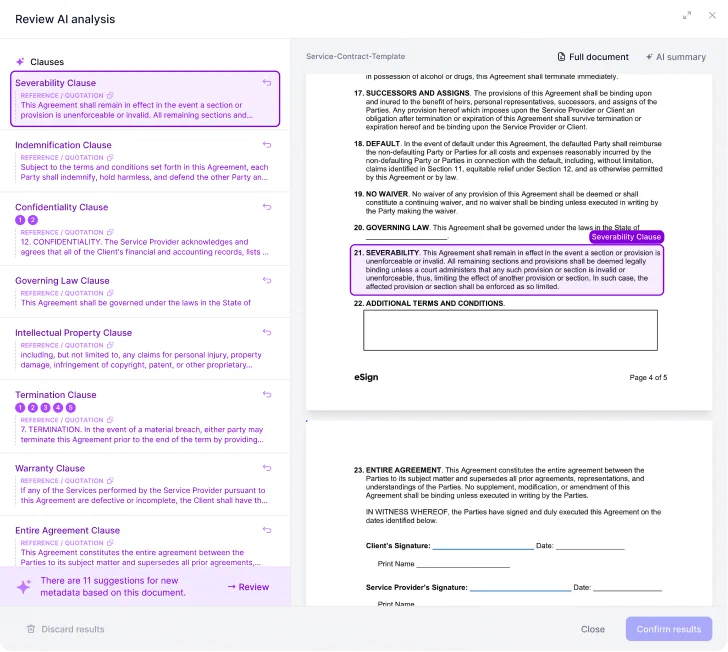
Analyze your contracts. Extract important clauses.
Try our AI contract analysis and extract important clauses and information from existing contracts.
Save your favourite clauses
Insert directly with a single click
Upload preferred precedents
Sample Net 30 payment terms clauses
Payment terms are net 30 days from date of invoice. Customer shall pay Teva a service charge of 1% per month, 12% per year, (or the highest amount allowed by law, if lower) on all amounts past due. In the event Customer is delinquent in payment or any amounts to Baxter, whether or not related to this Agreement, Teva may, at its option, declare all amounts owed to it under all agreements as due and payable immediately and terminate this Agreement.
The terms for all invoices are net 30 days and are due upon receipt. A 1.5% per month finance charge will be assessed for invoices unpaid after 30 days. You also agree to reimburse us for all expenses, including reasonable attorneys’ fees, incurred in the collection of any overdue and unpaid invoices. We may, at our discretion, suspend work on your account should any invoice remain unpaid for more than 30 days from the date of invoice.
Source
SMART BALANCE, INC.Payment Terms and Invoices. Payment terms are 1% 10, Net 30 until such time as Kagome completes the pre-blending transition contemplated above. Commencing the calendar month following the completion of the pre-blending transition, payment terms will change to Net 15 days from the invoice date, which shall correspond to the date shipment notification is delivered to GFA. Any prepaid freight shall be invoiced separately from Product invoices and shall be sent to GFA or GFA’s designated third party service provider, if applicable, for processing and payment and such invoices shall detail the various cost components of the freight charges as may be requested by GFA.
Source
TripAdvisor, Inc. (TRIP)- Payment Terms and Calculations. Advertiser shall be invoiced by Publisher on a monthly basis upon completion of the calendar moth in which the advertising was displayed unless stated otherwise in the applicable Schedule. Publisher’s payment terms are net 30 days from the date of invoice. In addition to any other rights, Publisher may immediately remove Advertiser’s Ad(s) in the event of non-payment by Advertiser within such time period. All sums payable by Advertiser to Publisher under this Agreement are exclusive of any sales tax, indirect or similar taxes chargeable on any supply to which those sums relate. All billing calculations are based solely on the ad impression or quick count metrics as calculated by Publisher (including, but not limited to CPM and CPC), not Advertiser or third party calculations, unless otherwise specified in the Schedule.
Source
QUANTUMSPHERE, INC.Parties specifically understand and agree that BLS shall receive commissions on all sales it makes in the Territory. The commission on the sale for QSI’s products shall be 12% of the contract price. For the avoidance of doubt, commissions are only earned upon receipt of revenues by QSI. To this end, commissions shall be due and payable net 30 from the date of receipt of payment by QSI. In addition, Representative shall be reimbursed for reasonable travel and other expenses outside of the territory which have been approved by QSI in advance.
Compensation for the consulting services described in this Agreement will be $100 per hour invoiced, subject to a 12-month cap of $100,000 over which an amendment to this Agreement from the Company is required. It is anticipated that efforts to advance the compound will require approximately 20 hours per week, although this may vary from 0 to 40 hours depending on developmental requirements and the Company’s work requests of any given week. Consultant should submit invoices either biweekly or monthly to the Company’s CFO, to be paid with standard Net 30 terms. Invoices should include itemized charges, including hourly work charges as well as incidental charges such as travel expenses, parking, lodging, etc.
What does net 30 mean?
Net 30 means the full invoice amount is due within 30 days. “Net” stands for the total amount owed, with no discount; “30” is the number of days the customer has to pay.
Example: you send an invoice dated March 1 with net 30 terms. The customer has to pay the full amount by March 31. If it pays on April 5, the payment is late, and any late fee in the contract can apply.
Net 30 is one of the most widely used payment terms between businesses. It gives the customer a month to receive the goods or services, check the invoice and run it through its approval process, while the supplier knows when to expect the money.
When does net 30 start?
Usually on the invoice date. But a contract can start the clock at a different moment, and that changes the due date:
| Start of the 30 days | Example wording | Effect |
|---|---|---|
| Invoice date | “net 30 days from the date of invoice” | The most common and clearest option |
| Receipt of the invoice | “within 30 days after receipt of the invoice” | A few days later; the customer may argue when it received it |
| Delivery or acceptance | “within 30 days after acceptance of the services” | Later still; acceptance can take time |
| End of the month (EOM) | “net 30 EOM” | 30 days from the end of the month the invoice is issued, so up to 60 days in total |
The 30 days are normally calendar days, not business days. Say what happens if the due date falls on a weekend or holiday, or write “net 30 calendar days” to remove the doubt.
Net 30 vs. other payment terms
| Term | When payment is due |
|---|---|
| Due on receipt | As soon as the invoice arrives |
| Net 7, net 10, net 15 | 7, 10 or 15 days after the invoice date |
| Net 30 | 30 days after the invoice date |
| Net 45, net 60, net 90 | 45, 60 or 90 days after the invoice date; common with large customers and in some industries |
| 2/10 net 30 | 2% discount if paid within 10 days, otherwise the full amount in 30 days |
| Net 30 EOM | 30 days after the end of the month in which the invoice is issued |
| CIA / PIA | Cash or payment in advance, before work starts or goods ship |
For an overview of all invoice terms, see billing and payment terms.
What does 2/10 net 30 mean?
“2/10 net 30” offers an early payment discount: the customer may deduct 2% if it pays within 10 days. Otherwise the full amount is due within 30 days.
Example: on a $10,000 invoice dated March 1, the customer can pay $9,800 by March 11, or $10,000 by March 31.
The discount is generous. Giving up 2% to keep the money 20 days longer is like borrowing at an annual rate of about 37% (2/98 × 365/20). That is why customers with cash usually take it, and why suppliers should only offer it when early cash really matters to them.
Net 30 vs. net 60
Net 60 gives the customer 60 days to pay. Large companies often ask for net 60 or longer, because it keeps cash in their business longer. For the supplier, it means waiting twice as long and financing the gap.
| Net 30 | Net 60 | |
|---|---|---|
| Customer pays within | 30 days | 60 days |
| Good for the supplier | Faster cash, less risk of non-payment | Can help win a large customer |
| Good for the customer | Common standard, simple | More time to sell the goods or check the work |
| Typical in | Most B2B services and supply | Large corporate buyers, retail, some public contracts |
Before agreeing to longer terms, check whether the law limits them. In the EU, the Late Payment Directive (2011/7/EU) sets 60 days as the general limit between businesses, unless a longer period is expressly agreed and is not grossly unfair to the supplier. Public authorities in the EU generally have to pay within 30 days. In the US, federal agencies must generally pay within 30 days of receiving a proper invoice under the Prompt Payment Act.
How to write net 30 payment terms in a contract
A clear net 30 clause states:
- The period and its start: “within thirty (30) days from the invoice date”.
- When invoices are issued: on shipment, monthly in arrears, or on reaching a milestone.
- How to pay: bank transfer, the currency, and who pays bank charges.
- Late payment: interest or a late fee, for example 1% or 1.5% per month, capped at what the law allows. In the EU, statutory interest and a fixed compensation of at least €40 per late invoice apply between businesses.
- Disputed amounts: the customer pays the undisputed part on time. See disputed invoices.
- Remedies: the right to suspend work or deliveries if an invoice stays unpaid after a reminder.
Avoid mixed signals. One of the sample clauses above says invoices are “net 30 days and are due upon receipt”, which leaves the actual due date open to argument.
Net 30 payment terms example
Sample clause: Payment terms (net 30)
Add this clause to a contract, send it and get it signed in fynk.
Use it in fynk for freeFor an invoice, a single line is enough: “Payment terms: Net 30. Payment due by [date]. Late payments are subject to interest of 1% per month.”
Keeping payment terms consistent
When every contract is drafted from a different file, payment terms drift: net 30 in one, net 45 in another, nothing at all in a third. In fynk, the payment term is a dynamic field in your templates, so it is set once per contract and appears the same way everywhere it is used. For contracts you already have, AI import reads the agreements and turns their terms into data, so you can see which customers pay on net 30 and which on net 60.
Which contracts use net 30 payment terms?
Service agreements, consulting agreements, supply and wholesale agreements, master service agreements, vendor contracts, purchase orders and invoices. These free templates set a payment period:
Free templates with this clause
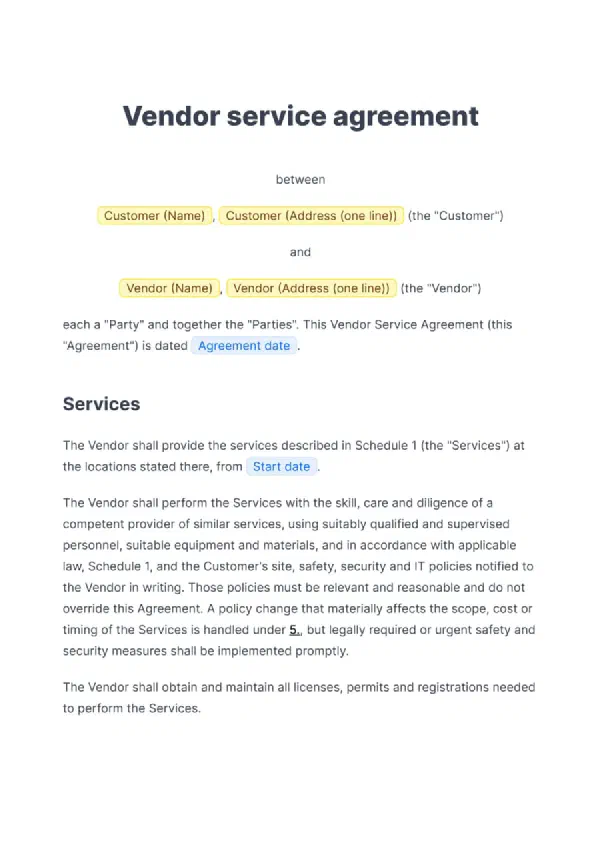 Vendor contract template
The client pays within the agreed payment term, counted from the later of receipt of the invoice or acceptance of the services.
Use the free template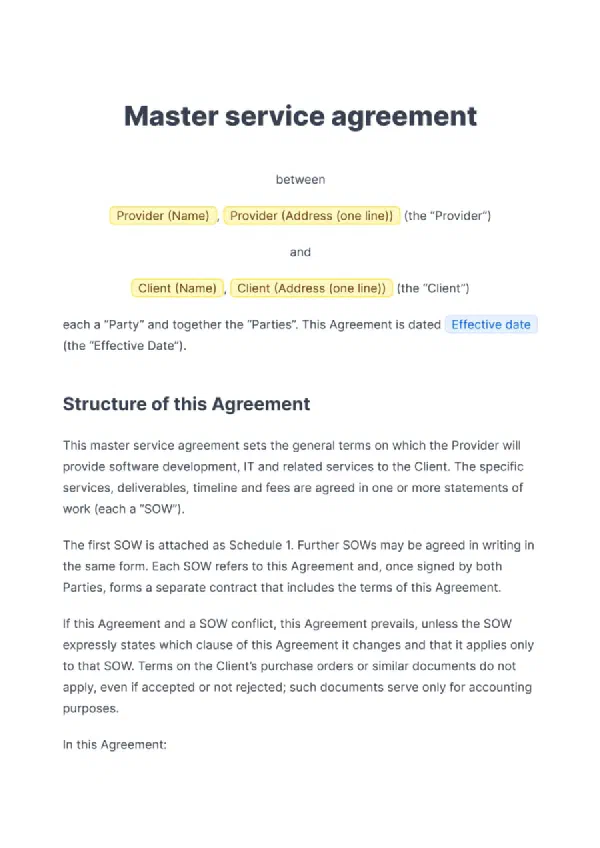 Master service agreement (MSA) template
The client pays each invoice within the payment term after receiving it, and pays the undisputed part on time if it disputes an invoice.
Use the free template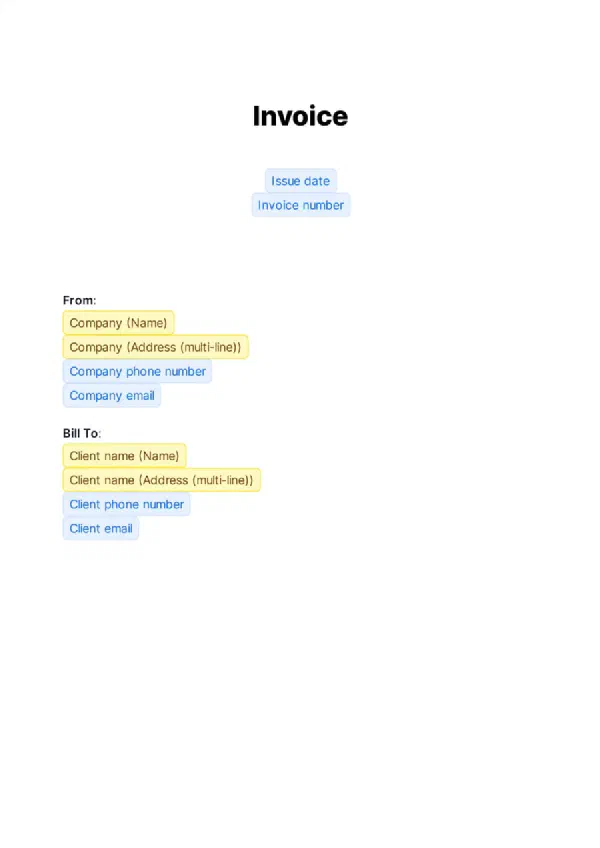 Simple billing invoice template
An invoice with fields for the payment terms and the due date.
Use the free template
Related clauses
- Billing and payment terms Billing and payment terms, also called invoice terms and conditions, set out when you invoice, when the customer has to pay, how they can pay, and what happens if they pay late or dispute an invoice. They belong in the contract first and are repeated on every invoice.
- Payment terms and conditions Payment terms and conditions outline the specifics of how and when a party will be compensated for goods or services provided. They typically include details on the payment method, due dates, any interest or penalties for late payments, and any discounts available for early payments.
- Disputed invoices A disputed invoice clause sets out what happens when a customer does not accept an invoice: the deadline and form for objecting, whether the undisputed part must still be paid on time, how the disagreement is resolved, and whether interest runs on amounts that turn out to be due.
- Late payment penalty A Late Payment Penalty clause stipulates that if a payment is not made by its due date, the party responsible for the payment will incur an additional fee or penalty. This clause incentivizes timely payments and compensates the payee for any inconvenience or financial impact caused by the delay.
- Default interest rate A default interest rate clause stipulates the interest rate that will be applied to overdue payments in a contract. This rate serves as a financial penalty, incentivizing timely payments and compensating the party owed for any delay.
- Upfront payment An upfront payment is money the customer pays before the work starts or the goods are delivered, either the full price or a share of it. It covers the supplier's setup costs and shows the customer is committed, and the contract should say whether it is refundable.
Frequently asked questions
The full amount is due within 30 days of the invoice date. An invoice dated March 1 with net 30 terms must be paid by March 31.
Usually calendar days. To avoid disputes, write “30 calendar days” and say what happens if the due date falls on a weekend or holiday.
The customer may take a 2% discount if it pays within 10 days. Otherwise the full amount is due within 30 days.
The payment is late. The supplier can charge the interest or late fee the contract sets, send a reminder and, if the contract allows, suspend work. Between businesses in the EU, statutory late payment interest and a fixed €40 compensation also apply.
Net 30 is better for the supplier, which gets paid sooner. Net 60 is better for the customer, which keeps its cash longer. Large buyers often ask for net 60; agree to it only if the price or the volume makes up for the wait.
More clauses from the library
See allNeutral reference
A neutral reference clause is a provision in an employment separation or settlement agreement where the employer agrees to provide only basic information about a former employee, typically limited to dates of employment and job title, without any positive or negative commentary. This clause is intended to prevent reputational harm and ensure impartiality during future employment verifications.
15 example clauses
New york style closing
A New York style closing is a real estate transaction process in which all necessary documents and funds are exchanged in person at a closing meeting, usually held at the office of a title company or attorney. This method ensures that all parties can immediately address any last-minute issues, allowing for the simultaneous transfer of property ownership and disbursement of funds.
7 example clauses
No agency relationship
This clause explicitly states that the agreement between the parties does not create an agency relationship. Each party operates independently and does not have the authority to act on behalf of or bind the other party in any manner.
12 example clauses
Analyze your contracts. Extract important clauses.
Try our AI contract analysis and extract important clauses and information from existing contracts.
Save your favourite clauses
Insert directly with a single click
Upload preferred precedents