
Disputed invoices
A disputed invoice clause sets out what happens when a customer does not accept an invoice: the deadline and form for objecting, whether the undisputed part must still be paid on time, how the disagreement is resolved, and whether interest runs on amounts that turn out to be due.
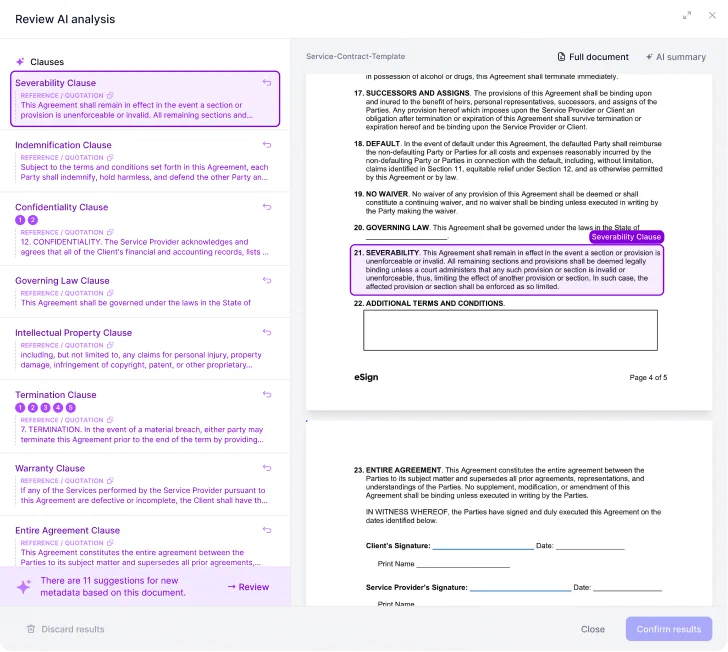
Analyze your contracts. Extract important clauses.
Try our AI contract analysis and extract important clauses and information from existing contracts.
Save your favourite clauses
Insert directly with a single click
Upload preferred precedents
Sample Disputed invoices clauses
Source
Otter Tail Corp (OTTR)Section 4.4 Disputed Invoices. If there is any dispute about any amount invoiced by Contractor, the amount not in dispute shall be promptly paid and any disputed amount that is ultimately determined to have been payable shall be paid, with interest calculated, as provided in Section 4.8.
Source
Recro Pharma, Inc.6.4 Disputed Invoices. If NOVARTIS disputes in good faith its obligation to pay all or part of any invoice submitted by SUPPLIER under this Agreement, then non-payment of such invoice or part of such invoice pending resolution of such dispute shall not constitute a material breach of this Agreement by NOVARTIS, provided, that if any such dispute is resolved in SUPPLIER’s favor, NOVARTIS shall be responsible for the payment of interest on the amount(s) that were in dispute.
3.6. Disputed invoices. In the event Client disputes any Service or other charge listed in an invoice, Host must be notified of such dispute in writing within seven (7) calendar days of the invoice date, and Client shall render full payment for the remaining undisputed portion. Notices of disputes issued by Client more than seven (7) calendar days of the invoice date shall be paid in full first. Client waives the right to dispute an invoice amount after thirty (30) calendar days following the applicable invoice date. Host shall credit any disputed amounts resolved in favor of Client to Client’s account, and any disputed amounts resolved in favor of Host shall be paid within ten (10) calendar days of such resolution.
Should either Party dispute any of the charges on the invoice, it shall notify the other Party of the disputed charges not later than thirty (30) days from the date of invoice. Said dispute shall set forth in writing all details concerning the disputed charges. In the event of a dispute; the entire invoice shall be paid in accordance with the payment terms set forth herein. Disputes shall be reviewed and resolved within fifteen (15) days of receipt of written dispute. However, the Provider shall have no obligation to review disputed charges until the disputed invoice is paid in full. In the event such dispute is resolved in favor of Customer, Provider shall provide Customer with a credit against future billing in the amount of the disputed billing. In the event that Customer fails to pay an invoice in full because of a billing dispute, Provider shall have the right, after giving Customer five (5) days prior written notice, to suspend all or any portion of the Services until such time as the dispute is resolved or to require Customer to provide additional security deposit.
Source
WD 40 CO (WDFC)4.3 Disputed Invoices
If the Service Recipient discovers an error or omission in any invoice, or disagrees with any item or calculation set forth thereon, the Service Recipient shall provide to the Service Provider prompt written notice of such error, omission or disagreement, and the Parties shall work in good faith to resolve such dispute informally (i.e., without initiating legal action or a claim for indemnification under the QPA) for a period of at least thirty (30) days. The Service Provider shall continue performing the applicable Services in accordance with this Agreement notwithstanding any such dispute.
What is a disputed invoice clause?
A disputed invoice clause says what happens when the customer does not agree with an invoice. It sets how and when the customer has to object, what it has to pay in the meantime, and how the two sides settle the disagreement.
Without one, a single wrong line item can hold up a whole invoice. The supplier treats the unpaid amount as late, the customer treats it as justified, and both sides argue about breach instead of the number. The clause turns that into a routine process.
It usually sits in the billing and payment terms of a service agreement, a supply contract or a master service agreement.
What a good disputed invoice clause covers
- A deadline to object. For example within 15 days after receiving the invoice. After that, the invoice counts as accepted or the right to dispute it ends.
- Written notice with reasons. Which line items, which amounts, and why.
- Payment of the undisputed part. The customer pays everything it does not dispute on time.
- A way to resolve it. Good-faith talks within a set number of days, then escalation to senior managers, then the contract’s dispute resolution process.
- What happens after. The disputed amount is paid within a few days if the supplier was right, or credited if the customer was.
- Interest. Whether interest runs on a disputed amount that turns out to be due, usually at the contract’s default interest rate.
- Services during the dispute. Whether the supplier must keep working, or may suspend services if the undisputed part stays unpaid.
Two ways to handle a disputed amount
| Pay the undisputed part | Pay in full first | |
|---|---|---|
| What the customer pays while the dispute runs | Only the amounts it does not dispute | The whole invoice |
| Who carries the money during the dispute | The supplier | The customer |
| How it ends | Supplier is paid the rest, if it was right | Customer gets a credit or refund, if it was right |
| Who usually asks for it | Customers | Suppliers, often in telecoms and hosting |
| Breach | Withholding a disputed amount in good faith is not a breach | Not paying in full can allow suspension |
Paying the undisputed part is the more common and more balanced model. The sample clauses above include both.
Disputed invoice clause example
Sample clause: Disputed invoices
Add this clause to a contract, send it and get it signed in fynk.
Use it in fynk for freeHow to dispute an invoice
- Check the contract. Find the deadline, the notice form and the address for notices.
- Pin down the error. Compare the invoice with the agreed prices, the work order and what was delivered.
- Send written notice in time. Name the invoice number, the disputed line items and amounts, and the reason, with any proof.
- Pay the undisputed part on the due date, so the dispute stays about the disputed amount only.
- Keep a record of the talks and agree the outcome in writing, as a credit note or a corrected invoice.
Keeping payment terms within reach
A dispute is only as strong as your notice: miss the deadline and the invoice may stand. In fynk, AI Search finds the payment and dispute terms of any contract in plain language, so you know the deadline and the notice address in seconds. Tasks and reminders put the deadline on the right person’s list, so the objection goes out in time.
Which contracts have a disputed invoice clause?
Service agreements, master service agreements, construction contracts, consulting and time-and-materials agreements, and supply agreements. These free templates include one:
Free templates with this clause
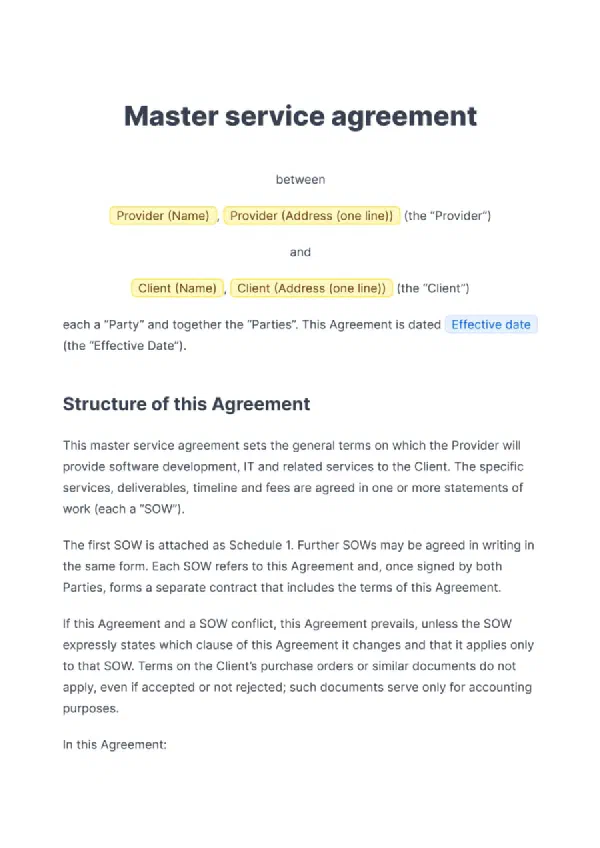 Master service agreement (MSA) template
The client disputes in writing within the agreed period, pays the undisputed part, and both sides try to settle it within 15 days.
Use the free template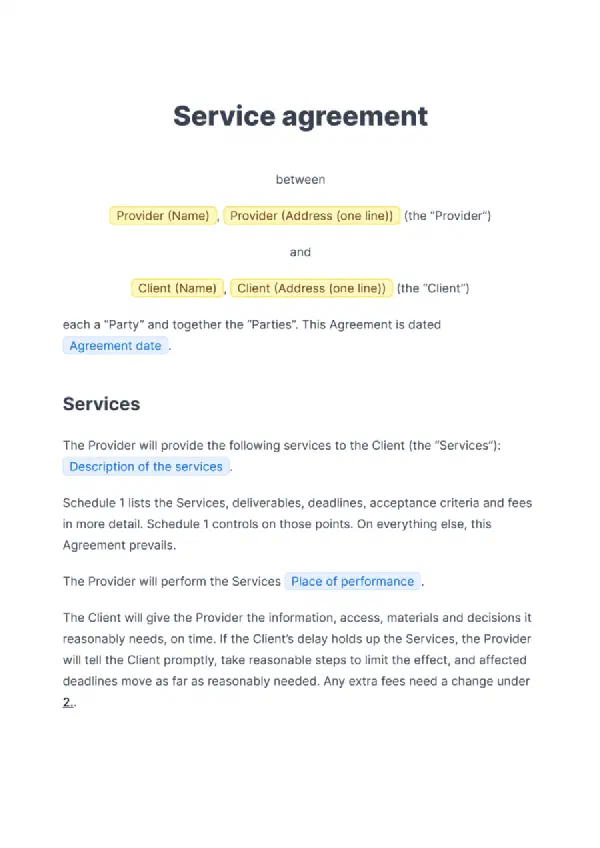 Service agreement template
The client objects in writing, normally within 14 days, and pays the undisputed part on time; a late notice does not waive a valid objection.
Use the free template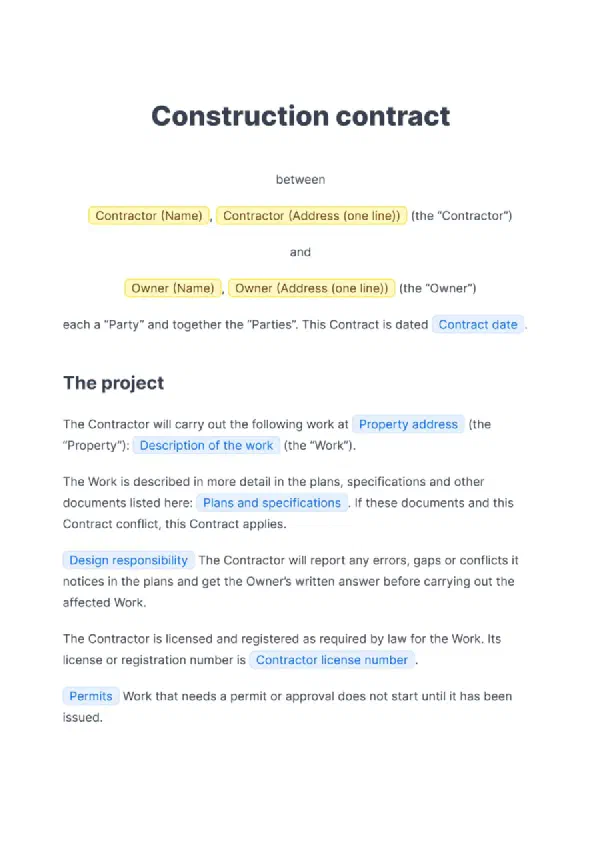 Construction contract template
The owner tells the contractor in writing why it disputes an invoice and pays the undisputed part when due.
Use the free template
Related clauses
- Billing and payment terms Billing and payment terms, also called invoice terms and conditions, set out when you invoice, when the customer has to pay, how they can pay, and what happens if they pay late or dispute an invoice. They belong in the contract first and are repeated on every invoice.
- Payment terms and conditions Payment terms and conditions outline the specifics of how and when a party will be compensated for goods or services provided. They typically include details on the payment method, due dates, any interest or penalties for late payments, and any discounts available for early payments.
- Right of set off The right of set-off is a contractual clause allowing one party to offset mutual debts with another party by deducting the owed amount against any obligations the other party has to them. This provision helps reduce the risk of default by enabling both parties to net out their liabilities and receivables.
- Late payment penalty A Late Payment Penalty clause stipulates that if a payment is not made by its due date, the party responsible for the payment will incur an additional fee or penalty. This clause incentivizes timely payments and compensates the payee for any inconvenience or financial impact caused by the delay.
- Right to audit The "Right to Audit" clause grants a party the ability to review and examine the financial records, systems, and practices of another party to ensure compliance with contractual terms and accuracy of financial reporting. This clause is often included to provide transparency and accountability, and to safeguard against fraud or mismanagement.
- Dispute resolution The dispute resolution clause outlines the methods by which any disagreements arising from a contract will be managed, specifying procedures such as negotiation, mediation, arbitration, or litigation. This clause aims to provide a clear framework for resolving conflicts efficiently, thus minimizing potential disruptions to the contractual relationship.
Frequently asked questions
An invoice, or part of one, that the customer does not accept, for example because of a wrong price, a wrong quantity or work that was not done. Most contracts let the customer withhold the disputed part while it is being resolved.
Usually only the undisputed part, if the contract says so. Some contracts require payment in full first, with a credit later. Check your contract: it decides.
As long as the contract allows, often 10 to 30 days after receiving the invoice. Without a set deadline, object as soon as you spot the problem and in writing.
Only if the contract allows it. Many clauses require the supplier to keep working during a good-faith dispute, and allow suspension only when undisputed amounts stay unpaid.
The invoice number and date, the disputed line items and amounts, the reason with supporting documents, the amount you will pay now, and a request for a corrected invoice or a credit note.
More clauses from the library
See alldivestiture
A divestiture clause outlines the conditions under which a party must sell or dispose of certain assets, typically to comply with regulatory requirements or to maintain competitive balance. This clause ensures that the involved entities act in accordance with antitrust laws and helps prevent monopoly practices.
10 example clauses
Double trigger acceleration
Double trigger acceleration is a contractual provision commonly found in employee stock or option agreements, which accelerates vesting based on the occurrence of two specific events, typically a change in company control followed by an employee's involuntary termination or departure for 'good reason.' This clause is designed to provide financial security to key employees in the event of company acquisition while also protecting the acquiring company from immediate mass vesting.
11 example clauses
Down payment
A down payment clause specifies the initial, non-refundable portion of the total cost that a buyer must pay upfront to secure the purchase of a product or service. This clause outlines the amount, timing, and any conditions associated with the down payment, providing assurance to both parties involved in the transaction.
20 example clauses
Analyze your contracts. Extract important clauses.
Try our AI contract analysis and extract important clauses and information from existing contracts.
Save your favourite clauses
Insert directly with a single click
Upload preferred precedents