
Gross negligence and willful misconduct
Gross negligence is a reckless disregard of an obvious risk; willful misconduct is deliberate wrongdoing. Contracts use the pair as an exception to liability caps, damages exclusions and indemnities, so a party is not protected from its own worst conduct.
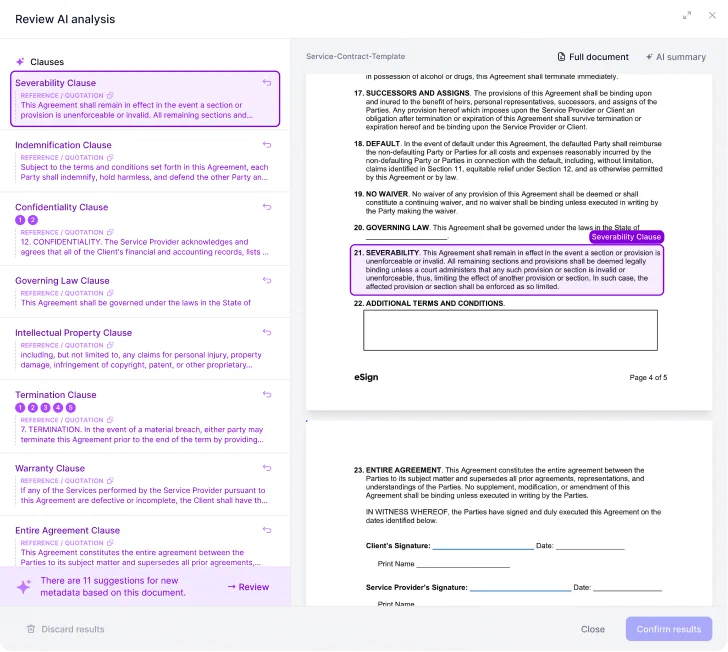
Analyze your contracts. Extract important clauses.
Try our AI contract analysis and extract important clauses and information from existing contracts.
Save your favourite clauses
Insert directly with a single click
Upload preferred precedents
Sample Gross negligence and willful misconduct clauses
(c) In no event shall Bank be liable, directly or indirectly, for any (i) damages or expenses arising out of services provided under this Agreement, other than damages which result from Bank’s gross negligence or willful misconduct, or (ii) indirect, special or consequential damages, including, but not limited to, lost profits, even if Bank has been advised of the possibility of such damages.
Source
STEPAN CO (SCL)- Liability of Limitation. EXCEPT FOR THE GROSS NEGLIGENCE OR WILLFUL MISCONDUCT OF CONSULTANT, NEITHER THE COMPANY NOR CONSULTANT SHALL BE LIABLE TO THE OTHER FOR ANY SPECIAL, INDIRECT, ECONOMIC, INCIDENTAL, EXEMPLARY, PUNITIVE, OR CONSEQUENTIAL DAMAGES, ARISING OUT OF OR RELATED TO THIS AGREEMENT OR OTHERWISE, INCLUDING ANY LOST REVENUE OR PROFITS, BUSINESS INTERRUPTION, OR DAMAGE TO BUSINESS REPUTATION, REGARDLESS OF THE THEORY UPON WHICH ANY CLAIM MAY BE BASED, INCLUDING, WITHOUT LIMITATION, TORT (INCLUDING NEGLIGENCE), BREACH OF CONTRACT, BREACH OF WARRANTY, PRODUCT LIABILITY, OR ANY STATUTORY CAUSE OF ACTION, REGARDLESS OF WHETHER SUCH DAMAGE WAS FORESEEABLE AND REGARDLESS OF WHETHER OR NOT THE COMPANY HAS BEEN ADVISED OF THE POSSIBILITY OF SUCH DAMAGES. THE COMPANY’S LIABILITY SHALL NOT EXCEED THE PRICE FOR SERVICES RENDERED HEREUNDER. EXCEPT FOR THE GROSS NEGLIGENCE OR WILLFUL MISCONDUCT OF CONSULTANT, CONSULTANT’S LIABILITY SHALL NOT EXCEED THE COMPENSATION PAID TO CONSULTANT FOR SERVICES RENDERED HEREUNDER.
10.4 Limitation of Liability. TO THE FULLEST EXTENT PERMITTED BY APPLICABLE LAW AND EXCEPT WITH RESPECT TO: (A) A CLAIM ARISING OUT OF FRAUD, GROSS NEGLIGENCE OR WILLFUL MISCONDUCT, (B) ANY AMOUNTS PAYABLE PURSUANT TO SECTION 10.1 OR SECTION 10.2, OR (C) ANY BREACH OF SECTION 11, IN NO EVENT SHALL EITHER PARTY, ITS DIRECTORS, OFFICERS, EMPLOYEES, AGENTS OR AFFILIATES BE LIABLE TO THE OTHER PARTY FOR ANY INDIRECT, INCIDENTAL, MULTIPLE, SPECIAL, PUNITIVE, EXEMPLARY OR CONSEQUENTIAL DAMAGES WHATSOEVER THAT IN ANY WAY ARISE OUT OF, RELATE TO, OR ARE A CONSEQUENCE OF, ITS PERFORMANCE OR NON-PERFORMANCE HEREUNDER, WHETHER BASED UPON A CLAIM OR ACTION OF CONTRACT, WARRANTY, NEGLIGENCE, STRICT LIABILITY OR OTHER TORT, OR OTHERWISE, EVEN IF SUCH PARTY HAS BEEN PUT ON NOTICE OF THE POSSIBILITY OF SUCH DAMAGES, ARISING OUT OF THE AGREEMENT. SUPPLIER’S AGGREGATE LIABILITY FOR ANY CLAIM ARISING UNDER THIS AGREEMENT SHALL NOT EXCEED THREE (3) TIMES THE AMOUNTS PAID OR PAYABLE BY ALL APPLICABLE LIGAND PARTIES TO SUPPLIER OVER THE TWELVE (12) MONTHS PRECEDING THE DATE ON WHICH SUCH CLAIM ARISES.
8.7 Indemnity. Except for Lessor’s gross negligence or willful misconduct, Lessee shall indemnify, protect, defend and hold harmless the Premises, Lessor and its agents, Lessor’s master or ground lessor, partners and Lenders, from and against any and all claims, loss of rents and/or damages, liens, judgments, penalties, attorneys’ and consultants’ fees, expenses and/or liabilities arising out of, involving, or in connection with, a Breach of the Lease by Lessee and/or the use and/or occupancy of the Premises and/or Project by Lessee and/or by Lessee’s employees, contractors or invitees. If any action or proceeding is brought against Lessor by reason of any of the foregoing matters, Lessee shall upon notice defend the same at Lessee’s expense by counsel reasonably satisfactory to Lessor and Lessor shall cooperate with Lessee in such defense. Lessor need not have first paid any such claim in order to be defended or indemnified.
B. Company agrees to indemnify, defend and hold harmless Consultant from and against all claims, liabilities, losses, damages, costs, and expenses (including reasonable attorneys’ fees) arising out of or related to Consultant’s performance of the Services, excluding Consultant’s gross negligence or willful misconduct in performing the Services.
- Indemnity. Pesicka agrees to indemnify the Company Parties, and hold them harmless, from and against any and all claims, liabilities, and expenses (including reasonable attorneys’ and accountants’ fees, costs, and expenses) resulting from, arising out of, or relating to any (a) gross negligence or willful misconduct by Pesicka in the performance of the Services, (b) breach of this Agreement by Pesicka, or (c) any claim that any Benefits or Taxes should have been paid or provided to Pesicka, or withheld or contributed for the benefit of Pesicka. The Company agrees to indemnify and hold harmless Pesicka from and against any and all claims, liabilities, and expenses (including reasonable attorneys’ fees) arising out of or relating to Pesicka’s performance of the Services in accordance with this Agreement, except to the extent such claims arise from Pesicka’s gross negligence, willful misconduct, or breach of this Agreement.
What do gross negligence and willful misconduct mean?
Both describe conduct that is worse than an ordinary mistake. They mark the point where a contract stops protecting a party from its own failures.
- Gross negligence is a serious failure to take care: conduct that is indifferent to an obvious risk or to other people’s rights. It is not deliberate, but it goes far beyond ordinary carelessness.
- Willful misconduct is deliberate wrongdoing: doing something you know is wrong, or ignoring a known duty on purpose or with reckless indifference to the result.
In contracts, the two are almost always used as a pair: “except in the case of gross negligence or willful misconduct”. The phrase appears wherever a contract limits or excludes liability, and it takes the worst behavior out of that protection.
Negligence, gross negligence, willful misconduct: the scale
| Level | What it looks like | Example in a service contract | Usual effect in a contract |
|---|---|---|---|
| Negligence | Failing to take the care a reasonable person would | A technician forgets one step of a checklist, causing a short outage | Covered by the liability cap and exclusions |
| Gross negligence | Reckless disregard of an obvious, serious risk | A provider runs production systems with no backups for months after being warned | Often carved out of the cap and exclusions |
| Willful misconduct | Knowingly doing wrong, or deliberately ignoring a duty | A supplier knowingly ships parts that fail the agreed safety test | Carved out; often treated like fraud |
| Fraud or intentional harm | Deliberate deception or intent to cause harm | Falsifying test reports to get paid | Cannot usually be excluded at all |
The lines between the levels are not sharp. That is why contracts that rely on these words should say what they mean.
Gross negligence vs. negligence
The difference is one of degree. Negligence is falling short of reasonable care. Gross negligence is falling far short of it, in a way that shows the person did not care about an obvious risk.
How courts put it differs by jurisdiction:
- New York. To get past a limitation of liability, gross negligence must “smack[] of intentional wrongdoing” and show “a reckless indifference to the rights of others”. In Sommer v. Federal Signal Corp., 79 N.Y.2d 540 (1992), the Court of Appeals held that a clause shielding an alarm company from liability covered ordinary negligence but not gross negligence, following Kalisch-Jarcho v. City of New York (1983).
- England and Wales. English law traditionally does not treat gross negligence as a separate category. When a contract uses the term, courts read it as something more than ordinary negligence. In Camerata Property v Credit Suisse Securities [2011] EWHC 479 (Comm), the judge called the difference “one of degree and not of kind” and accepted that it covers “serious disregard of or indifference to an obvious risk”.
Other states and countries have their own tests. If a contract turns on these words, write down what they mean.
Why contracts carve out gross negligence and willful misconduct
The phrase usually shows up as an exception in four places:
- Limitation of liability. The cap on damages falls away for losses that result from gross negligence or willful misconduct.
- Consequential damages waivers. Lost profits and indirect losses become recoverable if they result from that conduct.
- Indemnities. A party is not indemnified for losses caused by its own gross negligence or willful misconduct, as in the lease and consulting samples above.
- Exculpation of agents and service providers. Escrow agents, banks, trustees and administrative agents are typically liable only for gross negligence or willful misconduct, not for ordinary mistakes.
The logic is the same each time: a party can agree to carry the risk of the other side’s ordinary mistakes, but not of its reckless or deliberate wrongdoing.
Can a contract limit liability for gross negligence?
Often not. Many legal systems refuse to let a party contract out of liability for its own grossly negligent or intentional conduct. In New York, Sommer applies this both to clauses that exclude liability and to clauses that limit damages to a nominal sum, and the court pointed to Restatement (Second) of Contracts § 195(1), under which a term excluding liability for intentional or reckless harm is unenforceable. Even where the law does not forbid it, courts read such exclusions narrowly.
So the carve-out is partly a matter of law and partly a matter of negotiation. Writing it into the contract makes clear what the parties expect, and avoids a dispute over whether the cap was ever meant to cover deliberate wrongdoing.
How to draft the carve-out
- Define the terms, or at least say whose standard applies. A definition keyed to “reckless disregard” or “knowing and intentional breach” removes much of the argument.
- Say which protections fall away. The cap, the consequential damages exclusion, the indemnity, or all of them? The sample clauses above take different approaches.
- Decide who it applies to. Mutual carve-outs are standard in balanced contracts; one-sided ones appear when only one party performs services.
- Add fraud separately. Fraud is not always covered by “willful misconduct”, so many contracts list it on its own.
- Consider “intentional breach”. Some contracts also lift the cap for a deliberate refusal to perform, which is not always willful misconduct in the tort sense.
- Watch the employment meaning. In employment contracts, “willful misconduct” is often a ground for termination for cause, with its own definition. Do not copy it into a commercial contract without checking.
Gross negligence and willful misconduct clause example
Sample clause: Exceptions to limitations of liability
Add this clause to a contract, send it and get it signed in fynk.
Use it in fynk for freeSeeing where your caps stop
Most contracts state the cap in one sentence and its exceptions in another, sometimes pages apart. In fynk, AI Summary reads each contract on import and gives you a plain-language overview of what it says, so you can check its liability terms without reading every page. When a counterparty’s carve-out looks too wide, legal and the business owner can settle it in a comment thread on the clause itself with discussions.
Which contracts include a gross negligence and willful misconduct carve-out?
Service and consulting agreements, SaaS and IT contracts, commercial leases, escrow and agency agreements, credit agreements, property management and construction contracts. Three of our templates show different versions of the carve-out:
Free templates with this clause
- Service agreement template The liability caps do not apply to fraud, intentional misconduct or gross negligence, death or personal injury, or liability that cannot be limited by law. Use template
- Escrow agreement template (asset purchase transaction) The escrow agent is liable only for its fraud, gross negligence or willful misconduct when acting on instructions it reasonably believes are genuine. Use template
- Property management agreement template 'Misconduct' covers fraud, criminal conduct, willful misconduct, gross negligence and willful breach, with a cure period except for fraud. Use template
Related clauses
- Limitation of liability A limitation of liability clause limits how much, and for which kinds of loss, one party can claim from the other if something goes wrong. It usually combines an exclusion of indirect damages with a cap on the total amount, plus a short list of exceptions that stay uncapped.
- Exculpatory clause An exculpatory clause is a contract provision that relieves one party from liability for harm or damages caused during the execution of the contract, often found in agreements where one party is at risk for potential loss or damage. These clauses aim to limit or altogether exclude the legal responsibility of a party, though their enforceability varies based on jurisdiction and the specific circumstances surrounding the contract and the event.
- Consequential damages waiver A consequential damages waiver is a contractual clause that prevents a party from claiming losses that don't directly result from a breach but arise as a secondary effect, such as lost profits or reputational harm. This waiver limits liability to direct damages only, promoting clarity and reducing potential legal exposure.
- Indemnification and hold harmless The Indemnification and Hold Harmless clause requires one party to compensate the other party for any losses, damages, or liabilities arising from specific events or actions. It also ensures that the indemnified party is protected from any legal claims or damages related to the indemnifying party's actions or negligence.
- Waiver of liability A waiver of liability clause releases one party from legal claims or damages that may arise from their actions or negligence. By agreeing to this clause, the other party acknowledges and accepts the risks involved, forfeiting their right to seek compensation.
- Duty to defend A duty to defend is an obligation to provide and pay for the legal defense of another party when a third party makes a claim against it. It starts when the claim is made, before anyone knows who is at fault, which makes it broader than the duty to indemnify. It appears in contract indemnities and in liability insurance.
Frequently asked questions
Negligence is failing to take reasonable care. Gross negligence is a much more serious failure that shows reckless disregard for an obvious risk or for other people's rights. The difference is one of degree.
Deliberate wrongdoing: knowingly doing something wrong, or intentionally ignoring a known duty, with indifference to the consequences. It is more serious than gross negligence, which does not require intent.
No. Gross negligence is extreme carelessness; willful misconduct involves intent or knowing indifference. Contracts usually name both so that neither falls through the gap.
Often not. Many jurisdictions, including New York, will not enforce a clause that excuses or caps liability for gross negligence or intentional wrongdoing. Where it is allowed, courts read such clauses narrowly.
Harder than ordinary negligence. In New York the conduct must smack of intentional wrongdoing or show reckless indifference to the rights of others, and whether it does is usually a question of fact. In Sommer v. Federal Signal, that question alone was enough to send the case to trial instead of deciding it on summary judgment.
A provider that keeps running critical systems without backups after being warned of the risk, and then loses the customer's data, may be grossly negligent. A single forgotten step in an otherwise careful process usually is not.
More clauses from the library
See allGuarantee
A guarantee clause in a contract assures one party that certain conditions or obligations will be fulfilled, offering a promise of performance or a backup remedy if the specified terms are not met. It often involves the guarantor providing financial security or taking responsibility to ensure the contract's commitments are upheld.
13 example clauses
Guaranteed maximum price
A Guaranteed Maximum Price (GMP) clause in a contract establishes a ceiling on the total cost that the owner will pay to the contractor, protecting the owner from cost overruns while incentivizing the contractor to manage costs efficiently. Any savings generated under the maximum price typically benefit the owner, though such clauses may include provisions for shared savings between parties.
17 example clauses
Holdback
A holdback is part of a payment that the payer keeps back for a period, as security for claims, adjustments or unfinished work, and releases once agreed conditions are met.
4 example clauses
Analyze your contracts. Extract important clauses.
Try our AI contract analysis and extract important clauses and information from existing contracts.
Save your favourite clauses
Insert directly with a single click
Upload preferred precedents