
Duty to defend
A duty to defend is an obligation to provide and pay for the legal defense of another party when a third party makes a claim against it. It starts when the claim is made, before anyone knows who is at fault, which makes it broader than the duty to indemnify. It appears in contract indemnities and in liability insurance.
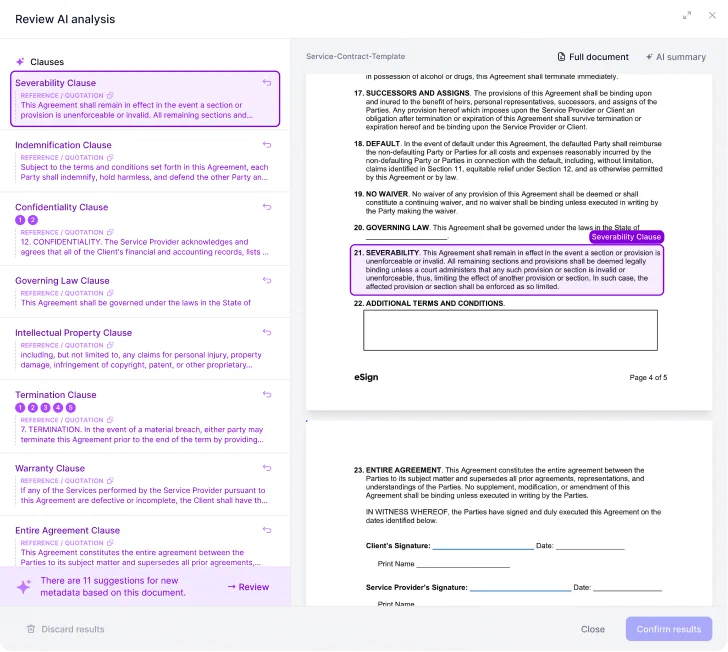
Analyze your contracts. Extract important clauses.
Try our AI contract analysis and extract important clauses and information from existing contracts.
Save your favourite clauses
Insert directly with a single click
Upload preferred precedents
Sample Duty to defend clauses
6.4 Procedures. The Indemnified Party shall promptly notify Licensee of any claim or action giving rise to a Liability subject to the provisions of Article 6.3. Licensee shall have the duty to defend any such claim or action, at its cost and expense. Indemnified Party must have the right, however, to approve counsel through the Mississippi Attorney General and through its governing board to represent it, and such approval will not be unreasonably withheld. In the event Licensee or any of its parents, affiliates or subsidiaries is also named in a particular claim, Licensee may choose the same attorneys who defend the Indemnified Parties to defend Licensee unless there arises a conflict of interest between the Licensee and one or more of the Indemnified Parties or among the Indemnified Parties. The indemnification rights of UM or other Indemnified Party contained herein are in addition to all other rights which such Indemnified Party may have at law or in equity or otherwise.
11.2 Defense of Claims. Contractor shall promptly advise Owner in writing of any action, administrative or legal proceeding or investigation as to which Contractor’s indemnification may apply, and Contractor, at Contractor’s expense, provided that the indemnification applies, shall assume on behalf of Owner and conduct with due diligence and in good faith the defense thereof with counsel reasonably satisfactory to Owner; provided, that if the defendants in any such action include both Contractor and Owner and Owner shall have reasonably concluded that there may be legal defenses available to it which are different from or additional to, or inconsistent with, those available to Contractor, Owner shall have the right to select separate counsel to participate in the defense of such action on its own behalf at Contractor’s expense.
(b)Indemnitor Conducts Defense. The assumption of a defense by the Indemnitor shall not be deemed an admission that the Indemnitor has an obligation to defend, indemnify or hold harmless an Arena Indemnitee or Eisai Indemnitee, as applicable, from and against any Loss from a Third Party Claim. If the Indemnitor assumes and conducts the defense of a Third Party Claim as provided above, and if it is ultimately determined pursuant to Section 17.1 that the Indemnitor was not obligated to indemnify, defend, or hold harmless an Arena Indemnitee or Eisai Indemnitee, as applicable, from and against any Loss from such Third Party Claim, the Indemnitee shall reimburse the Indemnitor for any and all reasonable and verifiable costs and expenses (including attorneys’ fees and costs of suit) and all other Losses incurred by the Indemnitor in connection with such Third Party Claim.
Source
LIGHTBRIDGE Corp (LTBR)The Indemnified Party shall have the right, at its own expense, to appoint its own counsel to participate in any claim, suit, or proceeding, and the Indemnifying Party shall cooperate with the Indemnified Party and such counsel. If the Indemnifying Party fails to reasonably discharge its obligation to defend the Indemnified Party, the Indemnifying Party shall reimburse the Indemnified Party for reasonable attorneys’ fees and other costs incurred by the Indemnified Party.
Source
NVE CORP /NEW/ (NVEC)15.5 Supplier shall not be liable and shall have no obligation to defend under this Section 14.2 to the extent any claim, demand or cause of action is solely based upon the combination by Sonova of the Product with devices or equipment not sold by Supplier. Supplier shall inform Sonova if it is aware that the combination of the Product with other devices or equipment as intended by Sonova may infringe upon third party intellectual property rights.
Source
Iron Eagle Group, Inc.- It shall be the duty of the Insurer and not the duty of the Insureds to defend any Claim. Such duty shall exist even if any of the allegations are groundless, false or fraudulent. The Insurer’s duty to defend any Claim shall cease when the Limits of Liability have been exhausted by the payment of Loss including Costs, Charges and Expenses.
What is a duty to defend?
A duty to defend is an obligation to provide and pay for the legal defense of someone else when a third party makes a claim against them. It covers lawyers, court costs and the work of fighting the claim, from the moment the claim is made.
It comes up in two places:
- In contracts, as part of an indemnity: “Supplier shall defend, indemnify and hold harmless Customer from any claim that the product infringes a patent.”
- In liability insurance, where the insurer promises to defend the policyholder against covered lawsuits.
Example: a customer is sued by a patent holder over software it licensed. The license says the vendor will defend the customer against infringement claims. The vendor has to hire and pay the lawyers now, long before any court decides whether the software infringes anything.
Duty to defend vs. duty to indemnify
The two often appear in the same sentence, but they are separate promises with different timing.
| Duty to defend | Duty to indemnify | |
|---|---|---|
| What it covers | The cost and work of defending the claim | The loss itself: a judgment, a settlement, damages |
| When it starts | When the claim is made and passed on (tendered) | When the loss is established |
| Depends on the outcome? | No. It applies to claims that turn out to be groundless | Yes. Only losses that fall within the indemnity are paid |
| Scope | Broader: any claim that falls, or may fall, within the indemnity | Narrower: only what is actually owed |
That is why a party can owe a defense and, at the end, owe nothing else. In Crawford v. Weather Shield (2008), the California Supreme Court held that a subcontractor had to pay for a builder’s defense even though a jury later found the subcontractor was not negligent. Under California law, unless the contract says otherwise, the duty to defend arises once the claim is properly tendered.
Duty to defend vs. right to defend vs. reimbursement
Three different ways to deal with defense costs:
- Duty to defend. The indemnifying party must take on the defense, usually with its own lawyers, and pays for it.
- Right to defend (or right to control the defense). The indemnifying party may take over the defense if it wants to. If it does not, the protected party defends itself and claims the costs later as part of its loss. Many purchase agreements use this model.
- Reimbursement of defense costs. The protected party runs its own defense and is repaid. Some contracts reimburse only at the end; some insurance policies, often D&O policies, work this way instead of defending.
The difference matters most for cash and control: with a duty to defend, the other side pays from the start but usually chooses the lawyers.
How a contractual duty to defend works
A well-drafted defense clause, like the sample clauses above, answers these questions:
- Notice. The protected party has to tell the indemnifying party about the claim promptly. Most clauses say that late notice reduces the obligation only to the extent it hurt the defense.
- Acceptance. The indemnifying party confirms within a set time that it takes on the defense. Taking it on is often stated not to be an admission that indemnity is owed.
- Counsel. Who picks the lawyers, and whether the protected party can approve them.
- Conflicts. If both parties are sued and their defenses differ, the protected party may hire separate counsel at the indemnifying party’s cost.
- Settlement. The indemnifying party may not settle in a way that admits fault for, or puts obligations on, the protected party without its consent.
- Cooperation. The protected party provides documents, witnesses and help with the defense.
- Failure to defend. If the indemnifying party does not defend, it pays the protected party’s own defense costs.
- Carve-outs. Claims caused by the protected party itself, or (for IP claims) by changes or combinations it made, are excluded.
Duty to defend in insurance
In a liability policy, the duty to defend is the insurer’s promise to defend the policyholder against lawsuits that the policy may cover. It is generally broader than the duty to pay claims:
- It is triggered by the allegations. If the lawsuit’s allegations could fall within the coverage, the insurer has to defend. In several states, including Texas, courts compare the complaint with the policy, known as the eight corners rule.
- It applies to groundless claims. Many policies say so in terms: the insurer defends “even if any of the allegations are groundless, false or fraudulent”.
- It often comes with a reservation of rights. The insurer defends but keeps the right to deny paying the loss later if it turns out not to be covered.
- It usually ends when the limits are used up. Standard policy wording ends the duty to defend once the policy limit has been paid out in judgments or settlements, as in one of the sample clauses above.
Contracts and insurance meet here: an indemnity with a duty to defend is only as good as the indemnifying party’s money, so contracts often add an insurance clause that requires it to carry liability insurance covering its contractual obligations.
How to negotiate a duty to defend
If you are the one who has to defend:
- Limit it to claims caused by you, for example by your negligence, your breach or your product.
- Keep control of the defense and the choice of counsel, and add that taking on a defense is not an admission.
- Reserve the right to be reimbursed if it turns out the claim was outside the indemnity.
- Check your insurance covers the defense you promised.
If you are the one being protected:
- Ask for “defend, indemnify and hold harmless”, not “indemnify” alone, so costs are covered from day one.
- Keep the right to approve counsel and settlements, and to hire your own lawyer if interests conflict.
- Say what happens if they do not defend: they pay your defense costs and lose control of the defense.
Duty to defend clause example
Sample clause: Defense of third-party claims
Add this clause to a contract, send it and get it signed in fynk.
Use it in fynk for freeWhen a claim arrives
A claim letter starts a clock: the contract usually requires prompt notice to the party that owes the defense. In fynk, you can ask the AI assistant which of your contracts with that supplier contain a defense obligation and what notice they require, without opening each one. The tender letter, the reply and the claim documents then go on the contract as related files, so whoever picks up the matter later finds the whole history in one place.
Which contracts include a duty to defend?
Software licenses and SaaS agreements (for intellectual property claims), master service agreements, construction and subcontracting agreements, commercial leases, distribution and supply agreements, and purchase agreements. These free templates include a duty to defend:
Free templates with this clause
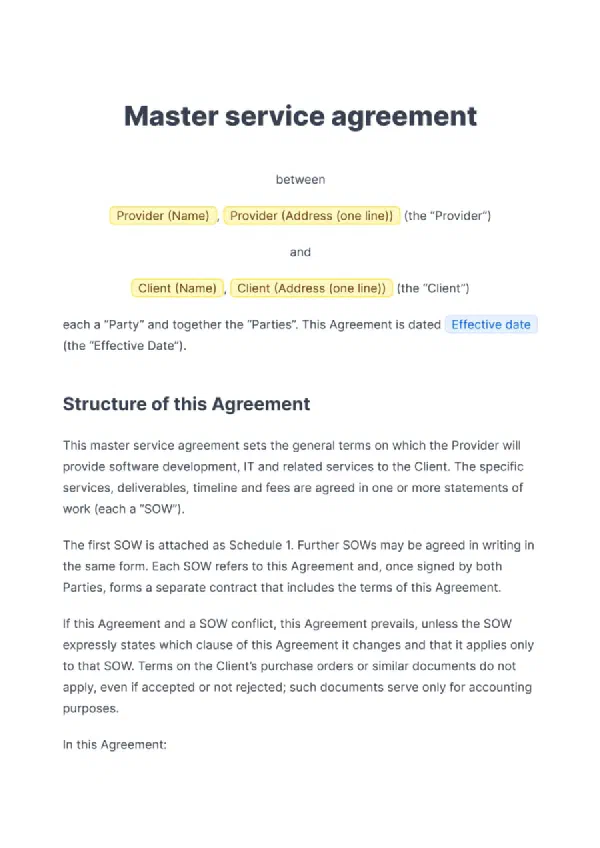 Master service agreement (MSA) template
The provider defends the client against third-party claims that a deliverable infringes their intellectual property and pays the damages finally awarded or agreed in an approved settlement.
Use the free template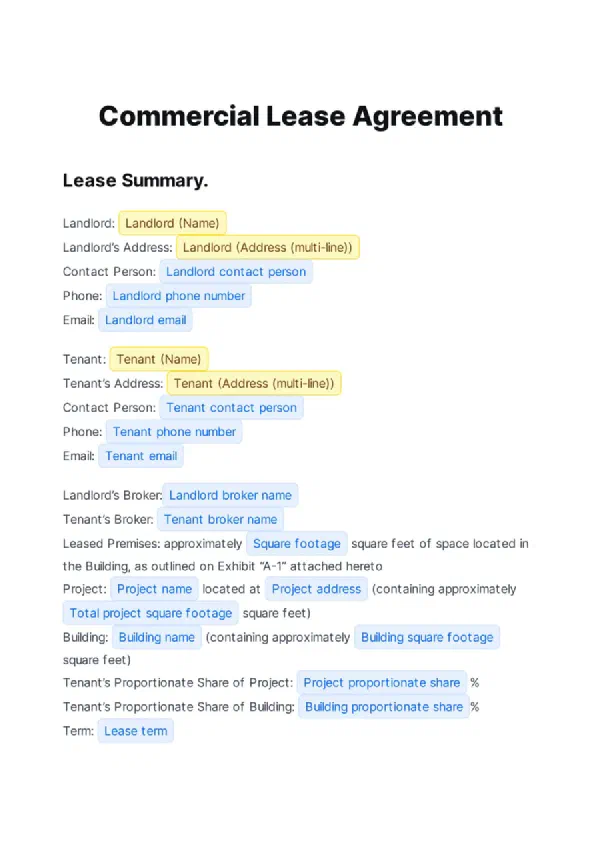 Commercial lease agreement template (office, retail and warehouse space)
The tenant must indemnify, defend and hold the landlord harmless from claims caused by a release of hazardous material.
Use the free template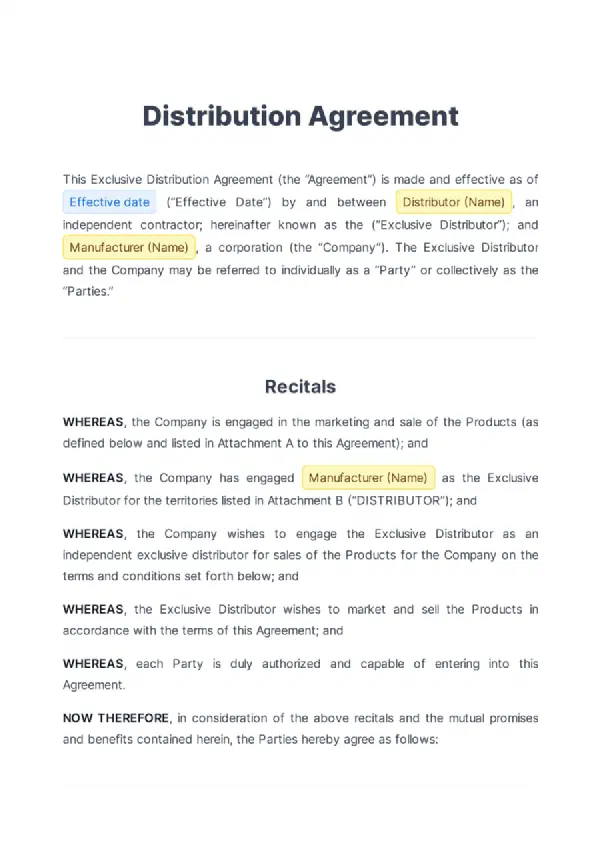 Exclusive distribution agreement template
The company indemnifies, defends and holds the distributor harmless from product liability claims caused by defective products.
Use the free template
Related clauses
- Indemnification and hold harmless The Indemnification and Hold Harmless clause requires one party to compensate the other party for any losses, damages, or liabilities arising from specific events or actions. It also ensures that the indemnified party is protected from any legal claims or damages related to the indemnifying party's actions or negligence.
- Indemnification for third party claims The indemnification for third-party claims clause obligates one party to compensate or defend the other party against claims, damages, or liabilities brought by third parties arising from the indemnifying party's actions or omissions. This clause is designed to allocate risk and provide financial protection to one party if legal issues or disputes with third parties arise during the contract's performance.
- Intellectual property indemnification Intellectual property indemnification is a contractual provision where one party agrees to compensate the other for any losses or damages arising from third-party claims of intellectual property infringement. This clause aims to protect the indemnified party from legal liabilities related to the use, production, or distribution of potentially infringing intellectual property.
- Mutual indemnification A mutual indemnification clause is a two-way promise in which each party agrees to cover the other's losses caused by its own breach, negligence or other listed events. It balances risk, as opposed to a one-way indemnity in which only one side protects the other.
- Indemnifying party The indemnifying party clause outlines the obligations of one party to compensate or reimburse the other party for certain costs or damages incurred. This clause ensures that the indemnifying party takes financial responsibility for any specified liabilities, such as legal claims or losses, arising during the execution of the contract.
- Waiver of subrogation A waiver of subrogation is a contractual provision whereby one party agrees to relinquish their right to seek compensation from a third party for losses covered by insurance. This clause is often used to prevent insurers from pursuing subrogation claims against other parties involved in the contract, promoting a smoother resolution of potential disputes.
Frequently asked questions
An obligation to provide and pay for the legal defense of another party when a third party makes a claim against it. It starts when the claim is made, not when liability is decided.
The duty to defend covers the cost of fighting the claim and starts right away. The duty to indemnify covers the loss itself, such as a judgment or settlement, and depends on the outcome. The duty to defend is broader.
In a contract, the clause decides; usually it runs until the claim is settled or finally decided. In insurance, standard policies end it once the policy limit has been used up paying judgments or settlements.
Not always. Whether defense costs are covered, and when they must be paid, depends on the wording and the governing law. To make it clear, write “defend, indemnify and hold harmless” and describe the defense procedure.
Usually the party that owes the defense, often subject to the other party's approval. If their interests conflict, contracts commonly let the protected party hire its own lawyer at the other side's cost.
More clauses from the library
See allDuty to mitigate damages
The duty to mitigate damages clause requires a party who has suffered a loss or injury to take reasonable steps to minimize the financial impact of that loss. Failure to mitigate can reduce the amount of compensation recoverable from the other party responsible for the breach or harm.
14 example clauses
Early termination of services
The early termination of services clause outlines the conditions under which parties can end their contractual agreement before the originally agreed-upon end date. It typically includes stipulations regarding notice periods, potential penalties or fees, and any rights or obligations that survive termination.
13 example clauses
Early termination right
An early termination right clause allows one or both parties to terminate the contract before the agreed end date under specified conditions, often involving notice periods and sometimes fees or penalties. This clause provides flexibility to adapt to changing circumstances but can also introduce uncertainty regarding the contract's duration.
8 example clauses
Analyze your contracts. Extract important clauses.
Try our AI contract analysis and extract important clauses and information from existing contracts.
Save your favourite clauses
Insert directly with a single click
Upload preferred precedents