
Insurance clause
An insurance clause requires a party to carry specific insurance while the contract runs, with minimum limits, and to prove it with certificates of insurance. It usually names the other party as an additional insured and makes sure there is money behind the indemnity.
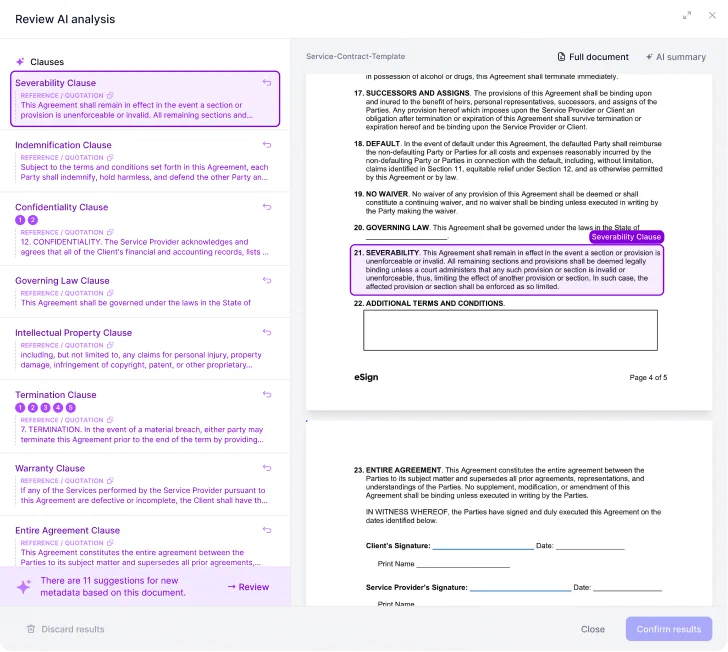
Analyze your contracts. Extract important clauses.
Try our AI contract analysis and extract important clauses and information from existing contracts.
Save your favourite clauses
Insert directly with a single click
Upload preferred precedents
Sample Insurance clause clauses
Source
Cardlytics, Inc. (CDLX)(b) Upon JPMC’s request, Supplier shall provide Certificates of Insurance certifying compliance with the above required insurance. Certificates of Insurance will include a copy of the insurance policy endorsements or policy provisions providing the following: (i) JPMC has been included as an additional insured where required, (ii) subrogation is waived where required; (iii) Supplier’s insurance is primary, and all insurance maintained by JPMorgan Chase & Co. is excess and secondary and shall not contribute with Supplier’s insurance; and (iv) all insurance will not be canceled or substantially changed without 30 days’ prior notice to JPMC.
11.4 Insurance. LICENSEE shall obtain and carry in full force and effect, or shall provide through self-insurance, commercial general liability insurance, including product liability and errors and omissions insurance, which shall protect LICENSEE and Indemnitees with respect to events covered by Section 11.1 above. Such insurance (i) shall list LICENSOR as an additional insured thereunder, (ii) shall be endorsed to include product liability coverage, and (iii) shall require [] written notice to be given to LICENSOR prior to any cancellation or material change thereof. The limits of such insurance shall be consistent with limits as are customary in the U.S. pharmaceutical industry for the activities to be conducted by LICENSEE under this Agreement. LICENSEE shall provide LICENSOR with Certificates of Insurance evidencing compliance with this Section. LICENSEE shall continue to maintain such insurance or self-insurance after the expiration or termination of this Agreement during any period in which LICENSEE or any SUBLICENSEE continues to make, use, or Sell a product that was a Licensed Product under this Agreement, and thereafter for a period of [].
Section 6.04 NCS Insurance Requirements.
(a) NCS will, at its own cost, obtain, and maintain in force, throughout the Term, and for an additional one (1) year following any termination of this Agreement, the policies of insurance currently included on NCS’s Certificate of Liability Insurance which is provided to and approved by Customer and attached hereto as Appendix D. NCS agrees to provide copies of all policies captioned on the approved Certificate of Liability Insurance and all endorsements mutually agreed to by the parties. NCS agrees to obtain product recall liability insurance and errors & omissions insurance as mutually agreed to be the parties. To the extent Customer requests any other additional coverages or policies, NCS agrees to procure such policies and any requested endorsements (to the extent that such policies and requested endorsements are commercially available through insurance markets accessible to USI International Services, LLC). Customer agrees to be responsible for any documented out of pocket costs for such additional insurance and NCS shall include such costs in its overhead calculations. To the extent a requested policy is used for other customers of NCS, in addition to Customer, NCS shall include Customer’s pro-rata share of such costs in its overhead calculations.
(b) Customer’s approval of the existence of NCS’s insurance policies does not relieve or limit any of NCS’s obligations under this Agreement.
15.13 NCC Group shall, at its sole cost and expense, throughout the term of this Agreement, procure and maintain in full force and effect, the following insurance coverage with an insurance carrier that is rated B+ or better by A.M. Best. NCC Group shall provide licensor and all licensees hereunder with a certificate of insurance evidencing such coverage. All certificates of insurance shall require that licensor and licensee be provided with no less than thirty (30) days advance written notice of cancellation of the staled coverage, and NCC Group shall request that its insurer use its best efforts to provide at least thirty (30) days advance written notification of such cancellation.
7.05 Insurance. Borrower shall maintain fire and other risk insurance, public liability insurance, flood insurance and earthquake insurance as provided in Paragraph 1.04 (I) of the Deed of Trust and such other insurance as Lender may require with respect to the Real and Personal Property and its operations, in form, amounts, coverages and with insurance companies reasonably acceptable to Lender. Borrower, upon request of Lender, will deliver to Lender from time to time the policies or certificates of insurance in form satisfactory to Lender, including stipulations that coverages will not be canceled or diminished without at least ten (10) days’ prior written notice to Lender. Each insurance policy also shall include an endorsement providing that coverage in favor or Lender will not be impaired in any way by any act, omission or default of Borrower or any other person. In connection with all policies covering assets in which Lender holds or is offered a security interest for the Loans, Borrower will provide Lender with such loss payable or other endorsements as Lender may require. Borrower shall promptly notice the Lender in the event that a policy of insurance described in the Section 6.05 is terminated or Borrower changes insurance carriers.
Source
STONERIDGE INC (SRI)Section 4. Insurance and Self Insurance. The Company shall not be required to maintain D&O Insurance in effect if and to the extent that such insurance is not reasonably available or if, in the reasonable business judgment of the Board of Directors, either (a) the premium cost of such insurance is disproportionate to the amount of coverage, or (b) the coverage provided by such insurance is so limited by exclusions that there is insufficient benefit from such insurance. To the extent the Company determines not to maintain D&O Insurance, the Company shall be deemed to be self-insured within the meaning of Section 1701.13(E)(7) of the Statute and shall, in addition to the Executive’s other rights hereunder, provide protection to the Executive similar to that which otherwise would have been available to the Executive under such insurance.
What is an insurance clause?
An insurance clause in a contract says which insurance a party must carry while the contract runs, and how it proves it. It lists the types of coverage, the minimum limits, who must be named on the policy, and what happens if the coverage lapses.
The point is simple: an indemnity or a promise to pay for damage is only worth what the other party can actually pay. Insurance puts money behind the promise.
Example: a facilities company signs a cleaning contract with an office landlord. The insurance clause requires the cleaner to carry general liability insurance of at least $1,000,000 per occurrence, add the landlord as an additional insured, and send a certificate of insurance before starting work. If a cleaner’s mop bucket causes a visitor to slip, the cleaner’s insurer pays, not the landlord’s.
The term also has a second meaning: a provision inside an insurance policy, such as an appraisal or other-insurance clause. This page covers insurance clauses in commercial contracts.
What an insurance clause covers
- The types of insurance. Which policies the party must hold. See the table below.
- Minimum limits. Per occurrence or per claim, and in total per year (the aggregate).
- Additional insured status. The other party is added to the policy, so it can claim under it directly for claims arising from the work. See additional insured.
- Primary and non-contributory. The insuring party’s policy pays first, without asking the other party’s insurer to share the cost.
- Waiver of subrogation. The insurer gives up its right to recover what it paid from the other party.
- Insurer quality. A minimum financial rating for the insurer, for example from A.M. Best.
- Proof. Certificates of insurance before work starts and at each renewal, often with copies of the endorsements.
- Notice of cancellation. Advance written notice, often 30 days, if a policy is cancelled or reduced.
- Duration. The whole term, and for claims-made policies a set period after the end.
- Deductibles and subcontractors. Who pays the deductible, and whether subcontractors must carry the same insurance.
Types of insurance commonly required
| Insurance | What it covers | Typically required from |
|---|---|---|
| Commercial general liability (CGL) | Injury to people and damage to property caused by the business | Contractors, service providers on site, tenants, suppliers |
| Professional liability (errors and omissions) | Financial loss caused by mistakes in professional services | Consultants, agencies, software and IT providers |
| Cyber liability | Data breaches, network security failures, privacy claims | Providers that handle personal data or customer systems |
| Workers’ compensation and employer’s liability | Injuries to the party’s own employees | Anyone sending staff to the other party’s premises |
| Commercial auto | Accidents with vehicles used for the work | Delivery, logistics and field service providers |
| Product liability | Injury or damage caused by a product | Manufacturers, distributors, licensees |
| Property insurance | Damage to buildings, equipment or goods | Tenants, borrowers, equipment lessees |
| Umbrella or excess liability | Higher limits on top of the other liability policies | Larger or riskier contracts |
The limits depend on the risk. A cleaning contract and a data center outsourcing deal need very different numbers, so ask your broker what is usual for the work.
Insurance clause vs. indemnity clause
The two work together, but they are not the same.
| Insurance clause | Indemnity clause | |
|---|---|---|
| What it is | A promise to buy and keep insurance | A promise to pay for certain losses |
| Who pays a claim | The insurer, up to the policy limits | The indemnifying party, from its own money |
| Limits | The policy limits and exclusions | Whatever the contract says, often capped |
| Why you need both | Insurance funds the indemnity | The indemnity decides who carries the loss |
Check that they match. If the contract makes the supplier indemnify you for data breaches but only requires general liability insurance, the indemnity has no insurance behind it, because standard general liability policies largely exclude data breach claims. Some contracts tie the two together the other way round, capping the indemnity at the amount of insurance a party has to carry.
Certificates of insurance: what they prove and what they don’t
A certificate of insurance (COI) is a one-page summary of a party’s policies, in the US usually on the ACORD 25 form. It is the standard proof that the required insurance exists.
But a certificate is information only. It does not change the policy and gives the holder no rights of its own. Listing a company as “additional insured” on the certificate is not enough: the policy itself has to carry an additional insured endorsement. The same goes for primary and non-contributory wording and waivers of subrogation. If these matter to you, ask for copies of the endorsements, as one of the sample clauses above does.
Claims-made policies and tail coverage
Professional liability and cyber policies are usually written on a claims-made basis: they cover claims made while the policy is in force. A mistake made during the contract but discovered a year after it ends would be uncovered if the policy has lapsed by then.
Contracts deal with this in one of two ways: the provider keeps the policy in force for a set period after the contract ends, often two or three years, or buys an extended reporting period, also called tail coverage. Some clauses also require the policy’s retroactive date to fall on or before the start of the contract.
How to review an insurance clause
If you are the one who must carry the insurance:
- Check the requirements against your actual policies with your broker before signing. Endorsements cost time and sometimes money.
- Push back on limits and policy types that do not fit the work, such as cyber insurance for a contract with no data.
- Ask for “commercially reasonable” or “customary” wording where exact limits are hard to meet.
- Watch the duration. Keeping a policy for years after the contract ends has a cost.
If you are the one being protected:
- Match the insurance to the indemnity, risk by risk.
- Ask for endorsements, not only certificates, for additional insured status, primary and non-contributory and waivers of subrogation.
- Require notice of cancellation and a right to buy the insurance at the other party’s cost if it lapses.
- Make clear that insurance does not limit liability, so the policy limits are not read as a cap.
Insurance clause example
Sample clause: Insurance
Add this clause to a contract, send it and get it signed in fynk.
Use it in fynk for freeKeeping certificates up to date
Certificates expire every year, and an expired one is easy to miss when you work with dozens of suppliers. In fynk, the certificate goes on the supplier contract as a related file, and its expiry date is tracked with dates and renewals, which notifies the contract owner before it runs out. The contract calendar shows the upcoming expiries for all suppliers in one view, so you can ask for the new certificate before the old one lapses.
Which contracts include an insurance clause?
Construction and subcontracting agreements, commercial leases, service and consulting agreements, master service agreements, supply and distribution agreements, equipment leases, license agreements and loan agreements. These free templates include one:
Free templates with this clause
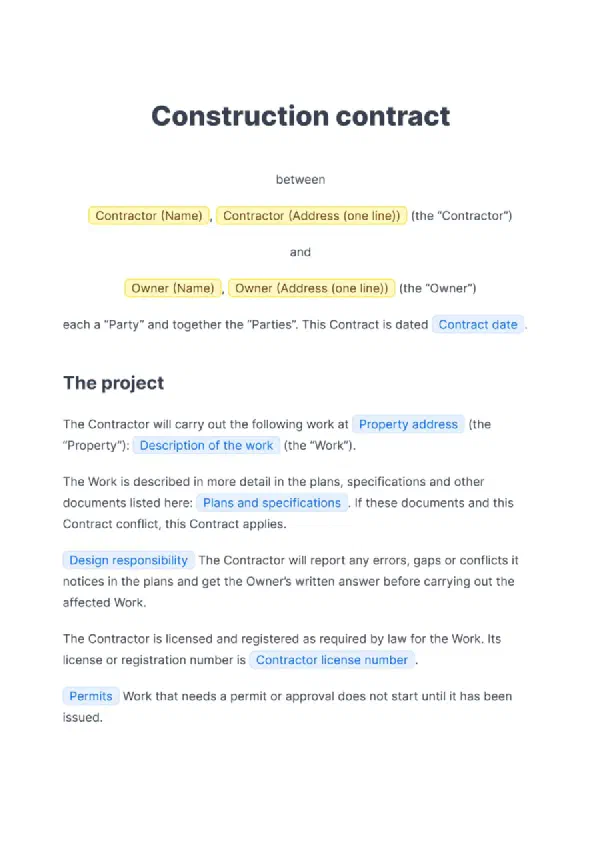 Construction contract template
The contractor holds general liability insurance of an agreed minimum and the workers' compensation insurance the law requires, and shows proof before work starts.
Use the free template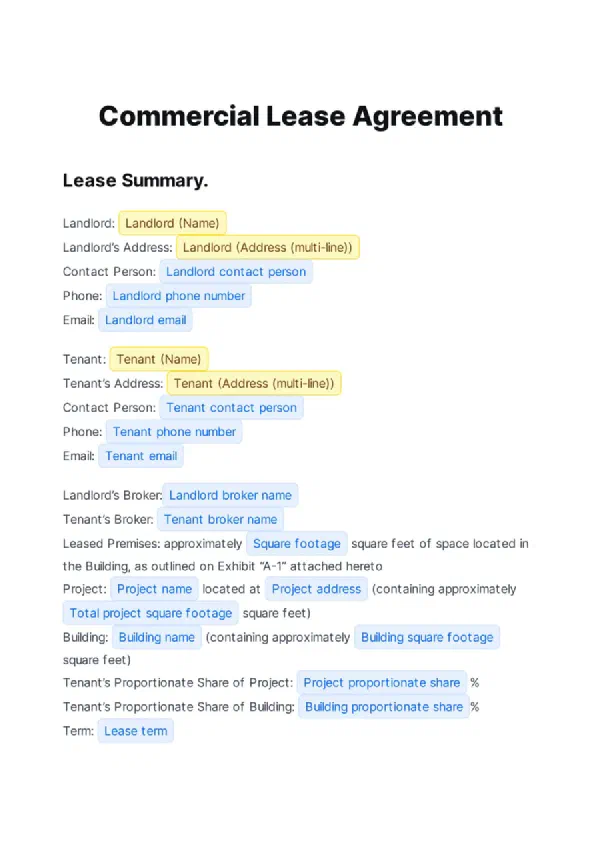 Commercial lease agreement template (office, retail and warehouse space)
The tenant insures the landlord, its manager and its lender, as well as itself, against property damage and personal injury claims.
Use the free template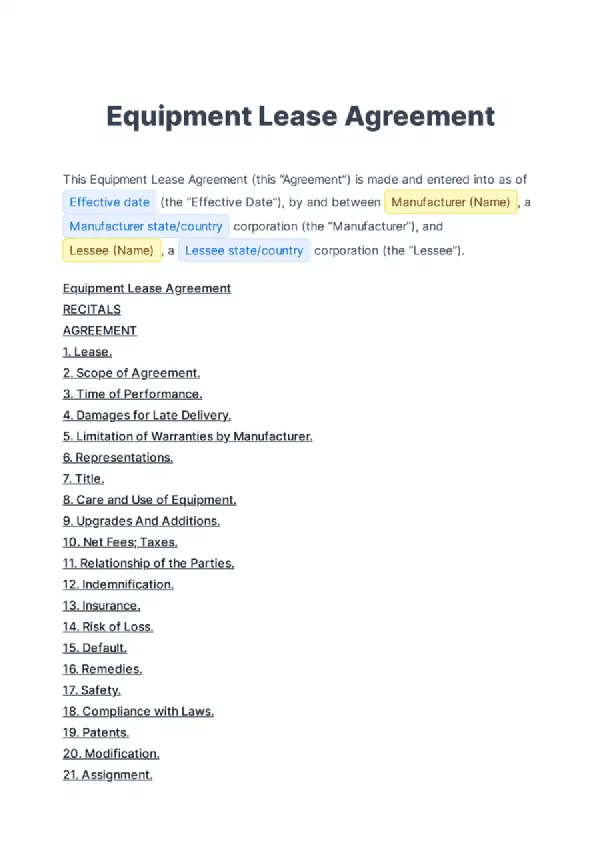 Equipment lease agreement template
The lessee insures or self-insures the equipment against loss, theft and damage, and carries liability insurance for the term.
Use the free template
Related clauses
- Additional insured An "additional insured" clause in an insurance policy extends coverage to other individuals or entities not originally named in the policy, typically providing them with the same protection as the primary insured. This clause is commonly used in business contracts to protect partners, landlords, or clients from potential claims related to the policyholder's actions or services.
- Waiver of subrogation A waiver of subrogation is a contractual provision whereby one party agrees to relinquish their right to seek compensation from a third party for losses covered by insurance. This clause is often used to prevent insurers from pursuing subrogation claims against other parties involved in the contract, promoting a smoother resolution of potential disputes.
- Mutual waiver of subrogation A mutual waiver of subrogation is a provision in a contract where both parties agree to waive their rights to seek compensation from each other for losses covered by insurance. This clause is typically included to prevent litigation and ensure that claims are handled solely by the insurance providers, minimizing conflict between the contractual parties.
- Duty to defend A duty to defend is an obligation to provide and pay for the legal defense of another party when a third party makes a claim against it. It starts when the claim is made, before anyone knows who is at fault, which makes it broader than the duty to indemnify. It appears in contract indemnities and in liability insurance.
- Indemnification and hold harmless The Indemnification and Hold Harmless clause requires one party to compensate the other party for any losses, damages, or liabilities arising from specific events or actions. It also ensures that the indemnified party is protected from any legal claims or damages related to the indemnifying party's actions or negligence.
- Subrogation Subrogation is a contractual clause that allows one party, typically an insurer, to assume the legal rights of another party, the insured, to pursue recovery from third parties responsible for a loss after compensation has been provided. This enables the insurer to seek reimbursement for claims paid out by holding the responsible third party accountable.
Frequently asked questions
A provision that requires a party to carry specific insurance during the contract, with minimum limits, and to prove it with certificates of insurance. It often also requires naming the other party as an additional insured.
It depends on the work. General liability is the baseline. Add professional liability for advice or services, cyber liability for vendors that handle data, workers' compensation for staff on your premises and auto liability for vehicles.
A certificate holder only receives the certificate as information. An additional insured is added to the policy by endorsement and can claim under it. Being listed on a certificate does not make you an additional insured.
The insuring party's policy pays first, and it cannot ask the other party's insurer to share the cost. Like additional insured status, it has to be in the policy through an endorsement.
Not unless the contract says so. Well-drafted clauses state that the required insurance does not limit the party's liability, so it remains liable above the policy limits.
More clauses from the library
See allInsuring agreement
An insuring agreement is a fundamental component of an insurance policy that outlines the scope of coverage provided by the insurer, including the types of risks or perils that are covered, the parties involved, and the conditions under which a claim can be made. It serves as the foundation of the policy, detailing the insurer's obligation to indemnify the policyholder for losses incurred from specified events.
9 example clauses
Integration clause
An integration clause, also known as a merger clause, ensures that the written contract represents the complete and final agreement between the parties by superseding all prior negotiations, discussions, or agreements, whether written or oral. This clause prevents any party from claiming that external statements or documents should be considered part of the agreement, thus providing clarity and reducing potential disputes.
22 example clauses
Intellectual property indemnification
Intellectual property indemnification is a contractual provision where one party agrees to compensate the other for any losses or damages arising from third-party claims of intellectual property infringement. This clause aims to protect the indemnified party from legal liabilities related to the use, production, or distribution of potentially infringing intellectual property.
7 example clauses
Analyze your contracts. Extract important clauses.
Try our AI contract analysis and extract important clauses and information from existing contracts.
Save your favourite clauses
Insert directly with a single click
Upload preferred precedents