
Holdback
A holdback is part of a payment that the payer keeps back for a period, as security for claims, adjustments or unfinished work, and releases once agreed conditions are met.
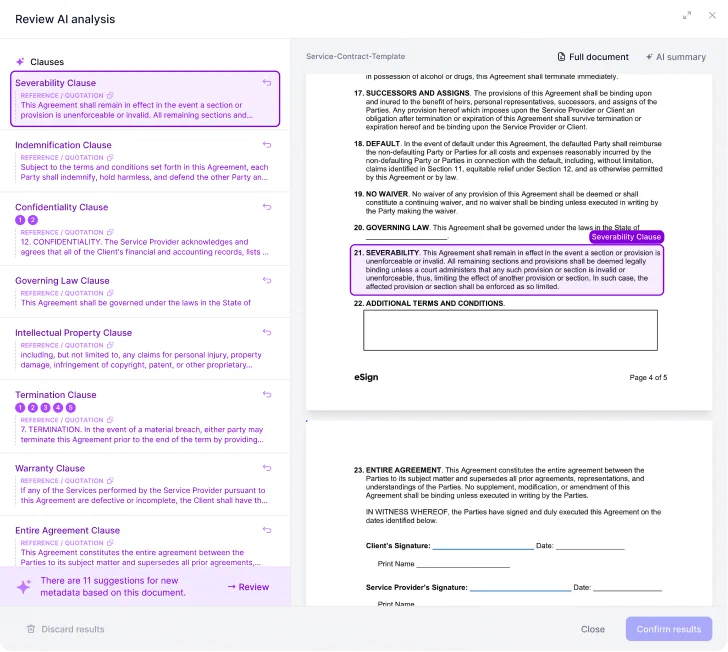
Analyze your contracts. Extract important clauses.
Try our AI contract analysis and extract important clauses and information from existing contracts.
Save your favourite clauses
Insert directly with a single click
Upload preferred precedents
Sample Holdback clauses
2.2 Holdback. Lantheus will be permitted to hold back from the Upfront Payment and retain an amount in cash equal to the Holdback Amount. In the event that the Holdback Termination Event occurs, then Lantheus will pay to Perspective a one (1)-time payment in cash in U.S. Dollars equal to the Holdback Amount within five (5) Business Days of the Holdback Termination Event, subject to prior receipt of wire transfer instructions from Perspective. If the Asset Sale Closing occurs, then Lantheus will be entitled to permanently retain the Holdback Amount and Perspective agrees that it will have no further claim whatsoever to any portion of the Holdback Amount.
The Company maintains an indemnity and adjustment holdback for the purposes of providing security against any adjustment to the amounts at closing. The indemnity holdback period extends for 18 months from the anniversary of the closing date. The indemnity holdback will be settled by transferring up to 128,351 shares of the Company’s stock, 15,304 options of the Company’s common stock and an immaterial amount of cash. The fair value of the indemnity holdback was $12.5 million as of the acquisition date. The adjustment holdback will be settled by transferring up to 3,416 shares of the Company’s stock, 408 options of the Company’s common stock and an immaterial amount of cash. The holdback adjustment liability was $0.3 million as of the acquisition date.
Source
KonaTel, Inc. (KTEL)Release of Holdback Amount. Notwithstanding the terms of Section 1.8 (a) or any other provisions of the Purchase Agreement to the contrary, Buyer agrees and consents to pay or credit to the account of KonaTel $700,000.00 of the Holdback Amount to Seller subject to KonaTel exercising best efforts to cause the FCC to reactivate the Company’s APIs, which will be paid or credited upon the full execution and delivery of this Amendment, together with those amendments to the Transaction Documents dated on or around the Amendment Effective Date, and the submission of such documents to the FCC.
(v) Disbursement of Holdback Amount. Holdback Servicer shall fail to disburse any Holdback Amount in accordance with the related Mortgage Loan Documents and such failure continues for [***] or such shorter period as required under the Mortgage Loan Documents. Notwithstanding anything herein to the contrary, in no event shall Buyer have any obligation to fund any Holdback Amount made to a Mortgagor with respect to any MortgageRTL Loan, which obligations shall be retained by Seller and Holdback Servicer.
What is a holdback?
A holdback is a portion of a payment that is kept back instead of paid at closing or on completion. It is released later, in full or after deductions, once agreed conditions are met: no indemnity claims have been made, repairs have been finished, a regulator has approved something, or a working capital figure has been confirmed.
The payer either keeps the money itself or deposits it with a neutral escrow agent. In both cases the holdback gives the payer security without having to sue for money already paid.
Example: a buyer acquires a software company for $20 million. The purchase agreement holds back $2 million for 18 months as security for breaches of the seller’s warranties. A year after closing, the buyer finds an undisclosed tax liability of $300,000 and deducts it from the holdback. At 18 months, the remaining $1.7 million is released to the sellers.
Common types of holdback
| Type | Purpose | Typical release |
|---|---|---|
| Indemnity holdback (M&A) | Security for warranty and indemnity claims | 12 to 24 months after closing, minus pending claims |
| Adjustment holdback (M&A) | Covers post-closing price adjustments, such as working capital | After the closing accounts are agreed |
| Special or specific holdback | A known risk, such as a lawsuit, tax issue or environmental matter | When that matter is resolved |
| Escrow holdback for repairs | Funds for repairs not finished before a home or property closing | When the repairs are completed and inspected |
| Construction holdback (retainage) | Security for completion and defects, and in some systems for subcontractors’ lien rights | Substantial or final completion |
| Lender holdback | Part of a loan held back until renovations or conditions are met | On completion of milestones |
Two other uses share the name but are not payments. In securities offerings, a “holdback agreement” is a lock-up in which shareholders agree not to sell shares for a period around an offering. In film and media licensing, a “holdback period” is a window during which rights cannot be exploited in another channel.
Holdback vs. escrow
The terms overlap, and a holdback is often placed in escrow. The difference is who holds the money:
- Holdback kept by the buyer: cheaper and simpler, but the seller carries the risk that the buyer will not release the money or becomes insolvent.
- Escrow held by a third party: the escrow agent pays out only on joint instructions or a final decision, which protects the seller, at the cost of fees and an escrow agreement.
Holdback vs. earnout
A holdback is part of a fixed price that is paid later. An earnout is additional price that is only paid if the business hits future targets. Holdbacks protect the buyer against problems; earnouts bridge a gap in valuation.
What a holdback clause should cover
- The amount, as a dollar figure or a percentage of the price.
- Who holds it: the buyer or an escrow agent, and in what account.
- What it secures: all indemnity claims, specific risks, adjustments, or completion.
- The release dates, including partial releases.
- How claims are made and how much is retained for pending claims at release.
- Interest: who receives interest earned on the funds.
- Whether it is the exclusive remedy, or claims above the holdback can still be pursued.
- Form: cash or shares. One sample settles its holdback partly in the buyer’s shares.
How to negotiate a holdback
If you are the seller:
- Keep the amount proportionate, often a modest percentage of the price.
- Prefer an escrow over a buyer-held holdback.
- Ask for staged releases, for example half at 12 months.
- Limit retention for pending claims to claims made in good faith with reasonable detail.
If you are the buyer:
- Size the holdback to the real risks found in due diligence.
- Add specific holdbacks for known issues.
- Make the holdback a source, not a cap, for indemnity claims.
Holdback clause example
Sample clause: Indemnity holdback
Add this clause to a contract, send it and get it signed in fynk.
Use it in fynk for freeNot missing a release date
Holdback release dates fall a year or more after closing, when the deal team has moved on. With tasks and reminders in fynk, the release dates and claim deadlines in a purchase agreement come with reminders for the right people, so claims are filed in time and released funds are actually requested.
Which contracts include a holdback?
Share and asset purchase agreements, merger agreements, escrow agreements, construction contracts, real estate purchase agreements and repair escrow addenda, renovation loans, registration rights agreements (as a lock-up), and film and media license agreements (as a holdback period). These free templates include one:
Free templates with this clause
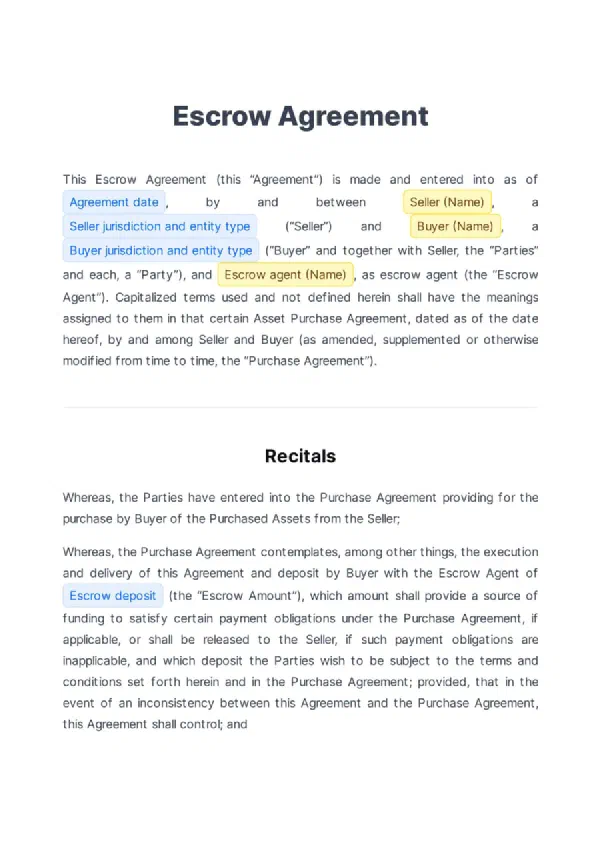 Escrow agreement template (asset purchase transaction)
The buyer deposits an escrow amount that funds certain payment obligations under the purchase agreement or is released to the seller.
Use the free template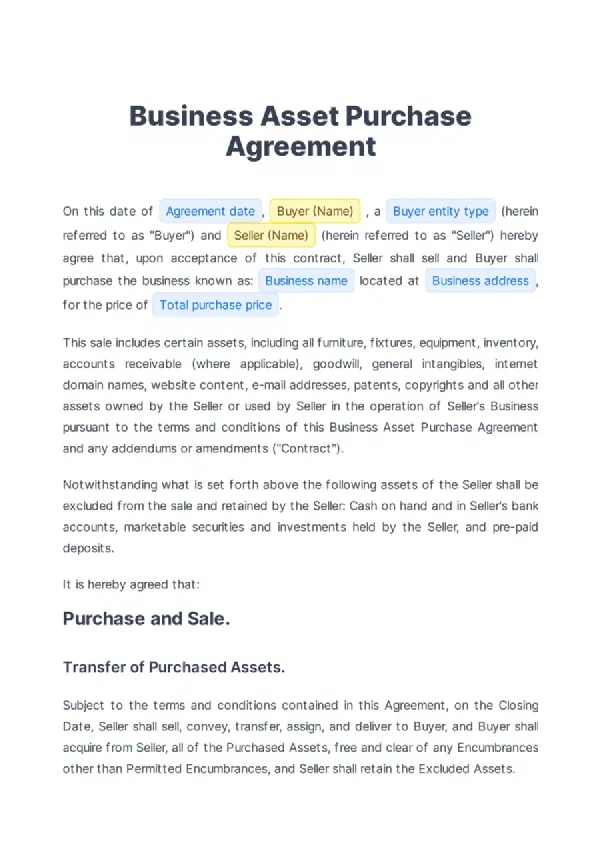 Business asset purchase agreement template
Indemnity claims are paid first from the indemnity escrow fund, and then from the buyer's insurance policy.
Use the free template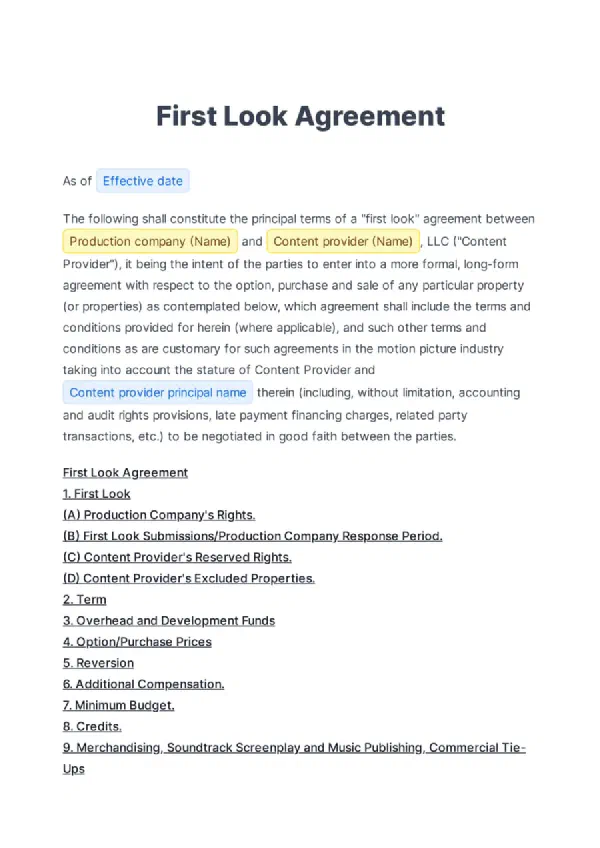 First look agreement template
Any deal with a third party for the TV rights must respect a holdback period on exploiting those rights.
Use the free template
Related clauses
- Escrow An escrow clause in a contract specifies that certain assets, funds, or documents will be held by a neutral third party until specific conditions of the contract are fulfilled. This ensures that each party complies with the agreed-upon terms, providing security and trust for both parties involved.
- Retainage Retainage is a common contract clause in construction agreements where a portion of the payment is withheld by the client until the project is completed to their satisfaction. This practice ensures that contractors have an incentive to finish the work properly and address any deficiencies before receiving the final payment.
- Earnout An earnout clause is a contractual provision typically used in business acquisitions, where part of the purchase price is contingent on the future performance of the acquired business. This clause aims to bridge valuation gaps by aligning the seller's compensation with the business's success post-acquisition, often based on specific financial targets or milestones.
- Escrow instructions Escrow instructions refer to the specific guidelines and conditions set by the parties involved in a transaction, which govern the management and disbursement of funds or documents held by an escrow agent until all obligations and contingencies in the transaction are met. These instructions ensure that the transaction is handled securely and accurately, protecting the interests of all parties involved.
- Indemnification and hold harmless The Indemnification and Hold Harmless clause requires one party to compensate the other party for any losses, damages, or liabilities arising from specific events or actions. It also ensures that the indemnified party is protected from any legal claims or damages related to the indemnifying party's actions or negligence.
- Indemnity An indemnity clause is a contractual provision where one party agrees to compensate the other for certain costs and liabilities that may arise due to specified events or actions. This clause is designed to allocate risk by holding one party responsible for losses incurred by the other, providing financial protection in situations such as breaches of contract, negligence, or legal claims.
Frequently asked questions
A part of the purchase price the buyer keeps back, or places in escrow, for a set period as security for indemnity claims or price adjustments, and then releases to the seller.
Money kept in escrow at closing until a condition is met, often to pay for repairs that could not be finished before a property sale or loan closed.
It depends on the deal and the risks. In M&A it is often a modest percentage of the purchase price; for repairs it is usually the estimated repair cost plus a margin.
Retainage is the construction version: a percentage of each progress payment held back until completion. Holdback is the broader term used in M&A, real estate and lending.
A lock-up: shareholders agree not to sell their shares for a period before and after an offering, so the market is not flooded with shares.
More clauses from the library
See allHoldover
A holdover clause in a contract specifies the conditions and obligations of the parties if a tenant or lessee continues to occupy the property beyond the expiration of the lease term. It typically outlines the changes in rental terms, such as an increase in rent, and the landlord's rights and remedies during the holdover period.
12 example clauses
Hsse standards
HSSE (Health, Safety, Security, and Environmental) standards are contractual clauses that set out the specific requirements and practices that parties must adhere to in order to ensure a safe, secure, and environmentally responsible working environment. These standards are designed to mitigate risks, protect personnel and assets, and ensure compliance with relevant laws and regulations.
2 example clauses
Icc arbitration
The ICC arbitration clause refers to an agreement between parties to resolve their disputes through arbitration under the rules of the International Chamber of Commerce (ICC). This clause specifies that any disagreements will be handled by an impartial tribunal, ensuring a binding and enforceable resolution while providing a streamlined alternative to court litigation.
21 example clauses
Analyze your contracts. Extract important clauses.
Try our AI contract analysis and extract important clauses and information from existing contracts.
Save your favourite clauses
Insert directly with a single click
Upload preferred precedents