
Grandfather clause
A grandfather clause lets people, contracts or situations that existed before a new rule keep the old rules. Contracts use it to protect existing customers, benefits and deals when terms change.
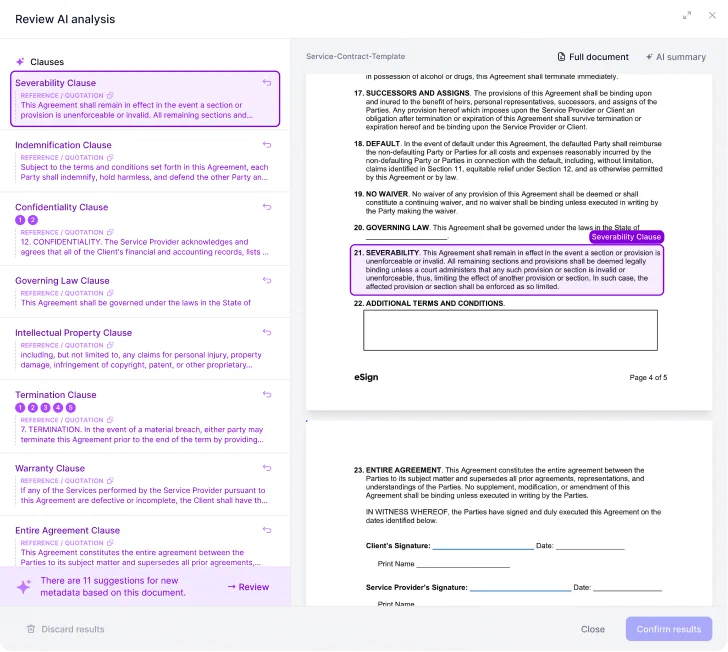
Analyze your contracts. Extract important clauses.
Try our AI contract analysis and extract important clauses and information from existing contracts.
Save your favourite clauses
Insert directly with a single click
Upload preferred precedents
Sample Grandfather clause clauses
1.2. Sales Process Protocol. Subject to the terms and conditions of this Agreement, SRDSP will have the sole right to demonstrate, sell, and distribute the Products and perform the installation and maintenance Services within the Territory during the Term of this Agreement. Hydro Phi will only sell and distribute the products in this Territory through the SRDSP during the term of this agreement. There are certain end users and clients that are granted as exclusive to: (a) HPTI corporate (b) Other SRDSP’s (c) Business Development Associates (d) HPTI suppliers & partners These exclusives are shown in Exhibit “C”; these potential exclusive clients have already engaged the assignees at high-level business discussions and fall under the grandfather clause described in article 3.6.E. SRDSP may select and appoint sub-distributors, dealers, and/or service providers within the Territory to perform specific activities related to the Products. No such selection or appointment will be valid, authorized or permitted without the prior written approval of Hydro Phi. The approval process shall be expedited in manner as to not impede business opportunities and shall have justifiable cause to be denied. All sub-distributors, dealers, service providers and local representatives will be subject to the terms and conditions of this Agreement; upon signing of any such affiliates to support the SRDSP, if any license fees are charged according the fees waived as shown in Exhibit “A” or any other amounts, these fees shall be shared on a [REDACTED*] basis with Hydro Phi. Neither SRDSP nor any sub-distributor, dealer, service provider or representative will make any sales of Products or perform any Services outside the appointed and assigned Territory without the express prior written consent of Hydro Phi.
Grandfathered Benefit.
The Grandfathered Benefit provides a monthly amount equal to a participant’s years of continuous service through December 31, 2013 (not to exceed 30) multiplied by the sum of 0.65% of the portion of the participant’s Final Average Pay that is less than or equal to 1/12 of the participant’s covered compensation (as defined in the plan) (an amount specified by Social Security based on year of birth), plus 1.3% of the portion of the participant’s Final Average Pay in excess of 1/12 of the participant’s covered compensation. Final Average Pay means the highest average monthly salary and bonus (including, but not limited to, overtime, commissions, performance-based bonuses, employee referral bonuses, and amounts deferred under a nonqualified deferred compensation plan or under Code Sections 125, 401(k), and 132 plans) paid during the 60-consecutive calendar month period occurring within the 120 consecutive calendar months of service ending with the earlier of December 31, 2013 or the participant’s final completed calendar month of service, taking into account the applicable Code limits. For certain participants the Grandfathered Benefit had been periodically increased by a fixed amount, not exceeding the applicable IRS limit, which resulted in a corresponding decrease in the Excess Benefit Plan benefit.
The Great-West Life & Annuity Insurance Company Executive Deferred Compensation Plan (the “Grandfathered Plan”) was established effective as of January 1, 1993 for the benefit of a select group of management or highly compensated Eligible Individuals. Effective as of December 31, 2004, the Grandfathered Plan was frozen, and no further amounts were deferred under that plan as of such date. The terms of the Grandfathered Plan as of October 3, 2004 continue to govern the amount deferred under that plan as of December 31, 2004.
Source
Speed Commerce, Inc.- FATCA. Company and the Credit Parties do not believe that the amendments made pursuant to this Amendment shall be treated as a “significant modification” of the Loans under Treasury Regulation Section 1.1001-3 and as such the Loans should still constitute a grandfathered obligation for the purposes of FATCA. From and after the Second Amendment Effective Date, Company and the Credit Parties shall jointly and severally indemnify the Administrative Agent and Lenders, and hold them harmless from, any and all losses, claims, damages, liabilities and related expenses, including taxes and the fees, charges and disbursements of any counsel for any of the foregoing, arising in connection with the Administrative Agent’s and Lenders’ treating, for purposes of determining withholding Taxes imposed under FATCA, the Loans as modified hereby as qualifying as a “grandfathered obligation” within the meaning of Treasury Regulation Section 1.1471-2(b)(2)(i).
What is a grandfather clause?
A grandfather clause is a provision that exempts existing situations from a new rule. Whoever or whatever was there before a cutoff date keeps the old rules; everyone after follows the new ones. Something covered by it is “grandfathered” or “grandfathered in”.
Example: a software company raises its prices on July 1. Its new price list says customers who subscribed before that date keep their current price for as long as they renew without changing plan. Those customers are grandfathered; new customers pay the new price.
Where the term comes from
The term has a troubling origin. After the Fifteenth Amendment barred racial discrimination in voting, several Southern states adopted literacy tests, poll taxes and property requirements, starting with Louisiana in 1898. “Grandfather clauses” exempted men who had been entitled to vote before 1867, or whose fathers or grandfathers had been, from these requirements. Because almost no Black citizens could vote before 1867, the clauses kept the new hurdles for Black voters while letting white voters through. The US Supreme Court struck down Oklahoma’s grandfather clause in Guinn v. United States in 1915.
Today the phrase is used neutrally for any protection of existing situations, and many drafters prefer plainer wording such as “legacy”, “existing” or “transition” provisions.
Grandfather clauses in contracts
In contracts, grandfathering usually protects a position one party already has when the other party changes its terms:
- Pricing: existing customers keep their price, plan or features after a price increase, sometimes only until a set date.
- Benefits and compensation: benefits earned or deferred before a plan change stay under the old terms, as several sample clauses above show.
- Distribution and sales territories: customers a company already serves directly stay with it when it appoints an exclusive distributor, as in one of the samples.
- Policies and HOA rules: existing members, tenants or units may keep a use that a new rule prohibits, such as a pet or a rental.
- Amended agreements: orders, statements of work or loans in place before an amendment continue under the old terms.
Grandfather clauses in laws and regulations
Legislators use the same technique. Some well-known examples:
| Law | What was grandfathered |
|---|---|
| Federal Food, Drug, and Cosmetic Act (1938 and 1962) | Drugs already on the market were exempted from certain new approval requirements |
| Sarbanes-Oxley Act, section 402 (2002) | Company loans to executives that existed on July 30, 2002, if not materially modified or renewed |
| Tax Cuts and Jobs Act, section 162(m) changes (2017) | Pay under written binding contracts in effect on November 2, 2017, if not materially modified |
| Section 409A (2004) | Deferred compensation earned and vested before January 1, 2005 |
| Zoning ordinances | Existing buildings and uses that no longer meet new rules, known as legal nonconforming uses |
The trap: material modification
A pattern runs through almost every grandfather clause, in laws and in contracts: the protection lasts only as long as the old arrangement stays the same. Under Sarbanes-Oxley, section 162(m) and the FATCA withholding rules (in one sample, a lender’s loans), a material modification of a grandfathered contract ends its protection. One sample shows how carefully parties approach this: the borrower indemnifies the lenders if an amendment is treated as a significant modification after all.
Before amending, renewing or restating a grandfathered contract, check whether the change could cost it its status.
How to draft a grandfather clause
- Define the cutoff date and what must exist by then: a signed contract, an active subscription, a vested benefit.
- Define who or what is covered, ideally in a schedule or list.
- Say which old terms continue, and which new terms apply anyway.
- Set an end point, if any: a date, the next renewal, a change of plan, or a transfer.
- Say what ends the protection, such as a material change, an upgrade or a lapse in the subscription.
- Keep a record of the grandfathered items, since the question usually comes up years later.
Grandfather clause example
Sample clause: Existing customers
Add this clause to a contract, send it and get it signed in fynk.
Use it in fynk for freeKnowing which contracts are grandfathered
Grandfather clauses depend on a date that nobody remembers years later: when was this contract signed, and has it been changed since? With AI import in fynk, older agreements are imported with their key data extracted, including their dates, so you can find the contracts signed before a cutoff and check which still qualify for the old terms.
Which contracts include a grandfather clause?
Price lists and subscription terms, deferred compensation and benefit plans, distribution and sales representative agreements, franchise agreements, HOA declarations and leases, loan amendments, and amended master agreements with existing orders.
This free template grandfathers existing plans until renewal:
Free templates with this clause
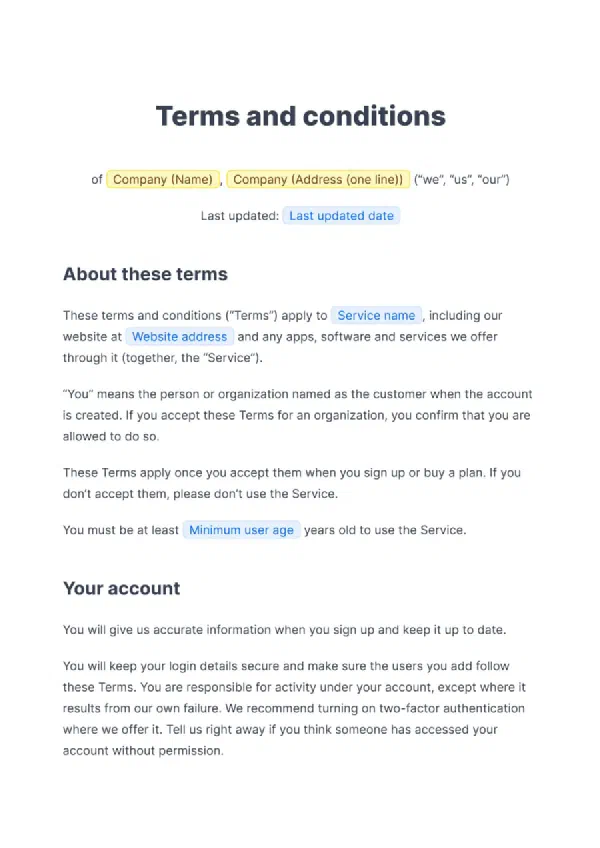 Terms and conditions template
Existing paid plans keep their current price until the next renewal, and the customer gets email notice and can cancel first.
Use the free template
Related clauses
- Price changes A price change clause sets whether, when and how a supplier may change its prices during a contract, usually with advance notice and sometimes a right for the customer to cancel. "Prices subject to change" is the short disclaimer version used on quotes, price lists and websites.
- Amendment An amendment clause outlines the procedures and requirements for making changes or modifications to an existing contract. It specifies how amendments can be proposed, agreed upon, and documented by the parties involved to ensure that all modifications are legally binding and enforceable.
- Contract amendment A contract amendment is a formal alteration to the terms of an existing contract, agreed upon by all parties involved. It allows changes to specific provisions without voiding the original contract, ensuring that the agreement remains relevant and effective in addressing the parties' needs.
- Most favored customer A "most favored customer" clause is a contractual provision ensuring that the customer receives terms as favorable as those granted to any other customer. This clause typically requires the seller to extend the same benefits or prices to the favored customer whenever offering better terms to others.
- Amended and restated agreement An amended and restated agreement is a revised version of an original contract that incorporates all previous amendments and modifications into a single, comprehensive document. This type of agreement clarifies the current terms and conditions, ensuring all parties have a clear understanding of their rights and obligations.
Frequently asked questions
That someone or something is exempt from a new rule because it existed before the rule took effect. A grandfathered customer, for example, keeps an old price.
Provisions in Southern state constitutions from 1898 onward that exempted men who could vote before 1867, or their descendants, from literacy tests and poll taxes. They kept Black citizens from voting and were struck down by the Supreme Court in 1915.
As long as the clause says. Some protect an existing situation indefinitely, others until a set date, a renewal or a change to the arrangement.
Yes. Many grandfather clauses end if the contract, plan or use is materially changed, transferred or interrupted, so check the conditions before amending anything.
A commitment that existing customers keep their current price after a price increase, either permanently or for a set period.
More clauses from the library
See allGrant of rights
The "Grant of Rights" clause specifies the permissions and entitlements that one party extends to another regarding the use of intellectual property or certain assets. It delineates the scope, duration, and limitations of these rights, ensuring both parties clearly understand how and to what extent the granted rights can be exercised.
10 example clauses
Guarantee
A guarantee clause in a contract assures one party that certain conditions or obligations will be fulfilled, offering a promise of performance or a backup remedy if the specified terms are not met. It often involves the guarantor providing financial security or taking responsibility to ensure the contract's commitments are upheld.
13 example clauses
Guaranteed maximum price
A Guaranteed Maximum Price (GMP) clause in a contract establishes a ceiling on the total cost that the owner will pay to the contractor, protecting the owner from cost overruns while incentivizing the contractor to manage costs efficiently. Any savings generated under the maximum price typically benefit the owner, though such clauses may include provisions for shared savings between parties.
17 example clauses
Analyze your contracts. Extract important clauses.
Try our AI contract analysis and extract important clauses and information from existing contracts.
Save your favourite clauses
Insert directly with a single click
Upload preferred precedents