
Move-in condition statement
A move-in condition statement records the state of a rental property on the day the tenant moves in, signed by landlord and tenant. It is the baseline for every deduction from the deposit at move-out. Residential landlords in some states can't keep a deposit without one; commercial leases usually replace it with an acceptance clause.
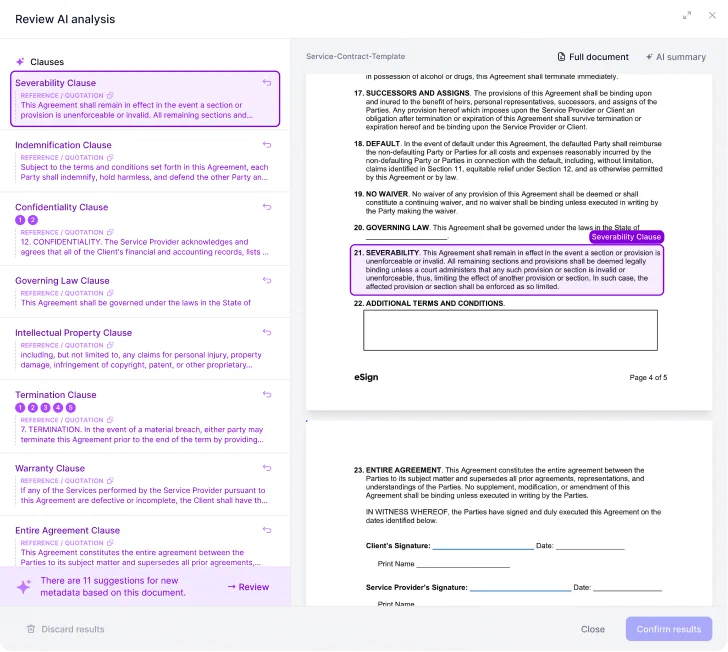
Analyze your contracts. Extract important clauses.
Try our AI contract analysis and extract important clauses and information from existing contracts.
Save your favourite clauses
Insert directly with a single click
Upload preferred precedents
Sample Move-in condition statement clauses
Source
FOCUS ENHANCEMENTS INCD. Acceptance of Premises. Tenant has inspected the Premises an I affirms that the Premises is acceptable in all respects in its current “as is” condition, except for latent defects that have been identified by Tenant and written notice of which has been provided to Landlord as provided in Section 3.B. of the Lease.
Source
PEGASYSTEMS INC (PEGA)(a) Tenant has inspected the Premises and agrees, except as otherwise expressly set forth herein (a) to accept possession of the Premises in the condition existing on the Effective Date in vacant, broom-clean condition, with all personal property and debris removed therefrom and in all other respects in its “as is,” “where is” condition, and (b) that except for Landlord’s Contribution, Landlord has no obligation to perform any work, supply any materials, incur any expense or make any alterations or improvements to prepare the Premises for Tenant’s occupancy. Any work to be performed by Tenant in connection with Tenant’s initial occupancy of the Premises shall be hereinafter referred to as the “Initial Installations.” All Initial Installations shall be considered to be “Alterations” and shall be performed in accordance with Article 5; provided that, notwithstanding anything else in this Lease to the contrary, this Section 4.1 below will govern with respect to the procedures for Landlord’s approval of the plans and specifications for the Initial Installations. Subject to the right of Tenant to dispute the accuracy of Landlord’s statement by giving notice thereof not later than ten (10) days after delivery of the following notice by Landlord, Landlord shall be deemed to have tendered possession of the Premises to Tenant upon the giving of notice by Landlord to Tenant stating that the Premises is vacant and in the condition required by this Lease.
Source
Cellteck Inc.Tenant accepts the Premises and Building in “AS IS -WHERE IS” condition without any representations or warranties from Landlord. Accordingly, Tenant hereby waives any implied or express warranties of habitability, suitability, merchantability, quality, condition or fitness for a particular purpose with respect to the Premises and Building. Tenant has inspected the Premises and Building to the degree it deemed necessary and desirable and is thoroughly familiar with its condition. Tenant hereby accepts the Premises and Building as being in good and satisfactory condition and suitable for their intended commercial purpose. THE PROVISIONS OF THIS SECTION 2(b) HAVE BEEN NEGOTIATED AND ARE INTENDED TO BE A COMPLETE EXCLUSION, NEGATION AND DISCLAIMER BY LANDLORD OF ANY AND ALL WARRANTIES BY LANDLORD, EXPRESS OR IMPLIED, WHETHER ARISING PURSUANT TO THE UNIFORM COMMERCIAL CODE OR ANOTHER LAW NOW OR HEREAFTER IN EFFECT OR OTHERWISE. Notwithstanding the foregoing, within thirty (30) days of the Lease Date Landlord shall provide Tenant with a certificate from a licensed contractor stating that the roof and HVAC system are in good working order. Should Landlord fail to do so, Landlord shall be obligated to repair the roof or HVAC system at its sole cost and expense.
Occupancy: 15. Tenant will not at any time use or occupy the Demised Premises in violation of the certificate of occupancy issued for the Building of which the Demised Premises are a part, it being understood and agreed that the use of the Premises for the permitted use will not violate the certificate of occupancy. Tenant has inspected the premises and accepts them as is, subject to the riders annexed hereto with respect to Owner’s work, if any, and subject to the provisions of this Lease (including the provisions that relate to Legal Requirements and Hazardous Substances) and subject to latent defects. Notwithstanding the foregoing, Owner represents that (i) there is a valid Certificate of Occupancy covering the Building, including the Demised Premises, which permits the Permitted Use in the Demised Premises (subject to the requirement that any new construction may require its own new certificate of occupancy or completion) and (ii) there are no violations of Legal Requirements affecting the Demised Premises as of the date hereof.
Why the statement matters
Every move-out dispute comes down to one question: was it like that when the tenant moved in? A signed move-in condition statement (also called a move-in checklist, inspection report or condition report) answers it. Without one, the landlord has a hard time proving the tenant caused the damage, and the tenant has a hard time proving they didn’t.
It works only if both sides sign it close to the start of the tenancy and keep a copy. A checklist the landlord fills in alone, three weeks after move-in, persuades nobody.
When the law requires one
Some states make the statement a condition for holding a deposit at all. Washington, for example: “No deposit may be collected by a landlord unless the rental agreement is in writing and a written checklist or statement is provided by the landlord to the tenant at the commencement of the tenancy.” The checklist must describe the condition and cleanliness of the premises and existing damage, and “shall be signed and dated by the landlord and the tenant”, with a copy for the tenant. A landlord who skips it “is liable to the tenant for the amount of the deposit”, and the winning side can recover court costs and attorneys’ fees (RCW 59.18.260).
Other states put the initiative with the tenant. In Maryland, the deposit receipt must tell tenants they can have the unit inspected in their presence, “for the purpose of making a written list of damages that exist at the commencement of the tenancy”, if they ask by certified mail within 15 days of moving in (Md. Real Property § 8-203.1).
Many states that require nothing still treat a missing checklist as a weakness in a deposit dispute. Check the rule where the property is.
Move-in inspection checklist: what to record
A useful statement goes room by room and item by item:
- walls, ceilings, floors and carpets: stains, holes, scratches, wear,
- doors, windows, locks and blinds,
- kitchen and bathroom fixtures and appliances, with a note that they were tested,
- heating, cooling, water heater and smoke detectors,
- cleanliness, separately from damage,
- keys, remotes and access cards handed over,
- meter readings, if the tenant pays utilities.
Write what you see (“two nail holes above bed, carpet worn at doorway”) rather than verdicts (“good”). Add dated photos or a video and refer to them in the statement, so the pictures are part of what both sides signed.
The commercial version: accepting the premises
Commercial leases rarely use a checklist. They put the same idea into an acceptance clause: the tenant has inspected the premises and accepts them as they are. The samples above show the range:
- Full “as is”: Cellteck’s tenant accepts the premises “AS IS - WHERE IS”, waives warranties of suitability and fitness, and confirms it is “thoroughly familiar” with the condition.
- As is, minus latent defects: Focus Enhancements and Electro Optical carve out hidden defects the tenant could not find by inspection.
- As is, with landlord promises: even Cellteck’s landlord owes a contractor’s certificate that the roof and HVAC work, and Electro Optical’s landlord confirms a valid certificate of occupancy. Pegasystems ties delivery to a notice that the space is vacant and in broom clean condition, which the tenant can dispute within ten days.
For a commercial tenant, the acceptance clause is the moment to list known problems. Anything not listed is, by the clause’s own terms, accepted.
Move-in condition statement template
Sample clause: Condition statement in the lease
Add this clause to a contract, send it and get it signed in fynk.
Use it in fynk for freeSigning it the same day
The statement is only as good as its date and signatures. Sending it as a short document for both parties to sign electronically on move-in day, with photos attached, gives it a timestamp nobody can dispute later. With fynk signatures both sides sign from their phones on site, and the signed copy with its photos stays with the lease for the move-out comparison.
Free templates with this clause
Related clauses
- Security deposit A security deposit clause outlines the amount of money a tenant must pay to the landlord before moving in, which serves as protection against potential damages beyond normal wear and tear or unpaid rent. This deposit is typically refundable at the end of the lease term, provided the tenant meets all the conditions of the contract.
- Broom clean condition Broom clean condition means the premises are empty and swept: no belongings, trash or debris left behind, floors swept, but not deep-cleaned or repaired. Commercial leases use it in the surrender clause, real estate contracts use it for the day of closing, and the details the clause adds decide what the tenant actually owes.
- Leased premises The "Leased Premises" clause typically identifies the specific property or area being leased in an agreement, including its address and any relevant boundaries or features. This clause ensures that both parties have a clear understanding of the property's specifics and outlines any limitations regarding its use.
- Use of premises The "Use of Premises" clause delineates the acceptable purposes and activities for which a leased property can be utilized by the tenant. It ensures that the tenant's use aligns with local regulations and the landlord's policies, thereby preventing any unauthorized or potentially harmful activities on the premises.
- Lease termination A lease termination clause outlines the conditions under which a lease agreement can be legally ended by either the landlord or tenant before its scheduled expiration. It typically includes specific terms such as notice periods, potential penalties, reasons for termination, and any obligations both parties must fulfill upon ending the lease.
- Refundable deposit A refundable deposit is money paid in advance to secure a booking, rental, purchase or service that is returned, fully or partly, if the agreed conditions are met. The contract says when it is refunded, what can be deducted and how fast it must be paid back.
- Holdover A holdover clause in a contract specifies the conditions and obligations of the parties if a tenant or lessee continues to occupy the property beyond the expiration of the lease term. It typically outlines the changes in rental terms, such as an increase in rent, and the landlord's rights and remedies during the holdover period.
Frequently asked questions
A walk-through of the rental unit by landlord and tenant before the tenant moves in. They note the condition of each room, take photos, and both sign the result, which becomes the move-in condition statement.
A written record of the rental property's condition at the start of the tenancy, signed by landlord and tenant, used to decide later which damage happened during the lease.
In some states, yes. Washington, for example, bars a landlord from collecting a deposit without a signed written checklist. Elsewhere it is not required but strongly advisable.
It depends on the state and the lease. Maryland gives tenants 15 days after moving in to request an inspection by certified mail. Where the law sets nothing, agree a deadline in the lease, ideally a few days, while the condition is still easy to prove.
Ask them to note what they disagree with on the form instead. If they still won't sign, keep dated photos and a written record of when you offered it.
Yes. Refer to them in the statement and keep them with the signed copy, so they are part of what both parties agreed.
Rarely. They usually have the tenant confirm it inspected the premises and accepts them as is, sometimes with exceptions for latent defects or work the landlord still owes.
More clauses from the library
See allMutatis mutandis
Mutatis mutandis is Latin for "with the necessary changes". Contracts use it to apply provisions written for one situation or agreement to another, adjusting the details that obviously differ.
5 example clauses
Mutual agreement
A mutual agreement clause specifies that certain actions, changes, or decisions within a contract require the consent of all involved parties before implementation. This clause ensures that all parties have equal input and acknowledge any modifications to the original terms, promoting collaboration and fairness in the contractual relationship.
7 example clauses
Mutual confidentiality
A mutual confidentiality clause is an agreement between parties to protect each other's confidential information from unauthorized disclosure or use. It requires both parties to maintain the confidentiality of shared sensitive information and can outline the duration, scope, and any permissible exceptions to this obligation.
8 example clauses
Analyze your contracts. Extract important clauses.
Try our AI contract analysis and extract important clauses and information from existing contracts.
Save your favourite clauses
Insert directly with a single click
Upload preferred precedents