
Broom clean condition
Broom clean condition means the premises are empty and swept: no belongings, trash or debris left behind, floors swept, but not deep-cleaned or repaired. Commercial leases use it in the surrender clause, real estate contracts use it for the day of closing, and the details the clause adds decide what the tenant actually owes.
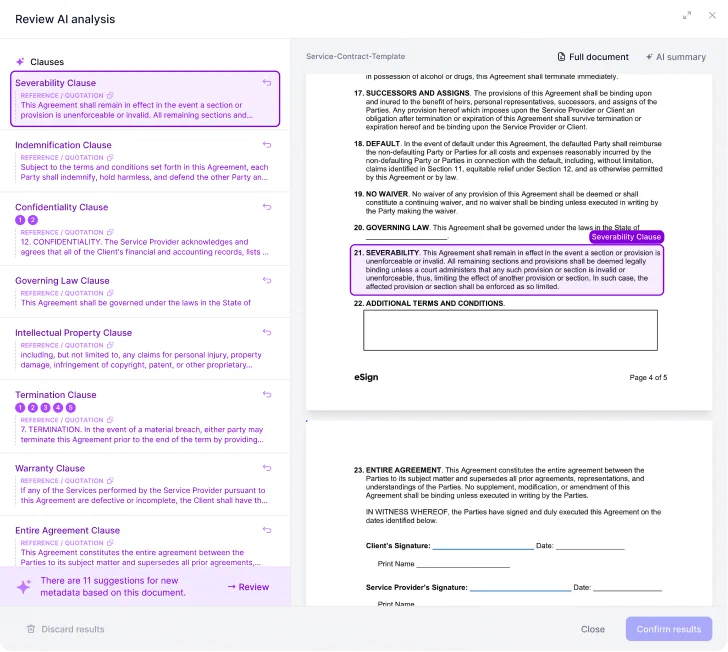
Analyze your contracts. Extract important clauses.
Try our AI contract analysis and extract important clauses and information from existing contracts.
Save your favourite clauses
Insert directly with a single click
Upload preferred precedents
Sample Broom clean condition clauses
7.05 Condition upon Termination. Upon the expiration or termination of this Lease, Tenant shall surrender the Premises to Landlord broom clean and in the same condition as received, except for normal wear and tear and any damage caused by a casualty that Tenant is not otherwise obligated to repair under any provision of this Lease. Tenant will not be obligated to repair any damage that Landlord is required to repair under Article Seven (Property Condition) or Article Eight (Damage or Destruction). In addition, Landlord may require Tenant to remove any Alterations before the expiration or termination of this Lease and to restore the Premises to their prior condition, all at Tenant’s expense. However, Tenant will not be required to remove any Alterations that were made with Landlord’s consent or that were otherwise permitted under the terms of this Lease. All Alterations that Tenant does not remove will become Landlord’s property upon the expiration or termination of this Lease. In no event may Tenant remove any of the following items without Landlord’s prior written consent: (i) electrical wiring or power panels; (ii) lighting or lighting fixtures; (iii) wall coverings, drapes, blinds or other window coverings; (iv) carpets or other floor coverings; (v) HVAC equipment; (vi) plumbing equipment; (vii) fencing or gates;
(c) Surrender; Restoration. Lessee shall surrender the Premises by the Expiration Date or any earlier termination date, with all of the improvements, parts and surfaces thereof broom clean and free of debris, and in good operating order, condition and state of repair, ordinary wear and tear excepted. “Ordinary wear and tear” shall not include any damage or deterioration that would have been prevented by good maintenance practice. Notwithstanding the foregoing and the provisions of Paragraph 7.1(a), if the Lessee occupies the Premises for 12 months or less, then Lessee shall surrender the Premises in the same condition as delivered to Lessee on the Start Date with NO allowance for ordinary wear and tear. Lessee shall repair any damage occasioned by the installation, maintenance or removal of Trade Fixtures, Lessee owned Alterations and/or Utility Installations, furnishings, and equipment as well as the removal of any storage tank installed by or for Lessee. Lessee shall also remove from the Premises any and all Hazardous Substances brought onto the Premises by or for Lessee, or any third party (except Hazardous Substances which were deposited via underground migration from areas outside of the Premises) to the level specified in Applicable Requirements. Trade Fixtures shall remain the property of Lessee and shall be removed by Lessee. Any personal property of Lessee not removed on or before the Expiration Date or any earlier termination date shall be deemed to have been abandoned by Lessee and may be disposed of or retained by Lessor as Lessor may desire. The failure by Lessee to timely vacate the Premises pursuant to this Paragraph 7.4(c) without the express written consent of Lessor shall constitute a holdover under the provisions of Paragraph 26 below.
or earlier termination of this Lease or Tenant’s right of possession of the Premises, and subject to the terms and provisions of Section 9.04 above, Tenant shall remove all of Tenant’s Property and Required Removables from the Premises and quit and surrender the Premises to Landlord, broom clean and in good order, condition and repair, ordinary wear and tear and damage which Landlord is obligated to repair hereunder excepted. If Tenant fails to remove any of Tenant’s Property or Required Removables or to restore the Premises to the required condition on the Termination Date or earlier termination of this Lease or Tenant’s right to possession, then Landlord, at Tenant’s sole cost and expense, shall be entitled (but not obligated) to remove and store Tenant’s Property and Required Removables and/or perform such restoration of the Premises. Landlord shall not be responsible for the value, preservation or safekeeping of Tenant’s Property or Required Removables. Tenant shall pay Landlord, upon demand, the expenses and storage charges incurred. If Tenant fails to remove Tenant’s Property and Required Removables from the Premises or storage within ten (10) days after notice, then Landlord may deem all or any part of Tenant’s Property and Required Removables to be abandoned and, at Landlord’s option, title to Tenant’s Property and Required Removables shall vest in Landlord or Landlord may dispose of Tenant’s Property and Required Removables in any manner Landlord deems appropriate. Notwithstanding the foregoing, Landlord shall not be obligated to store any Required Removables that are not practicable to be stored and instead may be removed or otherwise demolished by Landlord if they are not timely removed from the Premises by Tenant pursuant to the foregoing provisions.
24.1 Surrender. On the Expiration Date, Tenant shall surrender to Landlord the Premises and all Alterations (except for Alterations that Tenant is obligated to remove as expressly set forth above) in a good condition, less any normal wear and tear, free of trash and debris including cleaning of all flooring; all walls shall be patched and painted, subject to normal wear and tear; all signage installed by Tenant on any portion of the Buildings or Project shall be removed and the surfaces repaired, including restoration of the signage mounting surfaces to their pre-existing condition; all sign circuits, electrical circuits, and lighting fixtures shall be in good operating condition; all roof penetrations arising from Tenant’s occupancy of the Premises shall be in a watertight condition; and all doors, windows, locks, and hardware shall be in operable condition upon the termination of this Lease. Tenant shall additionally, as of the Expiration Date, remove all of Tenant’s Personal Property and perform all repairs and restoration required by the removal of any Alterations or Tenant’s Personal Property, and Tenant shall surrender to Landlord all keys to the Premises (including without limitation any keys to any exterior or interior doors). Landlord may elect to retain or dispose of in any manner any Alterations or Tenant’s Personal Property that Tenant does not remove from the Premises on the Expiration Date as required by this Lease by giving written notice to Tenant. Any such Alterations or Tenant’s Personal Property that Landlord elects to retain or dispose of shall immediately upon notice to Tenant vest in Landlord. Tenant waives all claims against Landlord for any damage to Tenant resulting from Landlord’s retention or disposition of any such Alterations or Tenant’s Personal Property. Tenant will be liable to Landlord for Landlord’s costs for storing, removing (including related restoration work), or disposing of any such Alterations or Tenant’s Personal Property. Subject to the provisions of Paragraph 24.2, below, if Tenant fails to surrender the Premises to Landlord on the Expiration Date in the condition required by this Paragraph, Tenant shall indemnify, defend, and hold Landlord harmless from and against all liabilities, damages, losses, costs, expenses, attorneys’ fees, and claims resulting from such failure, including without limitation any claim for damages made by a succeeding tenant.
What broom clean means
“Broom clean” (also written “broom swept condition”) is an old, deliberately modest standard: the space is empty and swept. In practice that means:
- all furniture, equipment, inventory and personal property removed,
- trash and debris gone, including from storage rooms and the yard or loading area,
- floors swept (and usually vacuumed),
- no obvious mess left behind, such as food, spills or stacked boxes.
What it does not mean: professional cleaning, shampooed carpets, washed windows, repainted walls or repairs. A tenant who leaves the space broom clean has met that part of the clause, even if the next tenant will want a deep clean.
That is why the phrase rarely stands alone. Every sample above pairs it with something more: “in good order, condition and repair” (Butterfly), “in the same condition as received” (Todos), or a list of specific jobs such as patching and painting walls and cleaning all flooring (Bridgepoint). The cleaning standard is broom clean; the overall surrender standard is usually higher.
What courts say broom clean means
New York courts read the obligation to surrender premises “broom-clean” as requiring that they “be free of garbage, refuse, trash and other debris at the time of surrender.” In Witter v Nitschke (2020), buyers of a house with a broom-clean clause counterclaimed against the sellers over the condition they found. The court sided with the sellers and put it plainly: “broom-clean” does not impose the duty on the seller to have the property professionally cleaned. A buyer who wants that has to negotiate a “professionally clean” condition instead.
The same decision shows what does fail the standard: furniture and appliances left behind, or debris such as empty paint cans. The test is what was removed, not how much scrubbing was done.
Where the phrase shows up
- Surrender clauses in commercial leases. The tenant must return the premises broom clean at the end of the term, with alterations and signage removed as required. This is where most disputes start, because the surrender clause also covers repairs and restoration.
- Delivery at the start of a lease. Landlords promise to deliver the space broom clean, as in the America Great Health lease, which then puts the tenant in charge from day one.
- Home and property sales. Purchase contracts often require the seller to leave the property broom clean at closing. A buyer who finds a garage full of old paint cans has a claim, though usually a small one.
- Residential leases. Many leases say “clean” instead, which landlords read as a higher standard. “Broom clean” is the friendlier term for tenants.
Ordinary wear and tear: the other half of the clause
Broom clean deals with mess. Wear and tear deals with use. Nearly all surrender clauses let the tenant return the space with “ordinary wear and tear” excepted: worn carpet in walkways, faded paint, small scuffs. Damage beyond that, such as holes from removed shelving or a stained floor, is on the tenant.
The America Great Health lease shows two refinements landlords use: wear and tear does not include deterioration that “good maintenance practice” would have prevented, and a tenant who stays 12 months or less gets no wear-and-tear allowance at all.
What to agree before move-out
The cheapest dispute is the one you settle before the keys change hands.
- Walk through together. The Astra Space lease requires a joint walk-through at least 30 days before expiration to list what must be removed and restored. That is worth copying.
- Photograph at both ends. Photos at move-in, attached to a signed move-in condition statement, and at move-out end most arguments about what “the same condition as received” means.
- Agree a price for what’s left. A clause letting the landlord clean or remove items at the tenant’s cost, with a cap or a rate, avoids a surprise invoice against the security deposit.
- Know the overstay rule. If cleaning or removal runs past the end of the term, the holdover clause may charge rent at a premium.
- Cover a tenant who just leaves. If the tenant moves out early and stops paying, the abandonment clause decides when the landlord can retake the space and what happens to anything left inside.
Cleaning clause example for a lease
Sample clause: Condition on surrender
Add this clause to a contract, send it and get it signed in fynk.
Use it in fynk for freeNot losing the move-out deadline
The walk-through, the removal list and the deposit return all hang off the expiration date, which in many leases moves with renewals and extensions. In fynk, contract calendar and tasks and reminders put the walk-through on the calendar a month before the lease ends, so it doesn’t become a last-week scramble.
Free templates with this clause
- Office sublease agreement template The sublandlord delivers the subleased premises in broom clean condition, with electrical, mechanical, plumbing and HVAC systems in working order. Use template
- Commercial lease agreement template (office, retail and warehouse space) Makes the tenant cover the landlord's losses if it fails to surrender the premises on time at the end of the term. Use template
Related clauses
- Security deposit A security deposit clause outlines the amount of money a tenant must pay to the landlord before moving in, which serves as protection against potential damages beyond normal wear and tear or unpaid rent. This deposit is typically refundable at the end of the lease term, provided the tenant meets all the conditions of the contract.
- Holdover A holdover clause in a contract specifies the conditions and obligations of the parties if a tenant or lessee continues to occupy the property beyond the expiration of the lease term. It typically outlines the changes in rental terms, such as an increase in rent, and the landlord's rights and remedies during the holdover period.
- Lease termination A lease termination clause outlines the conditions under which a lease agreement can be legally ended by either the landlord or tenant before its scheduled expiration. It typically includes specific terms such as notice periods, potential penalties, reasons for termination, and any obligations both parties must fulfill upon ending the lease.
- Leased premises The "Leased Premises" clause typically identifies the specific property or area being leased in an agreement, including its address and any relevant boundaries or features. This clause ensures that both parties have a clear understanding of the property's specifics and outlines any limitations regarding its use.
- Use of premises The "Use of Premises" clause delineates the acceptable purposes and activities for which a leased property can be utilized by the tenant. It ensures that the tenant's use aligns with local regulations and the landlord's policies, thereby preventing any unauthorized or potentially harmful activities on the premises.
- Triple net lease A triple net lease is a type of commercial lease agreement where the tenant is responsible for paying not only the base rent but also all additional expenses associated with the property, including property taxes, insurance, and maintenance costs. This arrangement shifts most of the financial responsibility from the landlord to the tenant, making it an attractive option for landlords seeking a more passive investment model.
Frequently asked questions
That the property is empty of belongings and debris and the floors are swept. It is a basic standard and does not require deep cleaning, repairs or repainting.
Usually not. Broom clean covers sweeping and removing trash. If the landlord or buyer wants carpets shampooed or windows washed, the contract has to say so.
Generally the landlord may deduct the reasonable cost of removing debris and cleaning up to the agreed standard, but not for ordinary wear and tear. State rules on deposit deductions apply, especially for residential leases.
No. A New York court held in 2020 that a broom-clean clause does not require professional cleaning. If you want the property professionally cleaned at handover, the contract has to require a professionally clean condition.
Broom clean is empty and swept. Move-in ready means cleaned, repaired and ready for the next occupant, which is a much higher standard and usually the landlord's job.
More clauses from the library
See allBuy back option
A buyback option is a contractual clause that grants the seller the right, but not the obligation, to repurchase an asset from the buyer at a predetermined price within a specified timeframe. This provision is often used to protect the seller's interests, allowing them to regain ownership under certain conditions or capitalizing on market changes.
11 example clauses
Buyout
A buyout clause lets one party end a contract early, or take over another party's share in a business, by paying a price or formula agreed in advance. It is common in employment and sports contracts, leases, partnerships and shareholder agreements.
18 example clauses
Call right
A call right is a contractual clause that grants a party the ability to buy a specific asset or financial instrument at a predetermined price within a certain period. This provision is often used to provide flexibility and control to the party holding the right, allowing them to capitalize on favorable market conditions or strategic opportunities.
20 example clauses
Analyze your contracts. Extract important clauses.
Try our AI contract analysis and extract important clauses and information from existing contracts.
Save your favourite clauses
Insert directly with a single click
Upload preferred precedents