
Joinder
A joinder is how a new party becomes bound by a contract others have already signed: it signs a short joinder agreement and joins as if it were an original party. Joinders are standard for new shareholders, LLC members, guarantors and lenders. In litigation, joinder means adding parties or claims to a case.
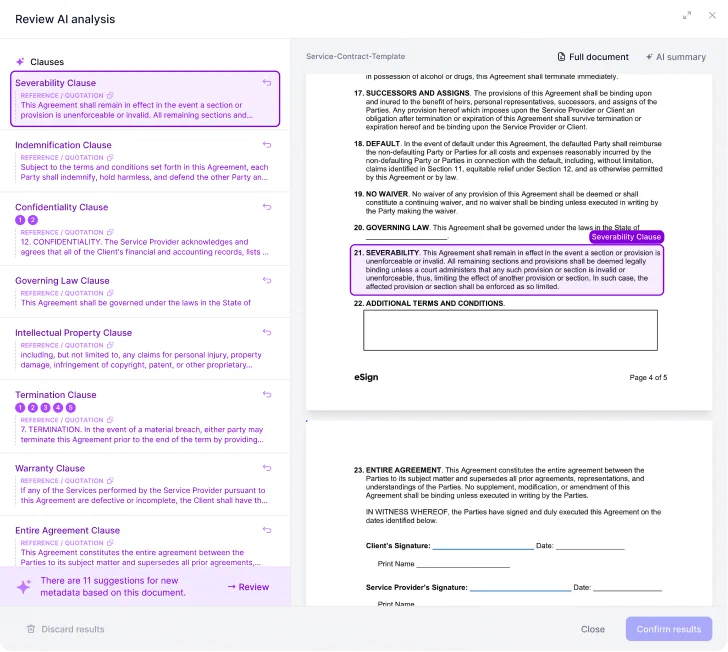
Analyze your contracts. Extract important clauses.
Try our AI contract analysis and extract important clauses and information from existing contracts.
Save your favourite clauses
Insert directly with a single click
Upload preferred precedents
Sample Joinder clauses
Section 5. Joinder. Additional Borrower hereby joins the Master Agreement and Loan Documents as if it were an Original Borrower thereunder. Borrower agrees that all references to “Borrower” in the Loan Documents (including, but not limited to, the Master Agreement and the Note) shall be deemed to include Additional Borrower and Original Borrower, and all references to “Mortgaged Property” in the Loan Documents (other than the Security Instruments executed by Original Borrower) shall be deemed to include the Additional Mortgaged Property.
- Joinder to the Tax Receivable Agreement. Upon the execution of this Joinder by the undersigned and delivery hereof to PubCo, the undersigned hereby is and hereafter will be a TRA Party under the Tax Receivable Agreement, with all the rights, privileges and responsibilities of a party thereunder. The undersigned hereby agrees that it shall comply with and be fully bound by the terms of the Tax Receivable Agreement as if it had been a signatory thereto as of the date thereof.
AGREEMENT 1.Joinder. By this Joinder Agreement, Joining Party hereby becomes a “Subsidiary Guarantor” and a “Guarantor” under the Loan Agreement, the Guaranty and the other Loan Documents with respect to all the Obligations of the Borrower now or hereafter incurred under the Loan Agreement and the other Loan Documents, and a “Subsidiary Guarantor” under the Contribution Agreement. Joining Party agrees that Joining Party is and shall be bound by, and hereby assumes, all representations, warranties, covenants, terms, conditions, duties and waivers applicable to a “Subsidiary Guarantor” and a “Guarantor” under the Loan Agreement, the Guaranty, the other Loan Documents and the Contribution Agreement.
Source
YAHOO INCBy executing this Joinder Agreement and delivering it to Alibaba, the Joinder Party hereby agrees to become a party to, to be bound by, and to comply with the provisions of the Framework Agreement and the terms of each the Transaction Documents applicable to the Zhejiang Alibaba E-Commerce Co., Ltd. Shareholders in the same manner as if the Joining Party had been an original party thereto. The Joinder Party agrees to refrain from taking any actions that would directly or indirectly (with or without the passage of time) cause the Zhejiang Alibaba E-Commerce Co., Ltd. Shareholders to fail to satisfy such obligations under the Framework Agreement or any Transaction Documents thereto.
Joining Party hereby acknowledges, agrees and confirms that, by its execution of this Joinder Agreement, the Joining Party shall be deemed to be a party to, and a “Supporting Company Shareholder” under, the Shareholder Support Agreement as of the date hereof and shall have all of the rights and obligations of a Supporting Company Shareholder as if it had executed the Shareholder Support Agreement.
CONDITIONS TO EFFECTIVENESS OF JOINDER. This Joinder shall not become effective unless and until (i) one or more counterparts of the same have been duly executed by New Credit Party and delivered to Agent, (ii) all of the conditions set forth in Section 1.12 of the Loan Agreement have been satisfied or waived by Agent and (iii) Borrower and the other Credit Parties shall have executed the attached Confirmation and delivered the same to the Agent.
What is a joinder?
In contracts, a joinder is how a new party becomes bound by an agreement that others have already signed. Instead of renegotiating and re-signing the whole agreement, the newcomer signs a short joinder agreement saying it joins the existing contract on the same terms as the parties who signed it first.
Example: three founders signed a shareholders’ agreement. A year later, an investor buys shares. The shareholders’ agreement says no one may become a shareholder without agreeing to be bound by it, so the investor signs a one-page joinder. From that moment, the investor has the same rights and obligations as the founders, including transfer restrictions, drag-along and tag-along rights.
The word also has a second, procedural meaning: in a lawsuit, joinder means bringing additional parties or claims into the same case. That is covered briefly at the end of this page.
Joinder agreement vs. amendment vs. assignment
| Joinder | Amendment | Assignment | |
|---|---|---|---|
| What changes | A new party is added | The terms change | A party’s rights move to someone else |
| Who signs | The joining party, often with an acknowledgment by one existing party or an agent | All parties, unless the contract says otherwise | Assignor and assignee, often with the other party’s consent |
| Effect on existing parties | They stay; the newcomer joins them | Everyone is bound by the new terms | The assignor may drop out |
| Typical use | New shareholders, members, guarantors, lenders, borrowers | Changing price, scope, dates | Selling a business, transferring a contract |
Strictly speaking, adding a party changes the contract, which is why some drafting experts call a joinder a kind of amendment. The difference is in who has to sign. A joinder only works smoothly if the original agreement allows it: well-drafted agreements say who may join, on what conditions, and whose signature is needed to accept them. Without that clause, adding a party usually needs everyone’s consent, the same as any other amendment.
Where joinder agreements are used
The sample clauses above show the usual settings:
- Shareholders’ and LLC operating agreements. New shareholders or members must sign a joinder before shares or membership interests are transferred or issued to them.
- Credit agreements and guarantees. New subsidiaries join as guarantors or borrowers, and new lenders join the facility, without re-signing the whole loan documentation.
- M&A transactions. Shareholders who did not sign the purchase agreement sign joinders, so its terms (such as indemnities and the appointment of a sellers’ representative) can be enforced against them.
- Support and voting agreements. Additional shareholders join commitments to vote for a transaction.
- NDAs. Affiliates, co-investors or financing sources join an existing confidentiality agreement.
- Registration rights and tax receivable agreements. Transferees of shares join to take over the rights that come with them.
Outside corporate deals, the word shows up in two more places: a person joining a pooled special needs trust signs a joinder agreement to the master trust, and a related company that wants to join an existing retirement plan signs a joinder to adopt it. The idea is the same each time: one short document, and the newcomer is bound by rules that already exist.
In the UK and some other jurisdictions, the same document is often called a deed of adherence or an accession agreement.
What a joinder agreement should contain
- Identification of the main agreement, with its date, parties and any amendments.
- The joining statement: the new party becomes a party “as if it had been an original signatory”.
- Its role: as a shareholder, guarantor, borrower or lender, and which defined terms now include it.
- Representations by the new party, such as authority to sign and, for investors, investor status.
- Notice details for the new party.
- Conditions to effectiveness, for example delivery to the agent or satisfaction of conditions in the main agreement.
- Acknowledgment by the company or agent, where the main agreement requires it.
- Governing law, usually the same as the main agreement.
Timing matters more than the wording. Get the joinder signed before shares are transferred, the loan is drawn or the deal closes. A purchase agreement binds the people who signed it or joined it, so a seller who never signed a joinder can be hard to hold to its release or indemnity, and chasing signatures after closing is slow.
Joinder clause in the main agreement
The other half of the mechanism sits in the original contract. A joinder clause says, for example:
Sample clause: Joinder of additional parties
Add this clause to a contract, send it and get it signed in fynk.
Use it in fynk for freeJoinder in litigation
In US federal courts, joinder of parties is governed by the Federal Rules of Civil Procedure, and there are two main types. Rule 19 covers required (compulsory) joinder, where a person must be added because the court cannot give complete relief without them or their interests are at stake. Rule 20 covers permissive joinder, which allows plaintiffs or defendants to be joined when their claims arise from the same transaction or occurrence and share a common question of law or fact. Rule 18 covers joining several claims in one case. This procedural meaning has nothing to do with joinder agreements, despite the shared word.
Sending joinders without the paperwork
Joinders are short, repetitive and often needed at the worst moment, such as just before closing. In fynk, the company or agent can sign the joinder template once with pre-signed documents, so every joinder goes out already signed on its side and the new party only countersigns. Each signed joinder can then be linked to the main agreement through related files, so the shareholders’ agreement or loan file always shows who has joined.
Which contracts use joinders?
Shareholders’ and LLC operating agreements, credit agreements and guarantees, merger and purchase agreements, voting and support agreements, NDAs, and registration rights agreements. These free templates provide for a new party to join or be bound:
Free templates with this clause
- Guarantee agreement template (securities purchase and notes) A new guarantor joins by signing a guarantee joinder in the attached form and becomes a guarantor for all purposes. Use template
- Name and likeness licensing agreement template A successor or assignee of the company must give the licensor a written agreement to be bound by all the terms. Use template
- Manufacturing agreement template An assignee may take over the agreement only if it assumes all of the assigning party's obligations. Use template
Related clauses
- Assignment An assignment clause in a contract outlines the conditions under which one party may transfer its rights or obligations to another party. It typically specifies whether prior consent is required for such a transfer and identifies any exceptions to these requirements.
- Amendment An amendment clause outlines the procedures and requirements for making changes or modifications to an existing contract. It specifies how amendments can be proposed, agreed upon, and documented by the parties involved to ensure that all modifications are legally binding and enforceable.
- Counterparts A counterparts clause lets each party sign a separate, identical copy of a contract. Every signed copy counts as an original, and all of them together form one agreement, so the parties never have to sign the same piece of paper.
- Successors and assigns The "Successors and Assigns" clause ensures that the rights and obligations of a contract are binding not only on the original parties but also on their successors, heirs, and any authorized entities they may assign these rights to. This clause provides continuity and enforceability of the contractual terms even if the parties undergo changes in ownership or structure.
- Novation Novation replaces one party to a contract with a new party, or an old contract with a new one, with the consent of everyone involved. Unlike an assignment, the party who leaves is released from its obligations.
- Successor in interest A successor in interest is a person or company that takes over the rights and obligations of another party and stands in its place, for example after a merger, the sale of a business or an inheritance. In contracts, the term decides who may take over the agreement without consent. In US mortgages, it gives heirs and divorced spouses who receive the home the right to deal with the servicer.
Frequently asked questions
A short agreement by which a new party becomes bound by an existing contract, such as a shareholders' agreement or credit agreement, as if it had signed it originally.
To add a party to an existing contract without renegotiating or re-signing it with everyone. It keeps all shareholders, guarantors or lenders on the same terms.
Usually not, if the main agreement allows new parties to join by signing a joinder. Often the company or an agent must accept it. Check the joinder clause in the main agreement.
If the company's shareholders' or operating agreement requires it, yes. Many agreements make a transfer void, or the company won't register it, until the buyer signs a joinder.
No. A voting agreement is a commitment about how shares will be voted. A joinder is the document a new shareholder signs to become a party to an existing agreement, which can be a voting agreement.
A joinder adds a new party alongside the existing ones. A novation replaces a party: the new party takes over and the old one is released.
Bringing additional parties or claims into the same case. In US federal courts, Rule 19 covers required joinder of parties and Rule 20 covers permissive joinder.
More clauses from the library
See allJoint and several liability
Joint and several liability means that two or more parties share an obligation, and each of them can be made to pay the whole amount. The creditor can collect from any one of them, who can then claim the others' shares back.
20 example clauses
Joint and several obligations
Joint and several obligations refer to a legal arrangement where multiple parties are collectively and individually responsible for fulfilling a contractual obligation. This means that a creditor can demand the full performance or payment from any of the involved parties, rather than just their proportional share.
8 example clauses
Jurisdiction and venue
A "Jurisdiction and Venue" clause specifies the particular court and location where any disputes related to the contract will be resolved. This clause helps provide clarity and predictability for the parties involved, ensuring that legal proceedings occur in a mutually agreed-upon and convenient forum.
16 example clauses
Analyze your contracts. Extract important clauses.
Try our AI contract analysis and extract important clauses and information from existing contracts.
Save your favourite clauses
Insert directly with a single click
Upload preferred precedents