
TCPA consent
TCPA consent is a consumer's permission to receive certain calls and text messages. For marketing by autodialer or prerecorded voice, US law requires prior express written consent with specific disclosures.
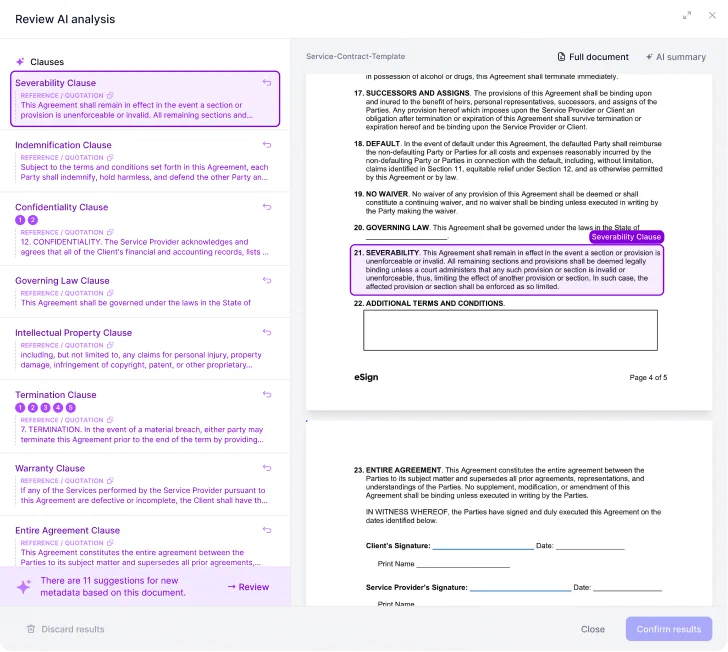
Analyze your contracts. Extract important clauses.
Try our AI contract analysis and extract important clauses and information from existing contracts.
Save your favourite clauses
Insert directly with a single click
Upload preferred precedents
Sample TCPA consent clauses
We utilize telephone calls and text messages as a means of responding to and marketing to customers interested in purchasing, trading in and/or selling vehicles and value-added products. We generate leads from our website and online advertising by prompting potential customers to provide their phone numbers so that we can contact them in response to their interest in selling a vehicle, purchasing a vehicle, trading in a vehicle or obtaining financing terms. We must ensure that our SMS texting practices comply with regulations and agency guidance under the Telephone Consumer Protection Act (the “TCPA”), a federal statute that protects consumers from unwanted telephone calls, faxes and text messages. While we strive to adhere to strict policies and procedures that comply with the TCPA, the Federal Communications Commission, as the agency that implements and enforces the TCPA, may disagree with our interpretation of the TCPA and subject us to penalties and other consequences for noncompliance. Determination by a court or regulatory agency that our SMS texting practices violate the TCPA could subject us to civil penalties and could require us to change some portions of our business.
Source
Sweetgreen, Inc. (SG)In addition to the risks we face under emerging privacy laws, the restrictions on text message communications imposed by the Telephone Consumer Protection Act (“TCPA”), have long been a source of potential liability for our business. The TCPA imposes various consumer consent requirements and other restrictions on certain telemarketing activity and other communications with consumers by phone, fax or text message. TCPA violations can result in significant financial penalties, including penalties or criminal fines imposed by the Federal Communications Commission or fines of up to $1,500 per violation imposed through private litigation or by state authorities. We currently send text messages to guests who opt in to receive customer support communications. Claims that we have violated the TCPA could be costly to litigate and could expose us to substantial statutory damages or settlement costs.
Source
EverQuote, Inc. (EVER)We were previously subject to class action lawsuits alleging violations of the Telephone Consumer Protection Act, or TCPA, and were subject to a class action lawsuit alleging federal securities law violations in connection with our IPO, and may be involved from time to time in various additional legal proceedings, including, but not limited to, actions relating to breach of contract, breach of federal and state privacy laws, and intellectual property infringement that might necessitate changes to our business or operations. Regardless of whether any claims against us have merit, or whether we are ultimately held liable or subject to payment of damages, claims may be expensive to defend and may divert management’s time away from our operations. If any legal proceedings were to result in an unfavorable outcome, it could have a material adverse effect on our business, financial position and results of operations. Any adverse publicity resulting from actual or potential litigation may also materially and adversely affect our reputation, which in turn could adversely affect our results.
What is TCPA consent?
The Telephone Consumer Protection Act (TCPA, 47 U.S.C. § 227) restricts calls and text messages made with an automatic telephone dialing system or an artificial or prerecorded voice, and unsolicited fax advertisements. Many of these communications are only allowed with the recipient’s consent. “TCPA consent” is that permission, and the wording used to collect it.
The level of consent depends on the message:
| Communication | Consent needed |
|---|---|
| Informational calls or texts to a mobile phone using an autodialer or prerecorded voice (appointment reminders, delivery updates) | Prior express consent, which can be oral or written |
| Telemarketing or advertising calls or texts to a mobile phone using an autodialer or prerecorded voice | Prior express written consent |
| Prerecorded telemarketing calls to a residential landline | Prior express written consent |
| Telemarketing to numbers on the National Do Not Call Registry | Written permission or an established business relationship |
Violations are expensive: 47 U.S.C. § 227(b)(3) lets consumers sue for $500 per call or text, and a court can triple that to $1,500 if the violation was willful or knowing. That is why TCPA class actions are common, as several company disclosures in the samples above show.
What prior express written consent must include
Under the FCC’s rules (47 CFR 64.1200(f)(9)), prior express written consent is a written agreement, signed by the person called, that:
- clearly authorizes the seller to deliver advertisements or telemarketing messages using an autodialer or an artificial or prerecorded voice;
- names the telephone number to which those messages may be sent;
- tells the signer, clearly and conspicuously, that signing authorizes autodialed or prerecorded telemarketing calls, and that they don’t have to sign, directly or indirectly, as a condition of buying any property, goods or services.
The rule counts an electronic or digital signature that federal law or state contract law recognizes, so a checkbox and a click on a web form can be enough when the disclosures are clear and the click is recorded. A consent box that must be ticked to finish checkout fails the second disclosure, because it makes consent a condition of purchase.
The one-to-one consent rule
In 2023 the FCC adopted a “one-to-one” rule that would have required consent to be given to a single seller at a time, ending the practice of one form authorizing many marketing partners. The Eleventh Circuit vacated it on January 24, 2025 in Insurance Marketing Coalition v. FCC, holding that the FCC had gone beyond what the statute allows, and the rule never took effect. The definition in the current rules has no single-seller requirement, so the prior express written consent standard above still applies.
Two things keep this from being the end of the story. In June 2025 the Supreme Court held in McLaughlin Chiropractic Associates v. McKesson that district courts are not bound by the FCC’s reading of the TCPA, so courts can now interpret consent questions themselves. And state laws, often called “mini-TCPAs”, can add their own consent, calling-hour and revocation rules. A form that names each seller is still the safest choice for lead generation.
Revoking consent
Consent can be taken back at any time, and the FCC rules set how fast the business has to react: a revocation must be honored within a reasonable time, no later than ten business days after it is received. One confirmation text is allowed if it only confirms the opt-out, contains no marketing and goes out within five minutes.
How a consumer may revoke changes on November 25, 2026, when the FCC’s revised revocation rules take effect:
| Until November 24, 2026 | From November 25, 2026 | |
|---|---|---|
| How consumers can revoke | Any reasonable means, and the caller can’t designate an exclusive one | The caller may designate an exclusive method: a key-press or voice opt-out on the call, a reply text with a standard word (“stop”, “quit”, “end”, “revoke”, “opt out”, “cancel”, “unsubscribe”), or its own website or phone number. It must disclose that method clearly on the call or in the text. Callers that don’t designate one still honor any reasonable means |
| What an opt-out covers | All calls and texts that need consent (“revoke all”), though that part was waived and never applied | An opt-out from an informational message covers only that category; an opt-out from marketing covers all marketing from that caller |
For a business this is a process question as much as a legal one: whoever runs the calls or texts needs one place where opt-outs land, and a record of when each one was honored.
TCPA clauses in business contracts
Companies that buy leads or outsource calling usually allocate TCPA risk by contract:
- Lead purchase agreements: the lead seller warrants that every lead came with valid prior express written consent naming the buyer, and keeps the consent records.
- Call center and SMS vendor agreements: the vendor complies with the TCPA, the Telemarketing Sales Rule and Do Not Call rules, and scrubs numbers against the registries.
- Indemnity: the party that collected consent indemnifies the other for TCPA claims.
- Audit rights: the buyer can request consent records for any number.
TCPA consent language example
Consent language on a sign-up form:
By checking this box and clicking “Submit”, I agree that [Company] may send me marketing calls and text messages, including messages sent using an automatic telephone dialing system or an artificial or prerecorded voice, at the phone number I provided above. Consent is not a condition of any purchase. Message and data rates may apply. Reply STOP to opt out.
Contract clause for a lead vendor:
Sample clause: TCPA compliance
Add this clause to a contract, send it and get it signed in fynk.
Use it in fynk for freeKeeping proof of consent
TCPA claims often come years after the consent was given, so the record matters as much as the wording: the date and time, the exact text the person saw, the number and how they signed. When consent is part of a signed document, fynk’s audit trail logs every view, approval and signature with a timestamp and can’t be changed afterwards.
Which documents include TCPA consent?
Website and app sign-up forms, credit and loan applications, terms of service and SMS program terms, patient intake forms, lead generation agreements, call center and SMS vendor agreements, and debt collection agreements.
Related clauses
- Data protection clause A data protection clause (also called a data privacy clause) sets out how the parties to a contract handle personal data: which laws apply, who is controller and who is processor, security, breach notification, transfers and deletion. When a supplier processes personal data for the customer, the clause usually points to a separate data processing agreement.
- General compliance with laws The "General Compliance with Laws" clause mandates that all parties to the contract adhere to applicable local, state, national, and international laws and regulations throughout the duration of their agreement. This clause ensures that all contractual activities are conducted legally and ethically, mitigating the risk of legal disputes and penalties.
- Indemnity An indemnity clause is a contractual provision where one party agrees to compensate the other for certain costs and liabilities that may arise due to specified events or actions. This clause is designed to allocate risk by holding one party responsible for losses incurred by the other, providing financial protection in situations such as breaches of contract, negligence, or legal claims.
- Right to audit The "Right to Audit" clause grants a party the ability to review and examine the financial records, systems, and practices of another party to ensure compliance with contractual terms and accuracy of financial reporting. This clause is often included to provide transparency and accountability, and to safeguard against fraud or mismanagement.
- Subscription cancellation A subscription cancellation clause sets how a customer can end a recurring subscription: how and when to give notice, when the cancellation takes effect, and what happens to fees and access.
Frequently asked questions
A consumer's permission, required by the Telephone Consumer Protection Act, to receive certain calls and texts, especially those made with an autodialer or prerecorded voice.
A signed written agreement, which can be electronic, authorizing a seller to send marketing calls or texts by autodialer or prerecorded voice to a specific number, with a disclosure that consent is not a condition of purchase.
No. The Eleventh Circuit vacated it in January 2025, before it took effect, and the current FCC definition has no single-seller requirement. The prior express written consent standard still applies, along with state law.
Consumers can sue for $500 per violation, increased up to $1,500 for willful or knowing violations, and many cases are brought as class actions.
Yes, at any time. Until November 24, 2026 any reasonable means counts. From November 25, 2026 a caller may designate an exclusive opt-out method, such as replying STOP, if it discloses it clearly; callers that don't still honor any reasonable means.
A reasonable time, no more than ten business days after it receives the request. A single confirmation text without marketing is allowed if it is sent within five minutes.
More clauses from the library
See allTenant improvement allowance
A tenant improvement allowance (TIA) is an amount a landlord agrees to pay toward building out or renovating a commercial space for a new tenant. It is usually set per square foot, paid against invoices once work is done, and limited to improvements described in the lease's work letter.
11 example clauses
Tendering party
The "Tendering Party" clause refers to the party responsible for formally offering to supply goods or services as outlined in a contract. It establishes the obligations and timelines for this party to meet in ensuring that their delivery meets the contract requirements.
10 example clauses
Term of agreement and termination
A term and termination clause sets how long a contract runs and how it can end early. It covers the start date and term, renewals, termination for convenience or for cause, notice periods and what happens after the contract ends.
6 example clauses
Analyze your contracts. Extract important clauses.
Try our AI contract analysis and extract important clauses and information from existing contracts.
Save your favourite clauses
Insert directly with a single click
Upload preferred precedents