
Data protection clause
A data protection clause (also called a data privacy clause) sets out how the parties to a contract handle personal data: which laws apply, who is controller and who is processor, security, breach notification, transfers and deletion. When a supplier processes personal data for the customer, the clause usually points to a separate data processing agreement.
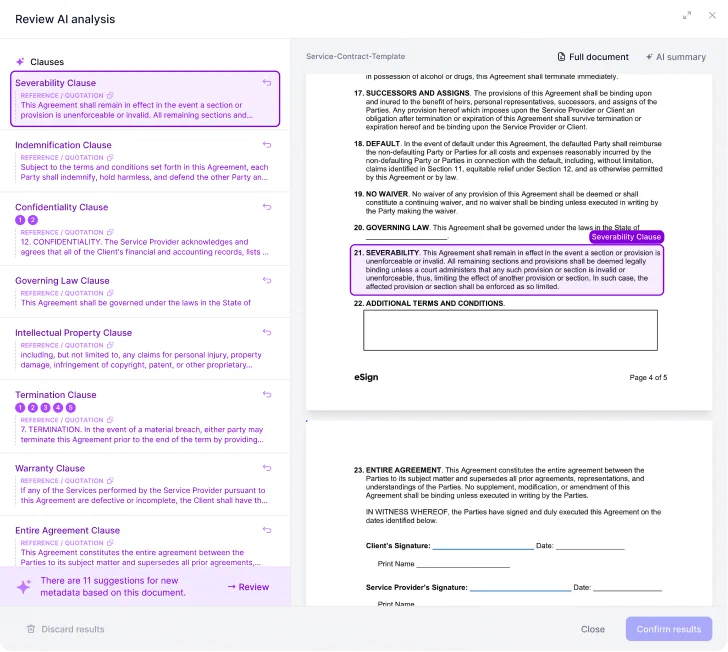
Analyze your contracts. Extract important clauses.
Try our AI contract analysis and extract important clauses and information from existing contracts.
Save your favourite clauses
Insert directly with a single click
Upload preferred precedents
Sample Data protection clause clauses
Source
GP STRATEGIES CORP(f) comply with all instructions of HSBC or the relevant HSBC Contracting Party in relation to any such HSBC Personal Data, including in relation to complying with any registration and/or notification requirements, providing full cooperation and assistance following requests from any Regulator, amending or deleting the HSBC Personal Data, or entering into any further contracts or paperwork (including where required by HSBC or the relevant HSBC Contracting Party and/or by any data processing agreement between HSBC or a HSBC Group Member and the Supplier). In the event that a legal requirement prevents the Supplier from complying with such instructions, it shall, unless such legal requirement prohibits it from doing so, promptly inform HSBC or the relevant HSBC Contracting Party of the relevant legal requirement before carrying out further processing activities in respect of the affected HSBC Personal Data;
- Data Protection Measures. Data Processor will consider the current state of the art in technology, the nature of the data stored and the risks to which such data are exposed, and will implement appropriate technical and organisational security measures to protect Relevant Personal Data against unauthorised or unlawful access or processing, as well as to protect against accidental loss or destruction of, or damage to, Relevant Personal Data. Data Processor will in particular ensure that subject data is encrypted when transmitted over a public network or stored on portable electronic media. Data Processor will also ensure that persons authorized to process Personal Data have committed themselves to confidentiality, or are under an appropriate statutory obligation of confidentiality.
- Transfer of Data. Data Processor will not transfer Relevant Personal Data outside the European Economic Area (other than to Data Processor’s employees accessing such Relevant Personal Data remotely in the performance of the Services) without Ionis’ prior written consent, which shall include but is not limited to a statement of work or change order, unless: (a) there has been a finding of adequacy by the appropriate regulatory authority (e.g.; the European Commission in accordance with GDPR Article 45) in respect of that country); (b) Ionis and the Data Processor have entered into standard contractual clauses attached hereto as Appendix B for the transfer of personal data to processors or controllers established in third countries; or (c) the data subject(s) has provided consent to such transfer in accordance with applicable Data Protection Laws (e.g.; GDPR Article 49).
(h) Compliance with Privacy and Data Security Requirements. You agree to comply with all of the Legal Requirements in connection with your collection, storage, use, and transfer of any User Data relating to your Application. You must also comply with any privacy or data security requirements communicated to you by SynapseFI. SynapseFI may request information regarding your privacy or data security practices at any time and you must provide such information within the time frame specified by SynapseFI.
2.25 Data Protection.
(a) None of the Group Companies has received written notice from a Data Protection Governmental Authority of any breach of the Data Protection Legislation by any of the Group Companies.
(b) During the last three years, no material breach of the Data Protection Legislation has been identified by any Group Company.
(c) Each of the Group Companies complies with all applicable material Data Protection Legislation in all material respects.
(d) None of the Group Companies has been involved in a dispute with an individual in respect of any breach of the Data Protection Legislation or has received a written claim for compensation.
Source
GoDaddy Inc. (GDDY)14.DATA PROTECTION
14.1The Employee agrees to act in accordance with applicable data protection laws at all times during the Term of this Contract and to comply with the Company’s Data Protection Policy (if any, as amended from time to time) and any other policies introduced by the Company in order to comply with data protection laws.
14.2The Employee consents to the Company and any of its Affiliates processing data relating to the Employee for legal, business, administrative and management purposes and in particular to the processing of any sensitive personal data relating to the Employee, including but not limited personal identity certificate, bank account, salary.
14.3The Company may make such personal data available to any of its Affiliates, those who provide products or services to the Company or any of its Affiliates (such as advisers and payroll administrators), regulatory authorities, potential purchasers of the Company, and as may be required by law.
14.4The Employee consents to the transfer of such personal data to any of the Company’s Affiliates and the Company’s or any of its Affiliates’ business contacts outside of PRC in order to further its or their business interests.
14.5The Employee shall comply with the relevant data protection obligations under PRC law when handling personal data in the course of employment including personal data relating to any employee, customer, client, supplier or agent of the Company or any of its Affiliates.
What is a data protection clause?
A data protection clause sets out how the parties to a contract handle personal data: information about customers, employees, users or anyone else who can be identified. It says which laws apply, who decides what happens to the data, how it is kept secure, and what happens if something goes wrong. It is also called a data privacy clause or privacy clause.
Almost every commercial contract touches personal data in some way. A software vendor stores your customers’ records, an agency runs your email campaigns, a payroll provider handles salaries. The data protection clause is where the contract deals with that.
Example: a company hires a marketing agency to send its newsletter. The agency gets the company’s mailing list. The data protection clause says the agency may use the list only to send the newsletter, must keep it secure, must report a data breach quickly and must delete the list when the contract ends.
Data protection clause vs. data processing agreement (DPA)
The two are often confused, and many contracts need both.
| Data protection clause | Data processing agreement | |
|---|---|---|
| Where it sits | A section of the main contract | A separate agreement or an annex to the main contract |
| Length | A paragraph or two | Several pages, with annexes |
| What it covers | The general rules: compliance with law, roles, security, breaches, and a link to the DPA | The detailed terms a processor must accept, such as instructions, subprocessors, audits, transfers and deletion |
| When it is enough on its own | When neither party processes personal data on behalf of the other | Required under the GDPR when a processor handles personal data for a controller |
A common setup: the main contract has a short data protection clause, and that clause says a DPA applies whenever one party processes personal data on the other’s behalf.
Controller and processor: who is who
Most data protection laws split the roles in two:
- The controller decides why and how personal data is used. Usually the customer: it owns the relationship with the people whose data it is.
- The processor handles the data on the controller’s behalf and only on its instructions. Usually the supplier: the software provider, the agency, the payroll service.
The clause should say which role each party has, because the obligations follow from it. Sometimes both parties are controllers for their own purposes, for example when two companies share customer data for a joint promotion. Then each is responsible for its own use, and the contract should say so.
What a data protection clause covers
- Compliance with law. Each party complies with the data protection laws that apply to it.
- Roles. Who is controller and who is processor, for which data.
- Purpose. The processor uses the data only to perform the contract and only on documented instructions.
- Security. Appropriate technical and organizational measures, such as encryption and access controls.
- Confidentiality. Only staff who need the data get access, and they are bound to confidentiality. This is narrower than a general confidentiality clause, which covers business information of any kind.
- Subprocessors. Whether the processor may use other providers, and how the customer is told.
- Breach notification. How fast the processor reports a data breach, and what information it provides. See personal data breach.
- International transfers. Whether data may leave the country or region, and on what basis.
- Rights of individuals. Help with requests to access, correct or delete data.
- Audits. Information and inspections to show compliance.
- End of the contract. Return or deletion of the data.
- Liability. Whether data protection breaches fall under the general liability cap or a separate one.
What the law requires
The clause has to meet the requirements of the laws that apply to the data. Two common examples:
- GDPR (EU). When a processor handles personal data for a controller, Article 28(3) requires a binding contract with specific terms, including processing only on documented instructions, confidentiality of staff, security measures, rules for subprocessors, help with breaches and requests, deletion or return at the end, and audits. Under Article 33, the processor must tell the controller about a personal data breach without undue delay, and the controller must usually notify the supervisory authority within 72 hours of becoming aware of it. That is why many contracts give the processor a short deadline, such as 24 or 48 hours.
- CCPA (California). A business that discloses personal information to a service provider needs a written contract that, among other things, prohibits the service provider from selling or sharing the information and from using it outside the business purposes specified in the contract. Without such a contract, the disclosure can count as a sale or sharing.
Other countries and US states have their own rules, so check which laws apply to the people whose data is involved, not only where the companies are based.
How to review a data protection clause
If you are the customer:
- Check whether a DPA is needed and that it is attached or referenced, not “to be agreed later”.
- Set a short breach notification deadline, so you can meet your own legal deadlines.
- Control subprocessors and transfers, with notice of changes and a right to object.
- Look at liability. A data breach can cost far more than the contract value; a general liability cap may not be enough.
If you are the supplier:
- Make sure your role is right. Accepting controller obligations for data you only process on instructions widens your exposure.
- Keep notification deadlines realistic, and make them run from when you become aware of the breach.
- Limit audits to reasonable notice, frequency and cost, and accept recognized certifications where possible.
- Align the clause with your standard DPA, so you do not end up with two sets of terms that contradict each other.
Data protection clause example
Sample clause: Data protection
Add this clause to a contract, send it and get it signed in fynk.
Use it in fynk for freeFinding the gaps in your supplier contracts
Many supplier contracts were signed before anyone asked about data protection, and some still have no DPA. In fynk, AI analysis reads each contract and extracts its key terms, so you can see which agreements contain a data protection clause and which still need a DPA. The DPA itself can be created from the free template and signed online with e-signatures, next to the main contract it belongs to.
Which contracts include a data protection clause?
Software and SaaS agreements, master service agreements, outsourcing and IT services contracts, marketing and agency agreements, payroll and HR services, employment contracts, and purchase agreements for companies that hold personal data. These free templates include one:
Free templates with this clause
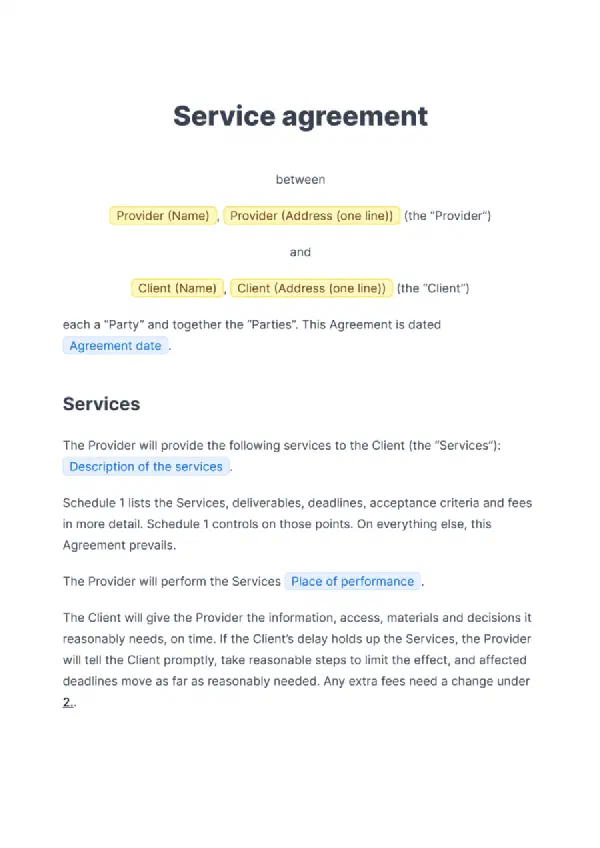 Service agreement template
Each party complies with data protection law, and the provider may not process personal data for the client until a data processing agreement is signed.
Use the free template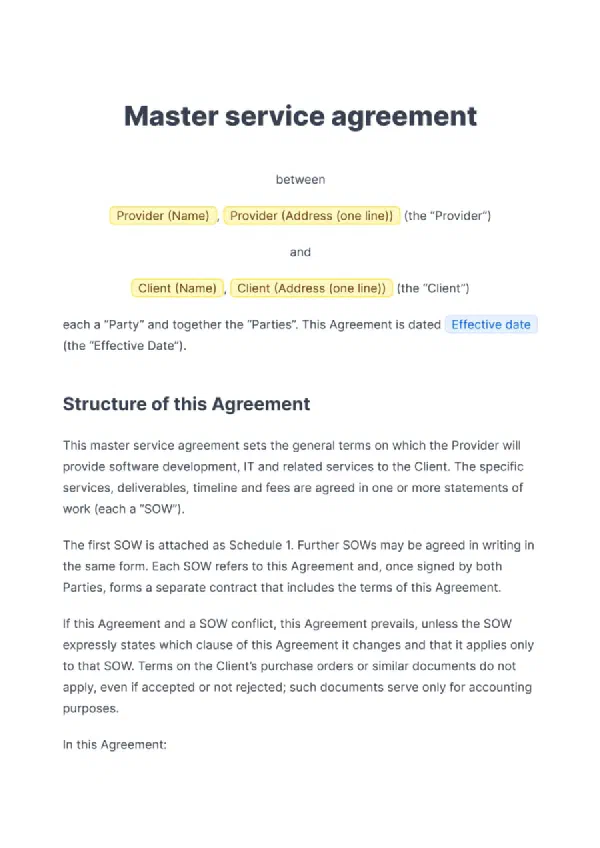 Master service agreement (MSA) template
Each party complies with the data protection laws that apply to it, and the parties sign a DPA before the provider processes personal data for the client.
Use the free template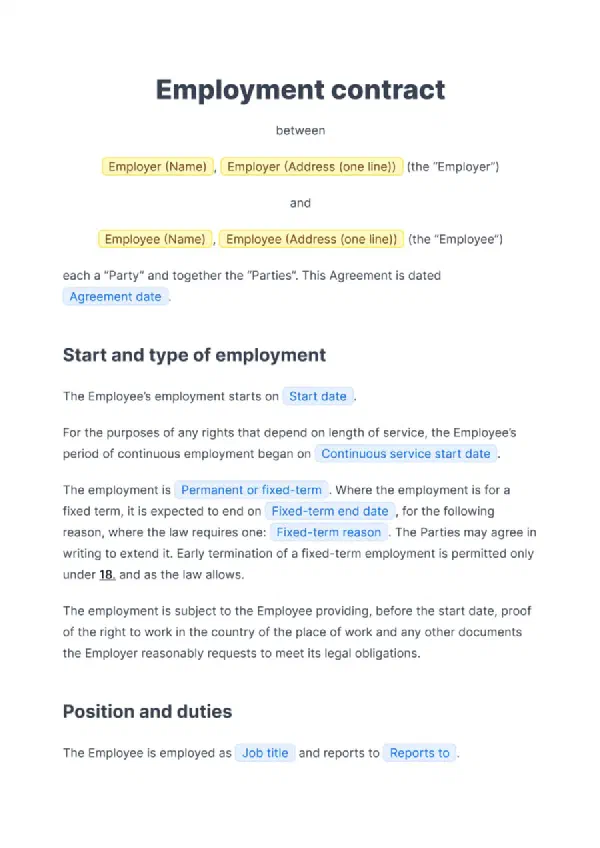 Employment contract template (employment agreement)
The employer processes the employee's personal data in line with the law and its privacy notice, and the employee follows the employer's data protection policies.
Use the free template
Related clauses
- Scope of processing The "Scope of Processing" clause outlines the specific activities and purposes for which personal data will be processed by one party on behalf of another, ensuring clarity and compliance with applicable data protection laws. It typically details the types of data involved, the processing methods to be used, and the duration of such processing activities.
- Subprocessing The subprocessing clause in a contract outlines the conditions under which a primary contractor may engage third parties to handle or process certain aspects of the contracted work. It typically includes obligations for obtaining consent from the primary client, ensuring subcontractor compliance with original contract terms, and maintaining data protection standards.
- Personal data breach A personal data breach clause sets out what happens when personal data is lost, stolen or exposed: how fast the party that discovers the breach reports it, what information it provides, and how it helps contain the breach and notify authorities and the people affected.
- Confidentiality clause A confidentiality clause is a provision in a contract that obligates one or both parties to keep certain information confidential and not to disclose it to third parties without prior consent. This clause is designed to protect sensitive information such as trade secrets, business strategies, and proprietary data shared during the course of the contractual relationship.
- Right to audit The "Right to Audit" clause grants a party the ability to review and examine the financial records, systems, and practices of another party to ensure compliance with contractual terms and accuracy of financial reporting. This clause is often included to provide transparency and accountability, and to safeguard against fraud or mismanagement.
- Return or destruction of confidential information The Return or Destruction of Confidential Information clause specifies the obligations of parties to either return or destroy all confidential information upon the termination or completion of the contractual relationship. This ensures that sensitive data is not retained unnecessarily, thereby protecting proprietary information and maintaining confidentiality.
Frequently asked questions
A section that sets out how the parties handle personal data: which laws apply, who is controller and who is processor, security, breach notification, transfers and what happens to the data when the contract ends.
No. A data protection clause is a short section of the main contract. A data processing agreement is a detailed agreement that the GDPR requires when a processor handles personal data for a controller. Contracts often have a clause that refers to a DPA.
Often yes. The GDPR can apply to companies outside the EU that handle data of people in the EU, and many other countries and US states, such as California, have their own requirements for contracts with service providers.
Under the GDPR, without undue delay after becoming aware of it. The controller usually has 72 hours to notify the authority, so contracts often set a shorter deadline for the processor, such as 24 or 48 hours.
A privacy policy tells individuals how a company uses their data. A data protection clause is an agreement between two companies about how they handle personal data between them.
More clauses from the library
See allData subject rights
The "Data Subject Rights" clause outlines the entitlements of individuals regarding the personal data collected and processed about them, including the rights to access, rectify, erase, restrict, and object to the processing of their data. It also often includes provisions on data portability, allowing individuals to receive their personal data in a structured, commonly used format for transfer to another data controller.
7 example clauses
Death of a limited partner
This clause addresses the procedures and implications in the event of a limited partner's death. It typically outlines the rights of the deceased's estate, the transfer of partnership interest, and any options for the remaining partners or the partnership to purchase the decedent's interest.
5 example clauses
Death of a member
The "Death of a Member" clause stipulates the procedures and consequences if a member of the contract passes away, including how shares, responsibilities, or benefits are redistributed or managed. It aims to provide clear guidance on transition and mitigate uncertainties, ensuring continuity and protecting the interests of surviving members or stakeholders.
11 example clauses
Analyze your contracts. Extract important clauses.
Try our AI contract analysis and extract important clauses and information from existing contracts.
Save your favourite clauses
Insert directly with a single click
Upload preferred precedents