
Take-or-pay
Under a take-or-pay clause, a buyer must either take an agreed minimum quantity or pay for it anyway. It gives the seller guaranteed revenue to finance plants, pipelines and capacity.
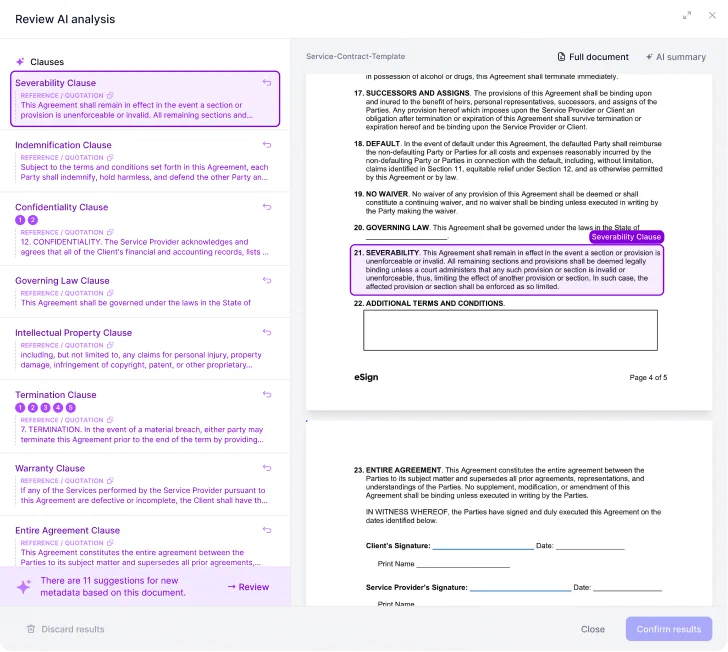
Analyze your contracts. Extract important clauses.
Try our AI contract analysis and extract important clauses and information from existing contracts.
Save your favourite clauses
Insert directly with a single click
Upload preferred precedents
Sample Take-or-pay clauses
Eco Take or Pay Ethanol Purchases. GFE agrees to sell to Eco, and Eco agrees to purchase from GFE, 100% of the production of ethanol during the term of the Agreement, including any production in excess of current production of 50.89 million gallons per year.
This shall include any production resulting from an expansion or any modification to existing technology. Each potential Eco purchase will be presented to the GFE representative by Eco for verbal approval. Upon such verbal approval and purchase, a confirmation of the purchase contract will be submitted to GFE by Eco, encompassing the details of each purchase. If GFE shuts down its facility, GFE’s liability to Eco shall be limited to any gallons of production forward sold by Eco prior to notice of shutdown. Eco shall provide notice to and obtain approval of GFE before pre-selling any GFE production.
Source
PETROHAWK ENERGY CORPSection 9.18 Gas Imbalances, Take-or-Pay or Other Prepayments. The Borrower will not allow gas imbalances, take-or-pay or other prepayments with respect to the Oil and Gas Properties of the Borrower or any Restricted Subsidiary that would require the Borrower or such Restricted Subsidiary to deliver Hydrocarbons at some future time without then or thereafter receiving full payment therefor to exceed a volume equal to 1% of the total proved reserves (on an mcf equivalent basis) set forth in the most recently delivered Reserve Report in the aggregate.
Source
US ENERGY CORP (USEG)3.12. Take or Pay Arrangements. Seller has not received any prepayments or buydowns, or entered into any take or pay arrangements, such that Seller is obligated after the Effective Time or will be obligated after Closing to make deliveries of oil and/or gas from the Assets without receiving full payment therefor, or make refunds of amounts previously paid under such contracts or arrangements.
Source
Clearwire Corp /DE3.1.4 Any amounts owed by Sprint for Wireless Broadband Services under this Section 3.1 for usage in calendar year 2011 will first apply to 2011 Take-or-Pay, and if the 2011 Take-or-Pay has been met, will be credited against the Wireless Broadband Services Prepayment unless and until it is exhausted. Any amounts owed by Sprint for Wireless Broadband Services under this Section 3.1 for usage in calendar years 2012 and beyond will be credited against the Wireless Broadband Services Prepayment unless and until it is exhausted.
What is a take-or-pay contract?
A take-or-pay contract obliges the buyer to take an agreed minimum quantity of a product or service in each period, or to pay for that quantity even if it does not take it. The seller gets a guaranteed minimum income; the buyer gets guaranteed supply, usually at a better price.
Example: a utility signs a 15-year gas supply contract with a take-or-pay level of 80% of the annual contract quantity. In a mild winter it takes only 60%. At year end it pays for the missing 20% as a deficiency payment. The contract gives it “make-up” rights, so in the next two years it can take that gas without paying for it again.
Take-or-pay originated in natural gas, where producers needed guaranteed income to develop fields and pipelines, and is now common wherever one side invests heavily in capacity for the other.
How take-or-pay works
- Contract quantity: the annual or monthly quantity the buyer expects to take.
- Take-or-pay level: the minimum percentage the buyer must pay for, often 70% to 100%.
- Shortfall: at the end of the period, the difference between the take-or-pay level and the quantity actually taken.
- Deficiency payment: the buyer pays for the shortfall, at the contract price or a discounted rate.
- Make-up: the buyer can later take the prepaid quantity without paying again, within a set time.
- Carry-forward: quantities taken above the minimum in one year may reduce the minimum in later years.
One sample above, from a broadband wholesale deal, shows how usage payments are first applied against the year’s take-or-pay commitment before any prepayment is used.
Take-or-pay vs. similar arrangements
| Arrangement | What the buyer commits to |
|---|---|
| Take-or-pay | Pay for a minimum quantity, whether taken or not, often with make-up rights |
| Take-and-pay | Pay only for what it takes; no minimum |
| Ship-or-pay | Pay for pipeline or transport capacity, whether used or not |
| Minimum commitment | Spend or buy a minimum amount over the term |
| Requirements contract | Buy all it needs from the seller, without a fixed minimum |
| Output contract | Buy all the seller produces, as in the ethanol sample above |
Where take-or-pay is used
- Natural gas and LNG supply contracts.
- Power purchase agreements, where the buyer pays for contracted energy on a firm basis.
- Pipelines, terminals and processing plants, as ship-or-pay or capacity reservation.
- Mining and industrial supply, such as offtake agreements for minerals or chemicals.
- Telecoms and cloud, as committed spend or capacity purchase agreements.
Lenders care about take-or-pay obligations too. Several sample clauses are oil and gas loan covenants and representations limiting take-or-pay prepayments that would force the borrower to deliver hydrocarbons later without being paid.
Is take-or-pay enforceable?
Generally, yes. Take-or-pay clauses are negotiated commercial bargains, often between sophisticated parties, and courts usually treat the payment as the price of a guaranteed supply rather than a penalty for breach. In England, after Cavendish v Makdessi (2015), such clauses are usually seen as primary payment obligations outside the penalty rule. Problems tend to arise when the clause is drafted as damages for failing to take, or when a force majeure event prevents the buyer from taking delivery.
How to negotiate a take-or-pay clause
If you are the buyer:
- Keep the minimum realistic for low-demand years.
- Get generous make-up rights and long make-up periods.
- Reduce the minimum for force majeure, seller shortfalls and planned outages.
- Allow carry-forward of excess takes.
If you are the seller:
- Set the deficiency price at the full contract price.
- Limit make-up to periods when you have spare capacity.
- Get credit support, such as a parent guarantee or letter of credit, for long contracts.
Take-or-pay clause example
Sample clause: Take-or-pay
Add this clause to a contract, send it and get it signed in fynk.
Use it in fynk for freeSeeing all minimum commitments in one place
Take-or-pay obligations across suppliers add up to a large fixed cost that finance needs to see. With dashboards in fynk, contracts with minimum commitments can be shown together in one view, so the total exposure and the upcoming reconciliation dates are visible at a glance.
Which contracts include take-or-pay?
Gas and LNG sale agreements, power purchase agreements, pipeline and terminal capacity agreements, offtake agreements, industrial supply agreements, telecoms wholesale and capacity agreements, and cloud committed-spend agreements. These free templates include one:
Free templates with this clause
- Power purchase agreement template Energy is sold on a take-or-pay basis: the buyer must take or pay for the contract quantity delivered at the point of delivery. Use template
- Offtake agreement template for product supply The buyer commits to purchase the seller's production under a long-term offtake arrangement. Use template
- Framework agreement template At the end of the contract year, any shortfall against the agreed volumes is reconciled and paid within the reconciliation period. Use template
Related clauses
- Minimum Commitment A Minimum Commitment clause in a contract obligates a party, typically a buyer, to purchase or use a specified minimum quantity or level of services within a defined period. This clause ensures a baseline level of engagement or business for the provider, and often involves financial penalties or adjustments if the commitment is not met.
- Minimum purchase requirements Minimum purchase requirements clause obligates a buyer to purchase a specified minimum quantity of goods or services from a seller within a defined timeframe. This provision helps ensure predictable revenue for the seller while securing volume discounts or business stability for the buyer.
- Requirements contract A requirements contract is an agreement in which a buyer commits to purchasing all or a specific percentage of its needed goods or services exclusively from a particular supplier during the contract period. This arrangement ensures the supplier has a dependable customer, while the buyer benefits from a consistent source for their requirements.
- Pay or play A pay or play clause guarantees an actor, director or other talent their agreed fee once certain conditions are met, whether or not the producer actually uses their services. The producer can choose not to "play" them, but must still "pay".
- Force majeure A force majeure clause excuses a party from performing, without liability, for as long as an event beyond its control prevents it. It only protects you for the events it names or clearly describes, so the event list, the notice deadline and the right to terminate matter more than the heading.
Frequently asked questions
A contract where the buyer must take a minimum quantity in each period or pay for it anyway, giving the seller guaranteed minimum revenue.
The payment the buyer makes for the shortfall between the minimum quantity and what it actually took in the period.
The buyer's right to take, in later periods, quantities it already paid for through deficiency payments, without paying again.
Take-or-pay applies to a product, such as gas or power. Ship-or-pay applies to transport or processing capacity, such as space in a pipeline, which is paid for whether used or not.
Usually not. Courts generally treat it as a price for guaranteed supply, especially between commercial parties, rather than as a penalty for breach.
More clauses from the library
See allTax disclaimer
A tax disclaimer clause states that the parties to the contract are responsible for their respective tax obligations and clarifies that the company providing a service or product will not be held liable for any tax-related issues or penalties incurred by the other party. This clause ensures that each party independently handles their tax liabilities in compliance with relevant laws.
12 example clauses
Taxes and duties
The "Taxes and Duties" clause specifies that each party is responsible for its own taxes and duties associated with the execution and performance of the contract. It may also outline the obligations for withholding taxes and state any requirements for the provision of tax-related documents.
13 example clauses
TCPA consent
TCPA consent is a consumer's permission to receive certain calls and text messages. For marketing by autodialer or prerecorded voice, US law requires prior express written consent with specific disclosures.
3 example clauses
Analyze your contracts. Extract important clauses.
Try our AI contract analysis and extract important clauses and information from existing contracts.
Save your favourite clauses
Insert directly with a single click
Upload preferred precedents