
Residuals clause
A residuals clause lets the receiving party of confidential information use what its people retain in their unaided memory, often for any purpose. It is common in NDAs with technology companies. For the disclosing party it is risky, so it is usually narrowed: no intentional memorization, no disclosure, no license and key exclusions.
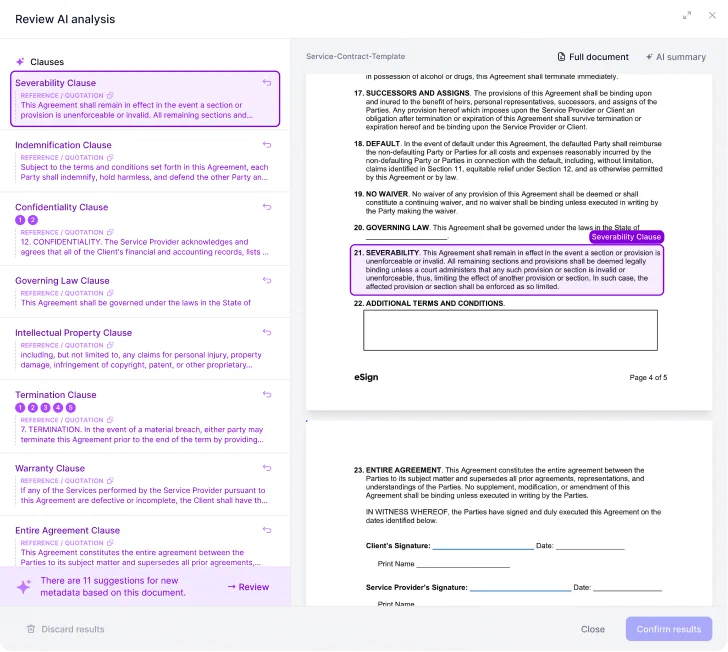
Analyze your contracts. Extract important clauses.
Try our AI contract analysis and extract important clauses and information from existing contracts.
Save your favourite clauses
Insert directly with a single click
Upload preferred precedents
Sample Residuals clause clauses
5.5 Nothing in this Section 5 shall prohibit the IPC Parties and their Representatives from using Residual Knowledge (as defined below) for any purpose, subject to any valid patents, copyrights, trademarks and service marks of the Company. “Residual Knowledge” means ideas, concepts, know-how or techniques related to Confidential Information that is retained in the unaided memories of such Representatives who have had access to such Confidential Information. A person’s memory will be considered to be unaided if the person has not intentionally memorized the Confidential Information for the purpose of retaining and subsequently disclosing it.
1.82 “Residual Information” shall mean with respect to Confidential Information, information in non-tangible form which may be incidentally retained in the unaided memory of the receiving party’s personnel having had access to the Confidential Information of the disclosing party, and which such personnel cannot identify as Confidential Information of the disclosing party. Such personnel’s memory is “unaided” if the personnel have not intentionally memorized any Confidential Information of the disclosing party.
2.4. Residuals. PFIZER may use for any purpose (other than the development, manufacture or Commercialization of Compounds or Products during the term of this Agreement) the Residuals resulting from PFIZER’s access to or work with Products and Know-How. As used herein, “Residuals” means information in non-tangible form which may be retained by persons who have had access to Products or Know-How, including information relating to ideas, concepts, know-how or techniques.
Source
Uni-Pixel12.4. Residuals. The terms of confidentiality included or referenced by this Agreement shall not be construed to limit either Party’s or its Affiliates right to independently develop or acquire products without use of the other paryt’s confidential or proprietary information and materials disclosed to a Party hereunder. Further, both parties and their Affiliates shall be free to use for any purpose the residuals resulting from access to or work with such confidential or proprietary information and materials, provided that the Party and their Affiliates shall maintain the confidentiality of the same as provided or referenced herein. The term “residuals” means information in non-tangible form, which may be retained by persons who have access to the confidential or proprietary information and materials, including ideas, concepts, know-how or techniques contained therein. Both Party’s and their Affiliates shall not have any obligation to limit or restrict the assignment of such persons or to pay royalties for any work resulting from the use of residuals. This Section, however, shall not be deemed to grant to either Party or its Affiliates a license under the other Party’s copyrights or patents.
(b) Residuals. Nothing in this Agreement shall restrict any employee or representative of a Party from using ideas, concepts or know-how relating to the provision of application management, telecommunication, IT infrastructure, help desk, and information products and services that are retained in the unaided memory of such employee or representative after performing the obligations of such Party under this Agreement, except to the extent that such use infringes upon any patent, copyright or trademark right of a Party or its Affiliates (or, in the case of Supplier, any Eligible Recipient); provided, however, that this Section 14.5(b) shall not operate or be construed as permitting an employee or representative of Supplier to disclose, publish, disseminate or use (a) the source of any Proprietary Information of ABM or an Eligible Recipient, (b) any financial, statistical or personnel information of ABM or an Eligible Recipient, or (c) any business plans of ABM or the Eligible Recipients. In addition, this Section 14.5(b) shall not operate or be construed as permitting an employee or representative of Supplier to disclose, publish, disseminate or use proprietary applications or systems of ABM or the Eligible Recipients relating to supply chain management, shelf space management, inventory management, retail floor space management, and/or order management (including ABM Owned Materials and customized configurations and uses of ABM licensed Third Party Materials), as such applications and systems may change from time to time. . An individual’s memory is unaided if the individual has not intentionally memorized the Proprietary Information for the purpose of retaining and subsequently using or disclosing it in contravention of Supplier’s obligations under this Agreement and does not identify the information as Proprietary Information upon recollection.
Source
SUNPOWER CORP (SPWRQ)(g) Reservation of Rights. Notwithstanding anything to the contrary in this Agreement, neither Party shall be prohibited from utilizing any general knowledge, skills, experience, ideas or concepts retained in the unaided memory of an individual acquired during the term of this Agreement.
What is a residuals clause?
A residuals clause lets the receiving party of confidential information use what its people remember from it. It is an exception to a confidentiality obligation: whatever stays in someone’s head after working with the other side’s information, the “residuals”, may be used freely.
It usually appears in non-disclosure agreements (NDAs) and in technology, outsourcing and development agreements. Large technology companies often ask for one, because their engineers see confidential information from many partners and cannot forget it on demand.
Example: a software company evaluates a startup’s product under an NDA. Its engineers learn how the startup solved a caching problem. A year later, they build something similar for their own product. Without a residuals clause, the startup could argue that its confidential information was misused. With one, the company can say the engineers only used what they remembered.
What does “unaided memory” mean?
Almost every residuals clause limits residuals to information retained in the unaided memory of people who had access to the confidential information. Memory is unaided when:
- the person did not intentionally memorize the information to use it later, and
- the person does not look at notes, documents, files or copies to recall it.
Some clauses add a third test: the person cannot identify the information as the other party’s confidential information when recalling it. The sample clauses above show these definitions in full.
The problem is proof. Once information is in someone’s head, it is very hard to show whether they memorized it on purpose or looked at a document. That is why the disclosing party should negotiate the scope of the clause, not rely on the definition.
Why a residuals clause is risky for the disclosing party
From the discloser’s side, a broad residuals clause can undo much of the NDA:
- Free use, even against you. Many clauses allow residuals to be used “for any purpose”, including to build a competing product.
- Trade secret protection. To protect a trade secret, its owner has to take reasonable steps to keep it secret. A clause that lets the other side use your information freely can weaken that argument.
- Hard to enforce. A dispute turns on what someone remembered and how, which is difficult to prove either way.
- Wide circle of people. Clauses often cover employees, contractors, affiliates and advisers.
For the recipient, the clause removes a real risk: without it, any product its team builds after seeing a partner’s information can be questioned.
How to negotiate a residuals clause
If you are disclosing the information:
- Strike it if you can. Many NDAs, including the free mutual NDA template, have no residuals clause at all.
- Exclude what matters most: source code, trade secrets, product roadmaps, business plans, financial and personal data.
- Require unaided memory with no intentional memorization and no reference to notes or copies.
- Keep confidentiality intact. Residuals may be used, but never disclosed, and the source of the information may never be named.
- Grant no license. Say expressly that the clause gives no license under your patents, copyrights or other intellectual property.
- Limit who and how long: only people who actually worked with the information, and only after a set period.
- Limit access. Share the most sensitive material with as few people as possible.
If you are receiving the information, keep the clause mutual if both sides share information, and make sure the definition covers general skills, know-how and experience so your teams can keep working normally.
Residuals clause example
Sample clause: Residuals
Add this clause to a contract, send it and get it signed in fynk.
Use it in fynk for freeResiduals clause vs. related terms
| Term | What it does | Difference from a residuals clause |
|---|---|---|
| Exclusions from confidential information | Takes public, already known and independently developed information out of the NDA | Covers information that was never really confidential; residuals covers information that was |
| Independent development | Confirms each party may develop similar products on its own | Requires that the confidential information was not used; residuals allows remembered use |
| Residual knowledge (in employment contracts) | Lets an employee keep using general skills and experience after leaving | Same idea, applied to one person rather than a company |
| Residuals (in film and TV) | Payments to actors, writers and directors for reuse of their work | A different meaning altogether, about royalties |
Building the clause into your NDA template
Most NDAs should go out without a residuals clause, but some deals with large technology partners need one. In fynk, conditional logic includes the narrow residuals clause in an NDA template only when a field such as “Residuals clause needed” is set to yes, so one template covers both cases. An approval workflow on the template makes sure legal signs off before any NDA can be sent for signature, so a residuals clause never goes out unchecked.
Which contracts include a residuals clause?
Non-disclosure agreements with technology companies, joint development agreements, IT outsourcing and managed services agreements, license and collaboration agreements, and some acquisition and spin-off agreements. This free template includes one:
Free templates with this clause
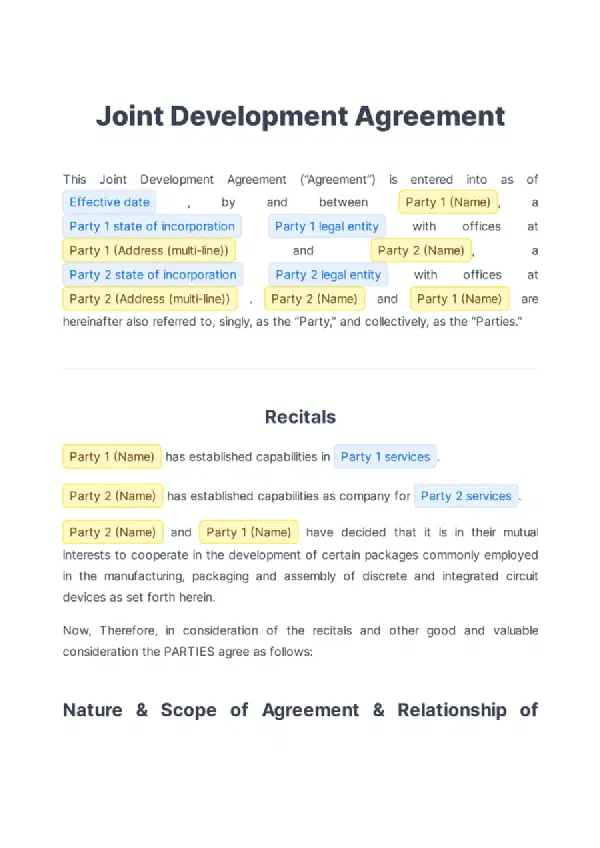 Joint development agreement template
After the agreement ends, each party may use residuals of the other's proprietary information, but no license is granted under either party's copyrights or patents.
Use the free template
For help with the rest of the NDA, see how to write an NDA.
Related clauses
- Confidential information The Confidential Information clause typically outlines obligations regarding the handling and protection of sensitive data shared between parties in a contract. It specifies what constitutes confidential information, the duration of confidentiality, and any exceptions to these terms, ensuring proprietary or private information is not disclosed to unauthorized third parties.
- Exclusions From Confidential Information The "Exclusions From Confidential Information" clause outlines specific categories of information that are not considered confidential under the terms of the agreement. Typically, these exclusions include information that is publicly known, already known by the receiving party prior to disclosure, independently developed by the receiving party, or disclosed by a third party without breach of any confidentiality obligation.
- Mutual confidentiality A mutual confidentiality clause is an agreement between parties to protect each other's confidential information from unauthorized disclosure or use. It requires both parties to maintain the confidentiality of shared sensitive information and can outline the duration, scope, and any permissible exceptions to this obligation.
- Return or destruction of confidential information The Return or Destruction of Confidential Information clause specifies the obligations of parties to either return or destroy all confidential information upon the termination or completion of the contractual relationship. This ensures that sensitive data is not retained unnecessarily, thereby protecting proprietary information and maintaining confidentiality.
- Duration of confidentiality The "Duration of Confidentiality" clause specifies the time period during which parties involved are obligated to maintain the confidentiality of the disclosed information. This period may extend beyond the termination of the agreement, ensuring continued protection of proprietary information for a defined duration or indefinitely.
- Breach of confidentiality A breach of confidentiality clause stipulates the obligations and responsibilities of parties to protect sensitive information from unauthorized disclosure or misuse. It outlines the repercussions and potential legal ramifications should any party fail to uphold these confidentiality commitments.
Frequently asked questions
An exception that lets the receiving party use information its people retain in their unaided memory after seeing the other party's confidential information, usually for any purpose. It is common in NDAs with technology companies.
Memory of a person who did not intentionally memorize the information and does not refer to notes, documents or copies when recalling it. Some clauses add that the person cannot identify the information as confidential.
As the disclosing party, only if you must, and in a narrow form: unaided memory only, no disclosure, no license under your IP, and exclusions for source code, trade secrets and business plans.
It should not. Well-drafted clauses state that they grant no license under patents, copyrights or other intellectual property rights. Check for that sentence before signing.
Mostly. Residual knowledge is the information itself; the residuals clause is the contract term that lets it be used. In employment contracts, residual knowledge clauses let employees keep using their general skills.
More clauses from the library
See allResignation for good reason clause
A "Resignation for Good Reason" clause allows an employee to resign while still receiving severance benefits if significant negative changes—such as a substantial reduction in salary or job responsibilities—occur within the company environment without the employee's consent. This clause is designed to protect employees from adverse modifications to their employment terms, maintaining fairness and security in their job conditions.
11 example clauses
Resolution date
The "Resolution Date" clause specifies a deadline by which a dispute, issue, or contractual obligation must be resolved or concluded. It establishes a fixed date to ensure timely action and closure between the parties involved, maintaining accountability and minimizing prolonged uncertainties.
6 example clauses
Restrictive legend
A restrictive legend is a notation placed on a stock certificate or document indicating that the securities in question are subject to specific restrictions on resale, often to comply with regulatory requirements such as securities laws. This legend serves to inform potential buyers that the securities cannot be freely transferred or sold without meeting certain conditions or obtaining approval.
9 example clauses
Analyze your contracts. Extract important clauses.
Try our AI contract analysis and extract important clauses and information from existing contracts.
Save your favourite clauses
Insert directly with a single click
Upload preferred precedents