
Photo release
A photo release is a person's written permission for a business to take and use photos or video of them. It is a short clause in an employment, event or talent agreement, or a standalone form, and it decides where the images may appear, for how long, and whether the permission can be taken back.
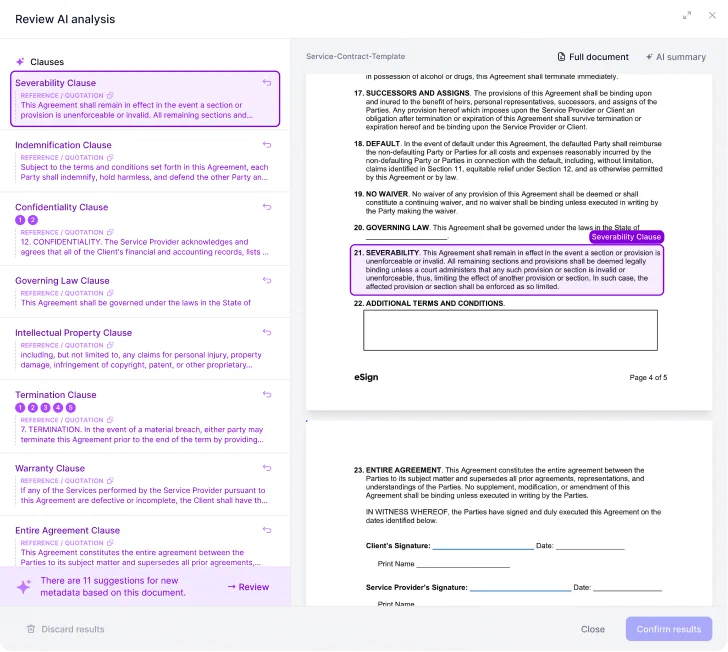
Analyze your contracts. Extract important clauses.
Try our AI contract analysis and extract important clauses and information from existing contracts.
Save your favourite clauses
Insert directly with a single click
Upload preferred precedents
Sample Photo release clauses
Use of Likeness
By signing below, you represent
that you understand that the Company may, from time to time, take photographs, or retain outside photographers to take photographs, of the Company’s business operations, including its offices, equipment and personnel. You authorize the Company to utilize, for legitimate business purposes, any such photographs that may include your portrait, picture or likeness. You understand that this shall serve as a continuing authorization for the Company to utilize your portrait, picture or likeness for the purposes noted above at any time in the future.
(f)Publicity. Executive authorizes the Company and its designees to create photographs, representations and recordings of Executive in connection with any Company Property or any business, operation, products or services of the Company or any Company Entity. To the maximum extent permitted by law, Executive authorizes the Company and its designees to perpetually, internally and externally use, reproduce, display, perform, prepare derivative works based upon, distribute, stream, transmit and retransmit any and all such photographs, representations and recordings and Executive’s names, usernames, voice, signatures, photographs, likeness, representations, portraits, appearance, images, videos, biographical information, opinions, publicity, personal characteristics, personality and the like captured, produced or provided in the course of Executive’s engagement or employment with the Company as well as the derivative works and copies thereof (collectively, the “Likenesses”), in connection with any Company Property or any business, operation, products or services of the Company or any Company Entity, throughout the world and the universe (including in connection with any pictures, audio, video, media, websites, social media, television programs, advertising, sales, marketing, promotion, books, publications, and all other forms and media, whether known now or later).
Source
RBB Bancorp (RBB)I. Publicity. The Executive hereby irrevocably consents to any and all uses and displays, by the Company and its agents, representatives and licensees, of the Executive’s name, voice, likeness, image, appearance and biographical information in, on or in connection with any pictures, photographs, audio and video recordings, digital images, websites, television programs and advertising, other advertising and publicity, sales and marketing brochures, books, magazines, other publications, CDs, DVDs, tapes and all other printed and electronic forms and media throughout the world, at any time during or after the period of her employment by the Company, for all legitimate commercial and business purposes of the Company (“Permitted Uses”) without further consent from or royalty, payment or other compensation to the Executive. The Executive hereby forever waives and releases the Company and its directors, officers, employees and agents from any and all claims, actions, damages, losses, costs, expenses and liability of any kind, arising under any legal or equitable theory whatsoever at any time during or after the period of her employment by the Company, arising directly or indirectly from the Company’s and its agents’, representatives’ and licensees’ exercise of their rights in connection with any Permitted Uses.
Source
PROKIDNEY CORP. (PROK)Discontinuation of Use of Executive’s Name and Likeness. The Company hereby affirms and agrees that it will remove each and every reference to Executive’s name and each and every photograph of Executive from its website and any and all public-facing Company materials by the Effective Date of this Agreement. The Company further affirms and agrees that it will not engage in any actions that could be reasonably understood to hold out Executive as a representative or employee of the Company.
When a business needs one
You need permission to use a recognizable person’s image for commercial purposes: advertising, product pages, social media campaigns, a website “meet the team” page, a case study video. In the US, that permission is often the law, not just good practice:
- New York makes it a misdemeanor to use the name, portrait, picture, likeness or voice of a living person “for advertising purposes, or for the purposes of trade” without their written consent, or a parent’s or guardian’s for a minor (Civil Rights Law § 50).
- California lets the person sue for the greater of $750 or their actual damages, plus the profits from the use, when someone knowingly uses their photograph or likeness in advertising without prior consent (Civil Code § 3344).
In the EU, the photo is personal data and needs a legal basis to process, which for marketing is usually consent.
Typical situations:
- Employees in marketing material or on the website.
- Customers in testimonials and case studies.
- Event attendees, speakers and workshop participants.
- Models, influencers and talent, where the release is part of a paid agreement.
You usually don’t need a release for crowd shots where nobody is the focus, or for news reporting. When in doubt for marketing use, get one.
What the clause should cover
The samples above run from short to sweeping. Strata’s is a few lines an employee signs: the company may photograph its offices and staff and use the pictures “for legitimate business purposes”, as “a continuing authorization”. Boot Barn’s executive agreement is the maximal version: photos, recordings, voice and “likenesses” usable “perpetually, internally and externally”, in any media “whether known now or later”. Most releases should sit in between, and say:
- What is covered: photos, video, audio, name, quotes, job title.
- Where it may be used: website, social media, print, paid ads, internal only.
- For how long, and what happens to material already published when that ends.
- Whether edits are allowed: cropping, retouching, captions, combination with other material.
- Payment, if any, or a statement that there is none.
- Approval rights, if the person gets to see images before publication. Common in talent deals, rare for staff and event photos.
- Withdrawal and exit: how the person can stop future use, and what happens when they leave.
- Release of claims, if you want one: RBB’s version adds that the executive “forever waives and releases” the company from claims arising from the permitted uses.
- Minors: a parent or guardian signs.
Employees and GDPR: consent you can lose
In the EU, a photo of an identifiable person is personal data. If you rely on consent to use it, the person can withdraw that consent at any time (GDPR Art. 7(3)), and consent from employees is viewed skeptically because they may not feel free to say no. In practice:
- make the release a separate, optional document, not a line in the employment contract,
- explain the uses in plain words,
- plan for removal: if someone leaves or withdraws consent, take their photo off the website and stop using it in new material,
- keep the signed release with the data protection records, not in a desk drawer.
US employment releases tend to go the other way: RBB’s consent is “irrevocable” and lasts “during or after the period of her employment”. Even then, departures get negotiated. In ProKidney’s separation agreement the company promised to remove “each and every photograph” of the executive from its website and public materials by the agreement’s effective date. Deciding that up front saves a scramble when someone leaves on bad terms.
Photo release examples
A simple photo release form for events, customer stories or social media. It works as a standalone form or as a clause in a speaker or customer agreement:
Sample clause: Simple photo release
Add this clause to a contract, send it and get it signed in fynk.
Use it in fynk for freeA clause for a paid talent or influencer agreement:
Sample clause: Name and likeness
Add this clause to a contract, send it and get it signed in fynk.
Use it in fynk for freeCollecting releases without paperwork
Releases fail when nobody can find them. A short form people sign on their phone at the event, stored with the date and the signer’s details, beats a stack of paper. In fynk you can turn a release into a conversational form that asks for the person’s details and choices, then send it for signature and keep every signed release in one place.
Free templates with this clause
- General consent form template A consent form you can narrow to photography and video: what is recorded, where it is published, and how to withdraw. Use template
- Influencer contract template (brand ambassador agreement) Sets the platforms, territories, period and uses for the content, including paid advertising, and requires a disclosure whenever the brand reposts it. Use template
- NFL player contract template Gives the club and league the right to use the player's name, likeness, image, picture, photograph and voice as described in the agreement. Use template
- Performance contract template (live performance agreement and release form) Grants the company rights to use the concert recordings and the artist's name, image and voice. Use template
Related clauses
- Name and likeness A "name and likeness" clause typically grants a party the right to use another individual's name, image, and personal attributes for specific purposes, such as marketing or promotional activities. This clause ensures that the individual consents to their likeness being used and clarifies any limitations or conditions associated with its use.
- Data protection clause A data protection clause (also called a data privacy clause) sets out how the parties to a contract handle personal data: which laws apply, who is controller and who is processor, security, breach notification, transfers and deletion. When a supplier processes personal data for the customer, the clause usually points to a separate data processing agreement.
- Use of logo The "Use of Logo" clause specifies the conditions under which one party is permitted to use the logo or trademark of the other party. It outlines the permissible contexts for logo usage, any approval requirements, and restrictions to ensure the brand's integrity and consistency are maintained.
- Waiver of moral rights A waiver of moral rights clause is an agreement where the creator of a work relinquishes their right to claim authorship and object to any derogatory treatments or modifications of their work. This clause allows the rights holder more flexibility in altering, using, or commercializing the work without the need for the creator's consent or potential claims of harm to the creator's reputation.
- Work made for hire A "Work Made for Hire" clause stipulates that any work created by an employee within the scope of their employment, or certain commissioned works falling under specific categories, is automatically owned by the employer or commissioning party from the moment of creation. This ensures that the entity paying for the work retains all intellectual property rights, rather than the individual creator.
- Intellectual property The intellectual property clause in a contract defines the ownership rights and usage conditions for any creations, inventions, or proprietary information that are developed, exchanged, or used during the course of the agreement. It typically outlines whether the intellectual property rights are retained by the creator, transferred to another party, or shared among parties, detailing any limitations and obligations associated with these rights.
Frequently asked questions
Written permission from a person for a business to take and use photos or video of them, stating where, how and for how long the images may be used.
For marketing use, yes, it is the safe choice. In the EU, consent from employees should be separate and optional, and they can withdraw it.
Under GDPR, consent can be withdrawn at any time. Elsewhere it depends on the release. A good release says how withdrawal works and what happens to material already published.
For close-up photos used in marketing, yes. Many events use a registration checkbox plus signs at the entrance, but a signed release is stronger for featured people.
A parent or legal guardian. New York's privacy law asks for the parent's or guardian's written consent for a minor, and many organizations ask for the minor's agreement as well.
Mostly. Model release is the photographer's and stock agency's name for the same permission from a person shown in a photo. A property release covers recognizable private property, such as a building or an artwork, instead of a person.
Not everywhere, but a signature is the proof. New York requires written consent for advertising and trade use, and a signed release with a date shows exactly what the person agreed to.
More clauses from the library
See allPoison pill
A poison pill is a strategy used by a company to discourage hostile takeovers by making its stock less attractive to potential acquirers. It typically involves the issuance of additional shares or rights to existing shareholders, diluting the value and control of the potential acquirer.
17 example clauses
Preamble
The preamble of a contract is its opening paragraph. It names the agreement, the date it is made and the parties, with their legal names, addresses and the short names used in the rest of the contract. It is followed by the recitals, which explain the background.
7 example clauses
Prepayment
A prepayment clause outlines the terms under which a borrower can pay off a loan or portion of it before its due date without facing penalties. This clause often specifies any conditions or fees associated with early payments, helping borrowers manage their financial obligations more flexibly.
14 example clauses
Analyze your contracts. Extract important clauses.
Try our AI contract analysis and extract important clauses and information from existing contracts.
Save your favourite clauses
Insert directly with a single click
Upload preferred precedents