
Non-reliance clause
A non-reliance clause is a statement by one party that it signed the contract based only on what the contract says, not on pitches, forecasts or data room documents. It is common in purchase, investment and loan agreements. A non-reliance letter does the same for a due diligence report written for someone else.
Analyze your contracts. Extract important clauses.
Try our AI contract analysis and extract important clauses and information from existing contracts.
Save your favourite clauses
Insert directly with a single click
Upload preferred precedents
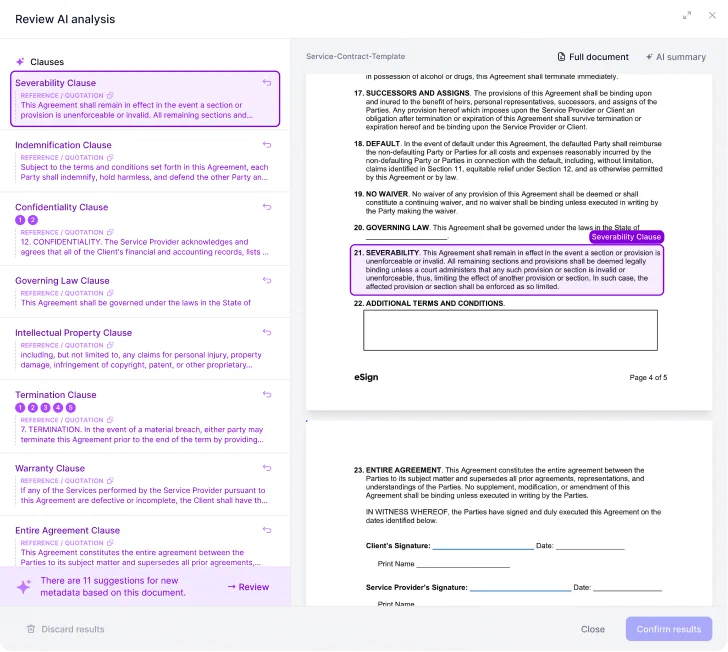
Sample Non-reliance clause clauses
Source
US ENERGY CORP (USEG)4.4. No Reliance. Buyer hereby represents and warrants to Seller that Buyer acknowledges that it has not relied on any oral or written statements, representations, warranties, or assurances from Seller or its officers, directors, employees, agents, or consultants, except those in Article III hereof. Buyer is sophisticated in the evaluation, purchase, ownership and operation of oil and gas properties and related facilities. In making its decision to enter into this Agreement and to consummate the transaction contemplated herein, subject to the express representations and covenants of Seller set forth in this Agreement, Buyer (a) has relied or shall rely solely on its own independent investigation and evaluation of the Assets (including, without limitation, environmental due diligence) and the express provisions of this Agreement and (b) has satisfied or shall satisfy itself as to the environmental and physical condition of and contractual arrangements affecting the Assets.
Source
Glucotrack, Inc. (GCTK)- No Reliance. Each party acknowledges and agrees that neither the other party nor any of such other party’s officers, directors, members, managers, equity holders, representatives or agents has made any representations or warranties to the party or any of its agents, representatives, officers, directors, or employees except as expressly set forth in this Agreement and the Transaction Documents and, in making its decision to enter into the transactions contemplated by this Agreement, the party is not relying on any representation, warranty, covenant or promise of the other party or such other party’s officers, directors, members, managers, equity holders, agents or representatives other than as set forth in this Agreement.
(b) No Reliance. Each Buyer Party, on behalf of itself and its Subsidiaries, acknowledges and agrees that, except for the representations and warranties expressly set forth in Article III, it is not acting (including, as applicable, by entering into this Agreement or the Ancillary Agreements or consummating the Transactions) in reliance on:
(i) any representation or warranty, express or implied;
(ii) any estimate, projection, prediction, data, financial information, memorandum, presentation or other materials or information provided or addressed to the Buyer Parties or any of their respective Affiliates or Representatives, including any materials or information made available in the electronic data room hosted by or on behalf of the Company in connection with the Transactions, in connection with presentations by the Company’s management or in any other forum or setting; or (iii) the accuracy or completeness of any other representation, warranty, estimate, projection, prediction, data, financial information, memorandum, presentation or other materials or information.
Source
RITE AID CORP (RADCQ)SECTION 8.08. Non-Reliance on Agents and Other Lenders. Each Lender acknowledges that it has, independently and without reliance upon any Agent or any other Lender and based on such documents and information as it has deemed appropriate, made its own credit analysis and decision to enter into this Agreement. Each Lender also acknowledges that it will, independently and without reliance upon any Agent or any other Lender and based on such documents and information as it shall from time to time deem appropriate, continue to make its own decisions in taking or not taking action under or based upon this Agreement, any other Loan Document or related agreement or any document furnished hereunder or thereunder.
14.No Reliance Upon Representation. Executive hereby represents and acknowledges that in executing this Agreement, Executive does not rely and has not relied upon any representation or statement made by Employer or by any of Employer’s past or present officers, directors, Executives, agents, representatives or attorneys with regard to the subject matter, basis or effect of this Agreement.
(b) Each of Parent and each Borrower will, and will cause each of the other Loan Parties to, permit Agent and each of its duly authorized representatives or agents to conduct appraisals and valuations at such reasonable times and intervals as Agent may designate. So long as no Event of Default has occurred and is continuing, Agent agrees to provide Borrowers with a copy of the report for any such valuation upon request by Borrowers so long as (i) such report exists, (ii) the third person employed by Agent to perform such valuation consents to such disclosure, and (iii) Borrowers execute and deliver to Agent a non-reliance letter reasonably satisfactory to Agent.
What is a non-reliance clause?
A non-reliance clause is a statement by one party that it signed the contract based only on what the contract itself says. It confirms that the party did not rely on anything else the other side said or showed it: sales pitches, management presentations, forecasts, emails or documents in a data room.
Example: a buyer acquires a company’s assets. The seller’s pitch deck promised strong growth, but the purchase agreement makes no promise about revenue. With a non-reliance clause, the buyer has confirmed that it relied on its own investigation and on the representations written into the agreement, not on the pitch deck. If growth never comes, the buyer cannot sue over the deck.
It is also called a no-reliance clause, an anti-reliance clause or a reliance disclaimer.
Why parties use a non-reliance clause
Before a deal is signed, people say and share a lot: estimates in meetings, spreadsheets in a data room, answers to questions over email. Most of it is never checked as carefully as the contract. A non-reliance clause draws a line:
- The seller or provider limits its exposure to what it actually promised in writing. Claims over informal statements, such as misrepresentation or fraud claims, become much harder.
- Both parties get a contract that can be read on its own, without a dispute over who said what before signing.
- The relying party is pushed to put every promise it needs into the contract as a representation or warranty, where it is enforceable.
Non-reliance clause vs. entire agreement clause
The two often sit side by side in the boilerplate, but they do different jobs.
| Non-reliance clause | Entire agreement clause | |
|---|---|---|
| What it says | “I did not rely on anything outside this contract” | “This contract is the whole deal and replaces earlier agreements” |
| Who speaks | The party that could claim it was misled | Both parties, about the contract |
| What it mainly blocks | Claims that a statement outside the contract misled you into signing | Claims that an earlier promise or side deal is part of the contract |
| Typical wording | “is not relying on any representation … other than those expressly set forth in this Agreement” | “supersedes all prior agreements and understandings” |
An entire agreement clause (also called an integration clause) on its own is usually not enough to stop a fraud claim based on statements outside the contract. Courts in Delaware, for example, look for a clear statement from the relying party itself that it did not rely on them.
Are non-reliance clauses enforceable?
Generally yes, between business parties, but courts read them strictly and the rules differ by jurisdiction.
- United States (Delaware). Delaware courts enforce a clearly drafted non-reliance clause against claims, including fraud claims, based on statements made outside the contract. They do not let it protect a party that lied in the contract’s own representations: in Abry Partners v. F&W Acquisition (Del. Ch. 2006), the court refused to enforce a limit on liability for intentional misstatements in the written representations. The clause also has to be written from the point of view of the party giving up the claim. A general integration clause is not enough.
- England and Wales. A non-reliance clause that excludes liability for misrepresentation must meet the reasonableness test under section 3 of the Misrepresentation Act 1967. In First Tower Trustees v. CDS (Superstores International) (2018), the Court of Appeal held that a blanket non-reliance clause in a lease failed that test.
Other jurisdictions have their own rules, so check the law that governs your contract.
Where non-reliance clauses appear
The sample clauses above come from the most common settings:
- Purchase agreements. The buyer confirms it relied on its own due diligence and on the seller’s written representations only. These clauses often name the data room, projections and management presentations.
- Investment and subscription agreements. The investor confirms it did not rely on statements by the placement agent or other investors.
- Syndicated loans. Each lender confirms it made its own credit decision and did not rely on the agent bank or the other lenders.
- Employment, separation and settlement agreements. The employee confirms that no promises were made beyond the written agreement.
- Derivatives and trading agreements. Each party confirms it is not treating the other’s explanations as investment advice.
What is a non-reliance letter?
A non-reliance letter is a separate short agreement signed before someone gets access to a report that was written for someone else. It is common in due diligence: a buyer, lender or bidder wants to read a financial due diligence report, a valuation or an environmental report that the seller or the bank commissioned.
The firm that wrote the report agrees to share it only if the reader signs a non-reliance letter. In it, the reader typically:
- confirms the report was prepared for the original client, not for it
- agrees that it will not rely on the report and that the author owes it no duty of care
- releases the author from claims based on the report
- agrees to keep the report confidential and not pass it on
A reliance letter does the opposite: the author allows a named third party to rely on the report, usually for a fee and with a cap on liability. Lenders often ask for one.
How to review a non-reliance clause
If you are the party giving up the claims:
- Put every promise you rely on into the contract. Revenue figures, customer numbers, the condition of an asset: if it matters, ask for a representation or warranty.
- Check what the clause names. “Any statement” is broad. Clauses that name the data room, projections and forecasts are broader still.
- Keep a fraud carve-out where you can. Ask that nothing in the clause limits claims for fraud, or at least for fraud in the written representations.
- Check who is covered. Some clauses also protect the other side’s officers, advisers and affiliates.
If you are the party relying on it, make sure it is written from the other party’s point of view (“Buyer acknowledges that it has not relied …”), names the kinds of information you shared, and works together with the entire agreement clause rather than replacing it.
Non-reliance clause example
Sample clause: Non-reliance
Add this clause to a contract, send it and get it signed in fynk.
Use it in fynk for freeCatching a one-sided reliance disclaimer
A non-reliance clause usually arrives in the other side’s first draft, buried in the boilerplate near the end. In fynk, AI Review compares the draft with your playbook and points out a disclaimer that is one-sided or has no fraud carve-out. You then propose the change as tracked redlining in the same document, so the counterparty sees exactly what you changed.
Which contracts include a non-reliance clause?
Asset and share purchase agreements, merger agreements, real estate purchase contracts, subscription and investment agreements, credit agreements, separation and settlement agreements. These free templates include one:
Free templates with this clause
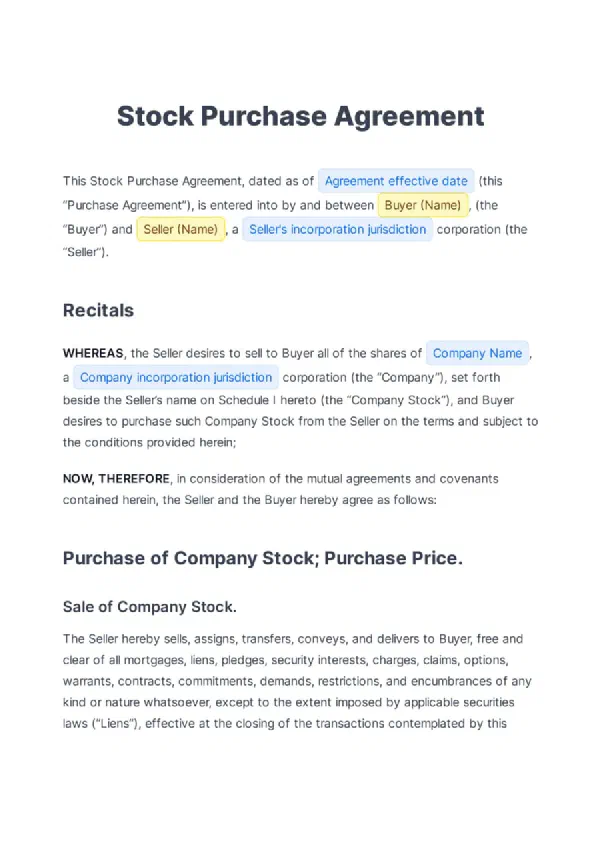 Private stock purchase agreement template
A “No Reliance” section in which the seller confirms it is a sophisticated investor that evaluated the deal on its own.
Use the free template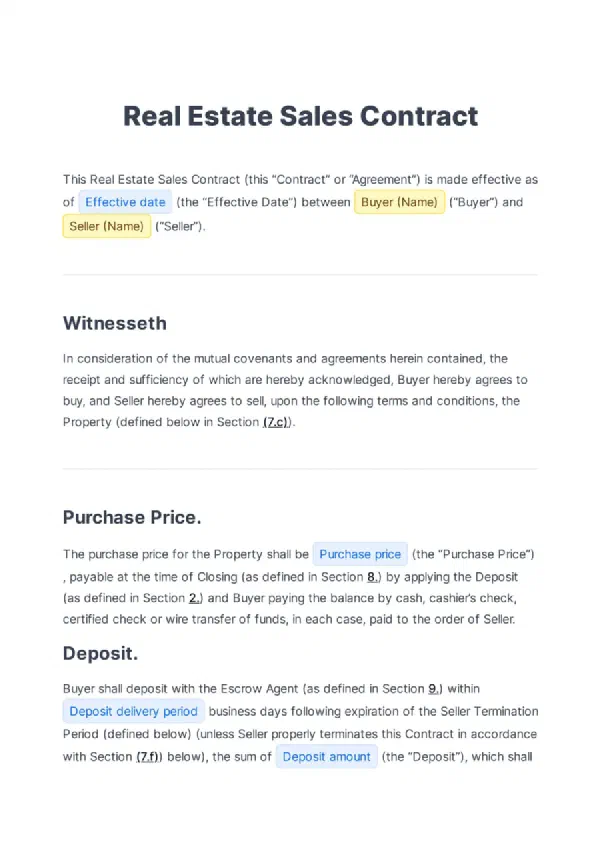 Real estate sales contract template
The seller makes no representation outside the contract, and the buyer confirms it has not relied on any.
Use the free template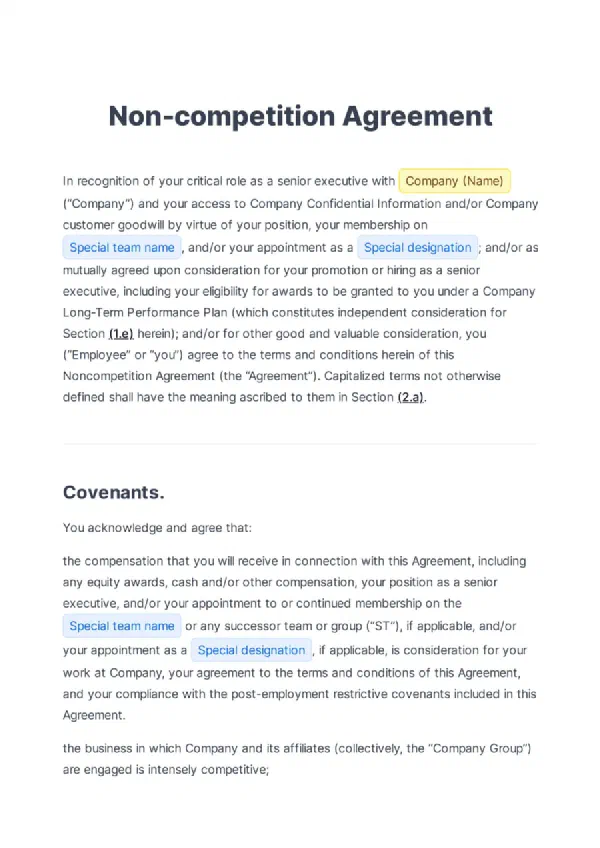 Non-competition agreement template
Both parties confirm they have not relied on any statements other than those in the agreement.
Use the free template
Related clauses
- Entire agreement The "Entire Agreement" clause asserts that the written contract constitutes the complete and final agreement between the parties, superseding any prior discussions, negotiations, or agreements. It ensures that no other verbal or written agreements outside the contract will affect or modify its terms unless formally amended in writing.
- Integration clause An integration clause, also known as a merger clause, ensures that the written contract represents the complete and final agreement between the parties by superseding all prior negotiations, discussions, or agreements, whether written or oral. This clause prevents any party from claiming that external statements or documents should be considered part of the agreement, thus providing clarity and reducing potential disputes.
- Representations and warranties "Representations and warranties are contractual statements made by one or both parties, asserting certain facts and conditions as true at the time of the agreement. These affirmations serve to allocate risk and establish grounds for potential legal remedies if the assertions prove to be false or misleading."
- As is purchase An as-is purchase means the buyer accepts the property or goods in their current condition, with all faults, and the seller makes no repairs and gives no warranties about quality. It does not let a seller hide known defects or skip disclosures the law requires.
- Due diligence period The due diligence period in a contract is a designated timeframe during which the buyer is allowed to thoroughly inspect and evaluate the property or assets involved in the transaction. This period aims to ensure the buyer can identify any potential issues and make informed decisions before finalizing the agreement.
- Survival A survival clause ensures that certain provisions of a contract continue to be enforceable even after the agreement has been terminated or expired. This clause typically includes obligations such as confidentiality, indemnification, and dispute resolution, which may be necessary to uphold beyond the contract's end date.
Frequently asked questions
That a party signed based only on what the contract says. It confirms it did not rely on other statements, forecasts or documents from the other side, which makes claims based on those statements much harder.
No. An entire agreement clause says the written contract replaces earlier agreements. A non-reliance clause is a statement by one party that it did not rely on anything outside the contract. Contracts often need both.
Against fraud claims based on statements outside the contract, often yes, if it is clearly drafted. It does not usually protect a party that lied in the contract's own representations. The rules depend on the governing law.
A short agreement signed before getting access to a report written for someone else, such as a due diligence or valuation report. The reader agrees not to rely on the report and releases its author from claims.
A reliance letter allows a named third party to rely on a report, usually with a cap on the author's liability. A non-reliance letter gives access to the report but rules out any reliance on it.
More clauses from the library
See allNon solicitation agreement
A non-solicitation agreement is a contract clause prohibiting an individual from soliciting a company's clients or employees for a specified period after leaving the organization. This clause is designed to protect a business's relationships and workforce from being disrupted by former employees or business partners.
10 example clauses
Non waiver
A non-waiver clause stipulates that if one party chooses not to enforce a particular term or condition in the contract at any time, it does not mean they waive their right to enforce that term or any other term in the future. This ensures that parties maintain their contractual rights even if they do not immediately enforce them upon a breach or other applicable situation.
16 example clauses
Noncontravention
A noncontravention clause ensures that entering into an agreement does not violate any existing laws, regulations, or other contractual obligations of the parties involved. This clause provides assurance that the execution and performance of the contract will not result in legal conflicts or obligations with third parties.
8 example clauses
Analyze your contracts. Extract important clauses.
Try our AI contract analysis and extract important clauses and information from existing contracts.
Save your favourite clauses
Insert directly with a single click
Upload preferred precedents