
Moonlighting clause
Moonlighting means working a second job or running a side business alongside a main job. A moonlighting clause sets whether and when an employee may do that.
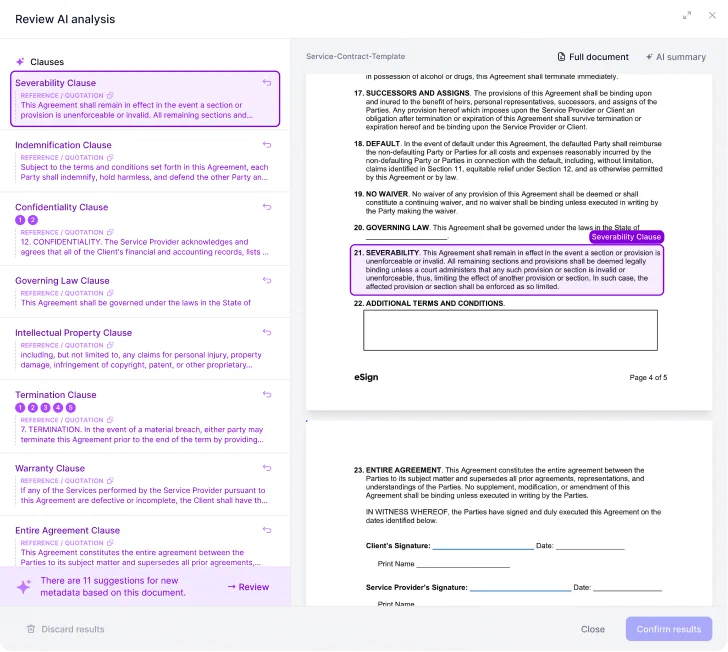
Analyze your contracts. Extract important clauses.
Try our AI contract analysis and extract important clauses and information from existing contracts.
Save your favourite clauses
Insert directly with a single click
Upload preferred precedents
Sample Moonlighting clause clauses
“Moonlighting”. During the Employee’s employment with the Employer, the Employee agrees not to accept or continue in any job, consulting work, directorship, or employment that may conflict with Employee’s duties and responsibilities to Employer, including the duty of loyalty, without the written approval of senior management of the Employer. Without limitation, Employee’s employment with the following shall not be deemed a violation of this provision: ApolloMed Hospitalists, Inc.
- Outside Activities. Executive shall not serve on any boards of directors of, or provide services (whether as an employee or independent contractor) to, any entity other than ICE (including, for example, any for-profit, civic, or charitable organization) on or after the date ICE signs this Employment Agreement without obtaining the consent required by ICE’s internal compliance reporting procedures then in effect.
- OUTSIDE EMPLOYMENT
Employee shall devote Employee’s full time and attention to the performance of the duties incident to Employee’s position with Parent and the Company, and shall not have any other employment with any other enterprise or substantial responsibility for any enterprise which would be inconsistent with Employee’s duty to devote Employee’s full time and attention to Parent and Company matters, provided that, the foregoing shall not prevent the Employee from participating in any charitable or civic organization that does not interfere with Employee’s performance of the duties and responsibilities to be performed by Employee under this Agreement.
Source
SOLERA HOLDINGS, INC- Outside Employment/Conflicting Outside Activities
Employees are not to engage in outside work or conflicting outside activities that have, or could have a material effect on the employee’s duties for the Company; imply sponsorship or support by the Company; adversely affect the reputation of the Company or otherwise compete with the Company. This prohibition also extends to the unauthorized use or application of resources and of any proprietary, confidential or trade secret information or intellectual property. If you wish to accept outside employment or engage in a conflicting outside activity (or have any questions about whether an outside activity conflicts with your employment by the Company), you must submit a request containing pertinent information about the outside employment or activity and obtain the prior written approval of your supervisor. Employees who have been authorized to engage in, and have accepted, outside work or an outside activity may not use paid time off to pursue that effort.
Source
AxoGen, Inc. (AXGN)(c) No Other Business Activities.
(i) Employee shall devote Employee’s entire professional time, energy and skill to the performance of Employee’s duties pursuant to the Agreement, the service of AXOGEN, and promotion of AXOGEN’s interests. The Parties agree that Employee may not during Employee’s employment, except as permitted in writing by AXOGEN, be engaged in any other business activity, whether or not such activity is pursued for gain, profit, or other pecuniary advantage including, without limitation, management or management consulting activities.
(ii) Notwithstanding the preceding subsection, Employee may invest Employee’s personal assets in businesses or real estate that are not in competition with AXOGEN where the form or manner of such investment will not require services on the part of Employee, and in which Employee’s participation is solely that of a passive investor.
Source
B&G Foods, Inc. (BGS)- OTHER BUSINESS ACTIVITIES.
During the Term and subject to Section 5 of this Agreement and Sections 10 and 11 of the Employment Agreement, Consultant may be engaged or employed in any other business, trade, profession or other activity that does not place you in a conflict of interest or perceived conflict of interest with the Company.
What does moonlighting mean?
Moonlighting means working a second job, freelancing or running a side business in addition to a main job, typically in the evenings or on weekends. The word comes from working “by moonlight”, after the regular working day.
Most moonlighting is perfectly legal. It becomes a problem for an employer when the side work competes with the business, uses its confidential information or equipment, creates a conflict of interest, or leaves the employee too tired to do the main job properly.
Example: a software developer at a payroll company builds websites for local shops on weekends. Under a typical moonlighting clause, that is fine. If the developer started building payroll software for a competitor, it would breach the clause, and probably the duty of loyalty too.
What is a moonlighting clause?
A moonlighting clause, also called an outside employment or outside activities clause, is a provision in an employment contract or company policy that sets the rules for work outside the job. It usually does one of three things:
| Approach | What it says | Typical for |
|---|---|---|
| Full-time and attention | The employee devotes full working time to the employer and takes no other employment | Executives, senior managers |
| Approval required | Outside work needs written approval, usually given unless there is a conflict | Many employees, codes of conduct |
| Allowed unless conflicting | Outside work is fine as long as it does not compete, conflict or interfere | Most modern employment contracts, consultants |
The samples above show all three, including a clause that lists a specific outside employer the employee may keep working for, and an exception for passive investments.
Can an employer ban moonlighting?
Within limits:
- Competing work: employers can prohibit work for competitors during employment. Employees owe a duty of loyalty while employed, independent of any non-compete that applies after it ends.
- Confidential information and resources: using the employer’s information, time or equipment for side work can be prohibited.
- Conflicts of interest: working for customers or suppliers can be restricted, as many codes of conduct do.
- Unrelated work in free time: a blanket ban is harder to justify. Some US states, including California and New York, protect lawful off-duty activities to some extent, and in the EU, the Transparent and Predictable Working Conditions Directive limits bans on parallel employment to justified grounds such as health and safety, confidentiality or conflicts of interest.
Working-time rules also matter: in the EU, total weekly working time limits can apply across jobs.
Moonlighting vs. related clauses
- Moonlighting clause: applies during employment, to outside work.
- Non-compete: usually applies after employment ends.
- Conflict of interest: broader, covering investments, gifts and relationships as well as outside work.
- Exclusivity: in commercial contracts, a party’s promise to work only with the other party.
How to write a moonlighting clause
- Define outside work broadly: employment, consulting, board seats, own business.
- Say what is prohibited outright: competing work, work for customers or suppliers, use of company resources.
- Set an approval process for everything else, with a short response time.
- Allow common exceptions: charitable and civic roles, passive investments, academic work.
- Tie it to performance: outside work must not interfere with working hours or performance.
- Keep IP clear: confirm that inventions made on company time or with company resources belong to the employer.
Moonlighting clause example
Sample clause: Outside activities
Add this clause to a contract, send it and get it signed in fynk.
Use it in fynk for freeUsing the right clause for each role
Senior executives usually get a strict full-time clause, while part-time staff and consultants need room for other work. With conditional logic in fynk, one employment template shows the right outside activities clause depending on the role and contract type entered when the contract is created.
Which contracts include a moonlighting clause?
Employment contracts and offer letters, executive employment agreements, codes of conduct and employee handbooks, consulting agreements (often in reverse, confirming that the consultant may work for others), and partnership agreements. These free templates address it:
Free templates with this clause
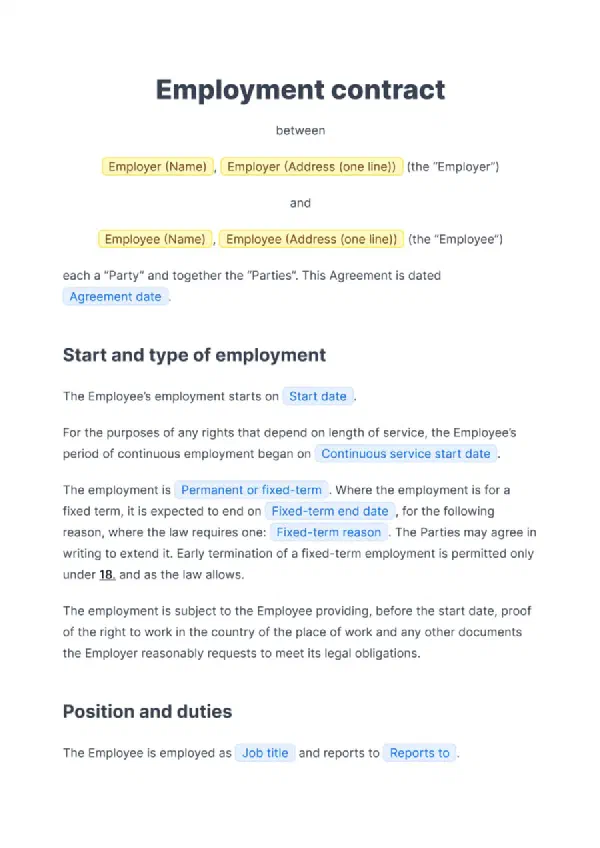 Employment contract template (employment agreement)
Outside working hours, the employee may take up other work unless it creates a material conflict of interest or competes with the employer.
Use the free template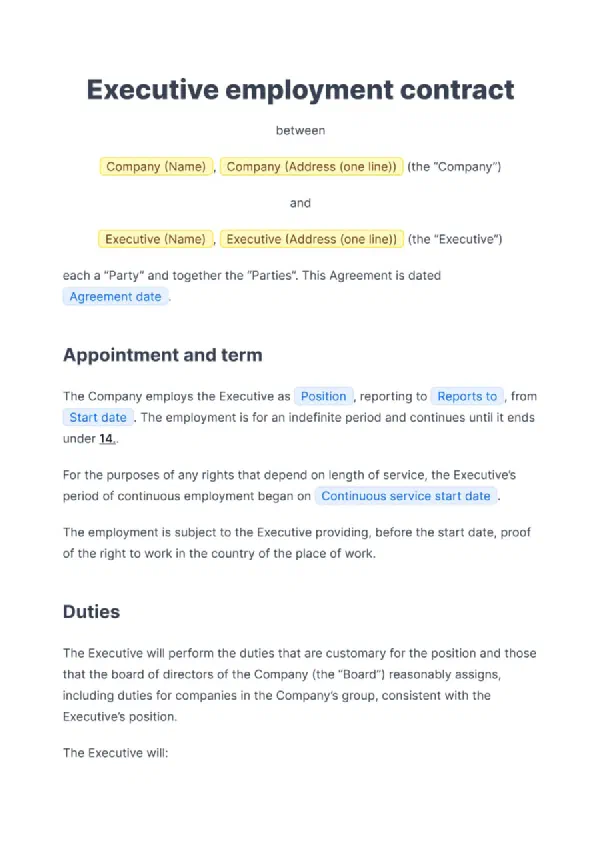 Executive employment agreement template
The executive devotes full working time, attention and skill to the business and acts in the company's best interests.
Use the free template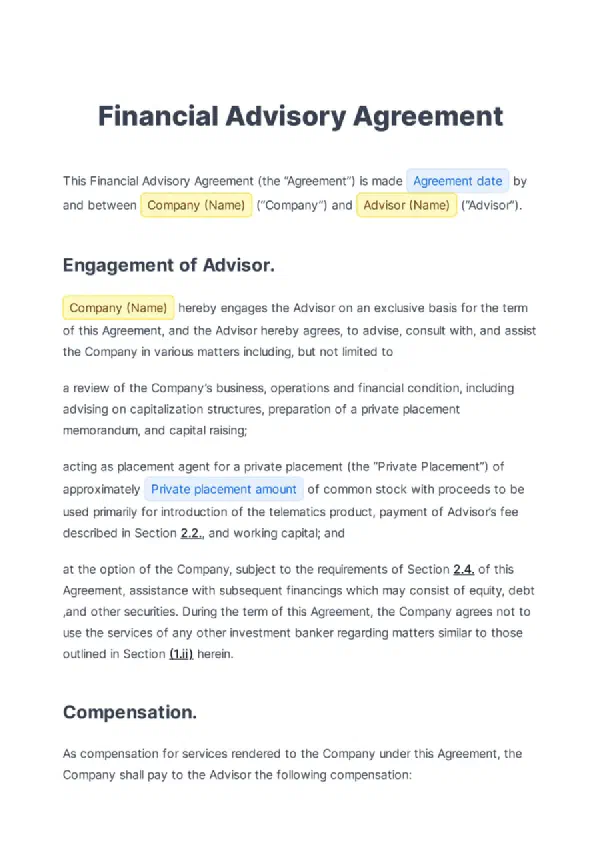 Financial advisory agreement template
The advisor may work for other businesses, including competitors, and need not devote its full time to the company.
Use the free template
Related clauses
- Conflict of interest A conflict of interest clause is designed to prevent situations where an individual's personal interests might interfere with their professional duties and responsibilities. It requires parties to disclose any potential conflicts and may set guidelines for managing or mitigating them to ensure ethical and impartial decision-making.
- Covenant not to compete A "Covenant Not to Compete" is a contractual clause where one party agrees not to enter into or start a similar profession or trade in competition against another party. This clause is typically used to protect business interests by restricting competitive actions in a specified geographic area and for a certain period after the termination of a business relationship.
- Loyalty A loyalty clause in a contract typically requires one party to refrain from engaging in activities that could undermine or compete with the interests of the other party during and sometimes after the contract term. Such clauses are often included in employment or partnership agreements to ensure commitment and allegiance to the company's goals and policies.
- Exclusivity An exclusivity clause is a contractual provision that restricts one party from engaging in certain activities or dealings with other parties outside the agreement. Typically used to secure a commitment, it ensures that the party provides services, products, or rights solely to the other contracting party, often to maintain competitive advantage or preserve confidentiality.
- Non solicitation agreement A non-solicitation agreement is a contract clause prohibiting an individual from soliciting a company's clients or employees for a specified period after leaving the organization. This clause is designed to protect a business's relationships and workforce from being disrupted by former employees or business partners.
- Compliance with company policies The "Compliance with Company Policies" clause typically requires employees, contractors, or partners to adhere to the organization's established policies, procedures, and ethical standards as a condition of their engagement. This clause ensures that all parties are aware of and agree to follow the rules and guidelines intended to maintain a safe, lawful, and cohesive working environment.
Frequently asked questions
Working a second job, freelancing or running a side business in addition to a main job, usually outside regular working hours.
No. Moonlighting is generally legal. It can breach an employment contract or company policy if the side work competes with the employer, creates a conflict of interest or uses the employer's resources.
An employer can usually stop competing or conflicting work and work that harms your performance. A blanket ban on unrelated work in your free time is harder to justify and limited by law in some places.
Only if your contract or company policy requires it. Many require notice or approval for outside work, especially for senior roles.
A moonlighting clause applies during employment and covers any outside work. A non-compete usually applies after employment ends and only covers competing work.
More clauses from the library
See allmortgagee
The mortgagee clause is a provision in a mortgage agreement that protects the lender's interest in the property by ensuring they are named as a beneficiary of insurance policies on the property. This clause guarantees that the lender will receive compensation for damages or losses to the property in cases covered by insurance, even if the homeowner commits fraud or other offenses.
20 example clauses
Most favored customer
A "most favored customer" clause is a contractual provision ensuring that the customer receives terms as favorable as those granted to any other customer. This clause typically requires the seller to extend the same benefits or prices to the favored customer whenever offering better terms to others.
5 example clauses
Most favored nation
The "Most Favored Nation" clause is a contractual provision that ensures a party receives terms that are at least as favorable as those given to any other party in similar agreements. This clause is commonly used to prevent discrimination and to maintain competitive equal footing among contracting parties.
15 example clauses
Analyze your contracts. Extract important clauses.
Try our AI contract analysis and extract important clauses and information from existing contracts.
Save your favourite clauses
Insert directly with a single click
Upload preferred precedents