Executive employment contract
between
Company (Name), Company (Address (one line)) (the “Company”)
and
Executive (Name), Executive (Address (one line)) (the “Executive”)
each a “Party” and together the “Parties”. This Agreement is dated Agreement date.
Appointment and term
The Company employs the Executive as Position, reporting to Reports to, from Start date. The employment is for an indefinite period and continues until it ends under 14..
For the purposes of any rights that depend on length of service, the Executive’s period of continuous employment began on Continuous service start date.
The employment is subject to the Executive providing, before the start date, proof of the right to work in the country of the place of work.
Duties
The Executive will perform the duties that are customary for the position and those that the board of directors of the Company (the “Board”) reasonably assigns, including duties for companies in the Company’s group, consistent with the Executive’s position.
The Executive will:
devote the Executive’s full working time, attention and skill to the business;
act in good faith and in the best interests of the Company, and comply with the Company’s articles, policies and codes of conduct and the lawful decisions of the Board;
promptly tell the Board about any matter that may materially affect the Company, including any serious wrongdoing by any employee or officer of which the Executive becomes aware; and
disclose any personal interest the Executive has in any transaction or arrangement with the Company.
If the Board asks, the Executive will serve as a director or officer of the Company or any group company without additional pay. The Executive will resign from all such offices when the employment ends, or earlier at the Board’s request, and will sign a separate resignation authority in the form the law requires when this Agreement is signed.
Place of work and working time
The Executive’s normal place of work is Place of work. The Executive will travel as the duties reasonably require. A permanent change of the normal place of work requires the Executive’s written agreement, unless the law allows otherwise.
The Executive’s normal working days are Normal working days and normal working hours are Normal working hours. The Executive will also work the additional hours reasonably needed for the proper performance of the duties, within the limits on working time and rest periods set by law.
The base salary covers additional hours only where the Executive lawfully qualifies for that treatment. All overtime pay that the law requires remains payable.
Base salary
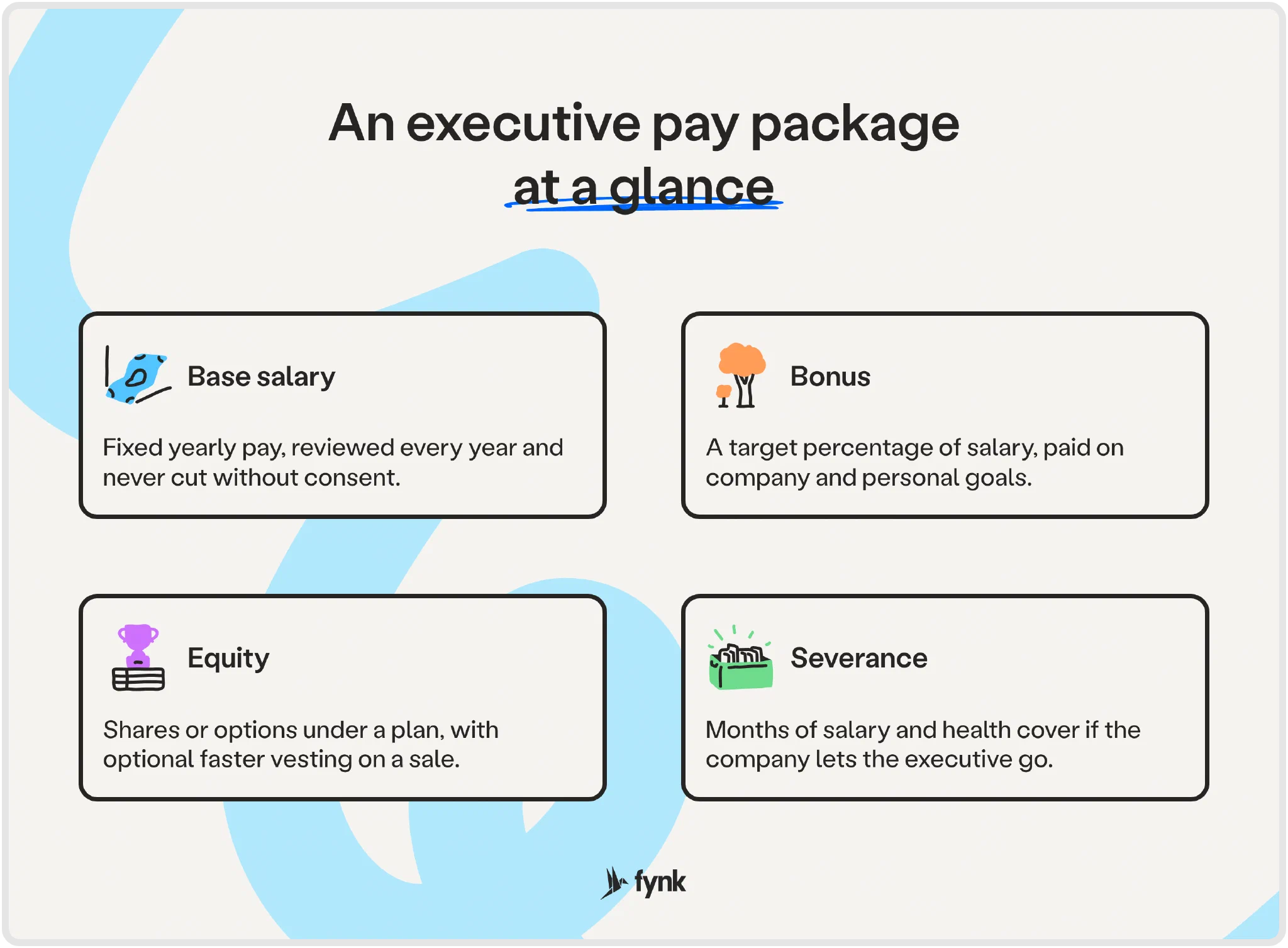
The Company will pay the Executive a gross base salary of Annual base salary per year, paid Pay frequency on Payday in arrears, less the taxes and contributions the Company must withhold by law.
The Board will review the base salary at least once a year. A review does not create a right to an increase. The base salary will not be reduced without the Executive’s written consent.
Bonus
For each financial year, the Executive is eligible for an annual bonus with a target of Target bonus (%) % of the base salary paid for that year. The Board sets company and personal targets at the start of each year after consulting the Executive.
After the end of the year, the Board decides in good faith to what extent the targets have been met and sets the bonus on that basis. No further reduction for time applies. The Company pays the bonus within Bonus payment deadline after the end of the financial year.
Equity
Equity award included?
Where an equity award is granted, the Company will grant Equity award details, under the plan and award agreement provided to the Executive before signing this Agreement. The terms of the award, including vesting, exercise and settlement, are governed by the plan and award agreement, except that the acceleration in 16. prevails over any inconsistent term. The Company will obtain all approvals needed for this before signing.
Benefits, expenses and insurance
The Executive is entitled to the following benefits: Benefits included, and may take part in the Company’s benefit plans available to its senior executives, subject to their terms.
The Company will fulfill any legal duty to enroll the Executive in a pension scheme and to pay contributions. The pension arrangements are: Pension arrangements.
The Company will reimburse reasonable business expenses in line with its expenses policy and against receipts.
During the employment and for at least 6 years after it ends, the Company will maintain directors’ and officers’ liability insurance covering the Executive, with a limit of at least Minimum D&O insurance cover, on terms no less favorable than for its other directors and officers. If such cover becomes unavailable on reasonable commercial terms, the Company will obtain the best cover reasonably available.
To the fullest extent the Company’s articles and the law allow, the Company will indemnify the Executive against liabilities arising from the Executive’s service as a director, officer or employee of the Company or any group company, and will advance reasonable defense costs, which the Executive must repay only if it is finally decided that the Executive was not entitled to the indemnity. These rights survive the end of the employment and any settlement or release.
Holiday, sickness and other leave
The Executive is entitled to Paid holiday days working days of paid holiday in each calendar year, in addition to the public holidays observed at the place of work, to be taken at times agreed with Reports to. The entitlement accrues in proportion in a partial year.
Holiday not taken by the end of a year may be carried over as follows: Holiday carryover. Holiday lapses only where the law allows it and the Company has given the Executive the opportunity and information the law requires. On termination, the Company pays for holiday accrued but not taken.
The Executive will tell Reports to about any absence as soon as reasonably practicable and provide medical evidence of the type the law permits the Company to require. During sickness absence, the Executive receives the following sick pay: Sick pay, and never less than the statutory entitlement.
The Executive is entitled to maternity, paternity, parental, adoption, family and other leave in line with the law and the Company’s policies.
Outside interests
During the employment, the Executive will not, without the Board’s prior written consent, be employed by, provide services to, or hold any office in, any other business. The Board will not unreasonably refuse consent for non-executive roles, charitable or academic activities that do not conflict with the Company’s interests or the Executive’s duties.
The Executive may hold up to 3 % of the shares of a listed company as a passive investment, and may hold investments in businesses that do not compete with the Company.
Confidentiality
“Confidential Information” means all information, in any form, about the business, finances, products, technology, customers, suppliers, employees, investors, plans and trade secrets of the Company and its group that is not public, and any information the Company receives from third parties in confidence.
During and after the employment, the Executive will keep the Confidential Information secret, will use it only for the Company’s benefit, and will not disclose it except as required by the duties or with the Board’s prior written consent.
This clause does not apply to information that is or becomes public through no fault of the Executive, that the Executive lawfully knew before the employment or received from a third party without a duty of confidentiality, or to the Executive’s general skills and experience.
Protected disclosures
Nothing in this Agreement, or in any settlement or release, restricts the Executive from reporting possible wrongdoing to a regulator, law enforcement agency or other authority, cooperating with an investigation or proceeding, giving testimony, receiving an award for information provided to an authority, making any other disclosure protected by law, or seeking legal advice. No prior approval from, or notice to, the Company is needed for these disclosures.
Where the applicable law provides such immunity, the Executive is not liable under trade secret law for disclosing a trade secret in confidence to a government official or to a lawyer solely for the purpose of reporting or investigating a suspected violation of law, or in a complaint or other document filed under seal in a lawsuit or other proceeding. An Executive who files a lawsuit for retaliation for reporting a suspected violation of law may disclose the trade secret to the Executive’s lawyer and use it in the proceeding, if the Executive files any document containing it under seal and does not disclose it except under a court order.
Intellectual property
All intellectual property rights in works, inventions, software, designs and other results that the Executive creates, alone or with others, in performing the duties (“Work Results”) belong to the Company. To the extent they do not belong to the Company automatically, the Executive assigns them to the Company on creation. Where an assignment is not possible under the applicable law, the Executive grants the Company an exclusive, perpetual, irrevocable, worldwide, transferable and sublicensable right to use and exploit the Work Results in all forms, including the right to change them, to the extent the law allows such a grant in advance.
The Executive will promptly disclose all Work Results to the Company and, to the extent the law allows, waives any moral rights in them. Mandatory rules on reporting, claiming, compensation for and release of employee inventions apply and are not limited by this clause.
This clause does not apply to anything the Executive creates on the Executive’s own time, without using the Company’s Confidential Information, and that does not relate to the Company’s business or actual or reasonably anticipated research or development, or to the following intellectual property the Executive owned before the employment: Executive's existing IP. If the Executive, with the Company’s approval, includes such pre-existing intellectual property in Work Results, the Executive grants the Company the rights reasonably needed to use those Work Results.
During and after the employment, the Executive will sign documents reasonably requested to confirm or register the Company’s rights. The Company pays the costs and, after the employment ends, reasonable compensation for the Executive’s time.
Data protection
The Company processes the Executive’s personal data for the purposes of the employment, in line with applicable data protection law and the privacy notice it provides. The Executive will comply with the Company’s data protection and information security policies.
Termination
Either Party may end the employment by giving the other Party Notice period written notice, or any longer notice required by law.
The Company will comply with all requirements of the law on the grounds, procedure, notice and payments for ending the employment. Before deciding that Cause exists, the Board will give the Executive written details of the allegations and a reasonable opportunity to respond.
“Cause” means that the Executive:
commits gross misconduct, fraud or dishonesty in connection with the employment;
commits a material breach of this Agreement or of a material Company policy and, if the breach can be remedied, does not remedy it within 30 days after written notice from the Board;
is convicted of a crime involving dishonesty or violence, or any crime that materially harms the Company’s reputation;
persistently refuses to carry out lawful and reasonable directions of the Board after written warning; or
is disqualified from acting as a director, or barred from performing the duties by a regulator, as a result of the Executive’s own serious misconduct.
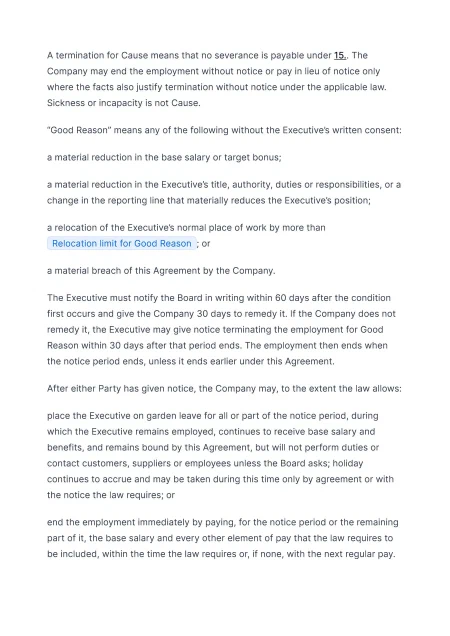
A termination for Cause means that no severance is payable under 15.. The Company may end the employment without notice or pay in lieu of notice only where the facts also justify termination without notice under the applicable law. Sickness or incapacity is not Cause.
“Good Reason” means any of the following without the Executive’s written consent:
a material reduction in the base salary or target bonus;
a material reduction in the Executive’s title, authority, duties or responsibilities, or a change in the reporting line that materially reduces the Executive’s position;
a relocation of the Executive’s normal place of work by more than Relocation limit for Good Reason; or
a material breach of this Agreement by the Company.
The Executive must notify the Board in writing within 60 days after the condition first occurs and give the Company 30 days to remedy it. If the Company does not remedy it, the Executive may give notice terminating the employment for Good Reason within 30 days after that period ends. The employment then ends when the notice period ends, unless it ends earlier under this Agreement.
After either Party has given notice, the Company may, to the extent the law allows:
place the Executive on garden leave for all or part of the notice period, during which the Executive remains employed, continues to receive base salary and benefits, and remains bound by this Agreement, but will not perform duties or contact customers, suppliers or employees unless the Board asks; holiday continues to accrue and may be taken during this time only by agreement or with the notice the law requires; or
end the employment immediately by paying, for the notice period or the remaining part of it, the base salary and every other element of pay that the law requires to be included, within the time the law requires or, if none, with the next regular pay.
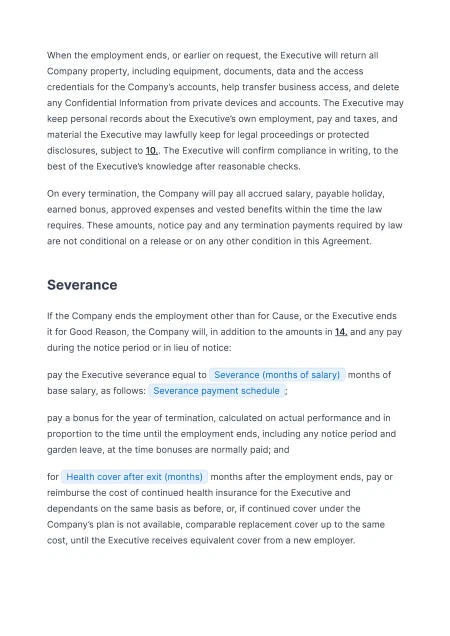
When the employment ends, or earlier on request, the Executive will return all Company property, including equipment, documents, data and the access credentials for the Company’s accounts, help transfer business access, and delete any Confidential Information from private devices and accounts. The Executive may keep personal records about the Executive’s own employment, pay and taxes, and material the Executive may lawfully keep for legal proceedings or protected disclosures, subject to 10.. The Executive will confirm compliance in writing, to the best of the Executive’s knowledge after reasonable checks.
On every termination, the Company will pay all accrued salary, payable holiday, earned bonus, approved expenses and vested benefits within the time the law requires. These amounts, notice pay and any termination payments required by law are not conditional on a release or on any other condition in this Agreement.
Severance
If the Company ends the employment other than for Cause, or the Executive ends it for Good Reason, the Company will, in addition to the amounts in 14. and any pay during the notice period or in lieu of notice:
pay the Executive severance equal to Severance (months of salary) months of base salary, as follows: Severance payment schedule;
pay a bonus for the year of termination, calculated on actual performance and in proportion to the time until the employment ends, including any notice period and garden leave, at the time bonuses are normally paid; and
for Health cover after exit (months) months after the employment ends, pay or reimburse the cost of continued health insurance for the Executive and dependants on the same basis as before, or, if continued cover under the Company’s plan is not available, comparable replacement cover up to the same cost, until the Executive receives equivalent cover from a new employer.
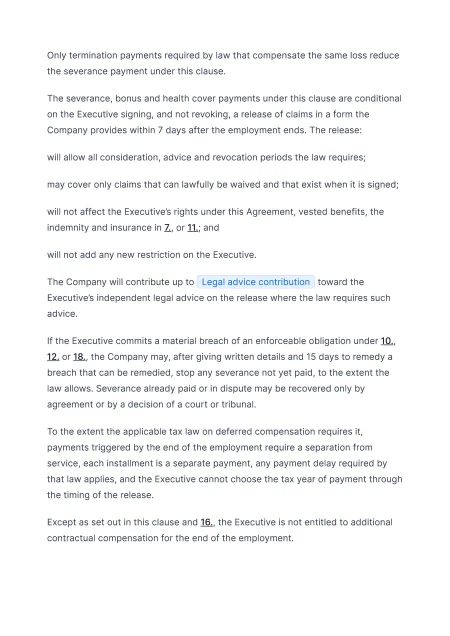
Only termination payments required by law that compensate the same loss reduce the severance payment under this clause.
The severance, bonus and health cover payments under this clause are conditional on the Executive signing, and not revoking, a release of claims in a form the Company provides within 7 days after the employment ends. The release:
will allow all consideration, advice and revocation periods the law requires;
may cover only claims that can lawfully be waived and that exist when it is signed;
will not affect the Executive’s rights under this Agreement, vested benefits, the indemnity and insurance in 7., or 11.; and
will not add any new restriction on the Executive.
The Company will contribute up to Legal advice contribution toward the Executive’s independent legal advice on the release where the law requires such advice.
If the Executive commits a material breach of an enforceable obligation under 10., 12. or 18., the Company may, after giving written details and 15 days to remedy a breach that can be remedied, stop any severance not yet paid, to the extent the law allows. Severance already paid or in dispute may be recovered only by agreement or by a decision of a court or tribunal.
To the extent the applicable tax law on deferred compensation requires it, payments triggered by the end of the employment require a separation from service, each installment is a separate payment, any payment delay required by that law applies, and the Executive cannot choose the tax year of payment through the timing of the release.
Except as set out in this clause and 16., the Executive is not entitled to additional contractual compensation for the end of the employment.
Change of control
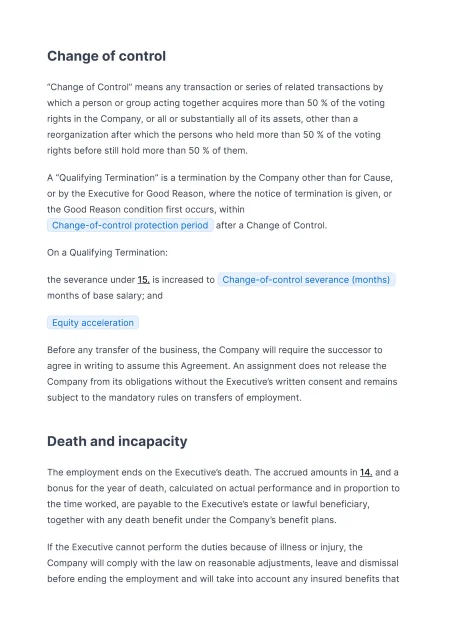
“Change of Control” means any transaction or series of related transactions by which a person or group acting together acquires more than 50 % of the voting rights in the Company, or all or substantially all of its assets, other than a reorganization after which the persons who held more than 50 % of the voting rights before still hold more than 50 % of them.
A “Qualifying Termination” is a termination by the Company other than for Cause, or by the Executive for Good Reason, where the notice of termination is given, or the Good Reason condition first occurs, within Change-of-control protection period after a Change of Control.
On a Qualifying Termination:
the severance under 15. is increased to Change-of-control severance (months) months of base salary; and
Equity acceleration
Before any transfer of the business, the Company will require the successor to agree in writing to assume this Agreement. An assignment does not release the Company from its obligations without the Executive’s written consent and remains subject to the mandatory rules on transfers of employment.
Death and incapacity
The employment ends on the Executive’s death. The accrued amounts in 14. and a bonus for the year of death, calculated on actual performance and in proportion to the time worked, are payable to the Executive’s estate or lawful beneficiary, together with any death benefit under the Company’s benefit plans.
If the Executive cannot perform the duties because of illness or injury, the Company will comply with the law on reasonable adjustments, leave and dismissal before ending the employment and will take into account any insured benefits that a termination may affect. A termination because of incapacity is treated as a termination by the Company other than for Cause.
Post-employment restrictions
The Executive acknowledges that, in the position, the Executive will obtain Confidential Information and build relationships with customers, investors and employees, and that the following restrictions protect the Company’s legitimate business interests. They apply for the stated periods after the employment ends, reduced by any time spent on garden leave.
Non-compete applies?
Where the non-competition restriction applies, for Non-compete period the Executive will not perform materially competing duties, for any business that competes with the Company in Restricted products or services, in any territory for which the Executive had material responsibility during the last 12 months of the employment. This does not cover passive investments permitted under 9. or work only for a part of a business that does not compete with the Company. For the restricted period, the Company will pay the Executive the following compensation: Non-compete compensation, in addition to any severance.
For Non-solicit period, the Executive will not:
actively solicit competing business from any customer, or prospective customer in substantial negotiations with the Company, with whom the Executive had material dealings during the last 12 months of the employment; or
actively persuade any senior or key technical employee with whom the Executive worked materially during the last 12 months of the employment to leave the Company.
General advertising, recruitment not targeted at the Company’s staff, and approaches made on the other person’s own initiative are not covered.
Each restriction is a separate obligation and applies only to the extent it is permitted by the law that applies to the employment and on any conditions that law requires. An invalid restriction may be reduced or removed only to the extent the law allows, without extending the remaining obligations.
Before taking up work during a restricted period that would conflict with an enforceable restriction, the Executive will tell the new employer or client about the restriction.
Clawback
Any bonus or incentive pay may be recovered by the Company where it was paid on the basis of financial results that are later materially restated because of the Executive’s misconduct, or where a clawback policy the Company adopts to comply with the law or stock exchange rules requires it.
Except where the law requires otherwise, recovery is limited to the amount paid in excess of what would have been paid on the restated results. The Company will give written reasons and a calculation and a reasonable opportunity to respond. Recovery through deductions from pay requires a lawful basis and any specific consent the law requires.
Disciplinary procedures, grievances and collective agreements
The Company’s disciplinary and grievance procedures are set out in Procedures location. They do not form part of this Agreement. The Executive may raise a grievance, or appeal a disciplinary decision, in writing to Grievance and appeal contact.
The following collective agreements apply to the employment: Collective agreements. If none is stated, no collective agreement currently applies.
Training the Executive must complete: Required training. The Company pays for training it requires.
General
Notices under this Agreement must be in writing and may be delivered by hand, post or email to the addresses stated above, or to another address a Party notifies in writing. A notice is effective when received. Email and electronic signatures may be used only where they meet the formal requirements of the law, and any requirement of the law for a signed original or a particular form must be met.
This Agreement, together with any equity plan and award agreement, is the entire agreement between the Parties about the employment and replaces all earlier agreements, offers and understandings. This Agreement does not affect any rights already accrued.
The Executive confirms that entering into this Agreement does not breach any obligation to a former employer or any other person, and that the Executive has told the Company about any restriction that binds the Executive.
Changes to this Agreement are valid only in writing, signed by both Parties.
If any provision is invalid or unenforceable, the rest of this Agreement remains in force, and the Parties will replace the invalid provision with a valid one that comes closest to its purpose.
Where mandatory law gives the Executive more favorable rights than this Agreement, those rights apply. All payments are subject to the taxes and contributions the Company must withhold by law.
The Executive may not assign this Agreement.
Governing law and disputes
This Agreement is governed by the laws of Governing law. This choice does not deprive the Executive of the protection of mandatory rules of the law that would apply without it.
The courts of Courts for disputes have jurisdiction over disputes arising from or in connection with the employment, subject to any mandatory rules on where either Party may bring a claim.
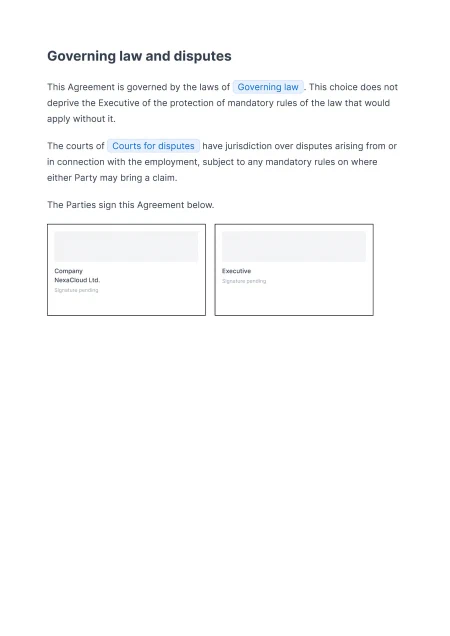
The Parties sign this Agreement below.