
At-will employment clause
An at-will employment clause states that the job has no fixed term and that either the employer or the employee can end it at any time, with or without cause or notice. It doesn't allow a firing for an illegal reason, and other promises in the contract or handbook can limit it.
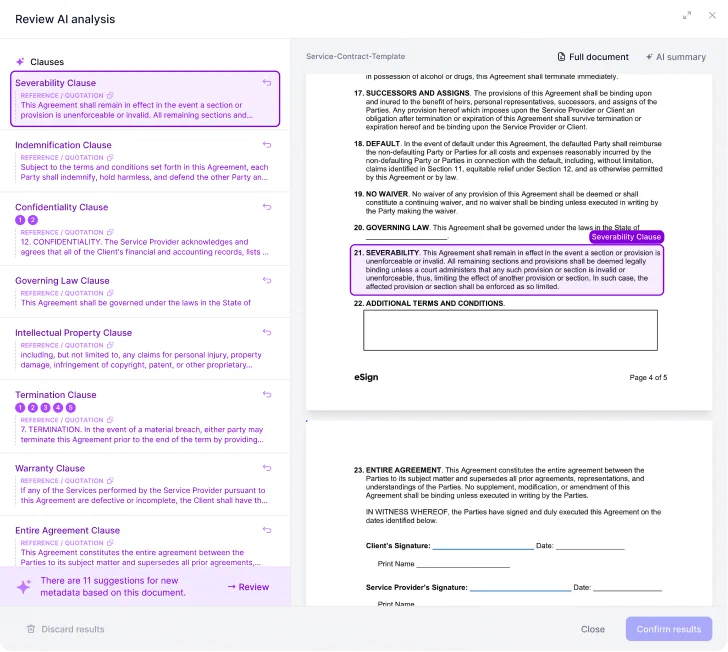
Analyze your contracts. Extract important clauses.
Try our AI contract analysis and extract important clauses and information from existing contracts.
Save your favourite clauses
Insert directly with a single click
Upload preferred precedents
Sample At-will employment clause clauses
At-Will Employment. This Agreement does not imply any right to your continued employment for any period with the Company or any parent, subsidiary, or affiliate of the Company. Your employment with the Company is and will continue to be at-will, as defined under applicable law. This Agreement and any provisions under it will not interfere with or limit in any way your or the Company’s right to terminate your employment relationship with the Company at any time, with or without cause or notice, to the extent permitted by applicable laws. We request that, in the event of resignation, you give the Company at least two weeks’ notice. This letter shall not be construed as an agreement, either expressed or implied, to employ you for any stated term.
Source
Casper Sleep Inc. (CSPR)At-Will Employment. The Company is excited about your joining and looks forward to a beneficial and fruitful relationship. Nevertheless, you should be aware that your employment with the Company is for no specified period and constitutes at-will employment, subject to the terms of this agreement. As a result, you are free to resign at any time, for any reason or for no reason. Similarly, the Company is free to conclude its employment relationship with you at any time, with or without cause, and with or without notice. We request that, in the event of resignation, you give the Company at least two (2) weeks’ notice.
Source
QuantumScape Corp (QS)At-Will Employment. The Company is excited about you joining and looks forward to a beneficial and productive relationship. Nevertheless, you should be aware that your employment with the Company is for no specified period and constitutes at-will employment. As a result, you are free to resign at any time, for any reason or for no reason. Similarly, the Company is free to conclude its employment relationship with you at any time, with or without cause, and with or without prior notice. We request that, in the event of resignation, you give the Company at least six weeks’ notice; provided, however that providing notice does not create an express or implied contract for continued employment or employment for a fixed period. The Company also reserves the right to, in its sole discretion, modify or rescind any of the terms set forth in this letter at any time during the course of your employment, to the extent permitted by law.
At-Will Employment.
I understand and acknowledge that, notwithstanding the terms of any employment agreement or understanding between myself and the Company, my employment with the Company constitutes “at-will” employment. I also understand that any representation to the contrary is unauthorized and not valid unless obtained in writing and signed by an authorized corporate representative of the Company. I acknowledge that this employment relationship may be terminated at any time, with or without good cause or for any or no cause, at the option either of the Company or myself, with or without notice, pursuant to where applicable, the terms and provisions of any employment agreement or understanding between myself and the Company.
At-Will Employment As always, you should be aware that your employment with the Company is for no specified period and constitutes at-will employment, and nothing in this letter constitutes a promise of continued employment for any length of time.
Source
TheRealReal, Inc. (REAL)At-Will Employment. Your employment is at-will, which means that either TRR or you can terminate your employment at any time with or without notice and with or without cause. Consistent with the at-will nature of your employment, TRR may in its sole discretion modify job titles, salaries and benefits from time to time in accordance with applicable laws.
Source
Casper Sleep Inc. (CSPR)At-Will Employment. Your employment with the Company will be “at-will,” and shall continue only so long as continued employment is mutually agreeable to you and to the Company. Either you or the Company may terminate the employment relationship at any time, with or without cause, at your option or at the option of the Company, with or without notice. We request that, in the event of resignation, you give the Company at least two weeks’ notice. Our hope is that you will enjoy your experience at the Company and that our partnership will be both long-standing and mutually beneficial. However, neither this Offer Letter nor any other written material issued by the Company constitutes a contract between you and the Company for employment, express or implied, for any specific duration. Notwithstanding anything herein to the Contrary, you will be party to the Company’s standard Executive Severance Agreement applicable to the Company’s senior executives, substantially in the form attached hereto as Appendix C (the “ESA”); provided that, notwithstanding anything therein to the contrary, the Company may not terminate your ESA other than in connection with an across-the-board termination of the ESAs to which the Company’s other senior executives are a party.
At-Will Employment. Your employment with the Company is “at-will.” This means that your employment with the Company is not for a specific term, and can be terminated by yourself or by the Company at any time for any reason or no reason, with or without cause and with or without notice. Any contrary representations which may have been made or which may hereafter be made to you are superseded by this offer.
Source
Marqeta, Inc.At-Will Employment. Your employment at the Company is “at-will.” You may terminate your employment with the Company at any time and for any reason whatsoever simply by notifying the Company. Likewise, the Company may terminate your employment at any time and for any reason whatsoever, with or without cause or advance notice. As required by law, this offer is subject to satisfactory proof of your right to work in the United States. As an exempt salaried employee, you will be expected to work additional hours as required by the nature of your work assignments.
What is an at-will employment clause?
An at-will employment clause says the job has no fixed term and that either side can end it at any time, with or without a reason and with or without notice. The employee can quit, and the employer can let the employee go. What the clause can’t do is make an unlawful firing lawful: discrimination and retaliation stay off the table.
In most of the US, the clause confirms the default rather than creating it. According to Cornell’s Legal Information Institute, employment is presumed to be at will in 49 states when no express or implied agreement says otherwise. Montana is the exception. Under Mont. Code Ann. § 39-2-904, a discharge is wrongful if it isn’t for good cause and the employee has completed the employer’s probationary period. During the probationary period, Montana lets either side end the job on notice, for any reason or none.
So why write down a default? Because promises made elsewhere, by a recruiter, in a handbook or in the offer letter itself, can be read as a job for a fixed term or a job that only ends for cause. A clear clause in the signed document answers that reading before anyone makes it.
What at-will clauses say: examples from real offer letters
The samples above come from offer letters and employment agreements that companies filed with the SEC. Most of them share the same core sentence and then add one or more of these parts:
- No right to stay employed. Ventyx says its agreement “does not imply any right to your continued employment for any period”, and Casper’s executive offer letter says no written material from the company is a contract for any specific duration.
- A notice request, not a notice period. Ventyx and Casper ask for at least two weeks’ notice when the employee resigns. QuantumScape asks for six weeks and adds that giving notice doesn’t create a contract for continued employment.
- Only a signed writing can change it. TRXADE says any representation to the contrary isn’t valid unless it’s in writing and signed by an authorized representative. ChargePoint says contrary representations, made before or after, are superseded by the offer.
- Room to change the job. TheRealReal reserves the right to modify job titles, salaries and benefits in accordance with applicable laws. QuantumScape reserves the right to modify or rescind the letter’s terms, to the extent permitted by law.
- A restatement at promotion. iRhythm repeats the at-will statement in a promotion letter, so the new role doesn’t read as a promise of job security.
At-will status and severance can sit side by side. Casper’s offer letter is at will and still makes the executive a party to the company’s standard Executive Severance Agreement. The clause decides that the job can end at any time; a severance agreement decides what is paid when it does.
Exceptions to at-will employment
At will means the employer doesn’t need a reason. It doesn’t mean every reason is allowed. The main limits:
- Discrimination and whistleblower laws. The Department of Labor’s termination guidance separates out terminations based on age, race, color, religion, sex, ethnic or national origin, disability or veteran status, and those tied to whistleblower status or a complaint filed under a law the department enforces.
- Public policy. The employment-at-will doctrine in many states bars terminating employees in violation of a well-established public policy of the state. What counts varies from state to state.
- Implied contract. If the employer’s statements or practices, such as handbook promises or a habit of firing only for cause, give the employee a reasonable expectation of continued employment, the at-will presumption may not hold. This is the same idea as an implied contract in general contract law.
- Good faith and fair dealing. Some states, including California, don’t allow an employer to terminate an employee in bad faith.
A written agreement can also replace at-will status altogether: a contract for a fixed term, or one that allows dismissal only for cause, overrides the presumption for that employee.
How to write an at-will employment statement
A short statement covers the essentials. It names the relationship as at will, gives both sides the same right to end it, and says who can change that:
Your employment with [Company] is at will. Either you or [Company] may end the employment relationship at any time, with or without cause and with or without prior notice. No one at [Company] has the authority to promise employment for a fixed period or to change this at-will relationship, except in a written agreement signed by you and [title of the authorized officer].
A few choices make it hold up:
- Put it everywhere a promise could be made. Offer letter, employment contract, employee handbook and the handbook acknowledgment the employee signs. A clause in one document doesn’t help if another one says the opposite.
- Say who can change it. The TRXADE and ChargePoint samples both close the door on side promises: only a signed writing counts, or the offer supersedes whatever was said before.
- Keep the rest of the paperwork consistent. A discipline policy written as a guarantee of warnings before dismissal, or a handbook that promises termination only for cause, invites the implied contract argument.
- Ask for notice, don’t require it. If you want resigning employees to give notice, phrase it as a request, as the QuantumScape letter does. A binding notice period is a separate clause with its own trade-offs.
- Check the state. In Montana, the statutory good-cause rule applies once probation ends.
Write the at-will wording once.
Reuse it in every offer.
If you found this clause in your employment contract
For a US job, an at-will clause is normal and doesn’t mean the employer plans anything. It means you can leave without giving a reason, and the employer can end the job without giving one either. It doesn’t take away the protections listed above, and it doesn’t stop the employer from agreeing to more. Things worth checking in the rest of your documents:
- whether any other document promises a fixed term or dismissal only for cause
- whether you’re asked, or required, to give notice when you resign
- severance terms, which live in a separate agreement or plan, if there is one
- the clauses that keep applying after you leave, such as confidentiality or a non-compete
Each of these has a usual place in a typical employment contract, so they’re quick to find.
Contracts that contain an at-will clause
You’ll find the clause in offer letters, employment agreements and employee handbooks. It also turns up in agreements that only deal with one part of the job and need to say they don’t change its at-will nature, such as retention bonus agreements and invention assignment agreements.
Free templates with this clause
- Employment contract template (employment agreement) Has an at-will employment option in the section on ending the employment, for US hires. Use template
- Employee retention agreement template States that the agreement only covers the retention bonus and that employment stays at will. Use template
- Proprietary information and inventions agreement template The employee acknowledges that the employment may be at will, as defined under applicable law. Use template
Frequently asked questions
Yes. The employee may quit at any time, and the employer may end the employment at any time, as long as the reason isn't unlawful.
Usually yes. The offer letters in the samples on this page only request notice, and QuantumScape's says outright that giving it doesn't create a contract. If your agreement makes notice a binding obligation, that term applies.
Not necessarily. The Department of Labor notes that the Fair Labor Standards Act doesn’t require severance pay; it’s a matter of agreement between employer and employee. An at-will job can come with a severance agreement.
No. At-will employment describes a job. A termination at will clause usually appears in commercial contracts, such as license agreements, and lets a party end the contract without cause, often after a notice period.
In general, yes. Montana is the exception: once the probationary period is over, a dismissal needs good cause. Everywhere, the employer can't fire for an unlawful reason, such as discrimination or retaliation for a protected complaint.
- Termination of employment The "Termination of Employment" clause outlines the conditions under which an employment contract can be terminated by either the employer or the employee. It typically includes details on notice periods, grounds for termination, severance pay, and any obligations or rights of both parties post-termination.
- Termination without cause A "termination without cause" clause allows either party to end the contract without providing a specific reason, usually following a notice period. This provision offers flexibility but requires adherence to any stipulated notice or compensation requirements outlined in the agreement.
More clauses from the library
See allAttornment
Attornment is a tenant's agreement to recognize a new owner, or a lender that has foreclosed, as its landlord and to keep paying rent to them under the existing lease. It is the "A" in an SNDA (subordination, non-disturbance and attornment agreement).
15 example clauses
Audit
An audit clause in a contract grants a party the right to examine and verify the financial records and compliance of the other party to ensure adherence to the agreed terms. This provision helps safeguard against fraudulent activity and ensures transparency and accountability in contractual relationships.
19 example clauses
Automatic renewal
An automatic renewal clause extends a contract for another term unless one party gives notice before a deadline. The clause is easy to agree to and easy to forget, because the date that matters is not the renewal date but the last day to give notice, which often lies months earlier.
6 example clauses
Analyze your contracts. Extract important clauses.
Try our AI contract analysis and extract important clauses and information from existing contracts.
Save your favourite clauses
Insert directly with a single click
Upload preferred precedents