
Internal use only
"For internal use only" limits who may use something and for what: the recipient may use it inside its own business, but may not sell, share or show it to outsiders. In a contract it is a scope restriction with legal force; stamped on a document, it is a label that only binds people who agreed to respect it.
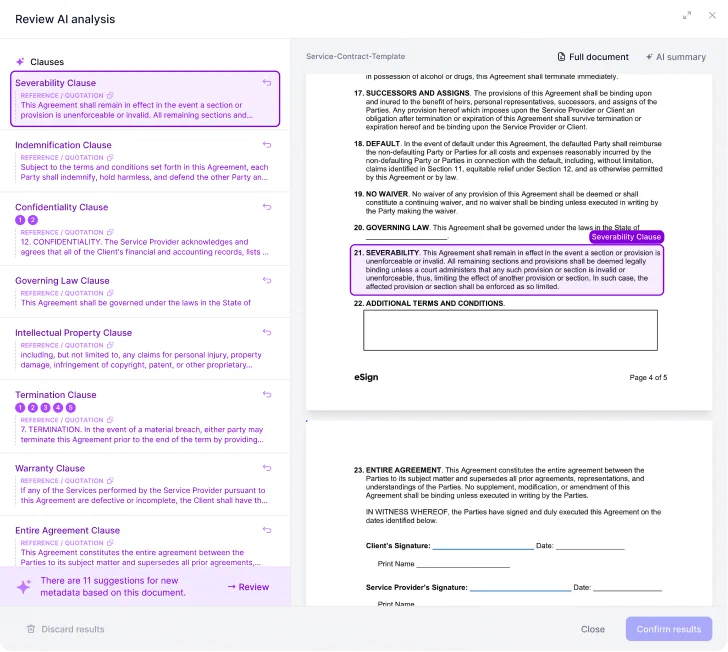
Analyze your contracts. Extract important clauses.
Try our AI contract analysis and extract important clauses and information from existing contracts.
Save your favourite clauses
Insert directly with a single click
Upload preferred precedents
Sample Internal use only clauses
Source
LANNETT CO INC(f) All systems, procedures and related materials provided to Service Recipient by or on behalf of Service Provider or any of its affiliates are for Service Recipient’s internal use only and only as related to the applicable Service. Service Recipient may copy, modify, use, distribute, perform, display, reverse engineer, decompile, disassemble, make derivative works of or in any way alter any software, hardware, data, databases or maintenance or support components, Work Product or intellectual property of Service Provider or any of its affiliates, or any portions of any of the foregoing, in each case, only to the extent Service Recipient has received a copy thereof in connection with the Services. Otherwise, Service Recipient may not do so without Service Provider’s express prior written consent (as may be granted or withheld in Service Provider’s sole and absolute discretion).
Source
Orbitz Worldwide, Inc.B. If Subscriber elects to install and use its own local area network operating environment (“LAN”) to access the Travelport GDSs: (a) Subscriber may copy the applicable Software for its internal use only, subject to Section 2.B above; (b) the number of Subscriber’s users who may concurrently access the Travelport GDSs at a Location shall be equal to the number of global terminal identifiers (“GTIDs”) licensed by Subscriber from Galileo for that Location; and (c) Subscriber shall be responsible for obtaining, implementing, installing, supporting, and maintaining the LAN, the LAN operating system, the workstation operating system, and all hardware and other software required to utilize the Travelport GDSs, but which is not provided by a Galileo Group Company or an NDC, and for all expenses related thereto. Galileo will continue to provide Subscriber with GTIDSs reasonably required to support access to the Services at no additional charge. Galileo will not unreasonably withhold any additional GTIDs requested by Subscriber where the request is to support a reasonable business purpose of Subscriber, such as disaster recovery.
- Use of Agents’ Advice. The Corporation acknowledges and agrees that all written and oral advice, analysis and materials provided by the Agents in connection with its engagement hereunder are intended solely for the benefit of the Corporation and its internal use only and the Corporation covenants and agrees that, except as may be required by applicable law, no such advice, analysis or material will be used for any other purpose whatsoever or reproduced, disseminated, quoted from or referred to in whole or in part at any time, in any manner or for any purpose, without the Agents’ prior written consent in each specific instance. Any advice given by the Agents hereunder will be made subject to and will be based upon such assumptions, limitations, qualifications and reservations as the Agents deem necessary or prudent in the circumstances. The Agents expressly disclaim any liability or responsibility by reason of any unauthorized use, publication, distribution of or reference to any oral or written advice, analysis or materials provided by us or any unauthorized reference to the Agents or this engagement.
- Yodlee Customer Care. Yodlee Customer Care (“YCC”) access is provided for the support of the Yodlee Service. The YCC tool allows for viewing of all the user’s accounts, the ability to view any user error messages and the ability to open a ticket with FIS Client Support. Client shall access and use YCC solely for Client’s internal use only in connection with providing End User support of the PFM Service.
Version A-1 to Exhibit 10.14 – Redacted BOVIE – Resection Device Product Specifications BOVIE MEDICAL CORPORATION CONFIDENTIAL FOR INTERNAL USE ONLY BOVIE MEDICAL CONFIDENTIAL THIS DOCUMENT IS THE PROPERTY OF BOVIE MEDICALCORPORATION AND MUST BE ACCOUNTED FOR. INFORMATION HEREIN IS CONFIDENTIAL. DO NOT REPRODUCE, USE, OR CONVEY ANY PORTION OF THIS DOCUMENT TO UNAUTHORIZED PERSONS, WITHOUT PROPER AUTHORIZATION.
Two different jobs for the same words
“Internal use only” turns up in two places, and it does different work in each.
In a contract, it defines the scope of a right. A software license “for internal use only” lets the customer run the software for its own operations, but not resell it, host it for others or build a service on top of it. A consultant’s report “for the client’s internal use” may be read and acted on, but not handed to a lender or quoted in a press release. Break that limit and you are in breach, and in a license you may also be infringing.
On a document, it is a classification label, like “confidential” or “public”. It tells employees how to handle the file. On its own, a stamp creates no contract with an outsider who receives the document by mistake. It matters legally when a contract or policy gives it force, for example a code of conduct or an NDA that defines confidential information to include anything marked “for internal use only”.
Where “internal use only” sits in a classification scheme
Most company information policies sort documents into three or four levels. The names vary, but the order is usually the same:
| Level | Who may see it | Typical examples |
|---|---|---|
| Public | Anyone | Website copy, published prices, press releases |
| Internal use only | All employees, plus contractors working for the company | Org charts, internal guides, meeting notes, most email |
| Confidential | Named teams or people with a need to know | Contracts, salaries, customer data, financials |
| Restricted | A small, listed group | Trade secrets, deal plans, security keys |
So “internal use only” is the lowest protected level: it keeps a file inside the company, but it doesn’t say who inside may read it. If only part of the company should see something, it belongs one level up, under strict confidentiality rules rather than an internal-use label.
Wording for the label
Short is better. A header or footer that people actually read beats a paragraph nobody does:
- Plain label: “For internal use only.”
- With a handling rule: “Internal use only. Do not share outside [Company].”
- Combined with confidentiality: “Confidential: for internal use only.”
A label that also forbids passing the file on is closer to a not for distribution notice. For the longer disclaimer at the bottom of an email, a confidentiality notice is the better fit, because it also tells a wrong recipient what to do.
Who counts as “internal”
This is where most disputes start. The phrase sounds obvious until the customer wants to give access to:
- Affiliates. A parent company and its subsidiaries are separate legal entities. Unless the contract says internal use includes affiliates, the safe reading is that it does not.
- Contractors and outsourcers. The IT provider that runs the customer’s systems, or the agency doing its marketing, is outside the company. Licenses often allow this expressly, “for the customer’s internal use, including use by contractors acting on its behalf”, and make the customer responsible for them.
- The customer’s own customers. Showing a report in a client meeting, or embedding a licensed dataset in a product, is almost never internal use.
- Successors. If the customer is acquired, does the buyer’s whole group get to use it? That answer comes from the assignment clause and any change of control wording, not from “internal use”.
If any of these will matter, write them in. “Internal use” leaves each of them open to argument.
How the samples use it
The Lannett transition services agreement limits everything the provider hands over to “Service Recipient’s internal use only and only as related to the applicable Service”, which ties the restriction to a purpose as well as a user. The Orbitz subscriber agreement uses it to control copying of software across a local network. The Newgioco engagement letter applies it to advice: the agents’ analysis may not be “reproduced, disseminated, quoted from or referred to” without their consent, and the agents disclaim liability to anyone who relies on it without permission. The Bovie product specification shows the label form, stamped on the document itself.
Drafting an internal use restriction
Sample clause: Internal use
Add this clause to a contract, send it and get it signed in fynk.
Use it in fynk for freeThree choices are packed into that clause: who is inside (affiliates and contractors, yes), what is outside (resale, publication, service bureau use), and who carries the risk for the people inside (the customer). If you are the provider, you may want the affiliate line out. If you are the customer, you almost always want it in.
When a document label is enough, and when it isn’t
A “for internal use only” footer is useful for one thing: it tells colleagues not to forward the slide deck to a client. It does very little once the document is outside, and it doesn’t replace a confidentiality clause with the people you share it with. Two practical points:
- Mark consistently. If some internal documents carry the label and similar ones don’t, it is harder to argue later that the unlabeled ones were meant to stay inside.
- Match the label to the contract. Many NDAs protect only information marked confidential. If your company labels things “internal use only” instead, check that the NDA’s definition of confidential information covers that wording too.
Keeping track of who may use what
Internal use limits are easy to sign and easy to forget, especially when a new subsidiary or an outsourcer starts using a licensed tool two years later. In fynk you can store the license scope as metadata on each contract, so the question “does our license cover the new entity?” is a search, not a reread of every agreement.
Free templates with this clause
- Consulting agreement template States that the consultant's advice is given for the client's internal use, and that the client stays responsible for its own decisions. Use template
- Cloud services agreement template Gives pilot access to the cloud services only for the customer to evaluate and test them for its internal business purposes. Use template
- Reseller agreement template Requires the reseller to buy and keep its own subscriptions to the service for its internal use. Use template
Related clauses
- License grant A license grant clause in a contract specifies the permissions and limitations under which the licensee can use the licensor's property, such as intellectual property or technology. It defines the scope, duration, territory, and conditions of the granted rights, thereby outlining the legal framework for usage and ensuring protection for the licensor's assets.
- Confidential information The Confidential Information clause typically outlines obligations regarding the handling and protection of sensitive data shared between parties in a contract. It specifies what constitutes confidential information, the duration of confidentiality, and any exceptions to these terms, ensuring proprietary or private information is not disclosed to unauthorized third parties.
- Confidentiality clause A confidentiality clause is a section of a contract that obliges one or both parties to keep certain information private and to use it only for the purpose of the contract. It defines what is confidential, who may see it, what is excluded, how long the duty lasts and what happens to the information when the contract ends.
- Confidentiality notice A confidentiality notice is a short statement on an email, fax or document saying the content is confidential and telling anyone who received it by mistake to notify the sender and delete it.
- Not for distribution The "Not for distribution" clause in a contract restricts the sharing or dissemination of the specified materials, information, or documents to unauthorized parties. Its purpose is to protect sensitive content and ensure it is only accessed by individuals or entities explicitly permitted by the contract.
- Definition of affiliate In contracts, an affiliate is any company that controls, is controlled by, or is under common control with a party, such as its parent, subsidiaries and sister companies. The definition decides who else can use rights or is bound by duties under the contract.
- Strict confidentiality The strict confidentiality clause mandates that all parties involved must keep the information disclosed during the agreement private and not share it with any unauthorized individuals or entities. Breaching this clause can lead to legal consequences, including possible financial penalties or termination of the contract.
Frequently asked questions
That the material may be used only inside the organization that received it, for its own purposes. It may not be shared with, sold to or used for the benefit of outsiders.
On a form, a box or section marked internal use only is for the organization's staff to fill in, such as a reference number or approval. The person filling out the form should leave it blank.
Internal use only means anyone inside the company may see the material. Confidential is a stricter level: only the people who need it for their work may see it, even inside the company.
Not automatically. The label shows how the owner wanted it handled. It gains legal force through a contract, policy or law that protects information marked that way.
Not unless the contract says so. Subsidiaries are separate companies, so a license limited to the customer's internal use is usually read as excluding them.
Only if the license allows it. Many licenses permit use by contractors working for the customer, as long as the customer remains responsible for them.
More clauses from the library
See allinterpretation
The interpretation clause in a contract provides guidance on how the terms and definitions within the agreement should be understood and applied. It helps prevent ambiguities by clarifying the meanings of specific words or phrases, ensuring that all parties have a consistent understanding of the contractual terms.
9 example clauses
Interruption of services
The "Interruption of Services" clause outlines the conditions and responsibilities associated with temporary or permanent disruptions in the provision of services outlined in a contract. It typically includes information on notification requirements, potential remedies, and liability limitations for the parties involved when service interruptions occur.
9 example clauses
Intuitu personae
The "intuitu personae" clause emphasizes the personal nature of a contractual relationship, indicating that the contract has been entered into specifically because of the individual qualities or characteristics of the parties involved. Such a clause often restricts the ability to transfer or assign rights and obligations to third parties without consent, as the identity and personal attributes of the involved parties are crucial to the contract's intent.
5 example clauses
Analyze your contracts. Extract important clauses.
Try our AI contract analysis and extract important clauses and information from existing contracts.
Save your favourite clauses
Insert directly with a single click
Upload preferred precedents