
Confidentiality notice
A confidentiality notice is a short statement on an email, fax or document saying the content is confidential and telling anyone who received it by mistake to notify the sender and delete it.
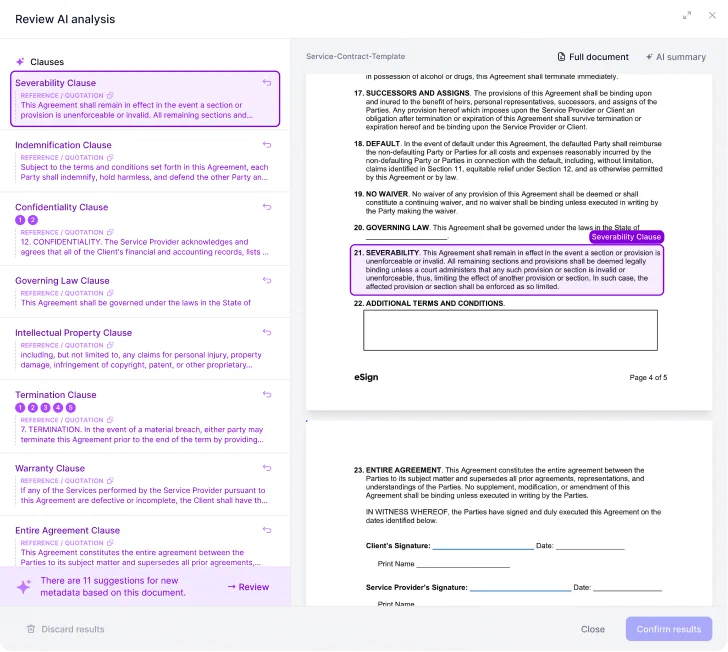
Analyze your contracts. Extract important clauses.
Try our AI contract analysis and extract important clauses and information from existing contracts.
Save your favourite clauses
Insert directly with a single click
Upload preferred precedents
Sample Confidentiality notice clauses
CONFIDENTIALITY NOTICE: This facsimile is intended only for the use of the individual or entity to which it is addressed and may contain information which is privileged and confidential. If the reader of this message is not the intended recipient or an employee or agent responsible for delivering the message to the intended recipient, you are hereby notified that any dissemination, distribution or copying of this communication is strictly prohibited. If you have received this communication in error, please notify us immediately by telephone and return the original message to us by mail. Thank you.
Source
ENERGY KING, INC.CONFIDENTIALITY NOTICE: This e-mail transmission, and any documents, files or previous e-mail messages attached to it may contain confidential information that is legally privileged. If you are not the intended recipient, or a person responsible for delivering it to the intended recipient, you are hereby notified that any disclosure, copying, distribution or use of any of the information contained in or attached to this transmission is STRICTLY PROHIBITED. If you have received this transmission in error, please immediately notify the sender. Please destroy the original transmission and its attachments without reading or saving in any manner. Thank you Law Offices of Larry Epstein APC.
Source
PARKWAY PROPERTIES INCNOTICE OF CONFIDENTIALITY RIGHTS: IF YOU ARE A NATURAL PERSON, YOU MAY REMOVE OR STRIKE ANY OR ALL OF THE FOLLOWING INFORMATION FROM THIS INSTRUMENT BEFORE IT IS FILED FOR RECORD IN THE PUBLIC RECORDS: YOUR SOCIAL SECURITY NUMBER OR YOUR DRIVER’S LICENSE NUMBER.
- Confidential and Proprietary Information.
“Confidential and Proprietary Information” means all documents, software, reports, data, records, forms and other material (a) obtained by Consultant from The Company in the course of performing the Services: (i) that have been marked as confidential;
(ii) whose confidential nature has been made known by The Company to Consultant; or (iii) that due to their character and nature, a reasonable person under like circumstances would treat as confidential or (b) developed or prepared by Consultant based upon information described in (a). Confidential and Proprietary Information does not include information which: (i) is already known to Consultant at the time of disclosure by The Company; (ii) is or becomes publicly known through no wrongful act of Consultant;
(iii) is independently developed by Consultant without benefit of The Company’s Confidential and Proprietary Information;
or (iv) is received by Consultant from a third party without restriction and without a breach of an obligation of confidentiality.
All Confidential and Proprietary Information of The Company remains the property of The Company and will be maintained in confidence by Consultant, will not be used by Consultant for any purpose other than to provide the Services under this Agreement, and will not be disclosed to any third party, except as provided herein, without The Company’s prior written consent, unless required by applicable law or legal process. At the conclusion of the Services, Consultant will, upon The Company’s request, return to The Company all Confidential and Proprietary Information of The Company in its possession or, upon The Company’s request, Consultant will destroy all Confidential and Proprietary Information of The Company in its possession, subject to Consultant’s need to preserve its interests hereunder. Upon written request by The Company, Consultant will certify the destruction of all Confidential and Proprietary Information of The Company, clearly identifying any such information retained by Consultant as necessary to preserve its interests hereunder. The confidentiality restrictions and obligations imposed by this section will terminate five (5) years after the expiration or termination of this Agreement.
What is a confidentiality notice?
A confidentiality notice, also called a confidentiality disclaimer or confidentiality statement, is a short text added to an email, fax cover sheet or document. It says the content is confidential and may be privileged, that it is meant only for the named recipient, and that anyone who received it by mistake should tell the sender and delete it.
It appears in three main places:
- Email footers, added automatically to every outgoing message.
- Fax cover sheets, where the classic wording comes from.
- Documents, as a header, footer or cover legend, such as “Confidential: for internal use only” or “Confidential and proprietary”, a pairing of secrecy with ownership. The internal use only part is a separate, weaker label: staff may share it with any colleague, but not with outsiders.
Contracts themselves use a related idea: many NDAs only protect information that is marked as confidential, which turns a document legend into something with real contractual weight.
Email confidentiality notice examples
The email version is often called a confidential email disclaimer. A typical one reads:
Confidentiality notice: This email and any attachments are confidential and may be legally privileged. They are intended only for the person or entity to whom they are addressed. If you are not the intended recipient, please notify the sender by replying to this email, delete it from your system and do not copy, forward or use its contents.
Short versions work better. Notices that run for a full paragraph in capital letters are skipped by readers and add little legally. Two shorter variants:
- One line: “Confidential: intended only for the addressee. If you received this by mistake, please tell the sender and delete it.”
- Internal email: “Internal and confidential. Please don’t forward outside [Company].”
On a fax cover sheet, the same idea fits in two lines:
Confidential: The pages that follow are intended only for the recipient named above. If you received this fax in error, please call the sender at the number above and destroy all pages.
Document confidentiality notice examples
For documents, the notice usually sits in the header or footer, or on a cover page:
- Internal document: “Confidential. For internal use only. Do not distribute outside [Company].”
- Shared under an NDA: “Confidential Information of [Company], provided under the Nondisclosure Agreement dated [date].”
- Legal advice: “Privileged and confidential. Attorney-client communication.”
- Draft contract: “Confidential draft for discussion purposes. Not an offer capable of acceptance.”
Do confidentiality notices have legal effect?
Less than their length suggests:
- They are not a contract. A stranger who receives an email by mistake never agreed to anything, so an email footer alone usually cannot bind them.
- They can help with privilege. Under US Federal Rule of Evidence 502(b), an inadvertent disclosure does not waive attorney-client privilege if the holder took reasonable steps to prevent it and promptly tried to fix it. A notice can be part of showing that, though it does not decide the question on its own.
- They trigger duties for lawyers. ABA Model Rule 4.4(b) requires a lawyer who receives a document they know or reasonably should know was sent by mistake to promptly notify the sender. A clear notice makes that knowledge harder to deny.
- They support trade secret protection. Under the federal Defend Trade Secrets Act, information only counts as a trade secret if its owner took “reasonable measures to keep such information secret”, and marking documents confidential is one of the measures that help show that.
- They matter most under an NDA. If the NDA defines confidential information as information “marked as confidential”, an unmarked document may not be protected at all.
In other words, a notice is a good habit, not a safeguard. What protects information is sending it only to the right people and having an agreement in place before sharing it.
Marking an email as confidential
A footer only asks. Email programs can do a little more, though neither option below makes a message secret:
- Outlook: in the draft, open File > Properties and set Sensitivity to Confidential. The recipient sees “Please treat this as Confidential” above the message, but Microsoft notes that the setting doesn’t stop anyone from forwarding it. Restricting forwarding and printing needs encryption or rights management.
- Gmail: confidential mode turns off forwarding, copying, printing and downloading, and lets you set an expiry date or revoke access. Recipients can still take screenshots or photos of the screen.
For documents that leave the company, the dependable steps are the old ones: a clear legend on every page, a short distribution list, and an NDA signed before anything is sent.
A notice the law requires: Texas deeds
One of the sample clauses above comes from a Texas real estate document. It carries a “Notice of confidentiality rights” telling an individual that they may remove their Social Security number or driver’s license number before the instrument is recorded. Texas Property Code section 11.008 has required this notice since 2003 on instruments that transfer real property to or from an individual, at the top of the first page in bold or capital 12-point type. Leaving it out doesn’t make the deed invalid, and the county clerk can’t reject the document for that reason alone.
Marking requirements in NDAs
If you rely on an NDA, check how it defines confidential information:
| Definition | What is protected | Risk |
|---|---|---|
| Only information marked “confidential” | Documents with a notice or legend | Unmarked emails, slides and calls may fall outside |
| Marked, or identified as confidential within a set time after oral disclosure | Marked documents and confirmed oral information | Someone has to send the written confirmation |
| Marked, or confidential by its nature | Anything a reasonable person would see as confidential | Less certainty about the edges |
| All information disclosed, marked or not | Everything shared under the agreement | Broadest, often negotiated down by recipients |
If the NDA requires marking, the confidentiality notice on each document is not a formality: it decides whether the information is covered.
Confidentiality notice clause example
This clause, for an NDA or services agreement, makes the marking rules explicit:
Sample clause: Marking of confidential information
Add this clause to a contract, send it and get it signed in fynk.
Use it in fynk for freePutting the notice on every document
Marking only helps if it is done every time, and it is the step people forget under deadline pressure. In fynk, the confidentiality legend can be built into your document templates, so every proposal, NDA and contract created from them carries the approved notice without anyone adding it by hand.
Which documents carry a confidentiality notice?
Business emails and fax cover sheets, NDAs and the documents shared under them, term sheets and draft contracts, board materials, financial statements and data room documents, legal advice, HR and medical records, and pricing proposals. These free templates define confidential information with or without marking:
Free templates with this clause
- Vehicle supply agreement template Confidential information must be marked as such in writing, or identified at the time of oral or visual disclosure and confirmed in writing. Use template
- Franchise agreement template Records the franchisee provides are kept confidential if they are marked confidential and would reasonably be considered confidential. Use template
- Confidentiality and exclusivity agreement (M&A) template Information about the company is confidential whether or not it is labeled or otherwise identified as confidential. Use template
Related clauses
- Confidential information The Confidential Information clause typically outlines obligations regarding the handling and protection of sensitive data shared between parties in a contract. It specifies what constitutes confidential information, the duration of confidentiality, and any exceptions to these terms, ensuring proprietary or private information is not disclosed to unauthorized third parties.
- Confidentiality clause A confidentiality clause is a section of a contract that obliges one or both parties to keep certain information private and to use it only for the purpose of the contract. It defines what is confidential, who may see it, what is excluded, how long the duty lasts and what happens to the information when the contract ends.
- Exclusions from confidential information The exclusions from confidential information clause lists the categories of information that are not considered confidential under the agreement. Typically, these exclusions cover information that is publicly known, already known by the receiving party before disclosure, independently developed by the receiving party, or received from a third party without breach of any confidentiality obligation.
- Strict confidentiality The strict confidentiality clause mandates that all parties involved must keep the information disclosed during the agreement private and not share it with any unauthorized individuals or entities. Breaching this clause can lead to legal consequences, including possible financial penalties or termination of the contract.
- Disclaimer A disclaimer clause is a legal statement included in contracts to limit or waive liability for certain actions or outcomes, protecting the party issuing it from potential claims or losses. Learn what a disclaimer clause is, how it limits liability, and explore practical disclaimer examples used in contracts and services.
- Copyright disclaimer A copyright disclaimer is either a copyright notice that states who owns a work (© year, owner) or a fair use statement about someone else's material. Notices are optional in the US since 1989 but still useful, and contracts often require licensees to keep them.
Frequently asked questions
A short statement in the email footer saying the message is confidential, meant only for the addressee, and should be reported and deleted if received by mistake.
Paste the notice below your name in your email client's signature settings, so it is added to every message you send. For a whole company, an admin can append the same footer to all outgoing mail with a disclaimer rule in Microsoft 365 or a footer setting in Google Workspace.
Generally not as a contract, because an unintended recipient never agreed to them. They can still help show that the sender treated the information as confidential or privileged.
Usually yes. Both names are used for the short text on an email or document that marks it as confidential. A confidentiality clause is different: it is the part of a contract that sets the duty to keep information secret.
In the header or footer of every page, or on the cover page, so it stays visible when pages are printed, copied or shared separately.
That the content is confidential and also protected by legal privilege, usually because it is communication with a lawyer for legal advice. The label alone does not create privilege.
Tell the sender, don't forward or use it, and delete it if they ask. That is what the notice requests, and for lawyers in the US it is a professional duty: ABA Model Rule 4.4(b) requires them to promptly notify the sender.
Only if the NDA requires it. Many NDAs protect only marked information or information identified as confidential, so check the definition before sharing.
More clauses from the library
See allConfidentiality of documents and information
The confidentiality clause ensures that all documents and information exchanged between parties remain private and are not disclosed to unauthorized individuals or entities. This clause obligates the parties to implement appropriate measures to safeguard sensitive data, thereby protecting proprietary and personal information from unintended exposure or misuse.
5 example clauses
Conflict of interest
A conflict of interest clause is designed to prevent situations where an individual's personal interests might interfere with their professional duties and responsibilities. It requires parties to disclose any potential conflicts and may set guidelines for managing or mitigating them to ensure ethical and impartial decision-making.
20 example clauses
Conflict of laws
A "conflict of laws" clause determines which jurisdiction's laws will be applied in interpreting and governing a contract in the event of legal disputes. It provides clarity and predictability for all parties involved by specifying the preferred legal framework to resolve any potential conflicts.
18 example clauses
Analyze your contracts. Extract important clauses.
Try our AI contract analysis and extract important clauses and information from existing contracts.
Save your favourite clauses
Insert directly with a single click
Upload preferred precedents