
Copyright disclaimer
A copyright disclaimer is either a copyright notice that states who owns a work (© year, owner) or a fair use statement about someone else's material. Notices are optional in the US since 1989 but still useful, and contracts often require licensees to keep them.
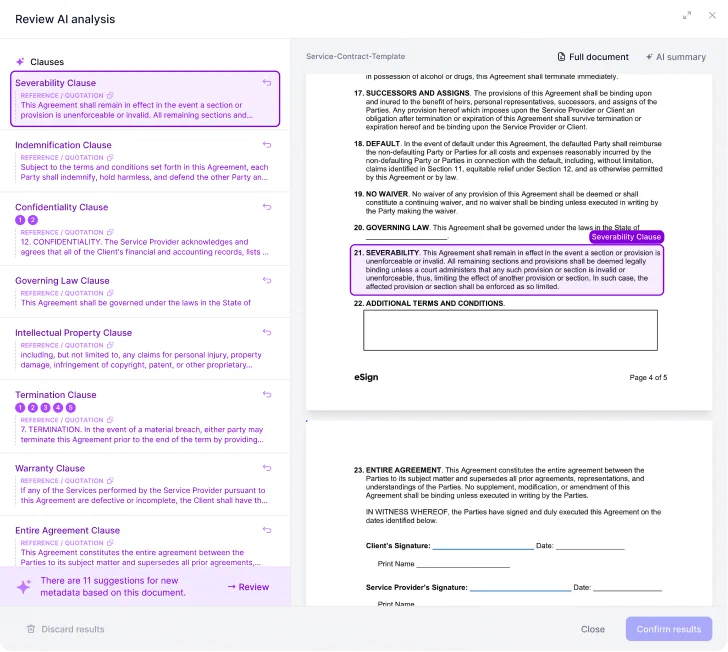
Analyze your contracts. Extract important clauses.
Try our AI contract analysis and extract important clauses and information from existing contracts.
Save your favourite clauses
Insert directly with a single click
Upload preferred precedents
Sample Copyright disclaimer clauses
7.3 Proprietary Notices. SRDSP will not (and will require that its Customers not) remove, alter, cover or obfuscate any copyright notices or other proprietary rights notices placed or embedded by Hydro Phi on or in any Products.
Source
QAD INCLicensee agrees not to remove, alter or destroy any proprietary, trademark or copyright notices placed upon or contained within the RSA software, user manuals or any related materials or documentation. Licensee acquires no rights of any kind in or to any RSA trademark, trade name, logo or product designation under which the RSA software was or is marketed and shall not make any use of the same for any reason.
Client agrees to display, without alteration, any and all copyright notices, proprietary notices, credit line, date line, bylines, disclaimers, restrictions or other provider information contained in the Content. Where MarketWatch or Yodlee (either directly or through FIS) is creating and hosting Internet web pages containing the Content, Client shall display and link the MarketWatch registered service mark, logo and/or textual attribution and that of MarketWatch’s content providers when required, on all pages displaying such Content.
9.1 Licensee agrees that it will cause to appear on or within each Licensed Product manufactured, sold, and/or distributed under this Agreement and on or within all advertising, marketing, promotional, or display material bearing the Licensed Marks, the appropriate trademark and copyright notices, markings, and/or designations, and/or any other notice requested by Licensor. Each Licensed Product that is distributed and/or sold in a carton, container, packing and/or wrapping material bearing the Licensed Marks, shall have such notices appear upon the said carton, container, packing, and/or wrapping material.
Source
DIGITAL RIVER INC /DE(j) COMPANY shall not alter, remove, or obscure any copyright notices in the Licensed Software and shall include in any copies of the Licensed Software the same notices as are contained in the copies delivered by MICROSOFT hereunder for the Licensed Software or as instructed by MICROSOFT.
Source
China PharmaHub Corp.J. The Service Provider agrees that any “works made for hire” shall recognize the Company as the copyright owner, shall contain all proper copyright notices and shall be in condition to be registered or otherwise placed in compliance with registration or other statutory requirements throughout the world.
What is a copyright disclaimer?
“Copyright disclaimer” is used for two different things, and it helps to keep them apart:
- A copyright notice says who owns a work: “© 2026 Acme Inc. All rights reserved.” It appears on websites, documents, software and products.
- A fair use disclaimer says that someone else’s material is being used without permission, and claims that the use is allowed: “Copyright Disclaimer under Section 107 of the Copyright Act 1976, allowance is made for fair use…”. It is common under videos and on blogs.
A third kind appears in contracts: clauses that require one party to keep, or add, the other party’s copyright notices on software, documents and products. The sample clauses above are all of this kind.
What a copyright notice must contain
Under US law (17 U.S.C. § 401), a copyright notice on visible copies has three parts:
- The symbol ©, or the word “Copyright” or the abbreviation “Copr.”
- The year of first publication.
- The name of the owner, or a recognizable abbreviation of it.
Example: “© 2026 Acme Inc.” Adding “All rights reserved” is common but not required. For websites that are updated over time, a range such as “© 2019-2026 Acme Inc.” is often used.
Do you need a copyright notice?
In the US, not for protection. Since March 1, 1989, a copyright notice has been optional for published works; copyright exists from the moment a work is created and fixed. The same is true in the many countries that follow the Berne Convention.
It is still worth using, because:
- It tells people who to ask for permission.
- It undercuts an “innocent infringement” defense. In the US, if a proper notice appeared on the copies the infringer had access to, the infringer generally cannot argue it did not know the work was protected to reduce damages (17 U.S.C. § 401(d)).
- It is often a contract requirement, as the license and distribution clauses above show.
Does a fair use disclaimer protect you?
No. Writing “no copyright infringement intended” or quoting Section 107 does not make a use fair. Under US law, fair use depends on four factors that a court weighs together:
| Factor (17 U.S.C. § 107) | Question |
|---|---|
| Purpose and character of the use | Is it commentary, criticism, teaching, news or parody, and is it transformative or commercial? |
| Nature of the copyrighted work | Is the original factual or highly creative, published or unpublished? |
| Amount and substantiality used | How much was taken, and was it the heart of the work? |
| Effect on the market | Does the use replace the original or harm its market? |
A disclaimer can show good faith and tell viewers you are not claiming the material as your own. It cannot turn copying into fair use. For business content, getting a license or using material you own is the safer route.
Copyright notice examples
Website footer
© 2026 Acme Inc. All rights reserved.
Document, report or presentation
© 2026 Acme Inc. This document is confidential and may not be copied or distributed without Acme Inc.’s prior written permission.
Software or documentation
Copyright © 2026 Acme Inc. All rights reserved. This software is licensed, not sold, under the terms of the license agreement.
Third-party material used with permission
Image © Jane Doe, used with permission.
Fair use statement (for commentary content)
This video contains short excerpts of copyrighted material used for commentary and criticism. All rights in that material remain with their owners.
Copyright notice clauses in contracts
Contracts deal with copyright notices in a few standard ways:
- Do not remove notices. Licensees, distributors and resellers must not remove, alter or obscure the licensor’s copyright and other proprietary notices.
- Reproduce them on copies. Any permitted copy, such as a backup, must carry the same notices.
- Add notices to licensed products. Brand and content licensees must place the licensor’s copyright and trademark notices on products, packaging and marketing.
- Display attribution. Content and data licenses often require credit lines next to the material.
- Work made for hire. Commissioned work must carry the client’s copyright notice, as the client owns it. See work made for hire.
Copyright notice clause example
Sample clause: Proprietary notices
Add this clause to a contract, send it and get it signed in fynk.
Use it in fynk for freeThe same notice on every document
A copyright or confidentiality line only helps if it is on every page, including the ones someone forwards on their own. With headers and footers in fynk, you add your legal text once to a template and it appears on every page of every document created from it, so nobody has to remember to paste it in.
Which contracts include copyright notice requirements?
Software and data license agreements, distribution and reseller agreements, brand and merchandising licenses, content and publishing agreements, and NDAs. These free templates include one:
Free templates with this clause
 Mutual non-disclosure agreement (NDA) template
The receiving party may not alter or remove copyright, trademark or confidentiality notices and must reproduce them on every copy.
Use the free template Data license agreement template
The licensee may not remove proprietary notices from the data or materials and must reproduce them on all copies.
Use the free template Non-exclusive distribution agreement template
The distributor must leave in place all notices and marks on the products, including copyright and other intellectual property notices.
Use the free template
Related clauses
- Disclaimer A disclaimer clause is a legal statement included in contracts to limit or waive liability for certain actions or outcomes, protecting the party issuing it from potential claims or losses. Learn what a disclaimer clause is, how it limits liability, and explore practical disclaimer examples used in contracts and services.
- Intellectual property The intellectual property clause in a contract defines the ownership rights and usage conditions for any creations, inventions, or proprietary information that are developed, exchanged, or used during the course of the agreement. It typically outlines whether the intellectual property rights are retained by the creator, transferred to another party, or shared among parties, detailing any limitations and obligations associated with these rights.
- Work made for hire A "Work Made for Hire" clause stipulates that any work created by an employee within the scope of their employment, or certain commissioned works falling under specific categories, is automatically owned by the employer or commissioning party from the moment of creation. This ensures that the entity paying for the work retains all intellectual property rights, rather than the individual creator.
- Waiver of moral rights A waiver of moral rights clause is an agreement where the creator of a work relinquishes their right to claim authorship and object to any derogatory treatments or modifications of their work. This clause allows the rights holder more flexibility in altering, using, or commercializing the work without the need for the creator's consent or potential claims of harm to the creator's reputation.
- Intellectual property ownership The intellectual property ownership clause outlines the rights and responsibilities regarding the ownership and control of intellectual property (IP) created or used within the scope of a contract. Typically, it specifies whether the IP rights are retained by the creator, transferred to another party, or shared between parties involved, thereby preventing potential disputes over IP rights.
Frequently asked questions
For your own work, use a copyright notice: © symbol, year of first publication and owner name, for example “© 2026 Acme Inc. All rights reserved.” For someone else's work, get permission and credit it; a fair use statement alone does not make the use lawful.
No. Section 107 sets out the four fair use factors a court weighs. Quoting it does not make a use fair, and it will not stop a copyright claim on its own.
Not in the US for works published since March 1, 1989, or in most other countries. It is still useful because it identifies the owner and limits an infringer's “innocent infringement” argument.
A copyright notice states who owns a work. A disclaimer limits responsibility or explains how material is used. A “copyright disclaimer” usually means one of the two, or both together.
The law asks for the year of first publication. For websites and documents that change over time, many owners show a range from the first year to the latest revision.
More clauses from the library
See allCorporate separateness
The corporate separateness clause ensures that each corporate entity within a group maintains its legal and financial independence from other affiliated entities. This clause protects each entity from being automatically liable for the debts and obligations of its affiliates, thereby preserving their distinct legal identities.
20 example clauses
Cost Allocation
The cost allocation clause outlines how financial responsibilities and expenses are distributed among the parties involved in a contract. It specifies the proportion or method by which costs are shared, ensuring clarity and preventing disputes over financial obligations.
17 example clauses
Counterparts and electronic signatures
The Counterparts and Electronic Signatures clause stipulates that a contract may be executed in multiple counterparts, each of which is considered an original, and that electronic signatures are as legally binding as handwritten ones. This allows parties to sign the contract in different locations and facilitates execution through digital means.
13 example clauses
Analyze your contracts. Extract important clauses.
Try our AI contract analysis and extract important clauses and information from existing contracts.
Save your favourite clauses
Insert directly with a single click
Upload preferred precedents