
Exclusive right to sell
An exclusive right to sell gives one broker or distributor the sole right to sell a property or product for a set period, and usually a commission on any sale in that period, even one the owner finds.
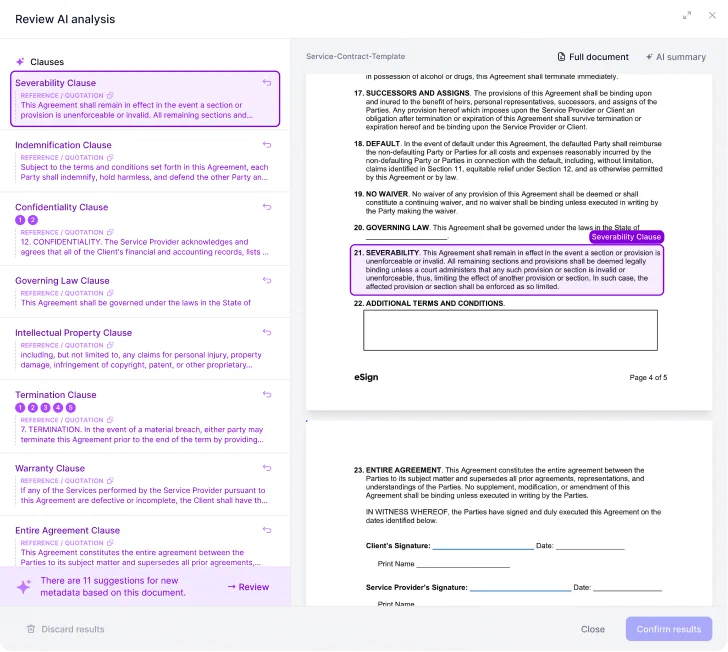
Analyze your contracts. Extract important clauses.
Try our AI contract analysis and extract important clauses and information from existing contracts.
Save your favourite clauses
Insert directly with a single click
Upload preferred precedents
Sample Exclusive right to sell clauses
In consideration of the services provided by Broker, Owner hereby irrevocably appoints Broker as its exclusive agent and lists with said Broker the Property described above, and Owner hereby grants said Broker the exclusive right to sell the same within said time at the price and on terms herein stated, or at such other price and terms which may be accepted by Owner, and to accept a deposit thereon.
If said property is sold by the Broker, the Owner or by any other person within 180 days after the expiration of this agreement or any renewal hereof to anyone with whom the Broker has presented the subject Property during the term of this agreement or any renewal hereof, subject to the provisions of this paragraph, the Owner agrees to pay the Broker a commission in cash either at closing or upon full execution of the Lease as provided herein. Broker shall provide Owner a list of Prospects for registration (“Registration Letter”) within ten (10) days after the expiration of this agreement or any renewal hereof.
(b) has the exclusive right to sell, or have its Related Entity Sensis Pty Ltd (Sensis MediaSmart) sell, all advertising inventory on the Consumer VMC Website in accordance with clause 3; and (c) must provide an account manager at Sensis MediaSmart who will sell health advertising and sponsorship for the Consumer VMC Website, and attend a monthly meeting with a representative of VMC to monitor advertising sales performance on the Consumer VMC Website;
1.3 Exclusive Sales Rights. Other than by or through Investor, the Company shall not, and shall not cause or allow any other third party to, and shall prohibit any third party to, directly or indirectly sell or distribute coal or coal products produced or distributed by the Company in or to China. In the event the Company desires to directly or indirectly sell or distribute coal or coal products produced or distributed by the Company in or to China, the Company shall offer to, and if acceptable to the Investor, enter into good faith negotiations with the Investor regarding an agreement whereby Investor would have the exclusive right to sell and distribute coal and coal products produced by the Company in or to China.
On June 30, 2010, Umami entered into a sales agency agreement with Atlantis pursuant to which Atlantis was granted the exclusive right to sell, on Kali Tuna’s behalf, all of its Bluefin tuna products into the Japanese market. Following the acquisition of Baja, Umami agreed to extend the sales agency agreement to most of Baja’s sales. Umami paid Atlantis an agency commission of 2% on all sales made under this agreement, resulting in payments of $1.0 million for the year ended June 30, 2011. In June 2011, the agreement was terminated.
What does exclusive right to sell mean?
An exclusive right to sell gives one party the sole right to sell something on the owner’s behalf for a set period. The term is used in two settings:
- Real estate listing agreements: the owner appoints one broker, who earns the commission if the property sells during the listing period, no matter who finds the buyer, even the owner.
- Distribution and sales agency agreements: a manufacturer or seller gives a distributor or agent the sole right to sell its products in a territory or channel. The other sample clauses above show exclusive rights to sell advertising inventory, coal into one country and seafood into one market.
Example: a company lists its warehouse with a commercial broker under a six-month exclusive right to sell, with a 3% commission. In month four, the company’s CEO meets a buyer at a conference and sells directly. Under an exclusive right to sell, the broker still earns the commission.
Exclusive right to sell vs. exclusive agency vs. open listing
| Listing type | Who can sell | Commission owed when |
|---|---|---|
| Exclusive right to sell | The listing broker (and cooperating brokers through it) | Any sale during the term, even by the owner |
| Exclusive agency | The listing broker, or the owner directly | Only if the broker or another agent sells; not if the owner finds the buyer alone |
| Open listing | Any number of brokers, and the owner | Only to the broker who actually procures the buyer |
| Net listing | A broker who keeps everything above a set net price | Restricted or prohibited in some states |
The exclusive right to sell is the most common listing type, because it gives the broker the security to invest in marketing.
Key terms in an exclusive right to sell agreement
- Term: start and end dates, often three to twelve months, with or without automatic renewal. One sample renews month to month with 30 days’ notice.
- Commission: a percentage of the sale price or a fixed fee, sometimes tiered, and who pays cooperating brokers.
- Protection (tail) period: the broker earns the commission if, within a set time after the listing ends, the property sells to someone the broker introduced during the term. One sample uses 180 days and requires the broker to send a list of registered prospects within 10 days after expiry.
- Exclusions: named buyers already in talks with the owner, for whom no commission or a reduced fee applies.
- Price and terms: the asking price and the owner’s authority to accept other offers.
- Marketing and signage: what the broker will do, and whether signs may be placed on the property.
- Termination: whether the owner can end early, and at what cost.
Exclusive sales rights in distribution
In commercial contracts, an exclusive right to sell is usually paired with obligations on the distributor:
- Territory and products covered, and whether online sales count.
- Minimum purchase or sales targets, with loss of exclusivity if they are missed.
- No competing products, within the limits of competition law.
- The supplier’s own sales: whether the supplier may still sell directly to certain customers.
In the EU, exclusive distribution is generally allowed under the Vertical Block Exemption Regulation, subject to market share thresholds and a ban on hardcore restrictions such as fixing resale prices.
How to negotiate an exclusive right to sell
If you are the owner or supplier:
- Keep the term short, with clear performance duties.
- Exclude buyers or customers you already know.
- Limit the tail period and require a list of registered prospects.
- Add a right to terminate if the broker or distributor underperforms.
If you are the broker or distributor:
- Get a protection period long enough to close deals you started.
- Cover sales by the owner during the term.
- Define the territory and channels precisely.
Exclusive right to sell clause example
Sample clause: Exclusive right to sell
Add this clause to a contract, send it and get it signed in fynk.
Use it in fynk for freeTracking listing periods and tail periods
A listing agreement ends on a fixed date, and the tail period runs from that date, so both sides need the exact dates in view. With dates and durations in fynk, the listing period and the protection period are calculated from the contract’s own dates and update if the term is extended.
Which contracts include an exclusive right to sell?
Residential and commercial real estate listing agreements, business broker agreements, exclusive distribution agreements, sales agency and representation agreements, consignment agreements and advertising sales agreements. These free templates include one:
Free templates with this clause
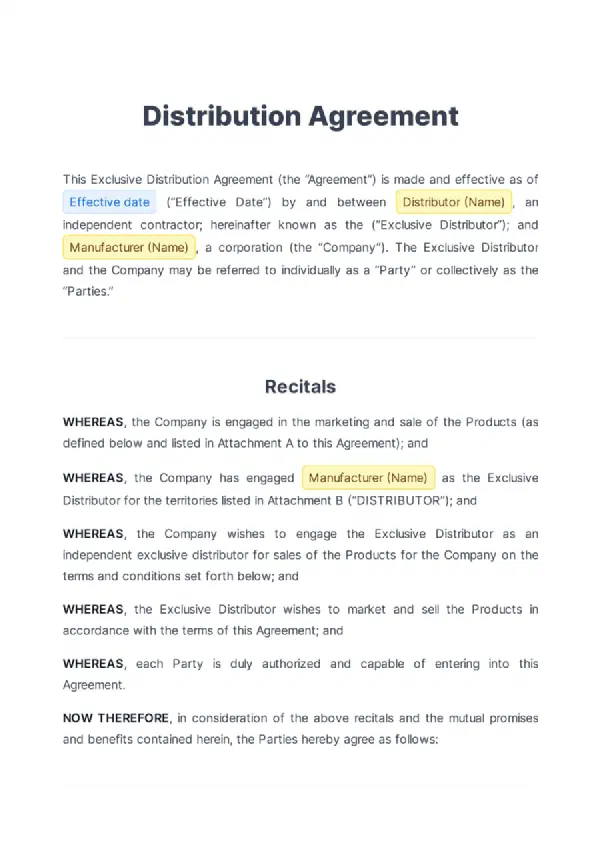 Exclusive distribution agreement template
The manufacturer appoints an exclusive distributor, an independent contractor, for its products.
Use the free template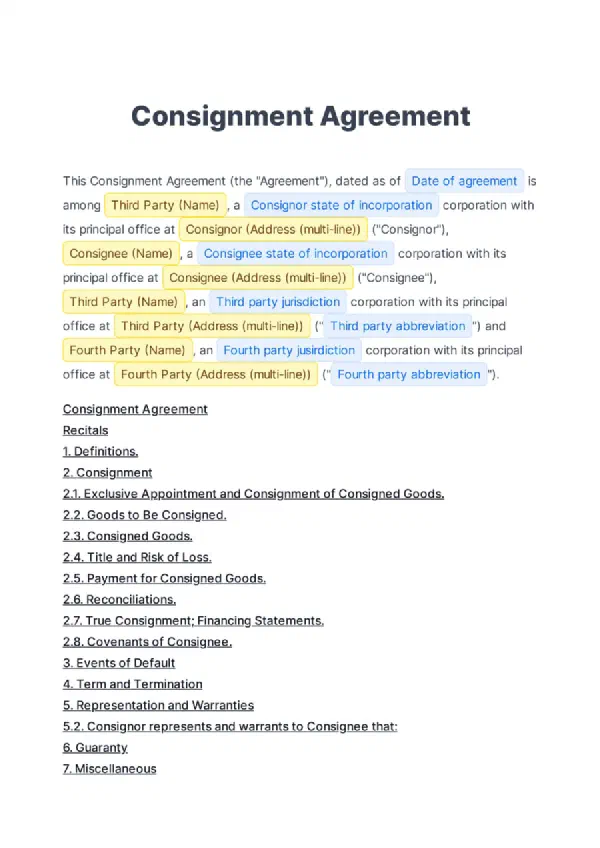 Consignment agreement template
As agent of the consignor, the consignee has the exclusive right to sell and distribute the consigned goods.
Use the free template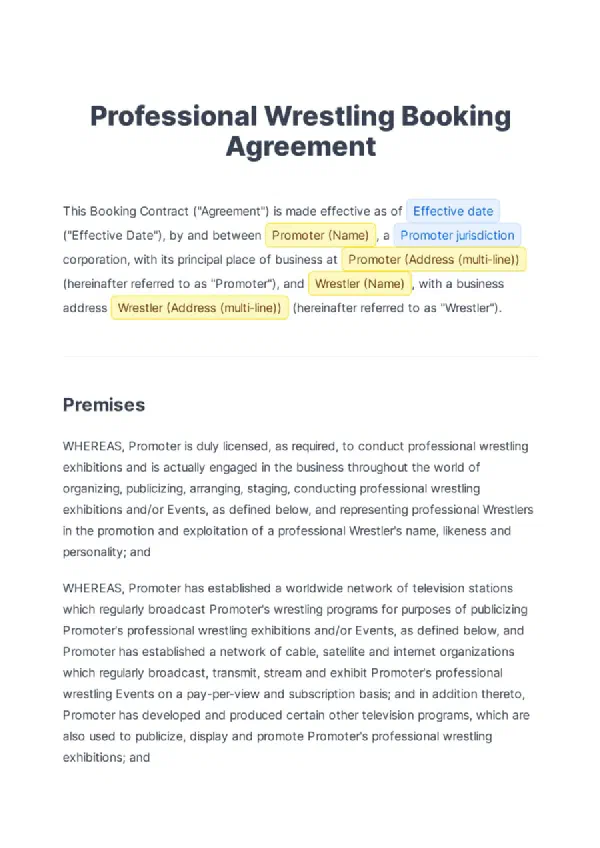 Booking agreement template for professional wrestling
The promoter has the exclusive right to sell or dispose of merchandise and other items covered by the agreement.
Use the free template
Related clauses
- Exclusivity An exclusivity clause is a contractual provision that restricts one party from engaging in certain activities or dealings with other parties outside the agreement. Typically used to secure a commitment, it ensures that the party provides services, products, or rights solely to the other contracting party, often to maintain competitive advantage or preserve confidentiality.
- No exclusivity Non-exclusive means a right or relationship is not reserved for one party alone. A no exclusivity clause makes clear that both sides may work with, sell to, license to or buy from others, unless the contract says otherwise.
- Exclusive supply An exclusive supply clause legally binds a supplier to provide goods or services solely to one buyer, prohibiting the supplier from selling to other parties. This arrangement often ensures consistent supply for the buyer, while potentially limiting the supplier's market reach.
- Minimum purchase requirements Minimum purchase requirements clause obligates a buyer to purchase a specified minimum quantity of goods or services from a seller within a defined timeframe. This provision helps ensure predictable revenue for the seller while securing volume discounts or business stability for the buyer.
Frequently asked questions
A listing agreement in which the owner appoints one broker, who earns the commission if the property sells during the listing period, no matter who finds the buyer.
Under an exclusive right to sell, the broker is paid even if the owner finds the buyer. Under an exclusive agency, the owner can sell directly without paying a commission.
A non-exclusive arrangement where several brokers and the owner can sell, and only the broker who actually procures the buyer is paid.
Only as the agreement allows, for example with notice or for the broker's breach. Cancelling early can still leave you owing a commission for sales to buyers the broker introduced.
A period after the listing ends during which the broker still earns a commission if the property sells to a buyer the broker introduced during the listing.
More clauses from the library
See allExclusive supply
An exclusive supply clause legally binds a supplier to provide goods or services solely to one buyer, prohibiting the supplier from selling to other parties. This arrangement often ensures consistent supply for the buyer, while potentially limiting the supplier's market reach.
20 example clauses
Exclusive use
The "Exclusive Use" clause grants one party the sole right to utilize or benefit from a particular asset, property, or service, thereby restricting others from doing the same. This provision ensures that the party with the exclusive rights has priority access without interference from competitors or other parties.
14 example clauses
Exclusivity
An exclusivity clause is a contractual provision that restricts one party from engaging in certain activities or dealings with other parties outside the agreement. Typically used to secure a commitment, it ensures that the party provides services, products, or rights solely to the other contracting party, often to maintain competitive advantage or preserve confidentiality.
16 example clauses
Analyze your contracts. Extract important clauses.
Try our AI contract analysis and extract important clauses and information from existing contracts.
Save your favourite clauses
Insert directly with a single click
Upload preferred precedents