
COD and CBD payment terms
COD and CBD are payment terms that require payment at or before delivery instead of on credit: cash on delivery means paying when the goods arrive, cash before delivery means paying before they are shipped.
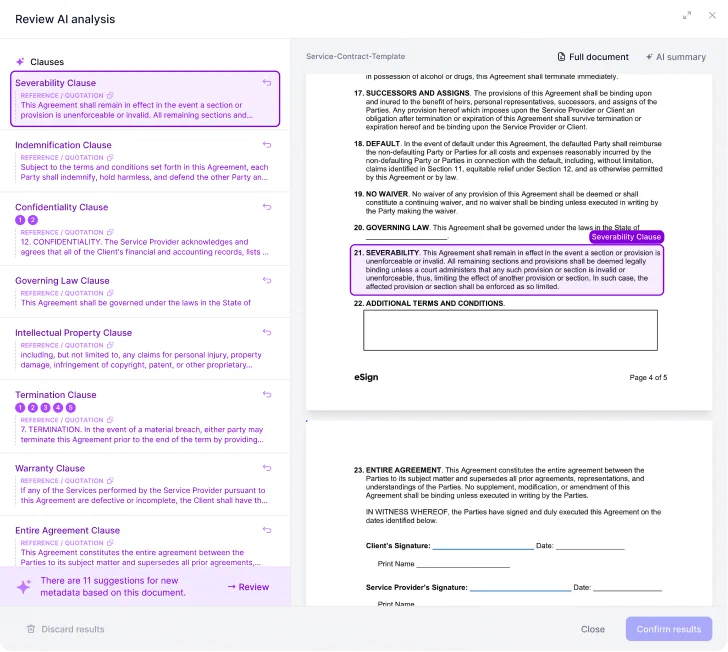
Analyze your contracts. Extract important clauses.
Try our AI contract analysis and extract important clauses and information from existing contracts.
Save your favourite clauses
Insert directly with a single click
Upload preferred precedents
Sample COD and CBD payment terms clauses
Source
IMH Financial Corp9.6 Delivery Stoppage. In the event Customer fails to make payment when due, Sysco may immediately, upon notice to Customer, condition future deliveries upon more stringent credit and/or payment terms, including, without limitation, cash in advance, cash on delivery, and/or the delivery of acceptable letters of credit, third party guarantees, and/or additional collateral and/or following five (5) days written notice to the Customer, cease shipment of any Products to the Customer failing to make such payment until the outstanding receivable balance is fully within terms.
Source
CATCHER HOLDINGS INCSupplier’s rights reserved under its credit policy include, but are not limited to the following: the right to modify payments for habitual late payment, including the right to require cash on delivery, cash in advance with order entry or an irrevocable letter of credit prior to order entry; the right to put any shipment on hold if outstanding receivables are more than *** days past due; and the right to hold both shipments and/or manufacturing if in Supplier’s opinion there has been a serious decline in the financial condition of Buyer, or Buyer has failed to make any payment for more than *** days from the date of Supplier’s invoice. Production schedules may be set back *** weeks or more at Supplier’s option, depending upon shop work load at the time, from the date of release following a manufacturing hold on Buyer’s Products. At any time and from time to time during the term of this Agreement upon Supplier’s request, Buyer shall provide Supplier with Buyer’s financial statements. Supplier shall notify Buyer in writing in the event Supplier, at any time during the term hereof, elects to exercise any of its aforesaid rights reserved under its credit policy.
Source
DIGITAL RIVER INC /DE1.5 Customer Payment Options. Digital River shall make available to Customers the credit card and direct debit card payment options required by Exhibit E to the Agreement, but shall not be required to make the cash on delivery payment option available until notice by Symantec (if any) at a later date after further evaluation of such option.
Source
INNOVO GROUP INCWe generally extend this credit without requiring collateral. A percentage of our customers are required to pay by either cash before delivery, credit card or cash on delivery, or C.O.D., which is also based on such factors as lack of credit history, reputation (or lack thereof) within our industry and/or prior payment history. For those customers to whom we extend credit, typical terms are net 30 to 60 days. Based on industry practices, financial awareness of the customers with whom we conduct business, and business experience of our industry, our management exercises professional judgment in determining which customers will be extended credit. We are exposed to some collection risk for receivables which were factored with recourse where CIT did not accept the credit risk. However, the aggregate amount of exposure is generally low and, therefore, we believe that the credit risk associated with our extension of credit is minimal.
Source
Whole Earth Brands, Inc.The Company’s contracts with customers generally contain payment terms ranging from cash before delivery to 60 days. Since the standard payment term is less than one year, the Company elected the practical expedient to not assess whether a contract has a significant financing component.
What do COD and CBD mean?
COD and CBD are payment terms that leave the seller no credit risk, or very little:
- COD (cash on delivery, sometimes collect on delivery): the buyer pays when the goods are delivered. If the buyer does not pay, the goods are not handed over.
- CBD (cash before delivery): the buyer pays after ordering but before the goods are shipped or delivered.
- CIA (cash in advance), also called CWO (cash with order) or prepayment: the buyer pays when placing the order, before the seller even starts preparing it.
“Cash” no longer means banknotes. It means immediate payment by any agreed method: bank transfer, card, certified check or a payment link.
Example: a distributor gets its first order from a new retailer with no credit history. It quotes CBD terms: the retailer pays the invoice by bank transfer, and the goods ship the day the money arrives. After six months of on-time orders, the distributor moves the retailer to net 30.
COD vs. CBD vs. CIA vs. net terms
| Term | When the buyer pays | Seller’s risk | Buyer’s risk |
|---|---|---|---|
| CIA / CWO | When ordering | None | Pays before the seller does anything |
| CBD | After ordering, before shipment | Very low | Pays before seeing the goods |
| COD | On delivery | The buyer refuses delivery and the seller pays return shipping | Pays before inspecting the goods closely |
| Net 30, net 60 | 30 or 60 days after invoice | Non-payment after delivery | Low |
The further down the table, the more credit the seller extends. Without any agreed term, US law under UCC section 2-310 treats payment as due when and where the buyer receives the goods, which is close to COD.
Paying on delivery is not accepting the goods
COD changes when the buyer may inspect. Normally a buyer can inspect goods before paying, but under UCC section 2-513 that right does not apply to deliveries “C.O.D.” unless the contract says otherwise: the driver wants the money first, and the boxes get opened afterwards. In return, UCC section 2-512 says that paying before inspection is not an acceptance of the goods and keeps the buyer’s right to inspect and to its remedies. A buyer who finds a problem after paying can still reject nonconforming goods or claim for them. If inspection before payment matters, for example for high-value equipment, write it into the clause.
When suppliers require COD or CBD
The sample clauses above show the typical situations:
- New customers with no credit history or credit application.
- Customers who paid late, where the contract lets the supplier switch future deliveries to cash on delivery or cash in advance.
- Financial trouble: signs that the buyer may become insolvent.
- One-off or custom orders, where the seller cannot resell the goods if the buyer backs out.
- High-risk markets or small orders, where a credit check costs more than it is worth.
From the seller’s side, COD and CBD sales are also treated differently in financing: some lenders exclude cash on delivery receivables from the borrowing base because they are not ordinary credit sales.
Advantages and disadvantages
For the seller:
- Pro: no bad debt and no money tied up in receivables.
- Con: fewer customers, because most business buyers expect credit terms, and COD deliveries can be refused.
For the buyer:
- Pro: COD at least lets the buyer see the shipment before paying.
- Con: cash flow suffers, and with CBD or CIA the buyer depends on the seller to deliver after being paid.
How to write COD and CBD terms into a contract
- Name the term exactly: cash on delivery, cash before delivery or cash in advance, and the payment methods allowed.
- Define “delivery” and what proof of payment releases the goods.
- Say who bears the cost of a refused COD delivery, and whether the buyer may inspect before paying.
- Set the switch rule: when the seller may move a credit customer to COD or CBD, such as after a late payment or a missed credit limit.
- Set the way back: how the buyer can return to credit terms, for example after a number of on-time orders.
- Cover refunds if a prepaid order is canceled or cannot be delivered.
COD and CBD payment terms clause example
Sample clause: Payment terms
Add this clause to a contract, send it and get it signed in fynk.
Use it in fynk for freeQuoting the exact amount to be paid up front
With CBD and CIA, the buyer pays before delivery, so the quote has to show the exact total, including discounts, taxes and freight. With pricing tables in fynk, quantities, discounts and totals in the contract calculate automatically, so the amount the customer pays in advance matches the order.
Which contracts use COD or CBD terms?
Supply and distribution agreements, purchase orders and order confirmations, wholesale terms and conditions, credit applications, food and beverage supply agreements, and e-commerce terms for consumers. These free templates require some payment before or at delivery:
Free templates with this clause
- Purchase order (PO) template for products A share of the purchase price is paid in advance after the order is signed, with the balance in later installments. Use template
- White label agreement template The customer pays invoices in advance of shipment of the branded products, by wire transfer. Use template
- SaaS agreement template Service fees are paid in advance. Use template
Related clauses
- Net 30 payment terms Net 30 means the full invoice amount is due within 30 days, usually counted from the invoice date. It is one of the most widely used payment terms between businesses. Variations such as 2/10 net 30, net 30 EOM and net 60 change the discount or the due date.
- Prepayment A prepayment clause outlines the terms under which a borrower can pay off a loan or portion of it before its due date without facing penalties. This clause often specifies any conditions or fees associated with early payments, helping borrowers manage their financial obligations more flexibly.
- Upfront payment An upfront payment is money the customer pays before the work starts or the goods are delivered, either the full price or a share of it. It covers the supplier's setup costs and shows the customer is committed, and the contract should say whether it is refundable.
- Payment terms and conditions Payment terms and conditions outline the specifics of how and when a party will be compensated for goods or services provided. They typically include details on the payment method, due dates, any interest or penalties for late payments, and any discounts available for early payments.
- Late payment penalty A Late Payment Penalty clause stipulates that if a payment is not made by its due date, the party responsible for the payment will incur an additional fee or penalty. This clause incentivizes timely payments and compensates the payee for any inconvenience or financial impact caused by the delay.
- Down payment A down payment clause specifies the initial, non-refundable portion of the total cost that a buyer must pay upfront to secure the purchase of a product or service. This clause outlines the amount, timing, and any conditions associated with the down payment, providing assurance to both parties involved in the transaction.
Frequently asked questions
Cash on delivery: the buyer pays when the goods are delivered, before taking possession. “Cash” means immediate payment by any agreed method.
Cash before delivery: the buyer pays after ordering but before the goods are shipped or delivered.
Timing. With CIA (cash in advance), the buyer pays when ordering. With CBD, payment can come later, as long as it arrives before shipment.
To avoid credit risk with new customers, customers who paid late, or customers in financial difficulty.
No. Under UCC section 2-512, paying before inspection is not an acceptance, and the buyer keeps the right to inspect and to reject goods that don't match the contract. What COD takes away is the right to inspect before paying, unless the contract allows it.
Usually by completing a credit application and building a record of on-time payments. Many supplier contracts set out when a customer can return to credit terms.
More clauses from the library
See allCommencement letter
A commencement letter is a formal document issued to officially notify the start date of a contract or project, ensuring all involved parties acknowledge and agree on when obligations and responsibilities are to begin. It typically confirms the acceptance of terms outlined in the contract and may include additional details pertinent to the initiation of services or work.
9 example clauses
Company rules and regulations
The "Company Rules and Regulations" clause typically outlines the expected standards of behavior, procedures, and guidelines that employees must adhere to while working for the company. It serves to ensure consistency, safety, and compliance within the organization and can include aspects such as attendance, dress code, and conduct.
15 example clauses
Compensation and payment
The "Compensation and Payment" clause outlines the terms under which the party providing services or goods will be remunerated. It details the agreed payment amount, schedule, method, and any conditions for adjustments, ensuring clarity and mutual understanding between the contracting parties.
13 example clauses
Analyze your contracts. Extract important clauses.
Try our AI contract analysis and extract important clauses and information from existing contracts.
Save your favourite clauses
Insert directly with a single click
Upload preferred precedents