
Procurement trends 2027: what changes for lean teams

Rezvan Golestaneh
Published · 9 min read

Prepare for procurement changes that affect the next renewal, supplier contract, and invoice.
- Use AI to reduce contract reading time, with a person checking the result.
- Standardize repeat purchases and review renewals before notice deadlines.
- Check cloud switching terms and Germany’s e-invoicing requirements.
- Keep security terms, supplier questionnaires, and supporting evidence together.
- Agree on backup supply terms before a disruption forces the conversation.
Procurement trends 2027 will show up as deadlines, higher prices, and paperwork landing on a small team. The software renewal includes new AI features nobody asked for. A customer wants another supplier questionnaire. The useful question is what to change before these become next week’s emergencies.
What are the key procurement trends for 2027?
The key procurement trends for 2027 are everyday AI contract work, tighter team capacity, SaaS price increases, cheaper cloud switching, German e-invoicing deadlines, supplier cybersecurity clauses, due diligence paperwork, and written backup supply plans.
Most surveys below look at large companies. Read them as a weather report for your own team, not as a to-do list.
1. AI moves from pilot to everyday contract work
AI in procurement is becoming useful for the supplier PDF that’s been waiting in your inbox since Monday. Deloitte’s survey found about 40% of procurement organizations were at least piloting AI, with contract drafting and summaries among the top 10 procurement GenAI use cases.
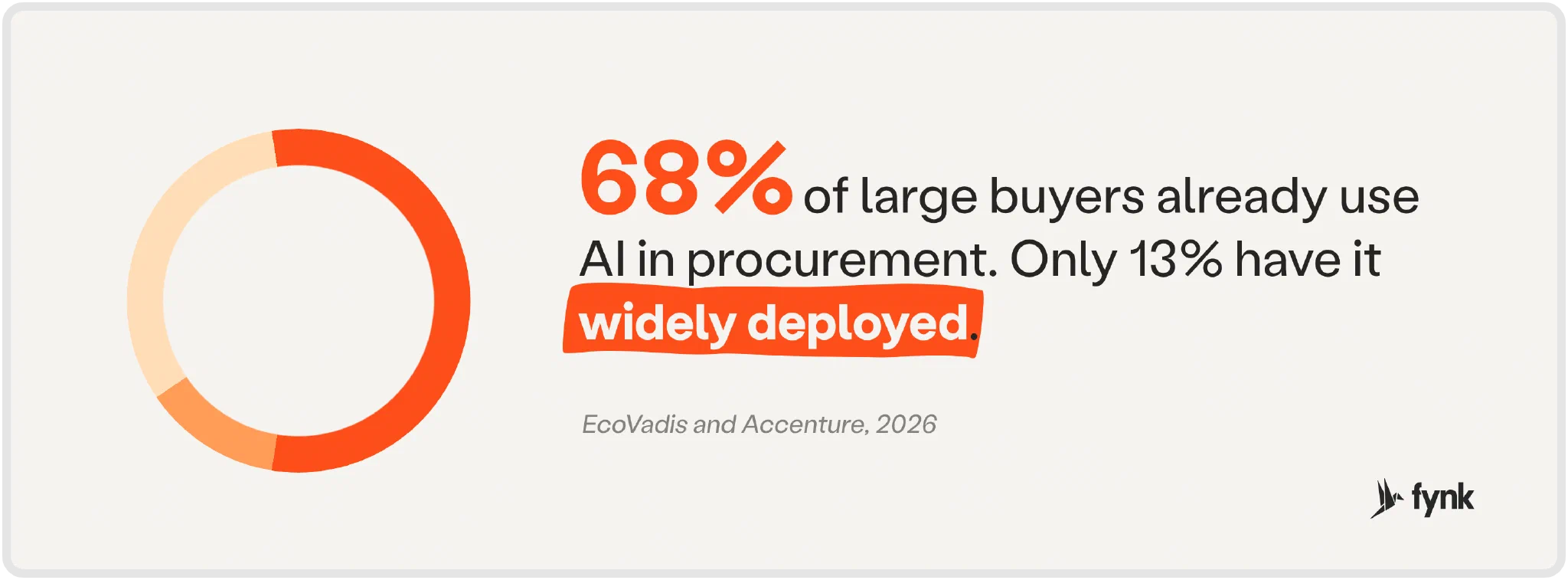
The EcoVadis and Accenture barometer reports that 68% of large buyers use AI in procurement: 55% operationally and 13% through wide deployment. Adoption and making it work across the business are different jobs.
Gartner predicted that by 2027, 50% of organizations would support supplier contract negotiations with AI risk analysis and editing tools. The gap between general AI use and contract-specific work also shows up in our contract management statistics roundup of 155 studies.
Start where AI saves reading time: compare incoming supplier contracts against your rules, or extract dates and terms from old PDFs. Keep human sign-off on findings and decisions. A confident summary still needs checking against the clause.
fynk’s AI review checks supplier contracts against your playbook and flags deviations with references to the relevant sections. AI import turns existing PDFs into searchable contract data, so useful details don’t stay trapped in attachments.
2. More work arrives without more people
Hackett’s research describes leading procurement teams facing an 8% workload increase amid declining headcount and operating budgets. Another purchase request won’t politely wait for the hiring plan.
For a lean team, repeat administration competes directly with negotiation time. Rebuilding a standard purchase agreement leaves less time to question its price.
Standardize recurring agreements and define who approves spending, security, and unusual terms. Give routine purchases an approved starting point and send exceptions to someone who can decide.
fynk’s document templates keep approved wording ready for repeat purchases. Its approval workflows route reviews and require approvals before signing, reducing the inbox chasing around each agreement.
3. Software prices keep climbing, sometimes with less included
Vertice’s price data shows SaaS inflation reaching 16.4% in June 2026, with preliminary September data putting it at 14.3%.
Price isn’t the whole comparison. Vertice’s SaaS Inflation Index reported 58% of software vendors raising prices over a six-month period and shrinkflation affecting 27% of vendors. Shrinkflation means fewer features, lower limits, or reduced service for the same or a higher price. The renewal quote can look familiar while the useful bit has moved to a pricier plan.
Make a renewal review due at least 90 days before the notice deadline, earlier if switching takes longer. Check usage, included features, pricing units, and competing quotes. Good vendor contract management starts with knowing when you can still say no.
fynk’s contract calendar brings contract dates and related tasks together. Reminders before notice periods give the owner time to negotiate while cancellation is still an option.
Don’t let contract deadlines
surprise you!
4. The EU Data Act makes cloud switching cheaper
From January 12, 2027, Article 29 of the EU Data Act generally bars providers of covered data processing services from charging switching fees. Until then, those charges cannot exceed costs directly linked to switching. This includes data egress needed for the switch.
There’s another date for older data agreements. Under Article 50, the rules against unfair data-related terms imposed on businesses extend from September 12, 2027 to contracts concluded on or before September 12, 2025 that run indefinitely or expire at least 10 years from January 11, 2024.
List your cloud and SaaS agreements with their switching fees, export terms, and notice periods. Check which provisions apply, then use them in renewal discussions. Separate switching charges from subscription commitments and early termination fees: they aren’t interchangeable.
fynk’s AI search lets you search agreements in plain language for terms such as exit or switching fees. That gives you a starting set to review. The exit fee shouldn’t be the last thing you discover on the way out.
5. German e-invoicing deadlines reach the purchasing desk
Germany’s e-invoicing law has required businesses to be able to receive structured e-invoices for covered domestic B2B transactions since January 1, 2025, with the general paper/PDF transition ending on December 31, 2026. An ordinary PDF doesn’t become a structured invoice because someone emails it.
Under the transition rules, larger issuers generally need structured e-invoices from January 1, 2027, while issuers with prior-year turnover up to EUR 800,000 can continue with paper/PDF through December 31, 2027. Exemptions and the remaining EDI transition still apply.
If you buy from or sell to German companies, check whether your transactions fall within the domestic rules. A German trading partner alone doesn’t make a cross-border invoice subject to this mandate.
Agree with finance and suppliers on the information needed to match invoices with purchases. Keep purchase order references, supplier legal details, and payment terms consistent across contracts, orders, and invoices. Test the match with an actual supplier invoice before the deadline.
6. Cybersecurity becomes supplier contract work
Supply chain security, including relationships with direct suppliers, is a required measure for covered entities under Germany’s NIS2 implementing law, in force since December 6, 2025. Austria’s corresponding rules have applied since October 1, 2026.
This is already visible in contracts: ENISA found that 48% of organizations in EU critical sectors included cybersecurity requirements in supplier agreements. Your customer may need evidence about your security even when your own company isn’t directly covered.
Prepare answers with IT before the next questionnaire arrives. For your own IT suppliers, agree on security duties, incident notification, and the evidence you’ll receive. Record which suppliers have signed the terms and who follows up. A security clause doesn’t check itself.
7. Due diligence rules shrink at the top, but paperwork still reaches suppliers
After Omnibus I, the CSDDD’s main EU-company scope covers businesses with more than 5,000 employees and over EUR 1.5 billion in net worldwide turnover, with application from July 26, 2029.
But contractual assurances from direct business partners remain part of covered companies’ due diligence measures where appropriate. Customers can still ask mid-size suppliers to sign codes of conduct and answer questionnaires.
In an IfM Bonn study for the VDMA’s Impuls foundation, a German machine builder reported supply chain and sustainability questionnaires growing from about 15 to roughly 90 pages per customer. So much for a quick form.
For sustainable procurement, keep an approved master set of answers, supporting certificates, and signed customer codes. Review incoming clauses before signing, especially promises about suppliers you cannot realistically verify.
fynk’s document hub keeps agreements searchable, with questionnaires, codes, and certificates stored alongside the relevant contract. The next request can start with the existing evidence.
8. Resilience means a plan B in writing
In Deloitte’s survey, 74% of CPOs rated maintaining active alternative sources the most effective supply risk mitigation strategy, while 40% had savings targets revised because of geopolitics, with four in five of that group facing higher targets.
For a smaller business, the useful lesson is to prepare alternatives for purchases that could stop operations. For each backup supplier, confirm the price, available capacity, and delivery commitment.
Identify critical items and services, qualify an alternative, and sign a framework agreement before you need it. Record ordering terms, lead times, capacity limits, and any minimum commitments. Check whether keeping the backup available costs money.
The future of procurement still includes calling suppliers. Ideally, the emergency call starts with an agreement already in place.
Can a lean procurement team keep up with this in spreadsheets?
A spreadsheet can track a small contract list, but reviews, approvals, reminders, and supporting files still need a process around it.
| What needs handling | Spreadsheet and inbox | fynk |
|---|---|---|
| Renewal and notice dates | Enter dates and maintain separate reminders. | Keep dates and tasks in the contract calendar, with reminders for owners. |
| Reviewing supplier paper | Read each draft against a separate checklist. | AI review checks playbook rules and flags relevant contract sections for human review. |
| Finding clauses across contracts, including exit fees, security, and codes of conduct | Search recorded notes, then open individual files. | Search agreements in plain language; use supplier metadata to record which suppliers signed security terms. |
| Approvals before signing | Collect replies and check that everyone approved the current draft. | Route required approvals within the contract workflow before signing. |
| Certificates and questionnaires | Maintain folders and links separately from the contract record. | Store supporting documents with the relevant agreement. |
For a lean procurement team, the deciding question is how much time goes into maintaining the process around the spreadsheet.
Is procurement a dead-end job?
No, procurement isn’t a dead-end job, but chasing missing attachments shouldn’t be a career plan. The useful work is shifting toward judgment, negotiation, and deciding which supplier risks the business can accept. Hackett’s workload findings show more being asked of procurement even as resources shrink. Build the skills to challenge a renewal, assess an AI finding, and agree on workable terms.
Searching for a contract management solution?
Find out how fynk can help you close deals faster and simplify your eSigning process – request a demo to see it in action.
The key trends are AI-assisted contract work, tighter team capacity, SaaS price increases, cheaper cloud switching, German e-invoicing changes, supplier cybersecurity clauses, due diligence paperwork, and backup supply agreements. Lean teams should focus on the changes affecting their own suppliers, customers, and renewal dates.
AI can help teams review supplier contracts against agreed rules, summarize terms, and extract dates and obligations from existing documents. Start with a defined task and check the output against the original contract. Keep people responsible for approvals and negotiation decisions.
The 5 P's aren't a single standardized procurement framework; different sources use different lists. A more established purchasing framework is the five rights: the right quality, quantity, time, place, and price. Use those as a practical check on what the business needs to buy.
Generally, yes: Data Act switching rules cover data processing services, including SaaS. Scope and exceptions depend on the service. Removing switching charges doesn’t automatically remove subscription commitments or early termination fees. Ask counsel to check your agreement before relying on an exit right.
Start with upcoming renewals and notice deadlines. Check cloud switching terms and whether German e-invoicing rules affect your transactions. Standardize recurring agreements, prepare security and sustainability evidence, and put backup supplier terms in writing. Choose an AI task that reduces reading time and keep a reviewer accountable.
Please keep in mind that none of the content on our blog should be considered legal advice. We understand the complexities and nuances of legal matters, and as much as we strive to ensure our information is accurate and useful, it cannot replace the personalized advice of a qualified legal professional.



Get a regular dose of insightful contract management content


Take control of your agreements. Move your business forward.
Run agreements the way they should run: fast, clear, and on your terms.
No setup headaches
Go live in days, not quarters
No lock-in
Full export anytime
No hidden fees
Signatures included, no envelope fee