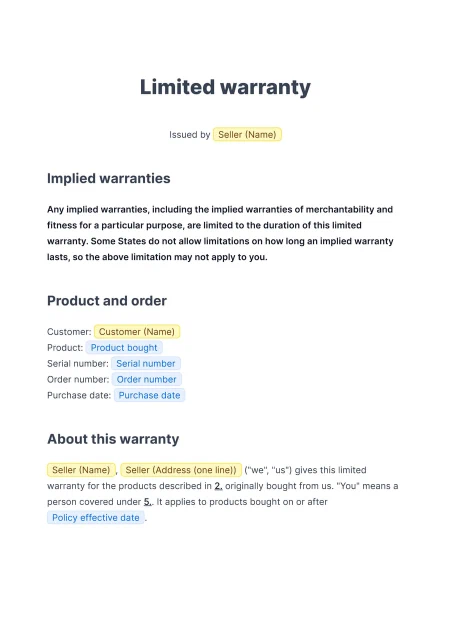
Any implied warranties, including the implied warranties of merchantability and fitness for a particular purpose, are limited to the duration of this limited warranty. Some States do not allow limitations on how long an implied warranty lasts, so the above limitation may not apply to you.
Product and order
Customer: Customer (Name) Product: Product bought Serial number: Serial number Order number: Order number Purchase date: Purchase date
About this warranty
Seller (Name), Seller (Address (one line)) ("we", "us") gives this limited warranty for the products described in 2. originally bought from us. "You" means a person covered under 5.. It applies to products bought on or after Policy effective date.
Products covered
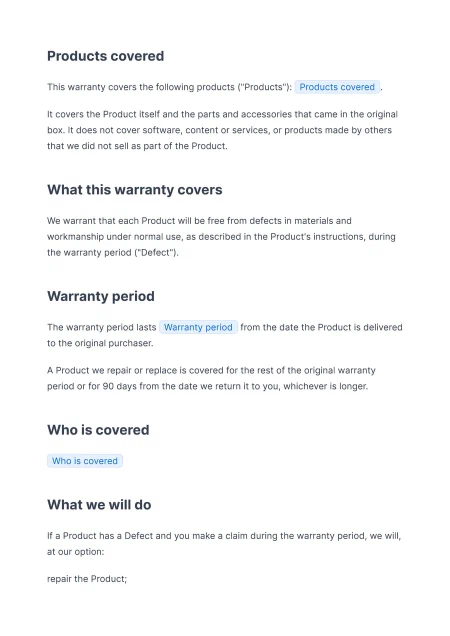
This warranty covers the following products ("Products"): Products covered.
It covers the Product itself and the parts and accessories that came in the original box. It does not cover software, content or services, or products made by others that we did not sell as part of the Product.
What this warranty covers
We warrant that each Product will be free from defects in materials and workmanship under normal use, as described in the Product's instructions, during the warranty period ("Defect").
Warranty period
The warranty period lasts Warranty period from the date the Product is delivered to the original purchaser.
A Product we repair or replace is covered for the rest of the original warranty period or for 90 days from the date we return it to you, whichever is longer.
Who is covered
Who is covered
What we will do
If a Product has a Defect and you make a claim during the warranty period, we will, at our option:
repair the Product;
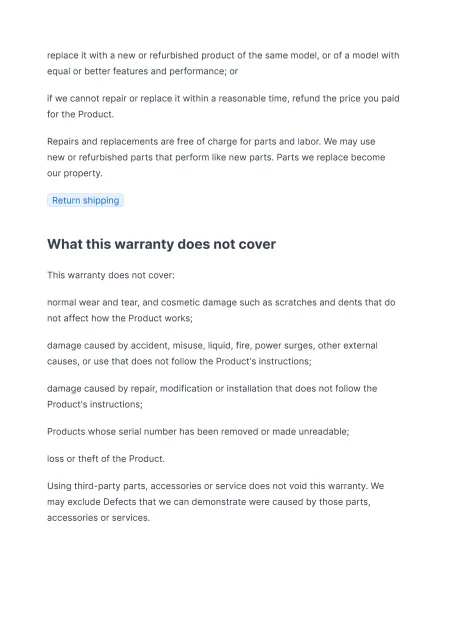
replace it with a new or refurbished product of the same model, or of a model with equal or better features and performance; or
if we cannot repair or replace it within a reasonable time, refund the price you paid for the Product.
Repairs and replacements are free of charge for parts and labor. We may use new or refurbished parts that perform like new parts. Parts we replace become our property.
Return shipping
What this warranty does not cover
This warranty does not cover:
normal wear and tear, and cosmetic damage such as scratches and dents that do not affect how the Product works;
damage caused by accident, misuse, liquid, fire, power surges, other external causes, or use that does not follow the Product's instructions;
damage caused by repair, modification or installation that does not follow the Product's instructions;
Products whose serial number has been removed or made unreadable;
loss or theft of the Product.
Using third-party parts, accessories or service does not void this warranty. We may exclude Defects that we can demonstrate were caused by those parts, accessories or services.
How to make a claim
To make a claim, follow these steps:
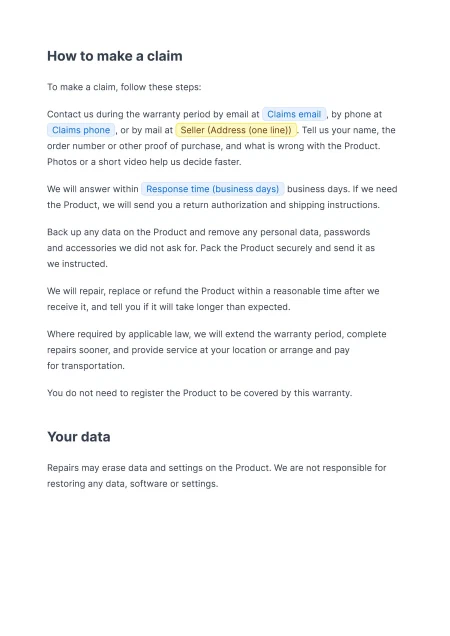
Contact us during the warranty period by email at Claims email, by phone at Claims phone, or by mail at Seller (Address (one line)). Tell us your name, the order number or other proof of purchase, and what is wrong with the Product. Photos or a short video help us decide faster.
We will answer within Response time (business days) business days. If we need the Product, we will send you a return authorization and shipping instructions.
Back up any data on the Product and remove any personal data, passwords and accessories we did not ask for. Pack the Product securely and send it as we instructed.
We will repair, replace or refund the Product within a reasonable time after we receive it, and tell you if it will take longer than expected.
Where required by applicable law, we will extend the warranty period, complete repairs sooner, and provide service at your location or arrange and pay for transportation.
You do not need to register the Product to be covered by this warranty.
Your data
Repairs may erase data and settings on the Product. We are not responsible for restoring any data, software or settings.
Limitation of remedies
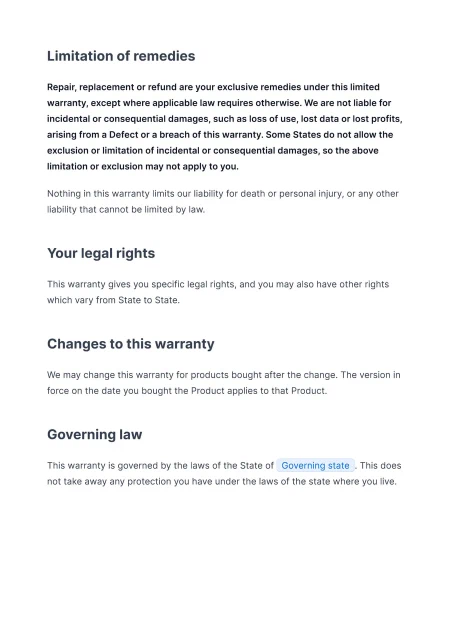
Repair, replacement or refund are your exclusive remedies under this limited warranty, except where applicable law requires otherwise. We are not liable for incidental or consequential damages, such as loss of use, lost data or lost profits, arising from a Defect or a breach of this warranty. Some States do not allow the exclusion or limitation of incidental or consequential damages, so the above limitation or exclusion may not apply to you.
Nothing in this warranty limits our liability for death or personal injury, or any other liability that cannot be limited by law.
Your legal rights
This warranty gives you specific legal rights, and you may also have other rights which vary from State to State.
Changes to this warranty
We may change this warranty for products bought after the change. The version in force on the date you bought the Product applies to that Product.
Governing law
This warranty is governed by the laws of the State of Governing state. This does not take away any protection you have under the laws of the state where you live.
Seller
NexaCloud Ltd.
Signature pending
The information, FAQs and templates provide general information, not legal or tax advice. fynk GmbH, the original creator and the author of this template give no warranty of factual or legal accuracy, completeness, currency or suitability for any jurisdiction or purpose. Have the information and document reviewed by a qualified adviser in the applicable jurisdiction before relying on them. To the extent permitted by law, fynk GmbH, the original creator and the author of this template exclude liability for losses arising from reliance on this information or template.
More than 12,000 teams chose fynk to outgrow legal chaos · Used in over 60 countries
A filled-in warranty policy sample, what each section of the template says, the US rules most warranty policies get wrong, and how to use it as a store policy or a per-order certificate.
Warranty policy
A seller’s written promise to repair, replace or refund a product that turns out to be defective within a set period. It says what is covered, what isn’t, and how a customer makes a claim.
Use this template if:
You sell physical products to consumers in the US and want one clear warranty for them
You’d rather not write the FTC’s required sentences and limits yourself
You want the same text on your website and on the warranty you send with an order
You need a warranty certificate with the product, serial number and order filled in
What is a warranty policy?
A warranty policy spells out what a seller does when a product fails within a set period, and what the customer has to do to get it. In US law, a written promise like this on a consumer product is a “written warranty”, and the Magnuson-Moss Warranty Act sets rules for how it’s worded and shown.
Nothing forces you to offer one. The same federal law says it doesn’t require any product to be warranted (15 U.S.C. 2302(b)(2)). But customers buying electronics, appliances or anything with a battery expect a warranty, and once you put one in writing, the rules below apply.
Warranty policy sample: an online electronics store
Here’s how the template reads once a store selling headphones and earbuds online has filled it in. The fields on the left are the ones you answer; everything else in the policy is already written.
Field
Filled in for the sample
Products covered
Wireless headphones, earbuds and their charging cases sold on our website
Warranty period
one year
Who is covered
Original buyer only, not transferable
Return shipping
We pay shipping both ways
Claims email and phone
The store’s support address and phone number
Response time
2 business days
Governing state
The state where the store is based
With those answers, the warranty period section reads: “The warranty period lasts one year from the date the Product is delivered to the original purchaser.” A Product the store repairs or replaces stays covered for the rest of that year or for 90 days from its return, whichever is longer.
If you send it per order, the “Product and order” block at the top gets the customer’s name, the product, its serial number, the order number and the purchase date. As a store-wide policy, you delete that block.
What the template says, section by section
The policy opens with the implied warranty limit, then runs from scope to governing law. In order:
Implied warranties (top of the page): implied warranties, such as the unwritten promise that a product is fit for ordinary use, last only as long as this limited warranty, followed by the FTC’s sentence that some states don’t allow this.
Product and order: customer, product, serial number, order number and purchase date, for per-order use.
About this warranty: who gives this limited warranty, with your company’s name and address, which products it covers and from which date the policy applies.
Products covered: the products you list, including the parts and accessories in the original box, but not software, content or services.
What this warranty covers: defects in materials and workmanship under normal use during the warranty period.
Warranty period: your period, counted from delivery, plus cover for repaired or replaced products.
Who is covered: the original buyer only, or anyone who owns the product during the period. You choose.
What we will do: repair, replace with a new or refurbished product of equal or better features, or refund the price if neither works within a reasonable time. Parts and labor are free, and you choose who pays shipping.
What this warranty does not cover: wear and tear, cosmetic damage, accidents and misuse, repairs or changes that don’t follow the instructions, removed serial numbers, loss and theft.
How to make a claim: four steps, from contacting you to the repair, replacement or refund, plus a line that no registration is needed.
Your data: repairs can erase data, and restoring it isn’t part of the warranty.
Limitation of remedies: no liability for incidental or consequential damages, with the FTC’s state-law sentence, and no limit on liability the law doesn’t allow you to limit.
Your legal rights, changes and governing law: the FTC’s rights sentence, how later changes apply, and the governing state without taking away the protection of the customer’s own state law.
Six things US law says about a written warranty
The federal rules for written warranties are short, and several of the free templates that rank for this search still break one of them. This template was written from the statutes, so each row below is something it already handles, except the last, which depends on where you show it.
Common wording
Why it’s a problem
What this template says
A title that just says “Warranty”
A written warranty on a consumer product over $10 has to be titled “full” or “limited” (15 U.S.C. 2303)
It’s titled “Limited warranty”
“We make no implied warranties”
A seller that gives a written warranty can’t disclaim implied warranties, only limit how long they last, in clear words on the face of the warranty (15 U.S.C. 2308)
The duration limit is the first thing on the page
“Void if repaired by anyone but us”
Coverage can’t depend on using branded parts or service, unless they’re free under the warranty (16 CFR 700.10)
Third-party parts and service don’t void it; only defects they caused are excluded
A warranty that starts on the purchase date
In California, an express warranty on a consumer good can’t start before delivery (Cal. Civ. Code 1793.01)
The period starts on delivery
State-law sentences rewritten or merged
For products over $15, the FTC prescribes the wording of three statements (16 CFR 701.3)
All three, word for word
A warranty only inside the box
Buyers must be able to read the terms before they buy (16 CFR 702.3)
That part is up to you: see the steps below
Good to know
The $15 line counts the price the customer actually paid. The FTC’s disclosure rule applies to written warranties on consumer products “actually costing the consumer more than $15.00” (16 CFR 701.2), so a $20 product sold at a $12 discount price is under it. Most stores use one policy for everything anyway, which is simpler than tracking which products cross the line.
Store policy or warranty certificate per order
You can use the same template two ways: as the policy on your website, or as a certificate you issue for each sale.
As a store policy, delete the “Product and order” block, fill in the rest once and publish it on a page that every product page links to. When something changes, the template’s “Changes to this warranty” section makes clear that customers keep the version that applied on the day they bought.
As a certificate, you create one document per order with the customer, product, serial number and order number filled in, and your side signs it. That’s useful for higher-value items, B2B resellers who ask for paperwork, or customers who want proof of cover for insurance. In fynk, you can pre-sign the template once, so every certificate created from it already carries your signature. For a batch of orders, bulk creation creates the certificates from a spreadsheet you upload with the order data.
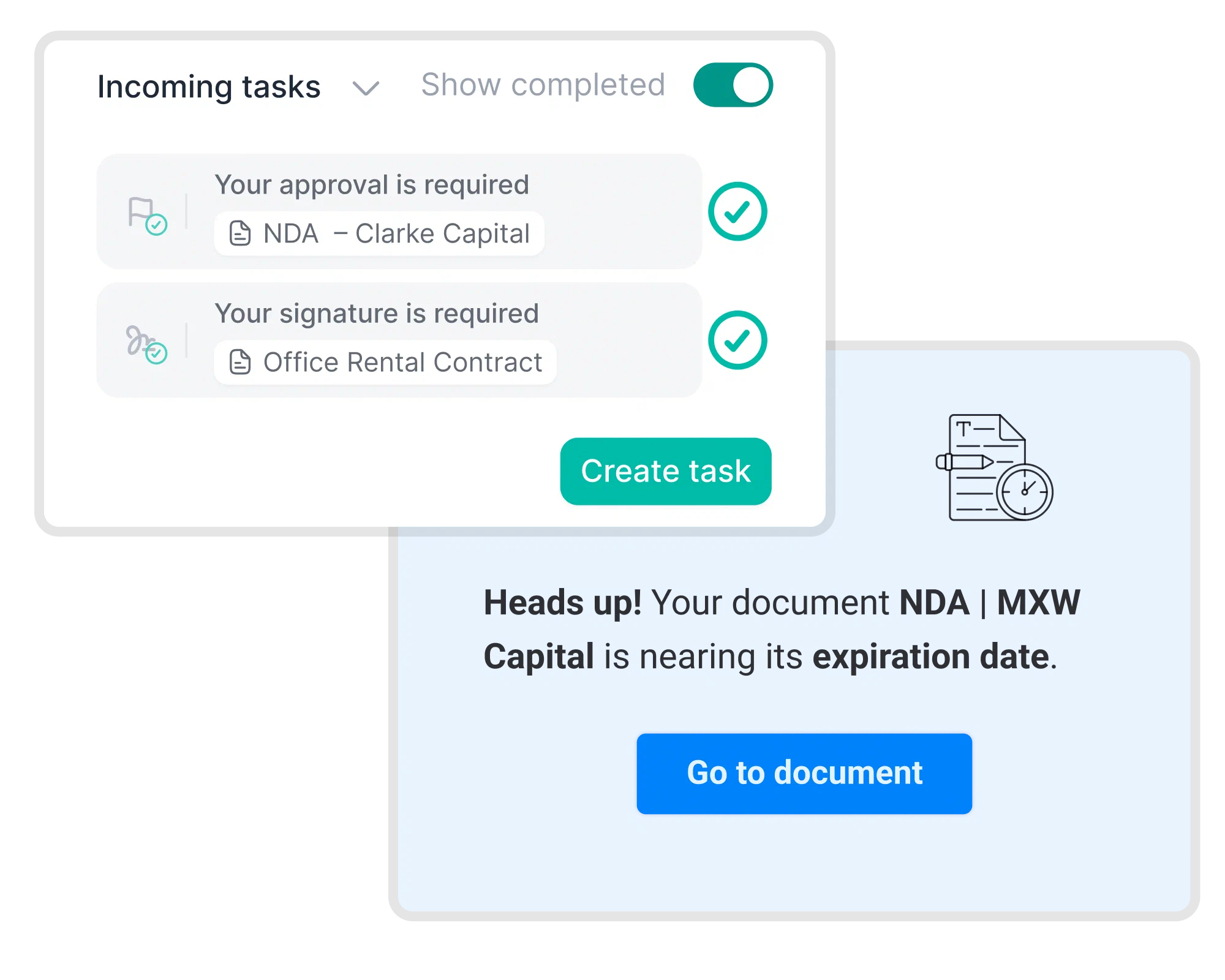
Warranties also end. A reminder before the expiry date of a certificate tells you when cover is about to lapse, so you can offer an extended plan or a renewal.
One warranty template, a certificate for every order.
Warranty policy vs return policy, extended warranty and warranty disclaimer
A warranty policy covers defects over time; the other three documents cover different situations and often sit next to it.
Warranty policy
Return policy
Extended warranty (service contract)
Warranty disclaimer
What it covers
Defects within the warranty period
Changing your mind within a short window
Repairs after or beyond the warranty, for a fee
Says no warranty is given
Who pays for it
Included in the price
Included in the price
Sold separately
Not applicable
Typical wording
Repair, replace or refund
Refund or exchange within a set number of days
Service plan terms
“As is”
Effect on implied warranties
Can only limit their duration
None
A seller that sells one at the time of sale or within 90 days after can’t disclaim them (15 U.S.C. 2308)
Tries to exclude them, where state law allows
You can’t combine a written warranty with a full warranty disclaimer on the same product, which is exactly what many store policies try to do. If you sell equipment to businesses on negotiated terms instead, a sales contract with its own warranty or as-is terms fits better than a consumer policy.
Decide the business terms first, fill in the template, then make sure customers can read it before they pay.
Pick the period. The law doesn’t set a length, but the limit on implied warranties only holds for a written warranty of reasonable duration (15 U.S.C. 2308(b)).
List the products. If batteries or other wear parts get a shorter period, say so in “Products covered”.
Choose who’s covered and who pays shipping. Both are choices in the template, so the wording follows your answer.
Fill in your claims contacts. Give at least an email or a phone number; your company’s mailing address comes in automatically. Delete a contact method you don’t offer.
Publish it before the sale. Online, put the full text or a clear link next to the product description. In a store, display it near the product or offer it on request with visible signs. If you deliver it only on your website, the rule asks for a few extra steps, such as a non-internet way to request a copy (16 CFR 702.3).
Fill in every field you keep. No field is mandatory in the template, so an empty “Warranty period” won’t stop a document from going out. Products, period, who’s covered and shipping are required disclosures.
The governing state field picks your state’s law for the policy, and the template adds that customers keep the protection of their own state’s law. Read it with the governing law and jurisdiction basics in mind if you sell nationwide.
A warranty you can send with every order
Fill in the template once, pre-sign it in fynk and create a signed warranty certificate for each sale.
Federal law doesn't set a length. Pick a period that covers the faults that show up in normal use, and keep it reasonable, because the limit on implied warranties only holds for a written warranty of reasonable duration.
If registration is a condition for coverage, the FTC rule says the warranty must disclose it. This template doesn't require registration and says so, because the order number already shows what was bought and when.
No. A warranty is a promise from the seller, so customers don't sign it. When you issue it as a certificate for one order, only your side signs, which shows the customer who stands behind the warranty.
It's written for US federal warranty law and a US governing state. Other countries have their own consumer rules for faulty goods, and this template isn't built for them.
The FTC disclosure rule covers consumer products and excludes products bought only for commercial use. You can still give business buyers the same warranty, but for negotiated equipment sales a sales contract with its own warranty terms is the better fit.