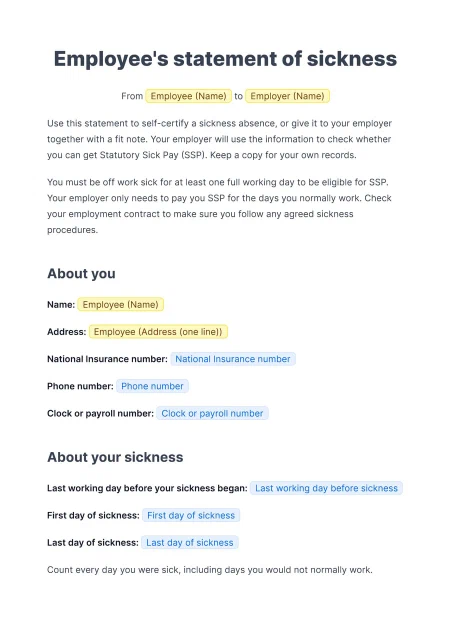
Use this statement to self-certify a sickness absence, or give it to your employer together with a fit note. Your employer will use the information to check whether you can get Statutory Sick Pay (SSP). Keep a copy for your own records.
You must be off work sick for at least one full working day to be eligible for SSP. Your employer only needs to pay you SSP for the days you normally work. Check your employment contract to make sure you follow any agreed sickness procedures.
About you
Name:Employee (Name)
Address:Employee (Address (one line))
National Insurance number:National Insurance number
Phone number:Phone number
Clock or payroll number:Clock or payroll number
About your sickness
Last working day before your sickness began:Last working day before sickness
First day of sickness:First day of sickness
Last day of sickness:Last day of sickness
Count every day you were sick, including days you would not normally work.
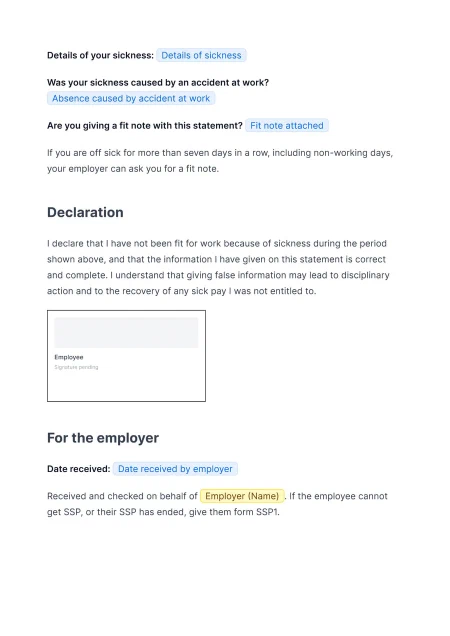
Details of your sickness:Details of sickness
Was your sickness caused by an accident at work?Absence caused by accident at work
Are you giving a fit note with this statement?Fit note attached
If you are off sick for more than seven days in a row, including non-working days, your employer can ask you for a fit note.
Declaration
I declare that I have not been fit for work because of sickness during the period shown above, and that the information I have given on this statement is correct and complete. I understand that giving false information may lead to disciplinary action and to the recovery of any sick pay I was not entitled to.
Employee
Signature pending
For the employer
Date received:Date received by employer
Received and checked on behalf of Employer (Name). If the employee cannot get SSP, or their SSP has ended, give them form SSP1.
Employer
NexaCloud Ltd.
Signature pending
The information, FAQs and templates provide general information, not legal or tax advice. fynk GmbH, the original creator and the author of this template give no warranty of factual or legal accuracy, completeness, currency or suitability for any jurisdiction or purpose. Have the information and document reviewed by a qualified adviser in the applicable jurisdiction before relying on them. To the extent permitted by law, fynk GmbH, the original creator and the author of this template exclude liability for losses arising from reliance on this information or template.
More than 12,000 teams chose fynk to outgrow legal chaos · Used in over 60 countries
What a self-certification form records, how it relates to HMRC's SC2 and the fit note, what this template asks for, and what the employer does once it comes back.
Self-certification form
A self-certification form (or “self cert”) is a statement in which a UK employee confirms, in their own words and over their own signature, that they were unfit for work because of sickness, and for which days. Employers use it as the written record behind a sickness absence and to check whether the employee can get Statutory Sick Pay (SSP).
Use this template if:
🤒 An employee was off sick and you need the absence in writing
🇬🇧 You employ people in the UK and pay Statutory Sick Pay
📅 You want the exact sickness dates for payroll, not a vague “off last week”
✍️ You’d rather collect a signed form online than chase a paper copy
What a self-certification form is for
A self-certification form turns a phone call or a message saying “I’m ill” into a dated, signed record. It answers the questions payroll actually needs: which days the employee was sick, when they last worked, what the illness was and whether a fit note covers any of it.
In the UK, HMRC publishes its own version, the SC2 employee’s statement of sickness. According to gov.uk, it can be used to self-certify a sick absence or alongside a fit note, and the employer uses the details to check whether the employee is eligible for SSP. The gov.uk version is filled in online in one go, and you can’t save your progress.
This template is not the SC2. It is fynk’s own form, built around the details gov.uk lists for the SC2 (National Insurance number, phone number, sickness dates, last working day and clock or payroll number), with signature lines for the employee and for the employer. Instead of asking the employee to fill in the gov.uk form and hand it over, you send this one yourself and get it back signed.
What the template asks for
The form has four short parts, and every blank is a question the employee answers. Nothing in it needs legal knowledge, which is the point: the person filling it in has just been ill and should not have to decode anything.
About you: name, address, National Insurance number, phone number and clock or payroll number.
About your sickness: the last working day before the sickness began, the first and last day of sickness, and a few words on what the illness was. The form asks the employee to count every sick day, including days they don’t normally work.
Accident at work and fit note: whether the absence was caused by an accident at work, and whether a fit note is attached. The form tells the employee that you can ask for a fit note after more than seven days off in a row.
Declaration: the employee confirms they were not fit for work during that period and that the information is correct, and accepts that false information may lead to disciplinary action and to recovery of sick pay they were not entitled to.
The employer’s part sits at the end. Your payroll or HR contact records the date the form was received and signs on behalf of the company. The same section reminds them to give the employee form SSP1 if they can’t get SSP or their SSP has ended.
Self-certification or fit note?
Short absences are covered by the employee’s own statement, longer ones by a fit note. gov.uk’s employer guide to sick pay says you can only ask for a fit note if the employee is off work for more than seven days in a row, including non-working days. That is why the template asks for every sick day, weekends included: the count decides whether a fit note can be requested at all.
A fit note can come from a GP or hospital doctor, a registered nurse, an occupational therapist, a pharmacist or a physiotherapist, and it can be printed or digital. When one exists, the self-certification form doesn’t become pointless. The employee ticks that a fit note is attached, and the form still gives you the date they last worked and the payroll details the fit note doesn’t contain.
For SSP itself, gov.uk’s SSP eligibility page says the employee must have been ill for at least one full working day. Since 6 April 2026, the SC2 guidance states the same rule, and adds that SSP is only paid for the days the employee normally works.
Good to know
A self-certification form is a record, not a condition for reporting sickness. According to gov.uk’s employer guide, the employee should tell you they’re sick within the time limit you set, or within 7 days if you haven’t set one, and you can’t insist they tell you in person or on a special form. So ask for the form to document the absence, and accept the first notice however it arrives.
Your sickness procedure lives in the contract
The form records an absence; the rules for reporting one belong in the employment contract or the staff handbook. gov.uk tells employees to check their employment contract to make sure they follow any agreed sickness procedures, so the contract is where you set the reporting deadline, who to call and any company sick pay on top of SSP. The sick leave clause is where most employers write this down.
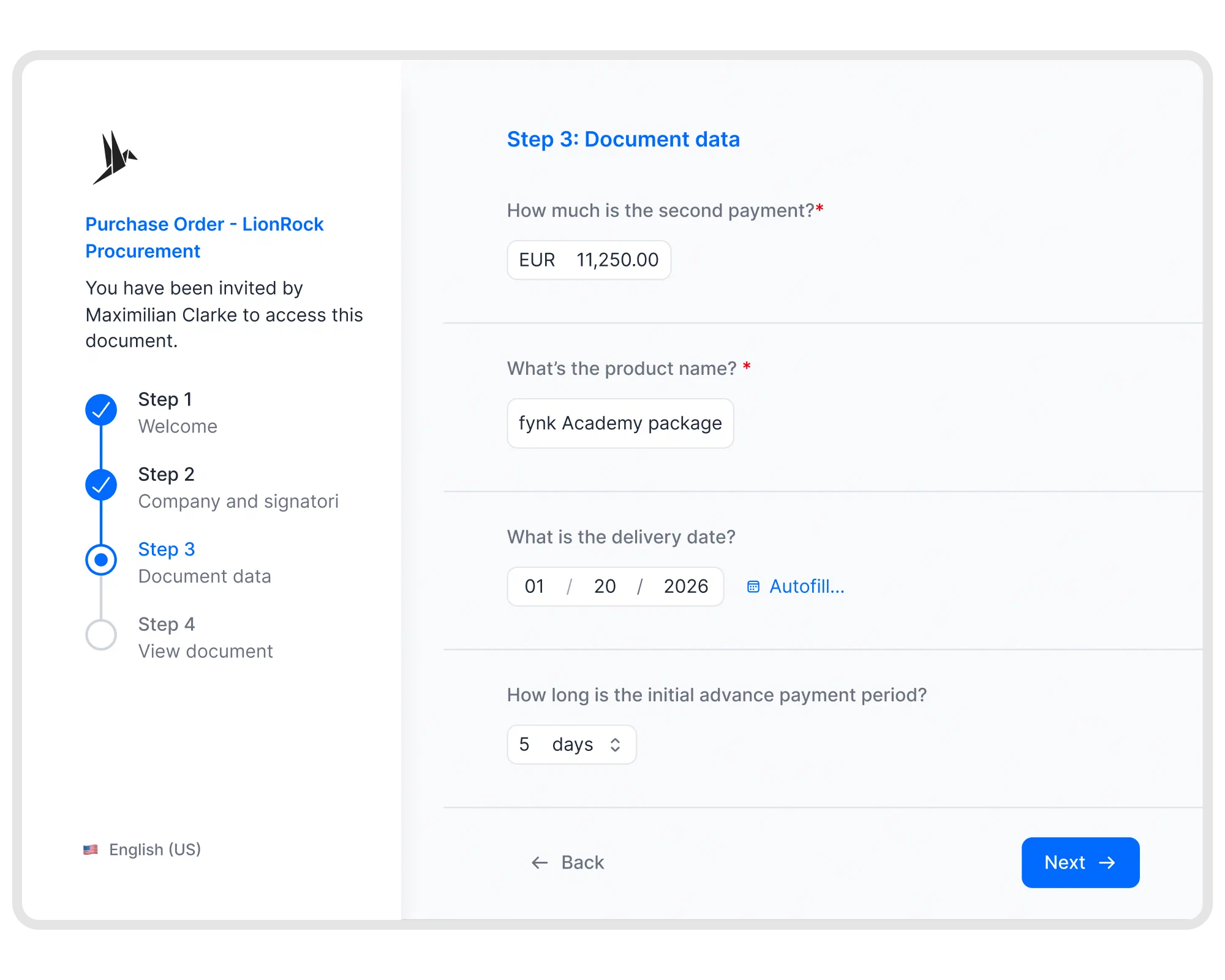
The quickest self cert is the one the employee can fill in on their phone from the sofa. In fynk, you create a document from this template and send it to the employee. With conversational forms, they don’t see a document full of blanks. They get the questions one after another (dates, illness, fit note), answer them and sign, without a fynk account.
Your HR or payroll contact then signs the employer’s part with an electronic signature, and the date received is filled in on the same document. If the employee says a fit note is attached, it can be uploaded next to the form as a related file, so both sit together when someone asks about that absence later.
Once the form comes back
Check the dates, decide on SSP and keep the record. A few things are worth doing every time:
Check the dates against your own records. The last working day and the first day of sickness decide when the absence started for payroll.
Request a fit note when the absence ran past seven days, counted in calendar days, not working days.
Give form SSP1 when SSP isn’t due. gov.uk’s eligibility guide for employers says that if the employee doesn’t qualify for SSP, you must send them form SSP1 within 7 days of their first day off sick. The employee can use it to apply for Universal Credit or Employment and Support Allowance.
Keep the form. gov.uk’s guide to SSP entitlement leaves it to you how you keep records of sickness absence, but HMRC may need to see them if there’s a dispute over payment.
Point four is where paper forms tend to fail: the signed copy sits in a manager’s drawer until the one week someone needs it, which is usually the week that manager is out of office.
Any UK employer that wants sickness absences documented the same way every time. It suits small companies without an HR system, teams that run payroll through an outside provider and need clean input, and employers whose staff work shifts or from several sites, where a paper form rarely makes it back to the office.
It is written for employees. Agency workers may also be entitled to SSP, so check who pays them before you send the form. The template is also not meant for countries outside the UK, where sickness reporting and sick pay follow different rules.
Sick days on record, without the paper chase
Send the self-certification form by link, let the employee answer on their phone, and keep the signed form with the rest of their employment documents.
No. The SC2 is HMRC's own form on gov.uk. This template is fynk's own form: it asks for the same details gov.uk lists for the SC2, has signature lines for the employee and the employer, and you send it, collect it and keep it in one place.
GP practices usually mean HMRC's SC2, the employee's statement of sickness. It covers absences of up to 7 days in a row, when an employer can't ask for a fit note, so the employee doesn't need a doctor for it. This template does the same job as a form you send yourself.
A fit note can only be requested once the absence runs past 7 days in a row, non-working days included. For shorter absences you can't require one, so the employee's own statement is the record.
You can ask for one to document the absence, and your contract or handbook can set out your sickness procedure. For the first notice of sickness, though, gov.uk says you can't insist the employee tells you in person or on a special form.
No. The employee fills in and signs the form themselves, and the employer confirms receipt. A doctor or other healthcare professional only comes in when a fit note is needed.
You must send them form SSP1 within 7 days of their first day off sick. The template reminds the employer of this in its own section, next to the receipt signature.
Yes. The employee and the employer both sign the form in fynk with an electronic signature, and the employee doesn't need a fynk account to do it.