
Witnesseth
“Witnesseth” is an old form of “to witness” that traditional contracts place after the preamble, before the WHEREAS recitals. It means “this document records the following” and has no legal effect of its own, so modern contracts leave it out.
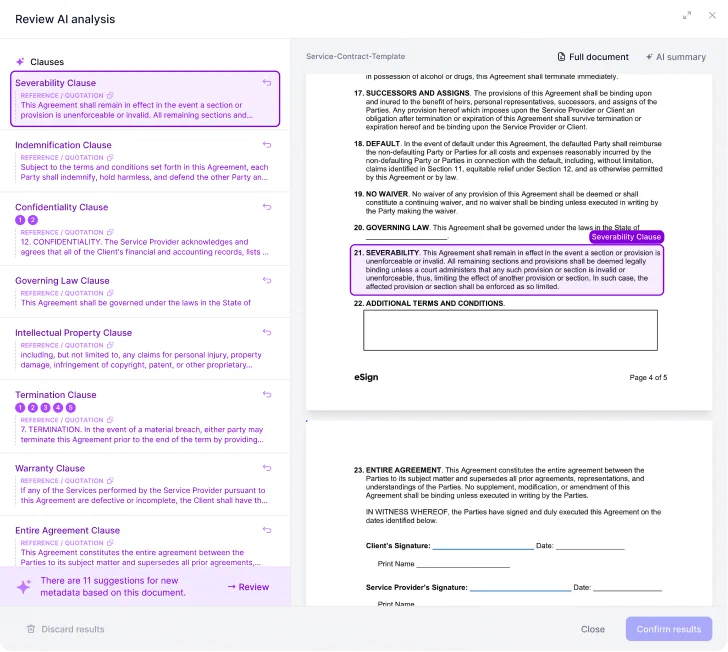
Analyze your contracts. Extract important clauses.
Try our AI contract analysis and extract important clauses and information from existing contracts.
Save your favourite clauses
Insert directly with a single click
Upload preferred precedents
Sample Witnesseth clauses
This indenture of lease is made and entered into this 1st day of March, 2023 by and between Red Bug, LLC, an Ohio Limited Liability Company hereinafter referred to as Lessor, and Amplex Electric, Inc., an Ohio for-profit corporation, hereinafter referred to as Lessee, WITNESSETH:
Source
VIAD CORP (VVI)NOW THEREFORE THIS AGREEMENT WITNESSETH THAT in consideration of the mutual promises and covenants contained herein and for other good and valuable consideration, the sufficiency and receipt of which is hereby acknowledged by each of the parties hereto, the parties have agreed and do agree as follows:
Source
Nikola Corp (NKLA)SUPPLEMENTAL INDENTURE WITNESSETH, for and in consideration of the premises and the issuance of the series of Securities provided for herein, it is mutually agreed, for the equal and proportionate benefit of all Holders of the Securities of such series, as follows:
WITNESSETH, that the Grantor, for and in consideration of the sum of Ten and 00/100 Dollars ($10.00), lawful money of the United States of America, unto it well and truly paid by the Grantee, at or before the sealing and delivery hereof, the receipt whereof is hereby acknowledged, has granted, bargained and sold, aliened, enfeoffed, released and confirmed, and by these presents does grant, bargain and sell, alien, enfeoff, release and confirm unto the Grantee, its successors and assigns, the premises described as follows:
WITNESSETH, that the Lessor, for and in consideration of Ten and More Dollars, cash in hand paid, the receipt of which is hereby acknowledged, and the covenants and agreements hereinafter contained, has granted, demised, leased and let, exclusively unto the Lessee, its successors and assigns, the land hereinafter described, for the purpose of mining, exploring by geophysical and other methods, and operating for and producing therefrom oil, gas, casing-head gas, casing-head gasoline, and the exclusive right of injecting gas, water, brine and other fluids or substances into subsurface strata, with rights of way and easements for laying pipelines, telephone, telegraph and electrical lines, tanks, power houses, stations, gasoline plants, ponds and roadways and fixtures for producing, treating and caring for such products and any and all other rights and privileges necessary, incident to, or convenient for the economical operation alone or conjointly with neighboring land, for the production of oil, gas, casing-head gas, casing-head gasoline, and the erection of structures thereon to produce, save and take care of said products.
What does witnesseth mean?
“Witnesseth” is an old form of the verb “to witness”. In a contract it means “this document records the following”. It is a heading word: it sits between the opening paragraph that names the parties and the text that follows, usually the recitals.
It has no legal effect of its own. A contract with “witnesseth” means the same as the same contract without it. It is still common because drafters copy older contracts, and because it makes a document look formal.
You will often see it in capitals, sometimes with letter spacing (W I T N E S S E T H) and usually followed by a colon.
Where witnesseth sits in a contract
A traditional contract opens in four steps, and witnesseth is the second:
- Preamble: “This Agreement is made on [date] between Acme Inc. and Beta LLC.”
- WITNESSETH: the heading word.
- Recitals: the background, each one starting with “WHEREAS”.
- Words of agreement: “NOW, THEREFORE, in consideration of the mutual covenants herein, the parties agree as follows:”
Some contracts move it into the last step: “NOW THEREFORE THIS AGREEMENT WITNESSETH THAT in consideration of …”. In deeds and older leases it opens the operative part: “WITNESSETH, that the Grantor, for and in consideration of …, has granted …”. The sample clauses above show each of these forms.
Witnesseth vs. whereas vs. now, therefore
| Word | Where it sits | What it means | Legal effect |
|---|---|---|---|
| Witnesseth | After the preamble | “This document records the following” | None |
| Whereas | Start of each recital | “Given that”, introduces background facts | Recitals can help interpret the contract, but usually create no obligations |
| Now, therefore | After the recitals | “So, on that basis”, leads into the terms | None on its own; it introduces the parties’ agreement |
At the other end of a traditional contract, just before the signatures, sits the matching closing line: in witness whereof.
Should you still use witnesseth?
No. Drafting guides recommend dropping it, and nothing is lost when you do. Most modern contracts replace the whole sequence with plain headings:
Sample clause: Modern opening without witnesseth
This Services Agreement is made on [date] between Acme Inc. (“Client”) and Beta LLC (“Provider”).
Background
A. Provider develops and supports software for logistics companies.
B. Client wants Provider to support its warehouse software, and Provider is willing to do so on the terms below.
The parties agree as follows:
Add this clause to a contract, send it and get it signed in fynk.
Use it in fynk for freeIf a counterparty sends a draft with “witnesseth”, there is no need to negotiate it. It is a style choice, not a term. For other old phrases and what they mean, see legalese.
Plain-English contracts in fynk
If your own templates still open with witnesseth and whereas, a rewrite is a good moment to clean them up. In fynk, AI Draft turns old wording into plain English inside the editor, and you can save the result as a template so every new contract starts from the clean version.
Which contracts use witnesseth?
Mostly older or traditional documents: deeds, real estate and lease agreements, indentures, loan documents and confidentiality agreements based on older forms. These free templates still use it:
Free templates with this clause
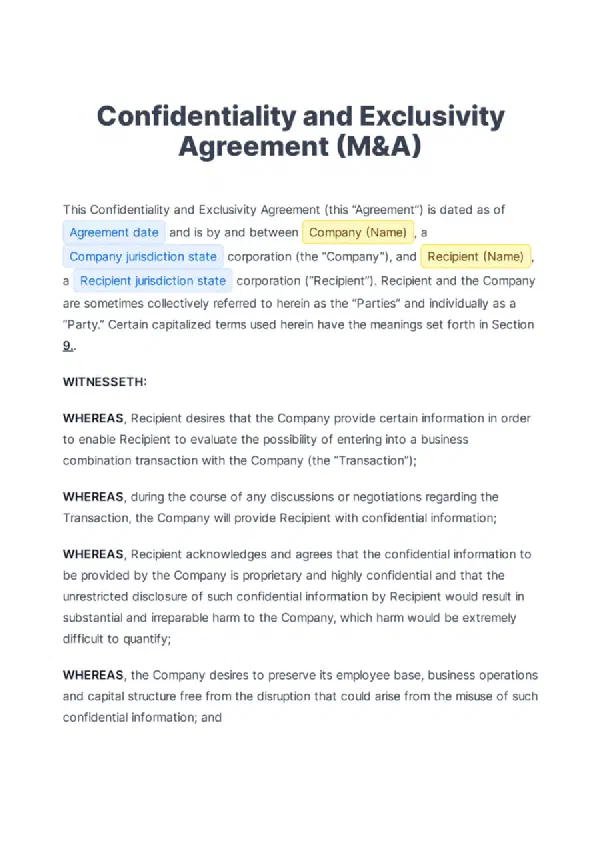 Confidentiality and exclusivity agreement (M&A) template
WITNESSETH, followed by WHEREAS recitals on the planned transaction.
Use the free template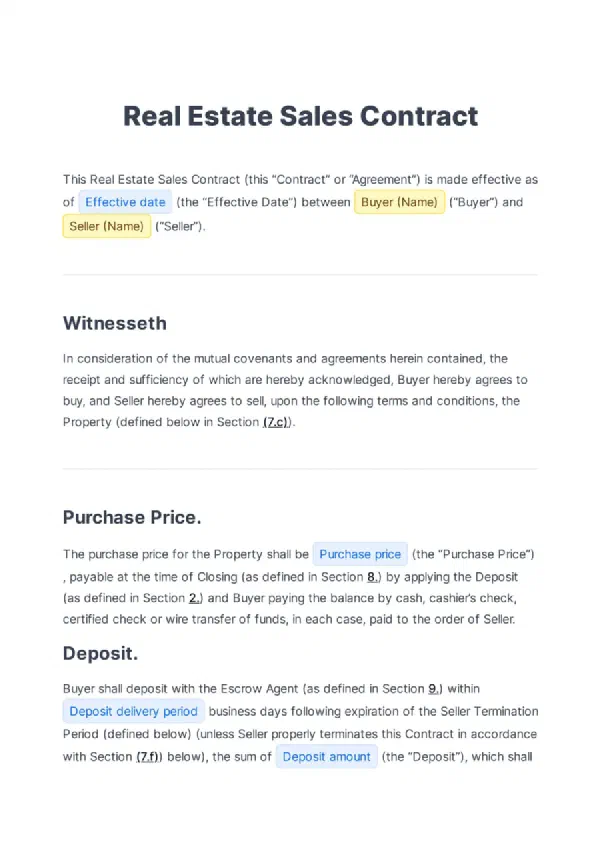 Real estate sales contract template
Witnesseth, followed directly by the buyer's promise to buy and the seller's promise to sell.
Use the free template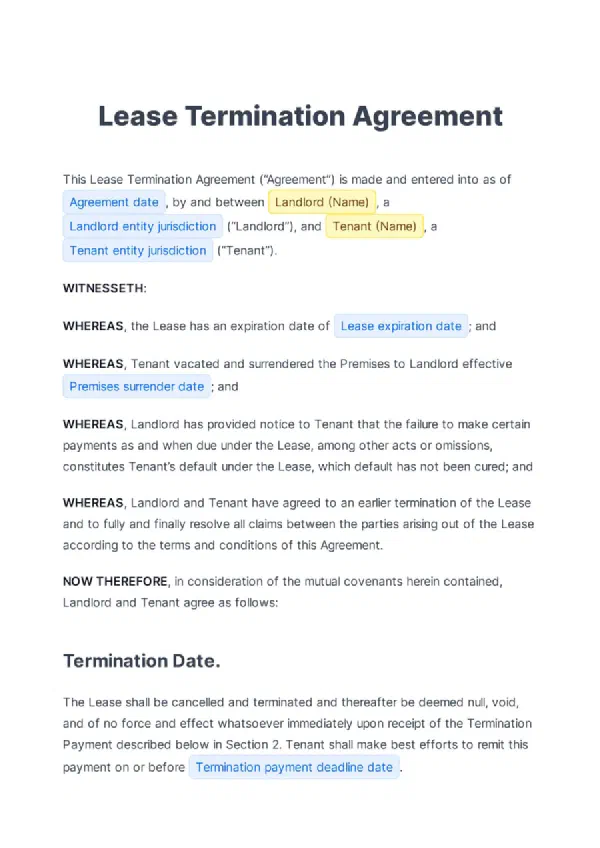 Lease termination agreement template
WITNESSETH, followed by WHEREAS recitals on the lease and the surrender of the premises.
Use the free template
Related clauses
- Recitals Recitals, often found at the beginning of a contract, provide a background or context for the agreement, outlining the reasons and purpose behind its formation. These introductory statements help clarify the intent of the parties involved but are not typically enforceable provisions within the contract itself.
- Preamble The preamble of a contract is its opening paragraph. It names the agreement, the date it is made and the parties, with their legal names, addresses and the short names used in the rest of the contract. It is followed by the recitals, which explain the background.
- Incorporation of recitals The "Incorporation of Recitals" clause specifies that the introductory statements (recitals) of a contract are fully integrated into the body of the agreement, making them legally binding and enforceable. This ensures the context and intentions outlined in the recitals are considered as part of the contractual obligations of the parties involved.
- Contract consideration Contract consideration refers to the value or benefit that each party agrees to exchange as part of the agreement, which is necessary for a contract to be legally binding. It can include money, services, goods, or a promise to refrain from a specific action.
- Counterparts A counterparts clause lets each party sign a separate, identical copy of a contract. Every signed copy counts as an original, and all of them together form one agreement, so the parties never have to sign the same piece of paper.
- Entire agreement The "Entire Agreement" clause asserts that the written contract constitutes the complete and final agreement between the parties, superseding any prior discussions, negotiations, or agreements. It ensures that no other verbal or written agreements outside the contract will affect or modify its terms unless formally amended in writing.
Frequently asked questions
It is an old form of “witness” and means “this document records the following”. It introduces the recitals or the terms and has no legal effect of its own.
No. Leaving it out changes nothing about whether the contract is valid or how it is read.
“So this agreement records the following.” It leads from the background into the terms the parties agree to.
No. Witnesseth is a single heading word. Whereas starts each recital, the background facts that explain why the parties are signing.
WIT-ness-eth, with the stress on the first syllable.
More clauses from the library
See allWork made for hire
A "Work Made for Hire" clause stipulates that any work created by an employee within the scope of their employment, or certain commissioned works falling under specific categories, is automatically owned by the employer or commissioning party from the moment of creation. This ensures that the entity paying for the work retains all intellectual property rights, rather than the individual creator.
17 example clauses
Work order
A work order is a short document that orders one specific job under a master agreement. It sets out the work, the timeline, the price and who does it, while the master agreement holds the legal terms that apply to every work order.
12 example clauses
Work product ownership
The "Work Product Ownership" clause stipulates that any work products, deliverables, inventions, or materials created by a contractor during the course of a project are the exclusive intellectual property of the hiring party. This clause ensures that the hiring party holds all rights, including copyrights and patents, to the work produced under the agreement.
17 example clauses
Analyze your contracts. Extract important clauses.
Try our AI contract analysis and extract important clauses and information from existing contracts.
Save your favourite clauses
Insert directly with a single click
Upload preferred precedents