
Service levels and KPIs
A service levels clause turns good service into numbers: what the provider measures, the target, how it is measured and what a miss costs. Service levels are binding and usually backed by service credits, while KPIs are tracked to manage the relationship without a financial consequence.
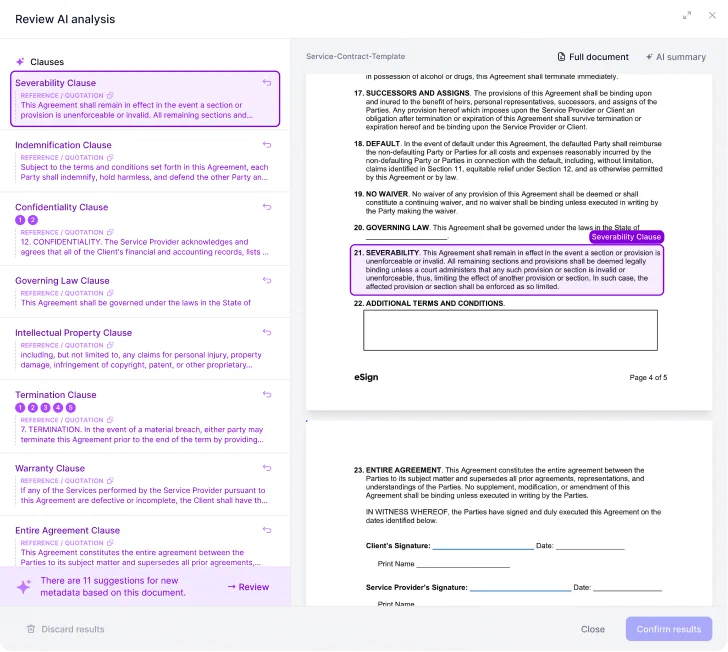
Analyze your contracts. Extract important clauses.
Try our AI contract analysis and extract important clauses and information from existing contracts.
Save your favourite clauses
Insert directly with a single click
Upload preferred precedents
Sample Service levels and KPIs clauses
“Critical Service Level” shall mean those Service Levels established under the applicable Supplement for which a Service Level Credit may be payable. Critical Service Levels are identified in the applicable Supplement and are described in the applicable Supplement. Each Critical Service Level has an Expected Service Level and a Minimum Service Level associated with it unless otherwise specified. It is the intent of the Parties that all Critical Service Levels shall be quantifiable, measurable, and objective.
3.1. This Schedule B describes the methodology for measuring Provider’s performance against the Service Levels (each such measurement a “Service Level Measurement”) and Key Performance Indicators set forth in Exhibit B-1 to Annex B of an applicable Managed Services Statement of Work and for calculating credits (the “Service Level Credits”) and incentives (the “Service Level Bonuses”) with respect to the Service Levels.
7.1.1 General Performance Standards. Beginning on the Commencement Date, unless otherwise provided in the applicable Supplement or for the Deferred Countries, such later date as Supplier assumes responsibility for providing Services in those Deferred Countries, Supplier shall perform the Services at levels of accuracy, quality, completeness, timeliness, responsiveness and resource efficiency that are at least equal to those received by Kraft or the Eligible Recipients 12 months prior to such date. In addition, for those Services for which there are no Service Levels, Supplier shall perform such Services at levels of accuracy, quality, completeness, timeliness, responsiveness, resource efficiency and productivity that are equal to or higher than the accepted industry standards of first tier providers of such business process and outsourcing services. This Section 7.1.1 shall not be deemed to supersede the Service Levels specified in the applicable Supplement.
Source
LEVI STRAUSS & CO (LEVI)6.4 Multiple Service Level Failures; At Risk Amount. If more than one Service Level Failure has occurred in a single month, the sum of the corresponding Service Level Credits shall be credited to LS&Co.; provided that in no event shall the Service Level Credits credited to LS&Co. with respect to all Service Level Failures incurred in a single month exceed the At Risk Amount.
Source
VONAGE HOLDINGS CORP6.2.1. Failure to meet Service Levels or exceed Service Levels may be subject to Amdocs’ provision of performance credits (“Service Level Credits”) to Company or the application of earn backs (as the term is used in Schedule 11) (as the case may be).
Failure to Meet Performance Standards. In the event FIS does not meet the Performance Standards for any period, Client will inform FIS in writing and FIS will use every reasonable effort to remedy the cause of such performance standards not being met.
What is a service levels clause?
A service levels clause turns “good service” into numbers. It lists what the provider measures, the target for each measure, how and how often it is measured, and what happens when a target is missed.
The service levels can sit in the main contract, in a schedule, or in a separate service level agreement (SLA) attached to a master service agreement. Wherever they sit, they work the same way: a promise you can check, with a consequence attached.
Example: “The platform will be available 99.9% of each calendar month, excluding scheduled maintenance. If availability falls below 99.9%, the customer receives a service credit of 5% of that month’s fee.”
SLA vs. KPI: what is the difference?
Both are performance measures, and contracts often use both. The difference is what happens when the number is missed.
| Service level (SLA) | Key performance indicator (KPI) | |
|---|---|---|
| What it is | A binding target the provider promises to meet | A measure the parties track to see how the service is going |
| Consequence of a miss | Service credits, a remediation plan, and after repeated misses a right to terminate | Usually none in money; it is discussed in governance meetings |
| How many | Few: the measures that matter most to the customer | More: anything useful for managing the relationship |
| Typical examples | Availability, response and resolution times, delivery on time | Customer satisfaction, first-contact resolution, ticket backlog, improvement ideas delivered |
| Can it change? | Only by written amendment | Often reviewed and adjusted by the parties more freely |
A common setup is to start a new measure as a KPI, collect data for a few months, and then turn it into a service level once both sides know what a fair target is.
Service level examples by type of service
The measures depend on what is being bought. Typical service levels:
| Service | Measure | Example target |
|---|---|---|
| SaaS and cloud hosting | Availability (uptime) | 99.9% per calendar month, excluding scheduled maintenance |
| IT support and help desk | Response time to a critical incident | Within 30 minutes, 24/7 |
| IT support and help desk | Resolution or workaround for a critical incident | Within 4 hours |
| Customer service outsourcing | Calls answered within a set time | 80% of calls within 20 seconds |
| Logistics and fulfilment | Orders shipped on time | 98% shipped on the promised day |
| Payroll and back office | Accuracy | 99.5% of payslips without errors |
| Facilities management | Repairs started | Urgent repairs started within 2 hours |
The numbers above are illustrations. The right target depends on the service, the price and what the business actually needs.
How to write a service level that works
A service level is only as good as its definition. For each one, the contract should say:
- What is measured. “Availability” of what: the whole platform, one module, the ability to log in? Define the event that counts as a failure.
- The target. A number, with the unit: a percentage, minutes, hours, a count.
- The measurement period. Per month is most common. A yearly figure hides bad months.
- The data source. Whose monitoring tool or ticket system counts, and whether the customer can see the raw data.
- The exclusions. Scheduled maintenance, the customer’s own systems, force majeure events. Keep the list short and specific.
- Reporting. A monthly report with the result for every service level, delivered by a fixed date.
- The consequence. What a miss costs and what the provider has to do about it.
Write the targets so a third person could check them from the data alone. “Quantifiable, measurable and objective” is the test, as one of the sample clauses above puts it.
What happens when a service level is missed
Contracts usually stack several remedies:
- Service credits. A reduction of the next invoice, often a percentage of the monthly fee per missed service level. Most contracts cap the total credits per month, sometimes called the amount at risk.
- Earn-back. The provider can win a credit back by beating the target in the following months.
- Root cause analysis and remediation plan. The provider has to find out why the miss happened and fix it, by a deadline.
- Termination for chronic failure. If the same service level is missed several times within a set period, the customer may terminate without waiting for a larger breach.
- Other remedies. The contract should say whether service credits are the only remedy or whether the customer can still claim damages. Providers prefer “sole and exclusive remedy”. Customers usually push back.
If you are the customer, check that the credits are large enough to matter. A credit of 1% of a monthly fee will not change how a provider staffs its support desk.
Service levels clause example
Sample clause: Service levels
Add this clause to a contract, send it and get it signed in fynk.
Use it in fynk for freeKeeping track of service levels after signing
Service levels only help if someone checks them each month and raises a miss in time. In fynk, you save the targets, the credit percentage and the review date as metadata on each supplier contract, so they can be filtered and reported on across every contract. A task with a reminder asks the contract owner to check the monthly report, and another one comes up before the annual SLA review, while there is still time to renegotiate targets.
Which contracts include service levels?
Software as a service and cloud agreements, IT managed services and outsourcing contracts, hosting and data center agreements, customer service and call center outsourcing, logistics and facilities management contracts. These free templates include service levels:
Free templates with this clause
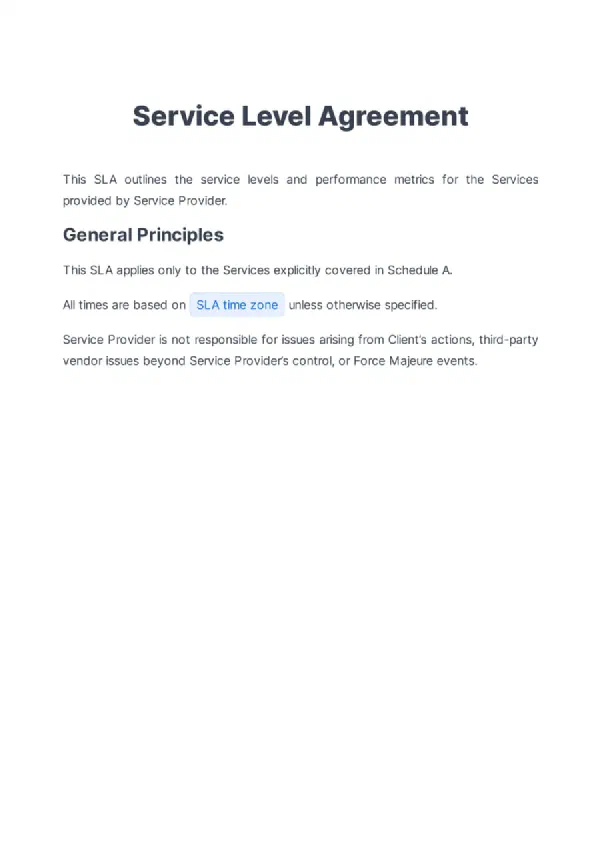 Service level agreement template
A full SLA with four incident severity tiers, response and resolution times, an uptime guarantee and capped service credits.
Use the free template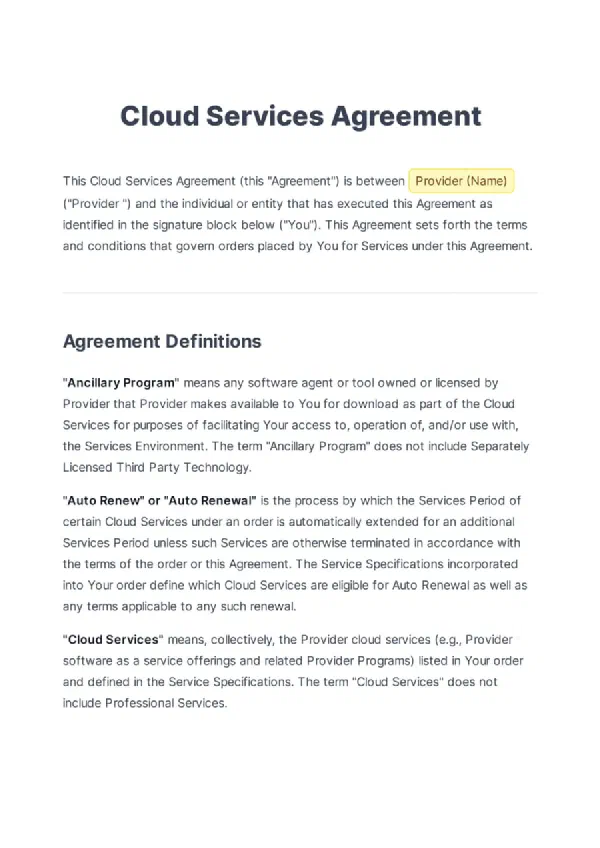 Cloud services agreement template
The provider may update its service specifications, but not in a way that materially reduces performance or availability during the term.
Use the free template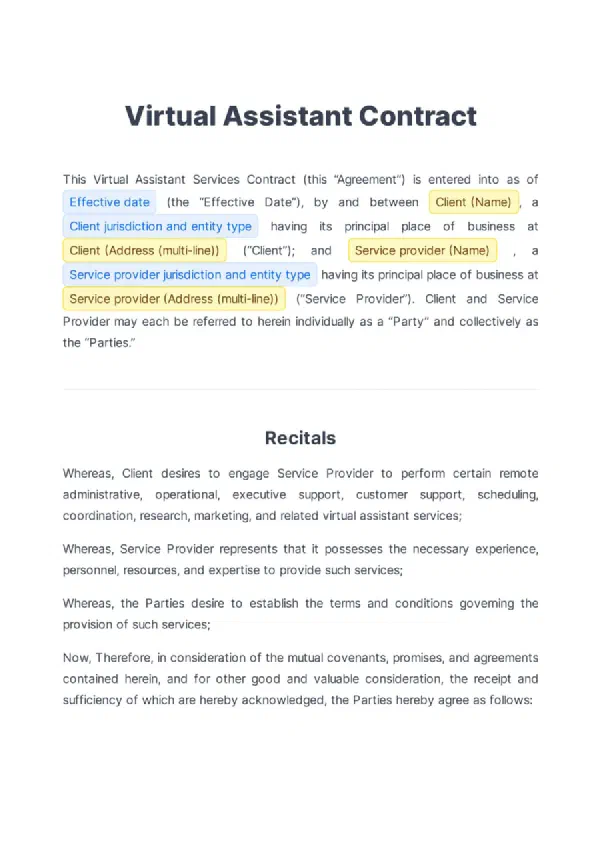 Virtual assistant contract template
Service levels and reporting duties are set per statement of work, and changes that affect them lead to an adjustment of fees or scope.
Use the free template
Related clauses
- Service credits Service credits are compensation mechanisms outlined in a contract where the service provider offers credit to the customer for any failure to meet agreed-upon performance standards or service levels. These credits serve as a financial remedy, incentivizing the provider to maintain high-quality service while acknowledging and compensating for any deficiencies.
- Standard of performance The "Standard of Performance" clause specifies the expected level of quality and diligence required from a party in fulfilling their contractual obligations. It typically outlines the criteria, industry standards, or benchmarks against which performance will be measured to ensure compliance and satisfactory completion of tasks.
- Interruption of services The "Interruption of Services" clause outlines the conditions and responsibilities associated with temporary or permanent disruptions in the provision of services outlined in a contract. It typically includes information on notification requirements, potential remedies, and liability limitations for the parties involved when service interruptions occur.
- scope of work The scope of work clause defines the detailed tasks, deliverables, and responsibilities that are required for a project, ensuring all parties have a clear understanding of what is expected. It outlines the project's boundaries and limitations to prevent scope creep and manage expectations effectively.
- Cure period A cure period clause provides a specific timeframe within which a party in breach of a contract can rectify or "cure" the breach to avoid further legal consequences, such as termination of the agreement. This clause offers a structured opportunity to remedy non-compliance, thereby maintaining the contractual relationship and reducing potential disputes.
- Liquidated damages Liquidated damages are a predetermined sum agreed upon by the parties to a contract, payable in the event of a specified breach, serving as compensation for losses that are difficult to quantify. This clause aims to provide certainty and avoid lengthy legal disputes over actual damages while discouraging breach of contract.
Frequently asked questions
An SLA (service level) is a binding target with a consequence, such as a service credit, when it is missed. A KPI is a measure the parties track to manage the service, usually without a financial consequence.
Availability or uptime, response time, resolution time, on-time delivery, accuracy and customer satisfaction. Which ones fit depends on the service being bought.
For business software, 99.9% per month is a common commitment. That allows roughly 43 minutes of unplanned downtime in a 30-day month. Higher commitments, such as 99.99%, usually cost more.
Whatever the contract says. Usually the customer receives a service credit, the provider has to find and fix the cause, and repeated misses give the customer a right to terminate.
Either works. A separate schedule or SLA is easier to update when targets change, while the main contract keeps the legal terms, such as liability and termination.
More clauses from the library
See allService provider indemnity
A service provider indemnity clause is a contractual agreement where the service provider agrees to compensate the client for any losses, damages, or liabilities resulting from the provider's actions or negligence. This provision is designed to protect the client from legal or financial repercussions tied to the service provider's performance.
8 example clauses
Services warranty
A services warranty clause guarantees that the services provided will meet certain quality and performance standards, typically for a specified period. It often outlines the provider's obligation to rectify any defects or deficiencies discovered during the warranty period, ensuring customer satisfaction and accountability.
15 example clauses
Settlement purposes only
The "Settlement Purposes Only" clause specifies that any agreements or statements made during negotiations are solely intended for resolving the current dispute and cannot be used as evidence or precedent in future disputes. This clause ensures confidentiality and encourages open discussions to reach a settlement without affecting other legal rights or obligations.
14 example clauses
Analyze your contracts. Extract important clauses.
Try our AI contract analysis and extract important clauses and information from existing contracts.
Save your favourite clauses
Insert directly with a single click
Upload preferred precedents