
Retainer
A retainer is a fee a client pays in advance to secure a professional's services, such as a lawyer, consultant or agency. Depending on the agreement, it reserves their availability or is a prepayment that later work is billed against, and any unearned part may have to be refunded.
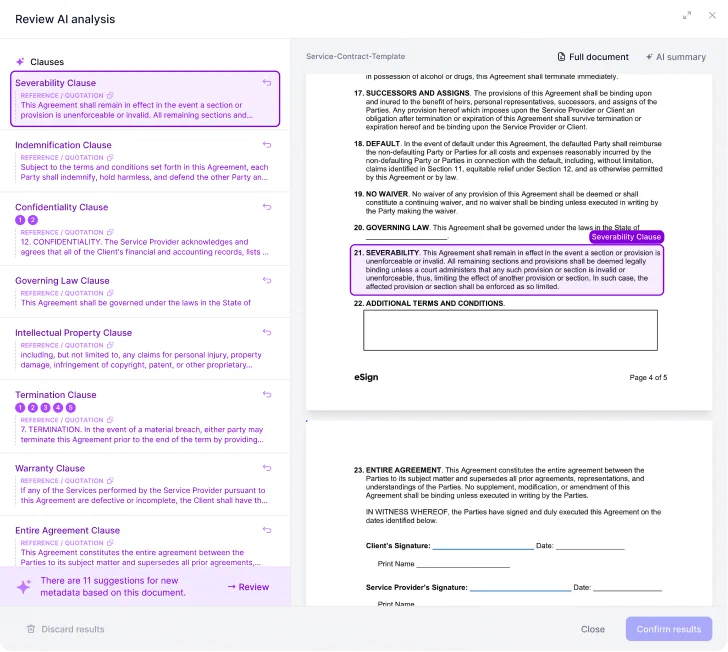
Analyze your contracts. Extract important clauses.
Try our AI contract analysis and extract important clauses and information from existing contracts.
Save your favourite clauses
Insert directly with a single click
Upload preferred precedents
Sample Retainer clauses
Source
Vontier Corp (VNT)In addition to any Equity Retainer (as defined below), an annual equity award with a target award value of $175,000 (the “Annual Equity Grant”), divided equally between options and RSUs; provided, however, that, at the sole discretion of the Compensation and Management Development Committee or the Board of Directors, such Annual Equity Grant may be comprised solely of RSUs. The options, if any, are fully vested as of the grant date. The RSU component of the Annual Equity Grant shall vest upon the earlier of (1) the first anniversary of the grant date, or (2) the date of, and immediately prior to, the next annual meeting of Vontier shareholders following the grant date, and will be converted into shares of Vontier common stock upon or as soon as practicable after vesting, subject to any applicable deferral election under the DCP.
Source
Vontier Corp (VNT)Moreover, each non-chair member of the Audit Committee receives an annual retainer of $15,000 (the “AC Member Retainer”), each non-chair member of the Compensation and Management Development Committee receives an annual retainer of $10,000 (the “CC Member Retainer”), each non-chair member of the Capital Deployment Advisory Group receives and annual retainer of $10,000 (the “CDAG Member Retainer”) and each non-chair member of the Nominating and Governance Committee receives an annual retainer of $7,500 (together with the AC Member Retainer, the CC Member Retainer and the CDAG Member Retainer, the “Annual Member Retainer”), which Annual Member Retainers are payable, based upon the Payment Election, either in cash (“Cash Member Retainer” and, together with the Cash Base Retainer, the Cash Board Chair Retainer, and the Cash Committee Chair Retainer, the “Cash Retainer”) equal to the corresponding Annual Member Retainer amount, in a RSU grant (“Equity Member Retainer” and, together with the Equity Base Retainer, the Equity Board Chair Retainer, and the Equity Committee Chair Retainer, the “Equity Retainer”) with a target award value of the Annual Member Retainer amount, or in a combination of Cash Member Retainer and Equity Member Retainer, with the allocation between Cash Member Retainer and Equity Member Retainer determined based on the Payment Election.
Source
Blend Labs, Inc. (BLND)Annual Retainer
Starting on January 1, 2022, each Outside Director who has not entered into an Outside Director Letter (as defined below) will be eligible to receive an annual retainer of $400,000 (the “Annual Retainer”) for services performed during the then-current calendar year. There are no per-meeting attendance fees for attending Board meetings. Any portion of the Annual Retainer that the Outside Director does not elect to forego in favor of receiving Retainer Options (as defined below) in accordance with the provisions of Section 2 of this Policy will be paid in cash in approximately equal monthly installments on the fifteenth (15th) day of each calendar month in the then-current calendar year, subject to the individual continuing to remain an Outside Director on the applicable payment date.
If an individual first becomes an Outside Director after January 1 of any calendar year, such Outside Director will receive a pro-rated portion of the Annual Retainer with such pro-rated amount equal to the Annual Retainer multiplied by a fraction with a numerator equal to the number of calendar months remaining in the calendar year in which the individual first becomes an Outside Director (with the month the individual first becomes an Outside Director counted as a remaining calendar month) and a denominator equal to 12. For purposes of example only, if an individual first becomes an Outside Director on April 15, the Outside Director will receive an Annual Retainer of $300,000 or ((9/12) * $400,000) for such calendar year.
Source
Blend Labs, Inc. (BLND)Retainer Options
Each Outside Director may elect to convert all or a portion of his or her Annual Retainer into a number of Options (“Retainer Options,” and such election, a “Retainer Option Election”). The number of Shares subject to each Retainer Option will be equal to the quotient of (i) 1/12th of the dollar value of the Annual Retainer that the Outside Director elects to forego over the course of the annual period covered by a Retainer Option Election in favor of receiving Retainer Options divided by (ii) the Value on the grant date of the applicable Retainer Option, provided that the number of Shares covered by each Retainer Option shall be rounded to the nearest whole Share using standard rounding principles (i.e., 0.5 or higher, round up, and below 0.5, round down). By way of example, if the Annual Retainer for the annual period covered by a Retainer Option Election is $400,000, and the Outside Director elects to convert 50% of the Annual Retainer into Retainer Options, and the Value to purchase one Share on the grant date of the applicable Retainer Option is $10, the Outside Director would receive a Retainer Option to purchase 1,667 Shares ((1/12th) * $200,000) / $10/Share = 1,667 Shares). Notwithstanding the foregoing, if an Outside Director first becomes an Outside Director after January 31 of a calendar year, the number of Shares subject to each Retainer Option will be calculated based on the number of Retainer Option grant dates remaining in the applicable calendar year. Retainer Options shall be subject to certain terms and conditions as provided for in Section 3 of this Policy.
Source
Blend Labs, Inc. (BLND)Retainer Option Election Mechanics
Each Retainer Option Election must be submitted to Stock Administration in the form and manner specified by the Board or Compensation Committee. An individual who fails to make a timely Retainer Option Election shall not receive Retainer Options and instead shall receive the full Annual Retainer payable in cash. Retainer Option Elections must comply with the following timing requirements:
Source
Blend Labs, Inc. (BLND)Terms of Retainer Options a. Grant Date. Each Retainer Option will be granted on the last calendar day of each month of the calendar year to which the Retainer Option Election applies, subject to the individual continuing to remain an Outside Director on the applicable grant date; provided, however, that if the last calendar day of the month is not a Trading Day, the Retainer Option will be granted on the previous Trading Day prior to such date. b. Vesting Schedule. Each Retainer Option will be fully vested on the grant date. c. Value. For purposes of this Policy, “Value” means, with respect to a Retainer Option, its grant date value calculated in accordance with the Black-Scholes option valuation methodology, or such other methodology the Board or Compensation Committee may determine prior to the grant of the Retainer Option becoming effective, as applicable. d. Type of Option. Each Retainer Option will be a Nonstatutory Stock Option. e. Term of Retainer Option. Each Retainer Option will have a 10-year term from the grant date, subject to earlier termination as provided in the Plan. f. Fair Market Value. The exercise price per Share of each Retainer Option will equal 100% of the Fair Market Value of one Share on the grant date of such Retainer Option. g. Automatic and Nondiscretionary. All grants of Retainer Options pursuant to Section 2 of this Policy will be automatic and nondiscretionary, except as otherwise provided herein, and will be made in accordance with the terms of the Plan, the form of stock option agreement adopted for use thereunder and this Policy.
Source
Blend Labs, Inc. (BLND)Change in Retainer Cash Payments. If an Outside Director makes a Retainer Option Election with respect to an Annual Retainer for a calendar year, but (i) if the Outside Director’s Annual Retainer is increased during such period, the Outside Director must receive the increased amount of Annual Retainer in cash payable in accordance with the terms of Section 1 of this Policy, or (ii) if the Annual Retainer is decreased during such period, no change will be made to any already granted Retainer Option(s), with the number of Shares subject to any Retainer Options granted after such decrease adjusted to reflect the decrease.
Annual Government Advisory Committee Retainer (Amounts and Payment Mechanic): Non-employee directors serving on the Government Advisory Committee during 2022 will receive an additional annual retainer of $15,000 in the form of RSUs, subject to vesting and the limitations described below regarding RSU grants. Non-employee directors serving on the Government Advisory Committee may not make an election to receive the Annual Government Advisory Committee Retainer in any other form.
Annual Board Retainer Elections: Non-employee directors may elect to receive all or a portion of $50,000 of the Annual Board Retainer in cash or RSUs (elections to receive cash or RSUs must be made in 5% increments). The remaining $175,000 of the Annual Board Retainer is paid in the form of RSUs and no election may be made with respect to such amount.
Annual Committee Chair Retainers: The following amounts will be payable for each calendar year to each chairperson of the following committees of the Board (each, a “Committee”) in the form of cash, unless the Non-Employee Director makes a timely election to receive all or a portion of the Annual Committee Chair Retainer in the form of RSUs (subject to the limitations described below): •Audit – $40,000; •Compensation – $15,000; and •Nominating and Corporate Governance – $10,000.
Annual Government Advisory Committee Retainer: $15,000 will be payable for each calendar year in the form of RSUs to each Non-Employee Director serving on the Company’s Government Advisory Committee during a calendar year (subject to the limitations described below). Non-Employee Directors serving on the Government Advisory Committee may not make an election to receive the Annual Government Advisory Committee Retainer in any other form.
Quarterly Retainer Election I hereby elect to receive _____% of the Quarterly Retainer(s) (and any Chair Quarterly Retainer or Lead Director Quarterly Retainer, as applicable) due to me on each Quarterly Payment Date in Shares having an equivalent value.
RETAINER GRANT ELECTION. By signing below, I elect to forego receiving payment of all (but not less than all) of the compensation I am otherwise eligible to receive in cash under the heading “Annual Cash Compensation” of the Policy for the period during the fiscal year of the Company ended [] commencing on []1 and ending on [___],2 and to receive a Retainer Grant in lieu thereof. If I do not timely submit a properly completed Election Form, I will not receive the applicable Retainer Grant and will instead receive the applicable cash compensation under the heading “Annual Cash Compensation” of the Policy.
What is a retainer?
A retainer is a fee a client pays in advance to secure a professional’s services. It either reserves the professional’s time and availability, or works as a deposit that later fees are taken from. The retainer clause in the agreement says which one it is, how much is paid and what happens to money that is not used.
Lawyers, consultants, agencies, accountants and freelancers use retainers, and companies pay an annual retainer to their non-employee board directors.
What does a retainer fee mean?
A retainer fee is the payment itself: the amount the client hands over at the start, before the work is done. It shows commitment from the client and protects the professional from unpaid invoices. Whether the fee is “earned” when paid or only as the work is done decides whether the client can get money back later.
Types of retainers
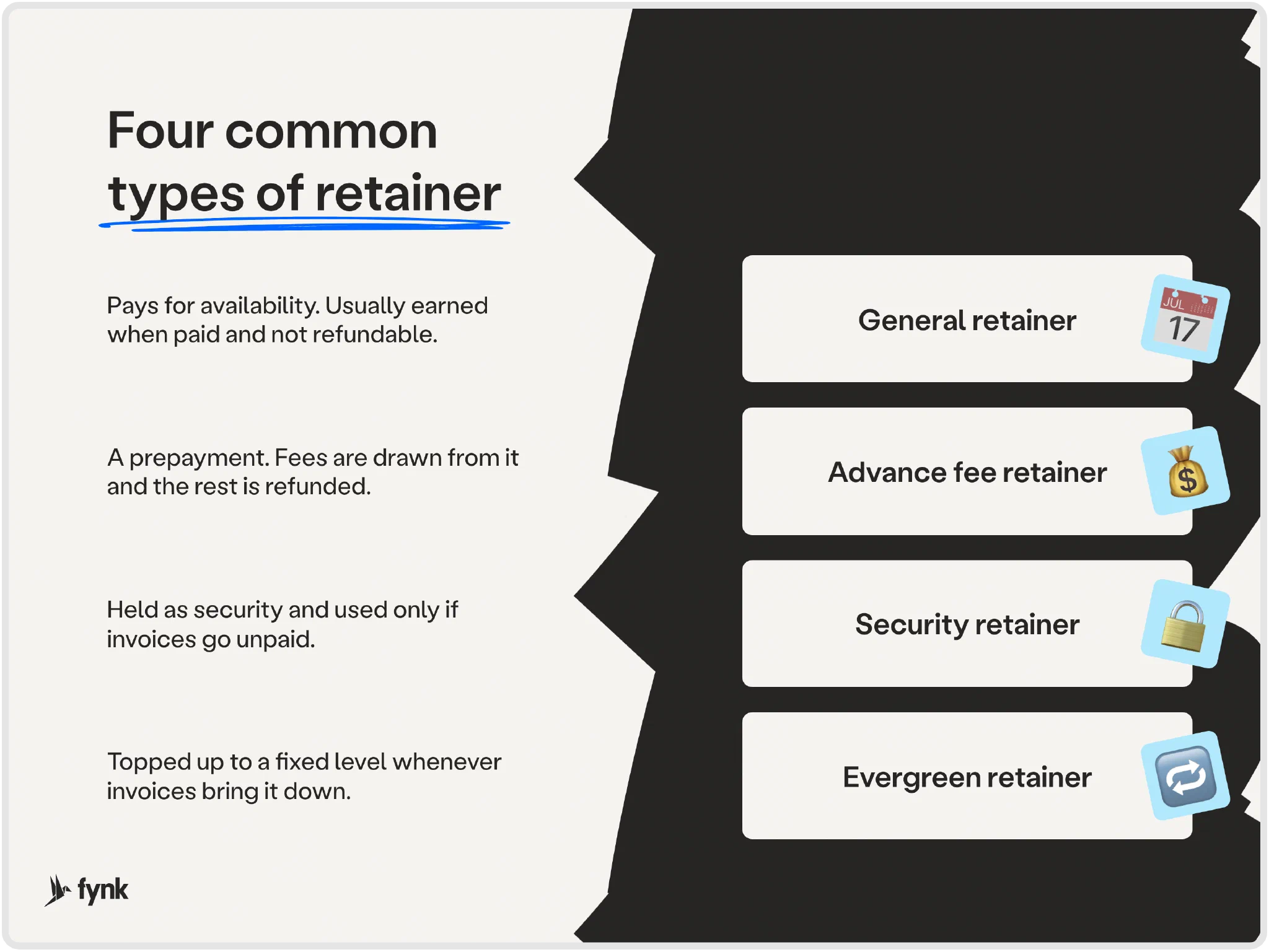
- General retainer: pays for availability. The professional agrees to be on call and may turn down conflicting work. It is usually earned when paid and not refundable.
- Advance fee retainer: a prepayment. Hourly or project fees are deducted from it as the work is done, and the unused balance is refunded at the end.
- Security retainer: held as security for future invoices and applied only if the client does not pay.
- Evergreen retainer: an advance fee retainer the client tops up to a fixed level whenever invoices bring it down.
- Monthly retainer: a fixed fee paid every month for ongoing work, such as an agency or bookkeeping retainer.
- Annual or cash retainer: a fixed yearly fee paid to non-employee directors for board service, often on top of meeting fees and equity awards.
Is a retainer refundable?
It depends on the type. An advance fee or security retainer is the client’s money until it is earned, so the unused part is normally refunded when the work ends. A general retainer that only pays for availability is usually not refundable. For US lawyers, the ABA Model Rules, which most states have adopted in some form, require fees to be reasonable (Rule 1.5), unearned advance fees to be held in a trust account (Rule 1.15(c)) and the unearned part to be refunded when the representation ends (Rule 1.16(d)), so a “non-refundable” label alone does not always hold.
Retainer vs. retainage
They sound alike but work in opposite directions. A retainer is money the client pays in advance. Retainage is money the client holds back, typically 5% to 10% of each payment in a construction contract, until the work is finished.
What a retainer clause should include
- Amount and type: how much is paid and whether it is general, advance fee or security.
- When it is earned: on payment, or only as work is done.
- How fees are drawn: the hourly rate or fees taken from the retainer, and how often the client gets a statement.
- Top-ups: whether the client must replenish it, and to what level.
- Refunds: what happens to the unearned balance when the agreement ends.
Retainer clause examples
Sample clause: Advance fee retainer
Add this clause to a contract, send it and get it signed in fynk.
Use it in fynk for freeSample clause: Non-refundable retainer
Add this clause to a contract, send it and get it signed in fynk.
Use it in fynk for freeHow to manage retainers in your contracts
Retainers leave open money between the parties: a balance to top up, a refund to pay at the end. In fynk, the retainer amount and type sit in the contract’s metadata, so finance can filter every agreement with an open retainer, and AI review flags retainer clauses that do not say what happens to the unused balance.
Which contracts contain a retainer?
Legal engagement letters, consulting and advisory agreements, agency contracts, board service agreements and retainer agreements. These free templates include one:
Free templates with this clause
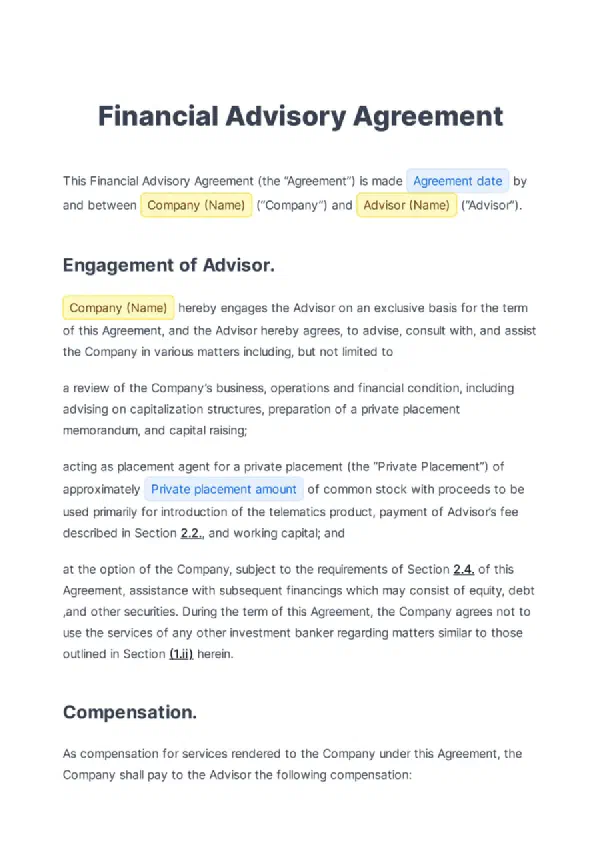 Financial advisory agreement template
The company pays the advisor a non-refundable retainer on signing, separate from the success fee on the private placement.
Use the free template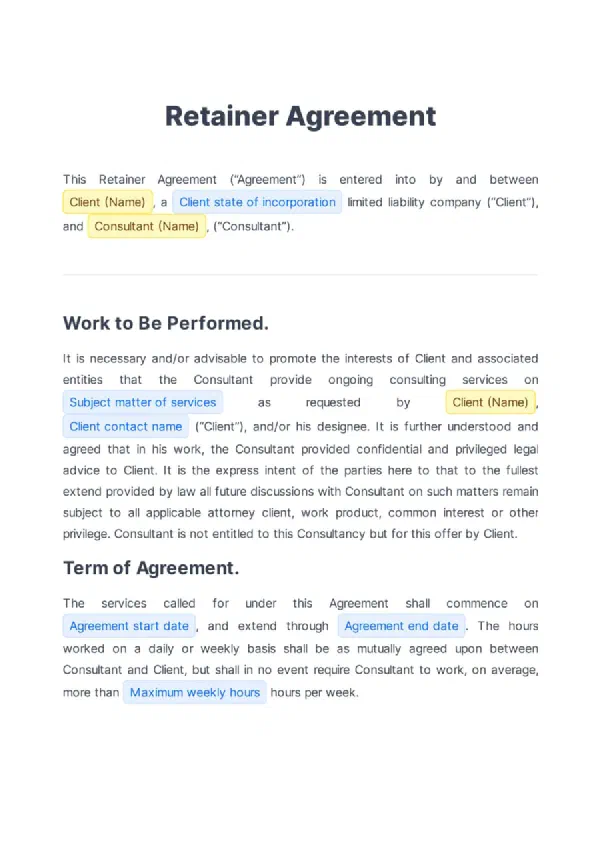 Executive consultant retainer agreement template (free)
A consultant retainer paid monthly in arrears for a defined scope of work, with a cap on the average hours per week.
Use the free template
Related clauses
- Monthly retainer A monthly retainer is a fixed fee a client pays a freelancer, agency, consultant or law firm every month for ongoing work or guaranteed availability. Both sides agree the scope up front, so the client gets steady access and the provider gets predictable income.
- Upfront payment An upfront payment is money the customer pays before the work starts or the goods are delivered, either the full price or a share of it. It covers the supplier's setup costs and shows the customer is committed, and the contract should say whether it is refundable.
- Refundable deposit A refundable deposit is money paid in advance to secure a booking, rental, purchase or service that is returned, fully or partly, if the agreed conditions are met. The contract says when it is refunded, what can be deducted and how fast it must be paid back.
- No refunds A no refund policy says that once a customer has paid, they cannot get their money back, for example because they changed their mind. It is legal in many cases if the customer sees it before buying, but it cannot override consumer rights such as refunds for faulty goods or legal cooling-off periods.
Frequently asked questions
The client pays an agreed amount at the start. Depending on the agreement, it either reserves the professional's availability, or the professional deducts fees from it as the work is done and the client tops it up or gets the unused part back at the end.
To secure payment before they commit time to a case and to confirm the client is serious. In the US, the lawyer keeps unearned retainer money in a client trust account and moves it to the firm only as fees are earned.
A contract that sets out the retainer: the amount, what it covers, how fees are billed against it, how the agreement ends and what happens to unused money. It is also called an engagement agreement.
A fixed yearly fee a company pays a non-employee director for serving on the board, often paid in cash, commonly in quarterly installments. Committee chairs and the lead director often get an additional retainer.
Templates referencing “Retainer”
These templates contain the clause you just read about.

Consulting agreement template
Free consulting agreement template: scope and deliverables, hourly, fixed or retainer fees, conflicts of interest, IP in work product and a liability cap.

Executive consultant retainer agreement template (free)
A clear retainer agreement defining scope, hours, pay, confidentiality, non-solicitation, and contractor status for post-employment consulting.
More clauses from the library
See allRetention bonus
A retention bonus is extra pay an employer promises an employee for staying until a set date or through an event, such as a merger, a restructuring or a big project. It is paid only at the end of the retention period, usually as a lump sum, and the employee loses it if they resign early.
17 example clauses
Retroactive effectiveness
The retroactive effectiveness clause stipulates that the terms and conditions of a contract will be considered effective from a date prior to the actual execution date of the agreement. This allows any actions taken within the specified retroactive period to be covered and governed by the contract, providing legal validity to pre-contractual conduct.
18 example clauses
Return of company property
The "Return of Company Property" clause mandates that an employee must return all company-owned items, such as equipment, documents, and keys, upon termination of their employment or upon request by the employer. Failure to comply with this clause may result in deductions from final paychecks, legal action, or other penalties as outlined by the employer's policies.
19 example clauses
Analyze your contracts. Extract important clauses.
Try our AI contract analysis and extract important clauses and information from existing contracts.
Save your favourite clauses
Insert directly with a single click
Upload preferred precedents