
Payment in lieu of notice
Payment in lieu of notice (PILON), or wages in lieu of notice, lets an employer end employment immediately and pay the employee what they would have earned during the notice period. A PILON clause makes this a contractual right, which matters for restrictive covenants and, in the UK, the tax treatment.
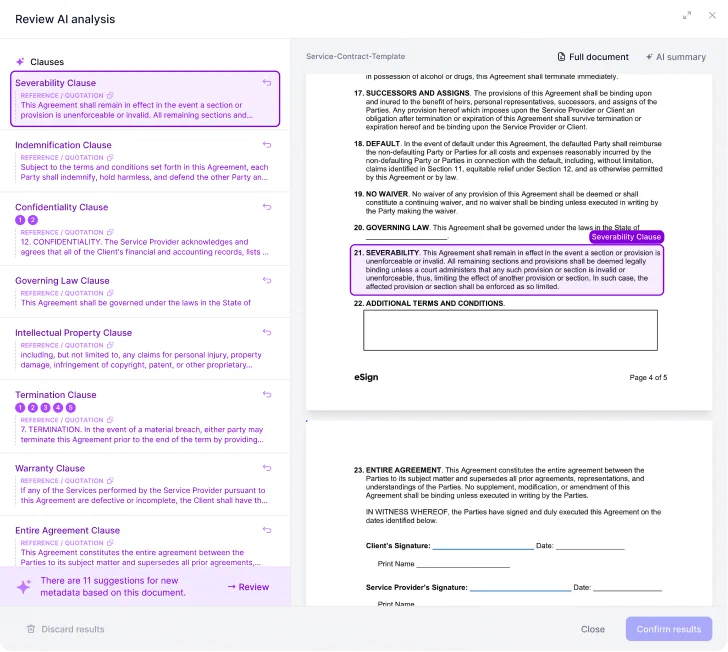
Analyze your contracts. Extract important clauses.
Try our AI contract analysis and extract important clauses and information from existing contracts.
Save your favourite clauses
Insert directly with a single click
Upload preferred precedents
Sample Payment in lieu of notice clauses
Source
EMERSON RADIO CORP (MSN)7.02 The Employee’s employment hereunder may be determined at any time by either of the parties hereto giving to the other not less than one (1) months’ prior written notice provided that the Company may elect to terminate the Employee’s employment hereunder forthwith upon payment to the Executive of not less than one (1) months’ Basic Salary in lieu of notice.
5.4 Resignation by Executive. Executive may resign his employment without Good Reason by giving the Company four weeks’ notice of said resignation; the Company may elect to pay Executive’s base salary in lieu of notice. If Executive resigns without Good Reason, then the Company’s obligation to Executive will be limited solely to the payment of accrued and unpaid base salary through the date of such termination and reimbursement of all then unreimbursed expenses properly incurred by Executive pursuant to Section 4.
Source
EPHS HOLDINGS, INC.Termination without Just Cause. The Company may terminate the Executive’s employment at any time without cause by providing the Executive with written notice of termination, or pay in lieu of notice, or a combination of notice and pay equivalent to the Executive’s minimum entitlements pursuant to the British Columbia Employment Standards Act, as amended. The Executive understands and agrees that by providing such notice, or pay in lieu of notice, the Company will have satisfied its entire obligation pursuant to statute and common law to provide the Executive with notice or pay in lieu of notice if the Executive’s employment is ended, including any obligation to provide the Executive with reasonable notice of termination.
- WARN Offset. Without limiting Section 7(b) of the Severance Plan, Employee acknowledges and agrees that, unless otherwise determined by the Administrator (as defined in the Severance Plan), Employee’s severance benefits pursuant to the Severance Plan shall be reduced, in whole or in part, by any other severance benefits, pay in lieu of notice, or other similar benefits payable to Employee by the Company that become payable in connection with Employee’s termination of employment pursuant to any applicable legal requirement, including, without limitation, the Worker Adjustment and Retraining Notification Act or any similar state or local statute, rule or regulation.
The Company shall continue to pay your basic salary during your Garden Leave (including for the avoidance of doubt, any other contractual entitlements, at the rate which is applicable at the commencement of the Garden Leave Period), and to make available to you during the Garden Leave Period all other benefits to which you are contractually entitled according to the terms of this Agreement.
However, during this period you may not engage in any other form of business or employment and must make yourself available at the Company’s request to attend work or participate in Company activities as and when required. This may include reporting to the office to sign in and sign out at the beginning and end of each day for the duration of Garden Leave.
What is payment in lieu of notice?
Payment in lieu of notice (PILON), also called pay in lieu of notice or wages in lieu of notice, is a payment an employer makes instead of letting an employee work out their notice period. The employment ends right away, and the employee receives the pay they would have earned during the notice period.
Example: an employee’s contract requires three months’ notice. The employer decides to end the employment and does not want the employee in the office for three more months. Instead of giving notice, it ends the employment immediately and pays three months’ salary in lieu of notice.
“In lieu of” simply means “instead of”.
PILON vs. garden leave vs. severance
| Pay in lieu of notice | Garden leave | Severance pay | |
|---|---|---|---|
| Does employment continue? | No, it ends immediately | Yes, until the notice period ends | No |
| Employee works? | No | No, but must stay available and cannot work elsewhere | No |
| Duties during the period | None | Still bound by the contract, including confidentiality and loyalty | None, beyond post-termination covenants |
| What is paid | Pay for the notice period | Normal salary and benefits during notice | An extra amount for ending the job, set by contract, policy or law |
| Typical purpose | Clean, immediate exit | Keep the employee away from clients and competitors while still employed | Compensation and often a release of claims |
Garden leave is often the stronger choice when the employee is moving to a competitor: during garden leave they are still employed and cannot start the new job. With a PILON, they are free immediately, and only post-termination restrictions protect the employer.
Why have a PILON clause?
The clause gives the employer a contractual right to pay instead of giving notice. Without one, ending employment immediately and paying instead of notice can be a breach of contract, even if the employee receives the full amount. That matters because:
- It protects restrictive covenants. In the UK, an employer that terminates in breach of contract may lose the ability to enforce post-termination restrictions such as non-competes and non-solicits. A PILON clause avoids the breach.
- It defines what is paid. Basic salary only, or also benefits, bonus and holiday that would have accrued?
- It allows installments, with payments reduced if the employee finds new work during the notice period, if the clause says so.
How to calculate pay in lieu of notice
Start with the notice the employee is still owed, then price it at the pay the contract says counts:
- Notice still owed: the contractual notice period, or what remains of it if notice was already given. It can never be shorter than any statutory minimum.
- Pay per period: usually basic salary for the same weeks or months. Whether benefits, pension contributions, commission or a car allowance are added depends on the clause and local law.
- Multiply, then deduct tax and social security as for normal wages, unless local rules say otherwise.
Example: an employee earns £900 a week in basic pay and is owed 6 weeks’ notice. The PILON is £5,400 before tax and National Insurance, plus any pension or health insurance contributions the contract would have paid for those weeks. If the employee had already worked 2 of the 6 weeks, the payment covers the remaining 4: £3,600.
The amount is where most PILON disputes start, so a clause that names what is included (and what is not) saves an argument later.
Payment in lieu of notice in the UK
UK employment contracts usually set a notice period, which can be longer but never shorter than the statutory minimum: at least a week after one month’s service, a week for every year of service from 2 years, and 12 weeks after 12 years. With a PILON clause, the employer can end the employment with no notice, but it still pays the basic pay for the notice period and any pension, private health care or other contributions the contract promises. Without a clause, the employee has to agree to it.
PILON clauses are common, and since 6 April 2018 the tax treatment is simpler: the basic pay the employee would have received for any unworked notice period, called post-employment notice pay, is subject to income tax and National Insurance in full, whether or not the contract contains a PILON clause. Only amounts above that can benefit from the £30,000 exemption for termination payments.
Pay in lieu of notice in the US
Most US employment is at will, so neither side usually has to give notice unless the contract says so. Executive agreements often require a notice period and allow the company to pay instead, as several of the sample clauses above show.
The federal WARN Act is the main exception for larger layoffs: employers with 100 or more employees generally must give 60 days’ notice of a plant closing or mass layoff. An employer that fails to do so owes affected employees back pay and benefits for the period of the violation, up to 60 days. The Department of Labor says paying 60 days’ wages and benefits instead of notice is technically still a violation, but it is a possible option, and voluntary payments can be offset against any damages. Some states have their own versions of the law with different thresholds.
Pay in lieu of notice can also delay unemployment benefits, because many states treat it as wages for the weeks it covers. New Jersey, for example, disqualifies a claimant for any week in which they receive remuneration in lieu of notice, while ordinary severance pay does not count as wages there. Rules differ from state to state, so check the state’s unemployment agency before promising an employee anything.
Other countries, such as Canada, set statutory minimum notice or pay in lieu, and one of the sample clauses ties the payment to those minimums.
How to draft a PILON clause
- Make it the employer’s choice, “at its sole discretion”, to pay all or part of the notice period in lieu.
- Define the payment: basic salary only, or salary plus benefits and other contractual pay, and say whether bonus is excluded.
- Say how it is paid: a lump sum, or monthly installments that stop or reduce if the employee starts new employment.
- Cover partial notice: pay in lieu for the remainder if notice has already been given.
- Keep the restrictive covenants alive after a PILON termination.
- Consider a garden leave option as an alternative for senior or client-facing roles.
Payment in lieu of notice clause example
Sample clause: Payment in lieu of notice
Add this clause to a contract, send it and get it signed in fynk.
Use it in fynk for freeChecking the notice terms before a decision
Before choosing between notice, garden leave and a PILON, HR needs to know exactly what each employee’s contract says, and older contracts all say something slightly different. In fynk, AI Summary gives a plain-language overview of each contract when it is imported, so the notice period, PILON wording and restrictive covenants are clear in minutes rather than after reading every page.
Which contracts include a PILON clause?
Employment contracts and executive service agreements, especially in the UK, Ireland, Canada, Australia and Asia, and separation agreements that set out how the notice period is handled. These free templates address it:
Free templates with this clause
- Employment contract template (employment agreement) The employer may put the employee on garden leave during notice, or end the employment immediately by paying basic pay and other required elements for the notice period. Use template
- Executive employment agreement template The company may end the employment without notice or pay in lieu of notice only where the facts justify immediate termination under the applicable law. Use template
Related clauses
- Notice period The Notice Period clause specifies the amount of time that must be given by one party to the other before terminating or making significant changes to an agreement. It ensures all parties have adequate time to prepare for any transitions or adjustments resulting from the termination or modification of the contract.
- Severance pay Severance pay is a financial compensation provided to an employee upon termination of employment, often based on factors such as duration of employment and salary level. It is intended to provide support during the transition period while the employee seeks new employment opportunities.
- Termination of employment The "Termination of Employment" clause outlines the conditions under which an employment contract can be terminated by either the employer or the employee. It typically includes details on notice periods, grounds for termination, severance pay, and any obligations or rights of both parties post-termination.
- Termination without cause A "termination without cause" clause allows either party to end the contract without providing a specific reason, usually following a notice period. This provision offers flexibility but requires adherence to any stipulated notice or compensation requirements outlined in the agreement.
- Termination with cause "Termination with cause" refers to a contract provision that allows one party to end the agreement if the other party engages in specific misconduct or breaches the contract's terms. This clause typically outlines what constitutes "cause," such as failure to meet obligations, illegal activity, or unethical behavior.
- Non solicitation agreement A non-solicitation agreement is a contract clause prohibiting an individual from soliciting a company's clients or employees for a specified period after leaving the organization. This clause is designed to protect a business's relationships and workforce from being disrupted by former employees or business partners.
Frequently asked questions
That the employer ends the employment immediately and pays the employee what they would have earned during the notice period, instead of having them work it.
The same thing: wages paid instead of a notice period. The term is common in the US, while payment in lieu of notice, or PILON, is common in the UK.
In the UK, yes: since April 2018, pay for any unworked notice period is subject to income tax and National Insurance. In other countries, it is generally treated like wages, but check local rules.
It can, but in the UK it is then usually a breach of contract, which can put post-termination restrictions at risk. A PILON clause makes the payment a contractual right.
On garden leave, the employee stays employed and paid but does not work, and cannot join a competitor yet. With pay in lieu of notice, employment ends immediately and the employee is free to start elsewhere.
More clauses from the library
See allPayment provisions
Payment provisions outline the terms regarding compensation for services or goods, specifying the amount, currency, method, and schedule of payments. They also detail conditions for late payments, such as interest or penalties, and any requirements for invoices or documentation.
10 example clauses
Payment terms and conditions
Payment terms and conditions outline the specifics of how and when a party will be compensated for goods or services provided. They typically include details on the payment method, due dates, any interest or penalties for late payments, and any discounts available for early payments.
16 example clauses
Penalty clause
A penalty clause is a provision in a contract that specifies a monetary charge or other detriment to be imposed on a party if they fail to fulfill certain contractual obligations. It is designed to incentivize compliance and deter breaches by setting predefined consequences for non-performance or other violations.
19 example clauses
Analyze your contracts. Extract important clauses.
Try our AI contract analysis and extract important clauses and information from existing contracts.
Save your favourite clauses
Insert directly with a single click
Upload preferred precedents