
Material adverse effect (MAC)
A material adverse effect (MAE) or material adverse change (MAC) clause lets a buyer, lender or investor refuse to complete a deal if the other side suffers a serious, lasting setback after signing. Definitions list carve-outs such as market conditions and pandemics, and courts set a high bar.
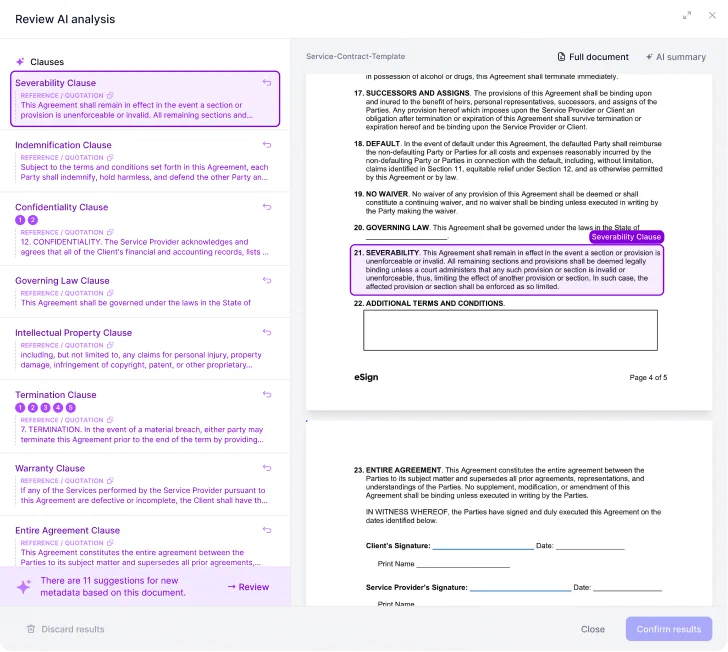
Analyze your contracts. Extract important clauses.
Try our AI contract analysis and extract important clauses and information from existing contracts.
Save your favourite clauses
Insert directly with a single click
Upload preferred precedents
Sample Material adverse effect (MAC) clauses
“Material Adverse Effect” means any change, event, circumstance, development, condition, occurrence or effect that, individually or in the aggregate, (a) was, is, or would reasonably be expected to be, materially adverse to the business, financial condition, properties, assets, liabilities, stockholders’ equity or results of operations of the Company and its subsidiaries, taken as a whole, or (b) materially delays or materially impairs the ability of the Company to comply, or prevents the Company from complying, with its obligations under this Agreement, the other Transaction Agreement, or with respect to the Closing, or would reasonably be expected to do so.
2.9 No Material Adverse Change. Since April 12, 2017 (filing date of the last Form 10-K), there has not been individually or in the aggregate a Material Adverse Change with respect to VRME. For the purposes of this Agreement, “Material Adverse Change” means any event, change or occurrence which, individually or together with any other event, change, or occurrence, could result in a material adverse change on VRME or material adverse change on its business, assets, financial condition, or results of operations. Provided, however, a Material Adverse Change does not exist solely because (i) there are changes in the economy, credit markets or capital markets, or (ii) changes generally affecting the industry in which VRME operates.
(a)No material adverse change in the condition of the Property has occurred since the Effective Date of this Agreement; provided, however, the foregoing condition shall not apply to general occurrences not related to the condition of the Property, including, without limitation, economic or market shifts, pandemics, quarantines, riots, acts of terrorism or war, insurrections, acts of God, or labor disturbances).
Source
TRON Group Inc.5.3 No Material Adverse Change. Prior to the Closing Date, there shall not have occurred any material adverse change in the financial condition, business, or operations of Talk Focus, nor shall any event have occurred which, with the lapse of time or the giving of notice, may cause or create any material adverse change in the financial condition, business, or operations.
Source
LendingClub Corp (LC)“Material Adverse Change” means any event, matter, condition, circumstance, change or effect that (a) materially and adversely affects the business, assets, financial condition, or results of operations of LendingClub and its Subsidiaries, taken as a whole, or the Borrower, (b) materially impairs the ability of LendingClub or the Borrower to perform or observe its respective obligations under any Transaction Document to which it is a party (including the ability of LendingClub, as Servicer, to collect the Purchased Receivables on a timely basis); (c) materially and adversely affects or impairs the rights, powers, remedies or interests of the Collateral Trustee, any other Agent or any Lender under any Transaction Document; (d) materially adversely affects the validity or enforceability of any material portion of the Purchased Receivables by the holder thereof in accordance with their terms, or the salability (relative to similar consumer loans) or collectability of a material portion of the Purchased Receivables; or (e) materially adversely affects the validity, attachment, perfection, priority or enforcement of any Liens granted in favor of the Collateral Trustee or the ability of the Collateral Trustee to exercise remedies or otherwise realize the benefits of the security afforded under the Transaction Documents.
“Material Adverse Effect” means any change, event, development or effect that, individually or in the aggregate, has had or would reasonably be expected to result in a material adverse effect, in or affecting (i) the business, properties or other assets, liabilities, general affairs, management, financial position, stockholders’ equity, development programs, prospects or results of operations of the Company and its Subsidiaries, taken as a whole, or (ii) the ability of the Company to perform its obligations under this Agreement, or the other Transaction Documents or to consummate the Transactions.
What is a material adverse effect (MAC) clause?
A material adverse effect clause deals with serious bad news that arrives after a contract is signed but before it is completed. It lets one party, usually a buyer or lender, walk away or refuse to go ahead if something happens that badly damages the business, assets or finances of the other side.
The terms are used interchangeably: material adverse change (MAC), material adverse effect (MAE) and material adverse change clause all describe the same idea. Most contracts define one of them and then use it in several places.
Example: a company signs an agreement to buy a competitor, with closing set for three months later. Before closing, the target loses its largest customer and a regulator suspends its main product. If those events amount to a material adverse effect under the contract’s definition, the buyer can refuse to close.
Where MAC clauses appear
| Contract | How the MAC is used | Effect |
|---|---|---|
| Merger and acquisition agreements | As a closing condition and in the seller’s representations (“since the balance sheet date, there has been no MAE”) | Buyer can refuse to close or terminate |
| Loan and credit agreements | As a representation repeated at each drawdown and as an event of default | Lender can refuse new advances or accelerate the loan |
| Investment and subscription agreements | In the company’s representations | Investor can refuse to fund |
| Real estate purchases | As a condition about the property’s condition | Buyer can terminate before closing |
| Commercial agreements | Occasionally as a termination right | A party can exit if the other side’s position collapses |
How a MAC definition is built
The sample clauses above follow a common pattern:
- The trigger. Any change, event or circumstance that is, or would reasonably be expected to be, materially adverse.
- What it must affect. The business, assets, liabilities, financial condition and results of operations, and sometimes “prospects”, which widens the clause considerably.
- A second limb. An effect that prevents or materially delays a party from completing the deal.
- The carve-outs. Events that do not count, even if they hurt the business: general economic or market conditions, changes affecting the whole industry, changes in law or accounting rules, war, terrorism, natural disasters, pandemics, and the announcement of the deal itself.
- The disproportionate-effect exception. Many carve-outs apply only if the target is not hit harder than its peers.
The carve-outs are where most of the negotiation happens. The seller wants a long list; the buyer wants the list short and the disproportionate-effect exception included.
When does something count as a material adverse effect?
Rarely, in practice. Courts set a high bar, because a MAC is meant to cover a fundamental change, not a bad quarter.
- Delaware. In IBP v. Tyson Foods (2001), the Court of Chancery held that an adverse change must threaten the target’s earnings potential in a durationally significant way, and a sharp drop in a single quarter of a cyclical business did not qualify. In Akorn v. Fresenius (2018), the court found a material adverse effect for the first time: the target’s business had deteriorated badly for a full year with no sign of recovery, alongside serious regulatory compliance failures. The Delaware Supreme Court affirmed.
In other jurisdictions the tests differ, but the theme is the same: short-term dips, known risks and general market downturns are hard to turn into a MAC.
How to negotiate a MAC clause
If you are the buyer or lender:
- Keep the carve-outs short, and add the disproportionate-effect exception to each of them.
- Consider including “prospects” if future performance is what you are paying for.
- Add objective triggers where you can, for example the loss of a named key customer or a fall in revenue or EBITDA below a set level. A number is easier to enforce than “material”.
- Use “would reasonably be expected to” so you do not have to wait for the damage to show up in the accounts.
If you are the seller or borrower:
- Push for broad carve-outs, including pandemics, changes in law and the effects of announcing the deal.
- Resist “prospects” and objective triggers that a bad month could hit.
- Limit where the MAC is used. In a loan, for example, try to keep it out of the repeated representations and the events of default.
Material adverse effect clause example
Sample clause: Material adverse effect
Add this clause to a contract, send it and get it signed in fynk.
Use it in fynk for freeKnowing which agreements carry a MAC
When markets turn, finance and legal want to know quickly which credit agreements and pending deals contain a MAC default or condition. Once the clause is recorded as a field on each contract in fynk, dashboards show every affected agreement, its counterparty and its key dates in one view, so nobody has to reread the whole portfolio.
Which contracts include a material adverse effect clause?
Merger, share and asset purchase agreements, loan and credit agreements, investment and subscription agreements, real estate purchase contracts and some long-term commercial agreements. These free templates include one:
Free templates with this clause
- Asset purchase agreement (APA) template A closing condition that no material adverse change has occurred in the assets, except ordinary-course changes and changes caused by the purchaser. Use template
- Business asset purchase agreement template The seller confirms that no event has occurred that has had, or is reasonably expected to have, a material adverse effect on the business. Use template
- Secured business loan agreement template The borrower confirms there has been no material adverse change in its business or financial condition since its latest financial statements. Use template
Related clauses
- Condition precedent A condition precedent is a contractual clause that specifies an event or action that must occur before a party is obligated to perform their duties under the contract. If the condition is not met, the contract may become void or the obligations are suspended until the condition is satisfied.
- Bring down certificate A bring down certificate is a document provided at specific intervals during a transaction, reaffirming that the representations and warranties made earlier in the agreement remain true and accurate as of the current date. This certificate is commonly used in merger and acquisition deals to ensure that no material changes have occurred since the initial signing of the contract.
- Representations and warranties "Representations and warranties are contractual statements made by one or both parties, asserting certain facts and conditions as true at the time of the agreement. These affirmations serve to allocate risk and establish grounds for potential legal remedies if the assertions prove to be false or misleading."
- Due diligence period The due diligence period in a contract is a designated timeframe during which the buyer is allowed to thoroughly inspect and evaluate the property or assets involved in the transaction. This period aims to ensure the buyer can identify any potential issues and make informed decisions before finalizing the agreement.
- Force majeure A force majeure clause excuses a party from performing, without liability, for as long as an event beyond its control prevents it. It only protects you for the events it names or clearly describes, so the event list, the notice deadline and the right to terminate matter more than the heading.
- Early termination right An early termination right clause allows one or both parties to terminate the contract before the agreed end date under specified conditions, often involving notice periods and sometimes fees or penalties. This clause provides flexibility to adapt to changing circumstances but can also introduce uncertainty regarding the contract's duration.
Frequently asked questions
A serious negative change in a company's business, assets or finances, as defined in a contract, that lets the other party refuse to complete a deal, stop lending or terminate. Each contract defines it differently.
None in substance. Material adverse change (MAC) and material adverse effect (MAE) are used for the same concept; what matters is how the contract defines it.
Only if the contract does not carve it out. Many definitions now exclude epidemics and pandemics, often unless the company is hit harder than others in its industry.
Hard. Courts expect a significant and lasting decline, not a short-term dip. In Delaware, Akorn v. Fresenius in 2018 was the first case where a court found one.
A provision that lets the lender refuse further advances, or treat the loan as in default, if the borrower suffers a material adverse change. Borrowers usually try to narrow it or remove it from the events of default.
More clauses from the library
See allMaterial breach
A material breach is a significant violation or failure to perform a fundamental aspect of a contract, undermining the contract's purpose and potentially excusing the non-breaching party from fulfilling their own obligations. This type of breach often provides grounds for the non-breaching party to seek damages or terminate the contract entirely.
9 example clauses
Materiality scrape
A materiality scrape is a contract clause that disregards materiality qualifiers in representations and warranties when calculating damages or determining indemnification thresholds. This ensures that all breaches, regardless of their impact, can be considered in assessing liability or indemnification.
9 example clauses
Mediation
The mediation clause requires that parties attempt to resolve disputes through a neutral third-party mediator before pursuing litigation or arbitration. This process fosters open communication and aims to reach a mutually satisfactory agreement, minimizing time and legal costs.
14 example clauses
Analyze your contracts. Extract important clauses.
Try our AI contract analysis and extract important clauses and information from existing contracts.
Save your favourite clauses
Insert directly with a single click
Upload preferred precedents