Executive Consultant Retainer Agreement Template (Free)

A retainer is not a casual stay available arrangement. It’s a long-term advisory relationship that needs boundaries, especially once employment ends. A retainer agreement turns ongoing access to expertise into clear rules about time, pay, confidentiality, and control so both sides understand the shape of the relationship.

Most retainers exist to protect continuity and speed. The company preserves institutional knowledge without reopening an employment file. The consultant gets predictable compensation and structure without drifting into employee status. When written well, a retainer gives both sides clarity instead of assumptions.

  • Screenshot 0
  • Screenshot 1
  • Screenshot 2
  • Screenshot 3
  • Screenshot 4
  • Screenshot 5
  • Screenshot 6

Full Text Template

The full content of the template is available, when you want to edit the text and enter your details make sure to click on the button to use the template.

Retainer agreement

CHSPSC, LLC.

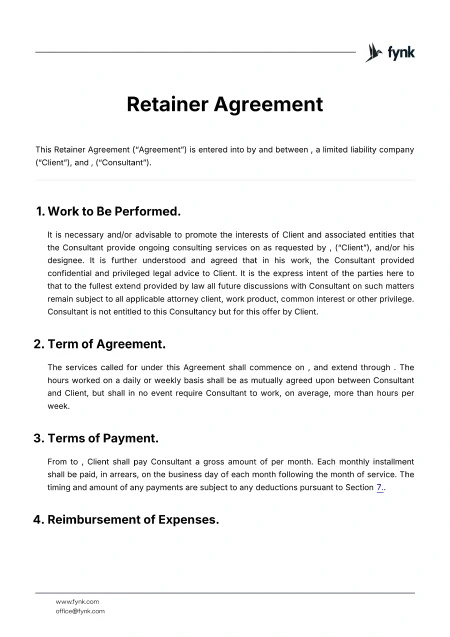
Retainer Agreement

This Retainer Agreement (“Agreement”) is entered into by and between , a limited liability company (“Client”), and , (“Consultant”).


Work to Be Performed.

It is necessary and/or advisable to promote the interests of Client and associated entities that the Consultant provide ongoing consulting services on as requested by , (“Client”), and/or his designee. It is further understood and agreed that in his work, the Consultant provided confidential and privileged legal advice to Client. It is the express intent of the parties here to that to the fullest extend provided by law all future discussions with Consultant on such matters remain subject to all applicable attorney client, work product, common interest or other privilege. Consultant is not entitled to this Consultancy but for this offer by Client.

Term of Agreement.

The services called for under this Agreement shall commence on , and extend through . The hours worked on a daily or weekly basis shall be as mutually agreed upon between Consultant and Client, but shall in no event require Consultant to work, on average, more than hours per week.

Terms of Payment.

From to , Client shall pay Consultant a gross amount of per month. Each monthly installment shall be paid, in arrears, on the business day of each month following the month of service. The timing and amount of any payments are subject to any deductions pursuant to Section 7..

Reimbursement of Expenses.

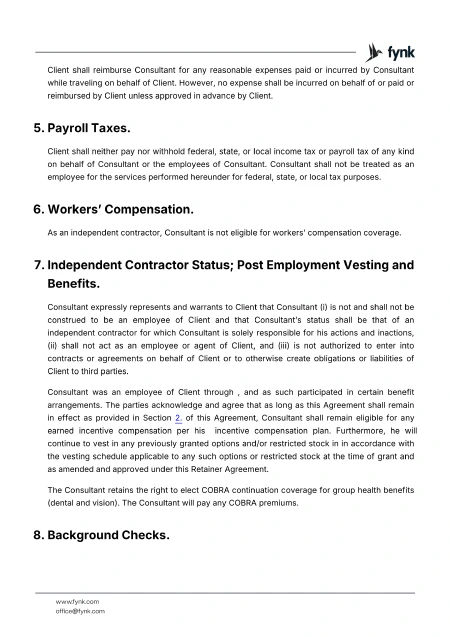
Client shall reimburse Consultant for any reasonable expenses paid or incurred by Consultant while traveling on behalf of Client. However, no expense shall be incurred on behalf of or paid or reimbursed by Client unless approved in advance by Client.

Payroll Taxes.

Client shall neither pay nor withhold federal, state, or local income tax or payroll tax of any kind on behalf of Consultant or the employees of Consultant. Consultant shall not be treated as an employee for the services performed hereunder for federal, state, or local tax purposes.

Workers’ Compensation.

As an independent contractor, Consultant is not eligible for workers’ compensation coverage.

Independent Contractor Status; Post Employment Vesting and Benefits.

Consultant expressly represents and warrants to Client that Consultant (i) is not and shall not be construed to be an employee of Client and that Consultant’s status shall be that of an independent contractor for which Consultant is solely responsible for his actions and inactions, (ii) shall not act as an employee or agent of Client, and (iii) is not authorized to enter into contracts or agreements on behalf of Client or to otherwise create obligations or liabilities of Client to third parties.

Consultant was an employee of Client through , and as such participated in certain benefit arrangements. The parties acknowledge and agree that as long as this Agreement shall remain in effect as provided in Section 2. of this Agreement, Consultant shall remain eligible for any earned incentive compensation per his incentive compensation plan. Furthermore, he will continue to vest in any previously granted options and/or restricted stock in in accordance with the vesting schedule applicable to any such options or restricted stock at the time of grant and as amended and approved under this Retainer Agreement.

The Consultant retains the right to elect COBRA continuation coverage for group health benefits (dental and vision). The Consultant will pay any COBRA premiums.

Background Checks.

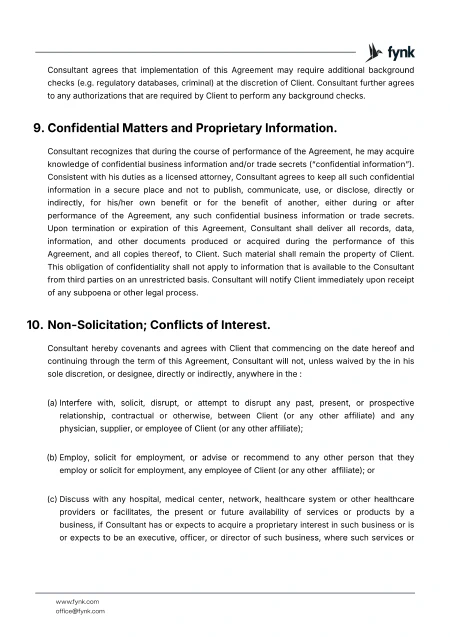
Consultant agrees that implementation of this Agreement may require additional background checks (e.g. regulatory databases, criminal) at the discretion of Client. Consultant further agrees to any authorizations that are required by Client to perform any background checks.

Confidential Matters and Proprietary Information.

Consultant recognizes that during the course of performance of the Agreement, he may acquire knowledge of confidential business information and/or trade secrets (“confidential information”). Consistent with his duties as a licensed attorney, Consultant agrees to keep all such confidential information in a secure place and not to publish, communicate, use, or disclose, directly or indirectly, for his/her own benefit or for the benefit of another, either during or after performance of the Agreement, any such confidential business information or trade secrets. Upon termination or expiration of this Agreement, Consultant shall deliver all records, data, information, and other documents produced or acquired during the performance of this Agreement, and all copies thereof, to Client. Such material shall remain the property of Client. This obligation of confidentiality shall not apply to information that is available to the Consultant from third parties on an unrestricted basis. Consultant will notify Client immediately upon receipt of any subpoena or other legal process.

Non-Solicitation; Conflicts of Interest.

Consultant hereby covenants and agrees with Client that commencing on the date hereof and continuing through the term of this Agreement, Consultant will not, unless waived by the in his sole discretion, or designee, directly or indirectly, anywhere in the :

Interfere with, solicit, disrupt, or attempt to disrupt any past, present, or prospective relationship, contractual or otherwise, between Client (or any other affiliate) and any physician, supplier, or employee of Client (or any other affiliate);

Employ, solicit for employment, or advise or recommend to any other person that they employ or solicit for employment, any employee of Client (or any other affiliate); or

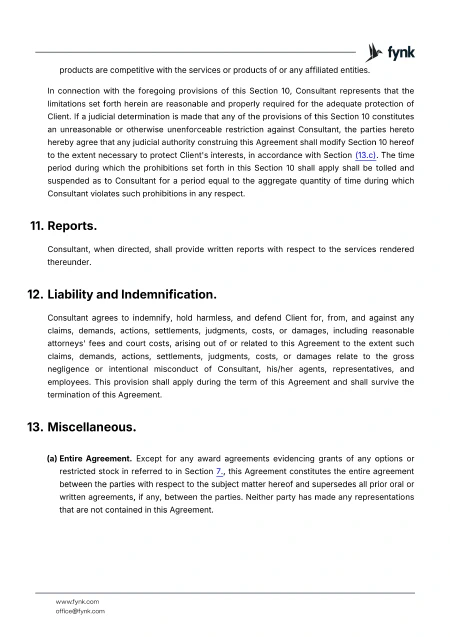
Discuss with any hospital, medical center, network, healthcare system or other healthcare providers or facilitates, the present or future availability of services or products by a business, if Consultant has or expects to acquire a proprietary interest in such business or is or expects to be an executive, officer, or director of such business, where such services or products are competitive with the services or products of or any affiliated entities.

In connection with the foregoing provisions of this Section 10, Consultant represents that the limitations set forth herein are reasonable and properly required for the adequate protection of Client. If a judicial determination is made that any of the provisions of this Section 10 constitutes an unreasonable or otherwise unenforceable restriction against Consultant, the parties hereto hereby agree that any judicial authority construing this Agreement shall modify Section 10 hereof to the extent necessary to protect Client's interests, in accordance with Section (13.c). The time period during which the prohibitions set forth in this Section 10 shall apply shall be tolled and suspended as to Consultant for a period equal to the aggregate quantity of time during which Consultant violates such prohibitions in any respect.

Reports.

Consultant, when directed, shall provide written reports with respect to the services rendered thereunder.

Liability and Indemnification.

Consultant agrees to indemnify, hold harmless, and defend Client for, from, and against any claims, demands, actions, settlements, judgments, costs, or damages, including reasonable attorneys' fees and court costs, arising out of or related to this Agreement to the extent such claims, demands, actions, settlements, judgments, costs, or damages relate to the gross negligence or intentional misconduct of Consultant, his/her agents, representatives, and employees. This provision shall apply during the term of this Agreement and shall survive the termination of this Agreement.

Miscellaneous.

Entire Agreement. Except for any award agreements evidencing grants of any options or restricted stock in referred to in Section 7., this Agreement constitutes the entire agreement between the parties with respect to the subject matter hereof and supersedes all prior oral or written agreements, if any, between the parties. Neither party has made any representations that are not contained in this Agreement.

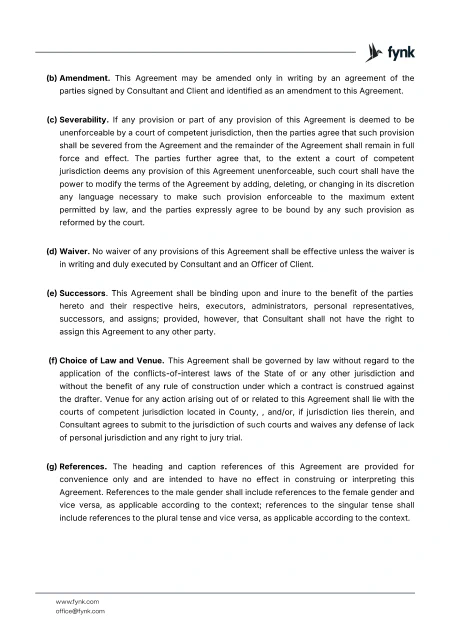
Amendment. This Agreement may be amended only in writing by an agreement of the parties signed by Consultant and Client and identified as an amendment to this Agreement.

Severability. If any provision or part of any provision of this Agreement is deemed to be unenforceable by a court of competent jurisdiction, then the parties agree that such provision shall be severed from the Agreement and the remainder of the Agreement shall remain in full force and effect. The parties further agree that, to the extent a court of competent jurisdiction deems any provision of this Agreement unenforceable, such court shall have the power to modify the terms of the Agreement by adding, deleting, or changing in its discretion any language necessary to make such provision enforceable to the maximum extent permitted by law, and the parties expressly agree to be bound by any such provision as reformed by the court.

Waiver. No waiver of any provisions of this Agreement shall be effective unless the waiver is in writing and duly executed by Consultant and an Officer of Client.

Successors. This Agreement shall be binding upon and inure to the benefit of the parties hereto and their respective heirs, executors, administrators, personal representatives, successors, and assigns; provided, however, that Consultant shall not have the right to assign this Agreement to any other party.

Choice of Law and Venue. This Agreement shall be governed by law without regard to the application of the conflicts-of-interest laws of the State of or any other jurisdiction and without the benefit of any rule of construction under which a contract is construed against the drafter. Venue for any action arising out of or related to this Agreement shall lie with the courts of competent jurisdiction located in County, , and/or, if jurisdiction lies therein, and Consultant agrees to submit to the jurisdiction of such courts and waives any defense of lack of personal jurisdiction and any right to jury trial.

References. The heading and caption references of this Agreement are provided for convenience only and are intended to have no effect in construing or interpreting this Agreement. References to the male gender shall include references to the female gender and vice versa, as applicable according to the context; references to the singular tense shall include references to the plural tense and vice versa, as applicable according to the context.

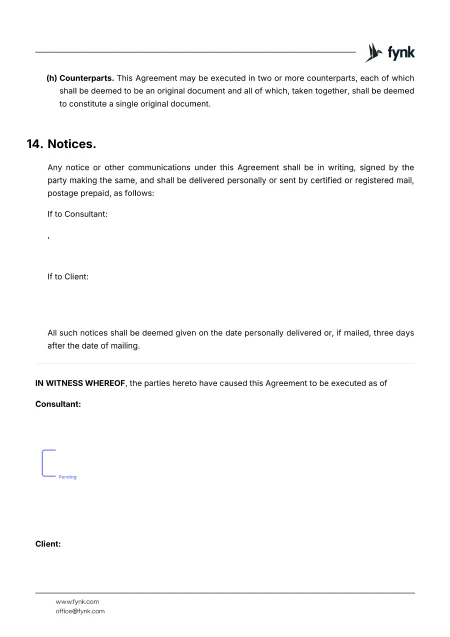
Counterparts. This Agreement may be executed in two or more counterparts, each of which shall be deemed to be an original document and all of which, taken together, shall be deemed to constitute a single original document.

Notices.

Any notice or other communications under this Agreement shall be in writing, signed by the party making the same, and shall be delivered personally or sent by certified or registered mail, postage prepaid, as follows:

If to Consultant:

,


If to Client:

All such notices shall be deemed given on the date personally delivered or, if mailed, three days after the date of mailing.


IN WITNESS WHEREOF, the parties hereto have caused this Agreement to be executed as of

Consultant:

Pending

Client:

Pending

For convenience, this Agreement may be signed and electronically transmitted between the Parties and be as effective as a signed, paper agreement.
Use this template

Disclaimer: The original creator, the author of this template, and fynk GmbH are not responsible for any damages or liabilities that may result from using this template. This template should not be considered a substitute for legal advice, and consulting with a legal professional is recommended before use. fynk GmbH, the original creator, and the author do not provide legal advice and will not be held accountable for any legal consequences arising from its use.

Making contract management easier for companies such as

Conrad logo Oekostrom AG Logo Datarade Logo Rampf Logo Unite Logo

Background Information

A clear agreement defining post-employment advisory services

This retainer agreement outlines ongoing consulting services, sets compensation and hour limits, and protects confidentiality, independence, and company interests.

What is a retainer agreement?

A retainer agreement is a contract where a Company pays a Consultant a recurring fee for ongoing, limited-scope services over a set period. It’s often used with former executives, counsel, or specialists a company wants access to without rehiring.

The agreement defines the work, expected time, payment terms, and independent-contractor status. It turns vague “ongoing help” into clear commitments: a timetable, fee, hour limits, confidentiality, and authority boundaries.

Unlike project contracts that end with deliverables, a retainer stays open, so the terms must be tighter. You’re paying for access, and access without guardrails is where disputes begin.

Why retainer agreements matter

Without a written retainer, you risk misclassification, blurred authority, unclear availability, and disagreements about what “support” actually includes. These issues tend to surface the moment priorities shift or someone requests more time than the consultant planned to give.

A strong retainer agreement protects:

  • Predictable access to expertise
  • Clear limits on hours and scope
  • Proper independent contractor classification
  • Confidentiality and privilege protection
  • Conflict-of-interest and non-solicitation boundaries
  • Termination rights and reporting structure
  • Indemnification for misconduct

People searching for a Retainer Agreement Template usually need to formalize a post-employment advisory relationship fast, define hours and fees, and protect sensitive information without having to build a contract from scratch.

How to use this retainer agreement template

This template gives you a full, post-employment consulting structure modeled on real corporate standards and translated into a free, editable format inside fynk. Customize the business terms to your situation, then have counsel finalize it based on your jurisdiction.

Who it’s for

  • Corporations retaining former executives or general counsel
  • Legal teams hiring outside or former advisors
  • Healthcare, financial services, and other regulated industries
  • Professional services firms using monthly retainers
  • HR teams documenting advisory relationships post-departure
  • Consultants formalizing work with former employers

What you can customize

  • Scope of advisory services and who can request them
  • Weekly hour cap or availability windows
  • Retainer fee amount and payment timing
  • Expense reimbursement rules
  • Whether attorney-client privilege applies
  • Background checks in regulated fields
  • Non-solicitation and conflict rules
  • Vesting or post-employment rights, if relevant
  • Governing law and venue

What to avoid

  • No hour limits
  • Scope so broad it becomes unmanageable
  • Confidentiality that doesn’t survive termination
  • Unclear payment triggers
  • No termination path

Core clauses in a retainer agreement

A retainer should function like an operating guide. Each clause plays a precise role.

Work to be performed (scope of services): This clause defines the advisory services and who at the Company can request them. Most corporate retainers limit work to legal, strategic, financial, or regulatory matters as directed by a CEO or comparable leader. Scope must be narrow and request-driven — not ongoing labor — to preserve contractor classification.

Term and hour limits: The agreement needs fixed start and end dates and a clear weekly hour cap. For example: not more than eight hours per week on average. This limit is one of the strongest indicators that the consultant is not an employee. It can also note “as-needed scheduling” within the cap.

Compensation and payment mechanics: This section sets the monthly retainer fee and payment method, often in arrears. It should clarify whether the fee is owed regardless of hours used (typical for access retainers) or tied to utilization. If deductions apply for breach or other sections, they belong here. Clear wording avoids disputes about what is or isn’t included.

Expense reimbursement: Companies typically reimburse reasonable, pre-approved expenses. Requiring approval prevents surprise invoices. Some agreements add receipt timelines or travel standards. The point is predictable expectations.

Payroll taxes and benefits separation: The consultant pays their own taxes; the Company doesn’t withhold payroll taxes. Benefits don’t carry over unless specifically stated. Sometimes COBRA or vested benefits continue, but premiums are paid by the consultant. This clause supports contractor classification.

Workers’ compensation: Consultant is not eligible for coverage as an independent contractor.

Independent contractor status and authority limits: This section makes explicit that the consultant is not an employee, partner, agent, or a representative of the Company and cannot bind the Company to third-party contracts. The consultant controls how work is done. It’s a core classification safeguard.

Post-employment vesting or continuing rights: Some retainers preserve post-employment vesting of equity already granted or the right to receive earned incentives. If included, it should reference the governing plan documents and specify how long vesting continues. This reduces disputes and maintains incentive alignment.

Background checks (when required): In industries such as healthcare or finance, the Company may require ongoing regulatory or criminal background checks. This clause states that the consultant consents to provide information and sign necessary authorizations.

Confidential matters, proprietary information, and privilege: Confidentiality applies during and after the term. The consultant must protect proprietary and strategic information, and privilege may apply when legal advice is involved. Notice is required if a subpoena is received.

Non-solicitation and conflict-of-interest restrictions: The consultant cannot recruit employees, disrupt relationships, or advise competitors. Courts may narrow broad restrictions.

Reports and communication: The consultant provides written reports or summaries when requested. This maintains accountability without creating employee-style supervision.

Liability and indemnification: The consultant indemnifies the Company for damages tied to gross negligence or intentional misconduct. This clause usually survives termination. It gives the Company protection without needing to control the consultant’s daily work.

Boilerplate that keeps it enforceable: This includes entire agreement, written amendments only, severability, waiver rules, successors, counterparts/e-signatures, notices, and governing law and jurisdiction. These clauses determine how the agreement holds up during disputes and ensure enforceability, and the notices define how termination, breach, and legal process is delivered.

Using fynk to manage retainer agreements

Retainers often involve sensitive information and long-term access. fynk helps keep them organized.

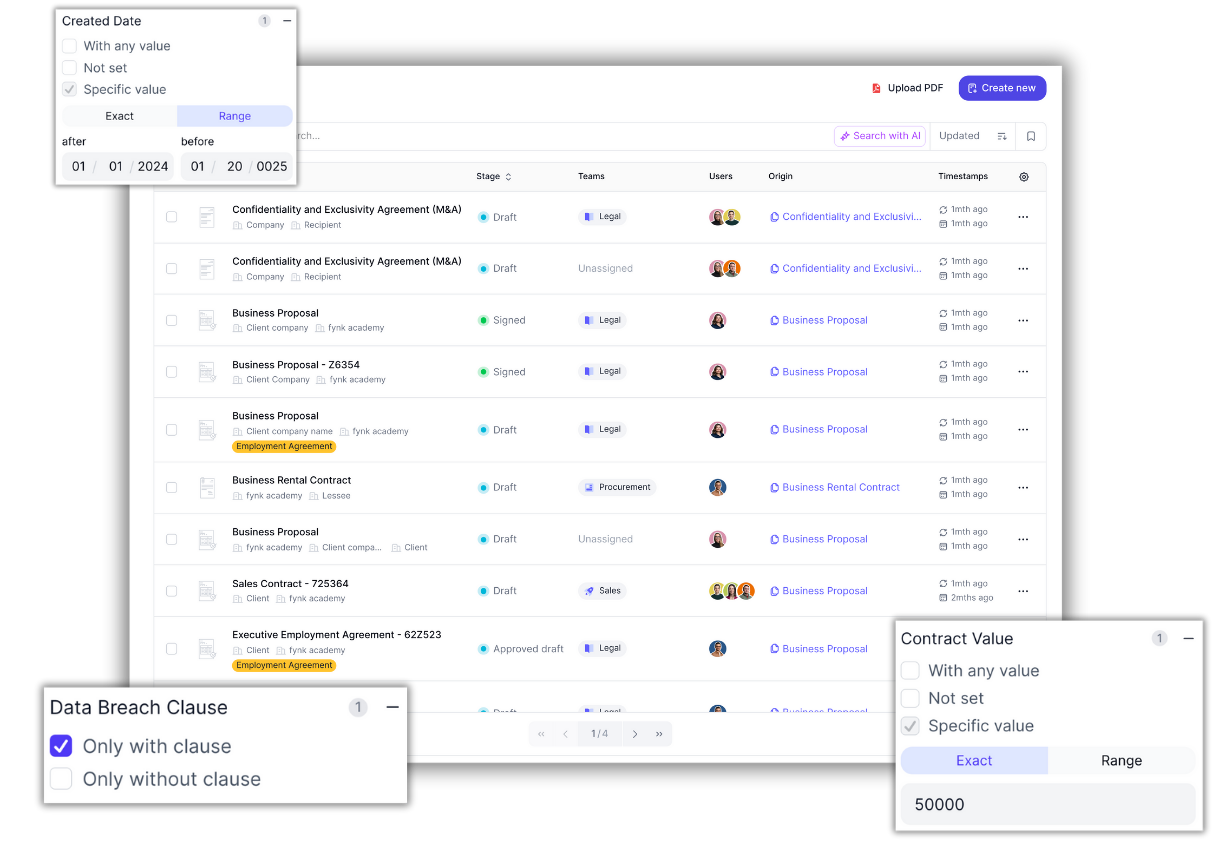
  • User roles and access management: limit visibility to legal, HR, and executives.

  • Metadata tracking: monitor term dates, fees, renewal timing, consultant status, and hour caps.

Metadata search in fynk
White zoom-in icon
Grey info bubble icon

Metadata search in fynk

  • Notifications and reminders: alert teams before expiration, payment cycles, background-check deadlines, and reporting milestones.
Notification and reminders settings in fynk
White zoom-in icon
Grey info bubble icon

Notification and reminders settings in fynk

  • Document archive: store expired agreements with full audit trails for future reference.

Download or customize this Retainer Agreement Template to formalize post-employment consulting relationships, define weekly limits, and lock in predictable compensation. With confidentiality, non-solicitation, and contractor compliance built in, you reduce misclassification risk and protect both sides. Manage everything through fynk so you can stay focused on continuity, not paperwork.

Searching for a contract management solution?

Find out how fynk can help you close deals faster and simplify your eSigning process – request a demo to see it in action.

FAQs

What is a retainer agreement?
A retainer agreement is a contract where a company pays a consultant a recurring fee for ongoing advisory services over a defined period.
When should a company use a retainer instead of employment?
When the company needs continued access to a consultant’s expertise without hiring them back as an employee.
What should a retainer agreement include?
It should define the scope of services, hour limits, compensation, confidentiality, contractor status, conflicts rules, and indemnification obligations.
How many hours should a retainer consultant work per week?
Most retainers include an hour cap to maintain proper independent contractor classification.
Does a retainer agreement create an employee relationship?
No. A well-drafted agreement clearly states independent contractor status and includes limits and boundaries that avoid misclassification.
Can a retainer cover privileged legal advice?
Yes. When structured correctly, discussions may remain protected by attorney-client privilege.

Ready to sign?
Use this template today.

Clause Library: learn more about the clauses in this template

Learn more about the clauses appearing in this template and find other clauses that are used in real contracts.

Compensation and payment

The "Compensation and Payment" clause outlines the terms under which the party providing services or goods will be remunerated. It details the agreed payment amount, schedule, method, and any conditions for adjustments, ensuring clarity and mutual understanding between the contracting parties.

13 example clauses

Independent contractor relationship

An independent contractor relationship clause defines the working relationship between parties, specifying that the contractor operates autonomously and is not an employee of the hiring party. This clause clarifies that the contractor is responsible for their own taxes, insurance, and adherence to laws, and it delineates the absence of benefits typically associated with employment.

10 example clauses

Indemnity

An indemnity clause is a contractual provision where one party agrees to compensate the other for certain costs and liabilities that may arise due to specified events or actions. This clause is designed to allocate risk by holding one party responsible for losses incurred by the other, providing financial protection in situations such as breaches of contract, negligence, or legal claims.

20 example clauses

Notices

The "Notices" clause in a contract stipulates the procedures and requirements for delivering formal communications between parties, including acceptable methods, designated addresses, and timelines for receipt. This clause ensures that both parties are informed in a clear and timely manner about any relevant updates, changes, or obligations under the contract.

10 example clauses

Governing law and jurisdiction

The "Governing Law and Jurisdiction" clause specifies which region's legal framework will be applied in interpreting and enforcing the terms of a contract and designates the location where any legal disputes will be resolved. This clause is crucial for determining procedural and substantive legal matters, ensuring both parties are aware of the legal standards and courts that will have authority in case of conflicts.

14 example clauses

Related Templates

Are you looking for more templates? fynk has them all!

Sale of Goods Contract Template

A Sale of Goods Contract is a legally binding agreement in which a seller agrees to transfer goods to a buyer in exchange for payment.