
How to insert a signature in Word

Rezvan Golestaneh
Updated · Published · 11 min read
To insert a signature in Word, go to Insert > Pictures, choose an image of your handwritten signature and drag it into place. It is free and works in Word for Windows and Mac. If someone else has to sign, or you need proof of who signed, use a digital signature or an eSignature tool instead.
6 ways to insert a signature in Word
- Method 1: Signature line and digital signature (Windows, needs a certificate)
- Method 2: Draw your signature with the Draw tab (Windows, Mac, phone)
- Method 3: Insert an image of your handwritten signature (Windows and Mac)
- Method 4: Type your name in a signature font (all versions)
- Method 5: Microsoft 365 eSignature for Word (business accounts with SharePoint)
- Method 6: Electronically sign it with an eSignature platform (any device, free)
On a Mac or phone? Jump to signing Word on a Mac or your phone.
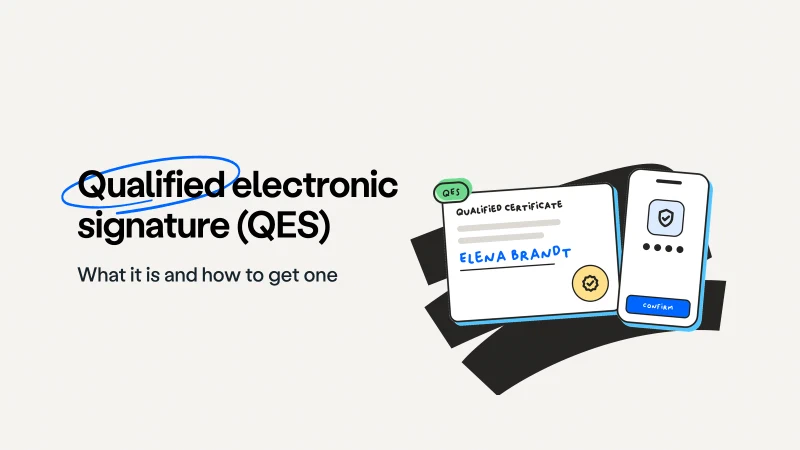
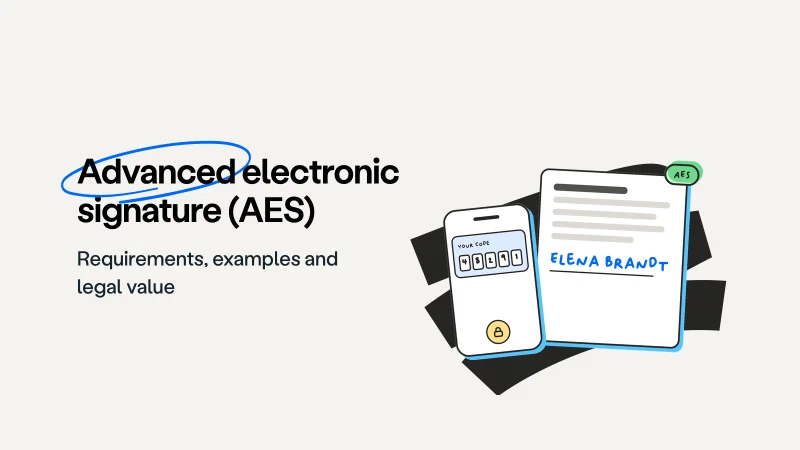
Methods 2, 3 and 4 give you a simple electronic signature, the weakest of the types of electronic signatures: it shows intent but proves little about who signed. For contracts, use an advanced electronic signature or a qualified electronic signature (Methods 1 and 6).
Sign a Word document for free.
Method 1: add a signature line and digital signature in Word (Windows)
A signature line marks where a document should be signed. Signing it attaches a digital signature based on a certificate, which makes any later change to the file detectable. Microsoft documents the signature line and digital signatures for Word for Windows.
How to add a signature line in Word
- Click where you want the line, then go to Insert > Signature Line in the Text group and choose Microsoft Office Signature Line.


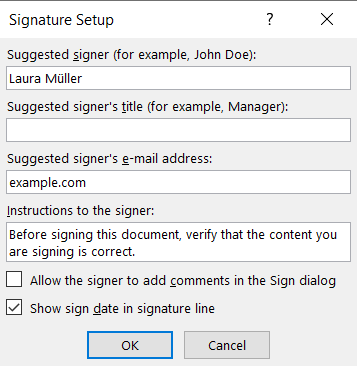
- Fill out the Signature Setup dialog (suggested signer, title, email address, instructions). Tick Allow the signer to add comments in the Sign dialog and Show sign date in signature line if you need them, then click OK.
A signature line like this is added to your document:

How to insert a digital signature in Word
To sign the line, you need a digital certificate. You have two options:
- A certificate from a certificate authority (CA). Recipients can verify your signature automatically. These certificates usually cost money and are often valid for about a year.
- A self-created certificate. Microsoft explains how to create your own certificate, but other people cannot verify a signature made with it unless they manually decide to trust your certificate. It is fine for testing, not for contracts.
Save the document as a .docx file, then:
- Right-click the signature line and select Sign.
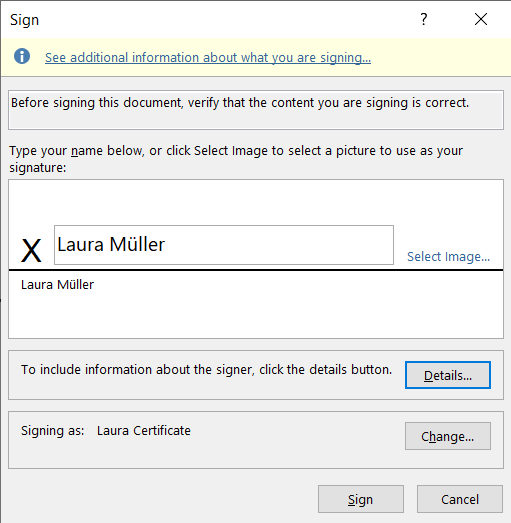
- Type your name next to the X, write it with ink, or click Select Image to use an image of your handwritten signature.
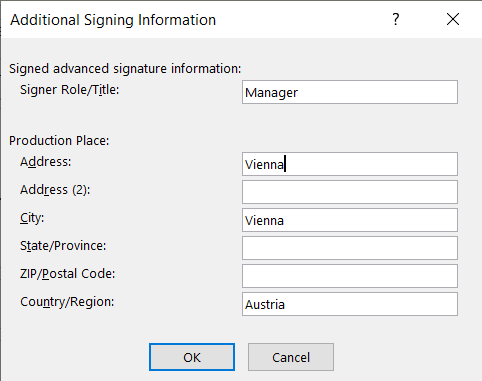
- Click Details… to add more signing information, such as your address and job title.
- If you have several certificates or the one shown isn’t yours, click Change to select the right certificate.
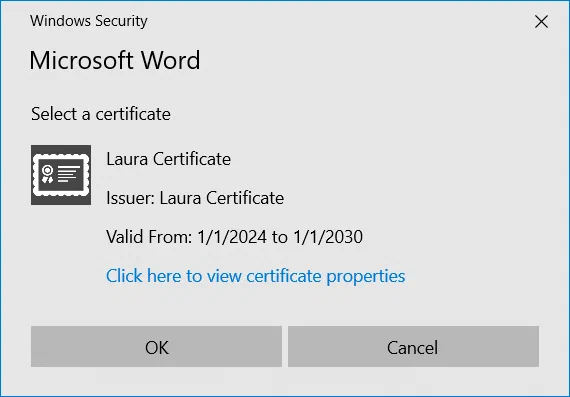
- Click Sign. Word shows a Signatures button at the bottom of the document, and your signature looks like this:
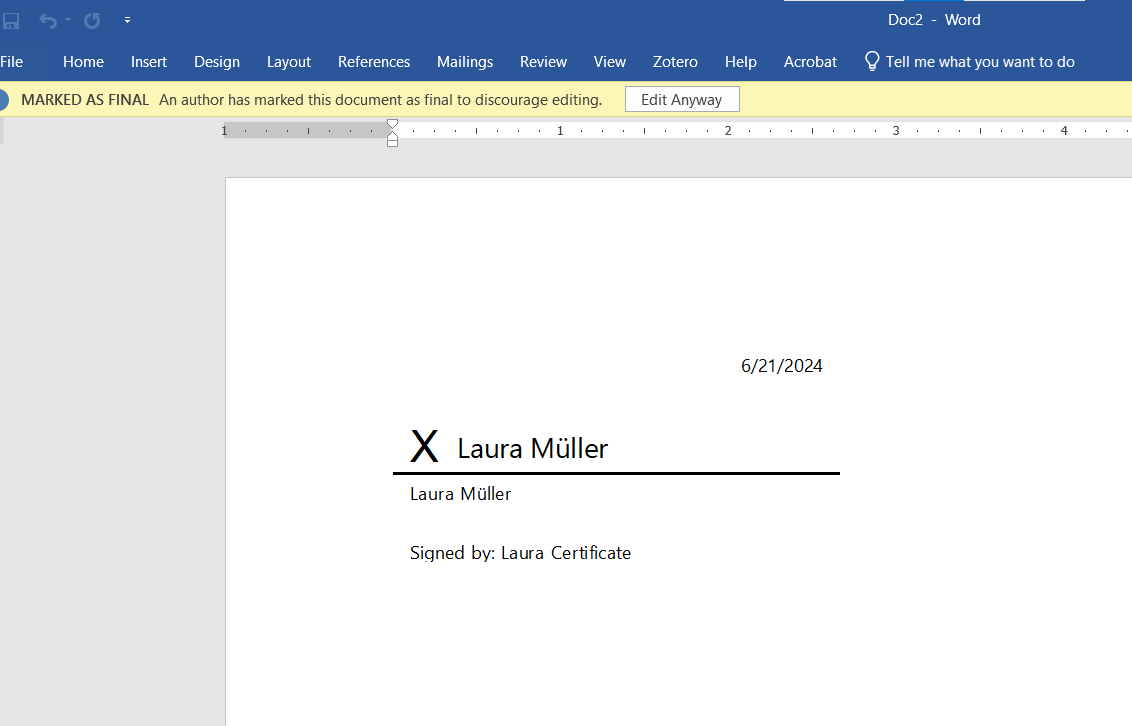
Remember: A digitally signed document becomes read-only. If anyone edits it afterwards, the signature is no longer valid and has to be added again.
How to create a digital signature in Word without a signature line
If you only want to seal the file, without a visible line, add an invisible digital signature:
- Go to File > Info > Protect Document > Add a Digital Signature.
- Choose a Commitment Type and enter the purpose for signing.
- Click Sign.
The signature doesn’t appear on the page, but Word shows it in the Signatures pane and marks the file as signed. Source: Microsoft Support.
Pros and cons of the Word signature line
Pros
- ✅ Built into Word for Windows, no extra tool needed
- ✅ Tamper-evident: any change after signing breaks the signature
- ✅ Can reach advanced or qualified level with a suitable certificate
Cons
- ❌ You need a certificate: CA certificates cost money, self-created ones can’t be verified by others
- ❌ Windows only
- ❌ Every signer needs their own certificate and Word, and there is no built-in way to send, track or remind
- ❌ The signature belongs to the .docx file: once someone edits or converts the document, it is gone
Method 2: draw your signature in Word
The Draw tab lets you write your signature by hand with a mouse, trackpad, touchscreen or stylus. It is available in Word for Microsoft 365 on Windows and Mac (Office 2019 or later on Mac), as well as in Word for the web, iPhone, iPad and Android, according to Microsoft.
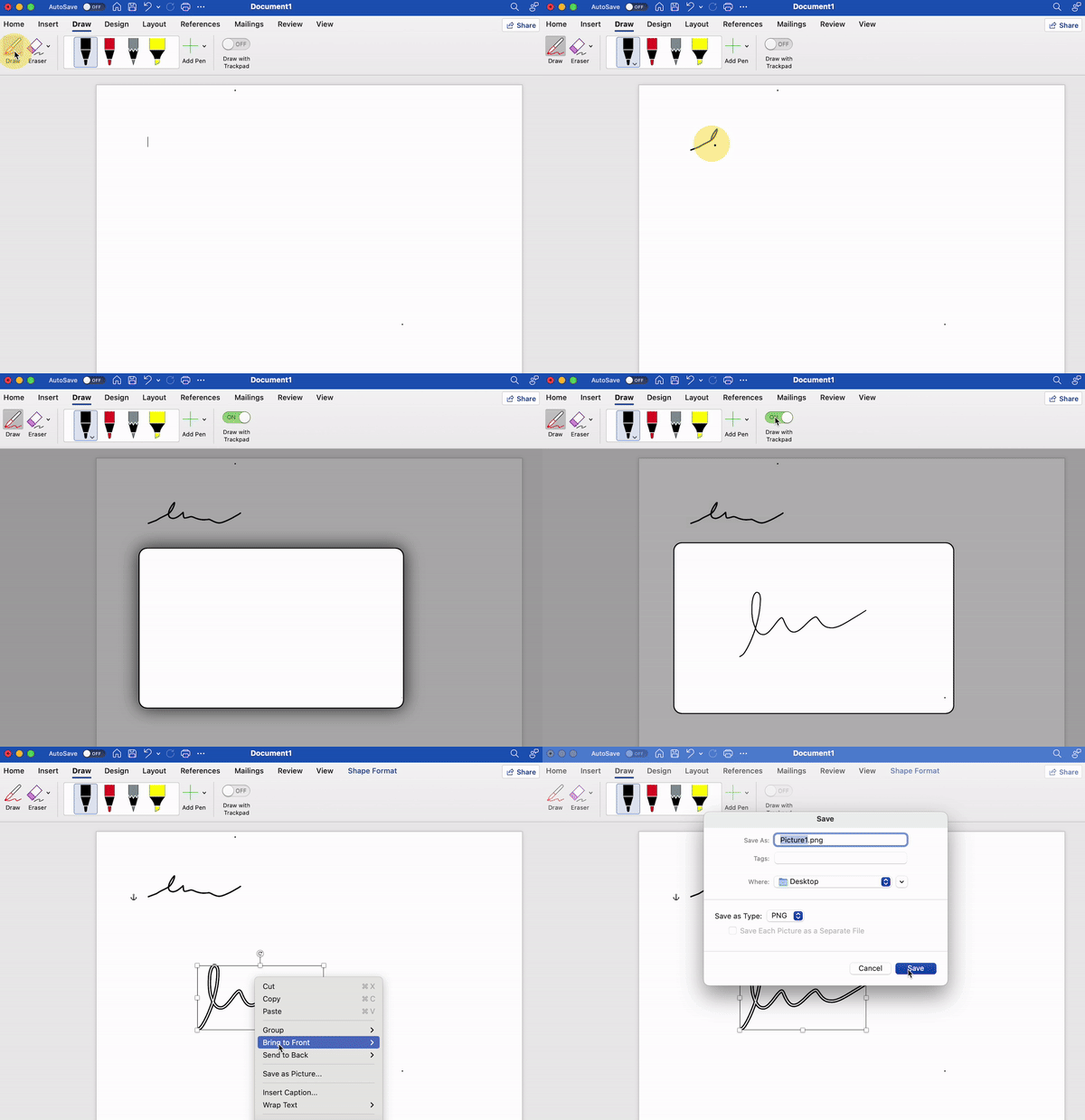
- Open your document and make sure you are in Print Layout (View > Print Layout). Word only lets you draw in this view.
- Open the Draw tab. If you don’t see it on Windows, go to File > Options > Customize Ribbon and tick Draw.
- Select a pen. Click the small arrow next to it to change thickness and colour (dark blue or black looks most like ink).
- Draw your signature where it should go. On a Mac without a touchscreen, turn on Draw with Trackpad to sign with your finger.
- Switch back to the selection tool to move or resize the drawing.
Pros and cons of drawing your signature
Pros
- ✅ No scanner or photo needed
- ✅ Feels natural with a stylus or on a touchscreen
- ✅ Works on Windows, Mac, the web and mobile
Cons
- ❌ Drawn with a mouse, signatures often look shaky
- ❌ You redraw it every time, unless you turn it into an image (Method 3)
- ❌ Only a drawing: it doesn’t prove who signed and can be copied
Method 3: insert a handwritten signature image in Word
This is the method most people use to insert a signature in Word, because the result looks like your real handwritten signature.
Don’t have a signature image yet? You can make one first with our free signature generator. Draw it, type it, or clean up a photo, then download a transparent PNG that sits cleanly over your document text instead of in a white box. The same file works when you insert a signature in Excel.
To insert an image of your wet signature into Word:
- Sign a sheet of white paper and scan it or take a photo with your smartphone.
- Save the image to your computer as a JPG or PNG file.
- Open your Word document and place the cursor where the signature should go.
- Go to Insert > Pictures. On a Mac, choose Insert > Pictures > Picture from File.
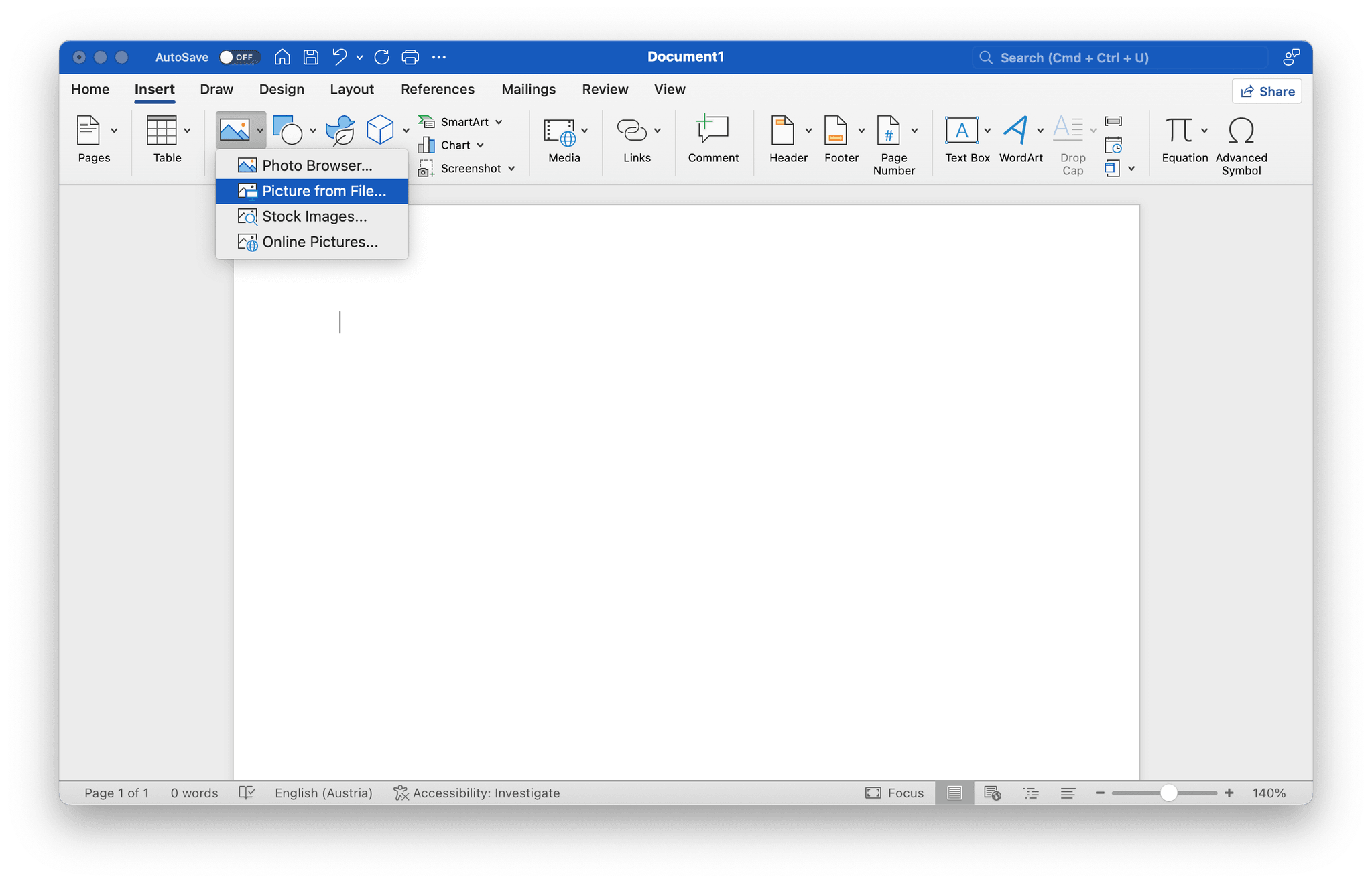
- Choose your signature file, click Insert, and drag the corner handles to resize it.
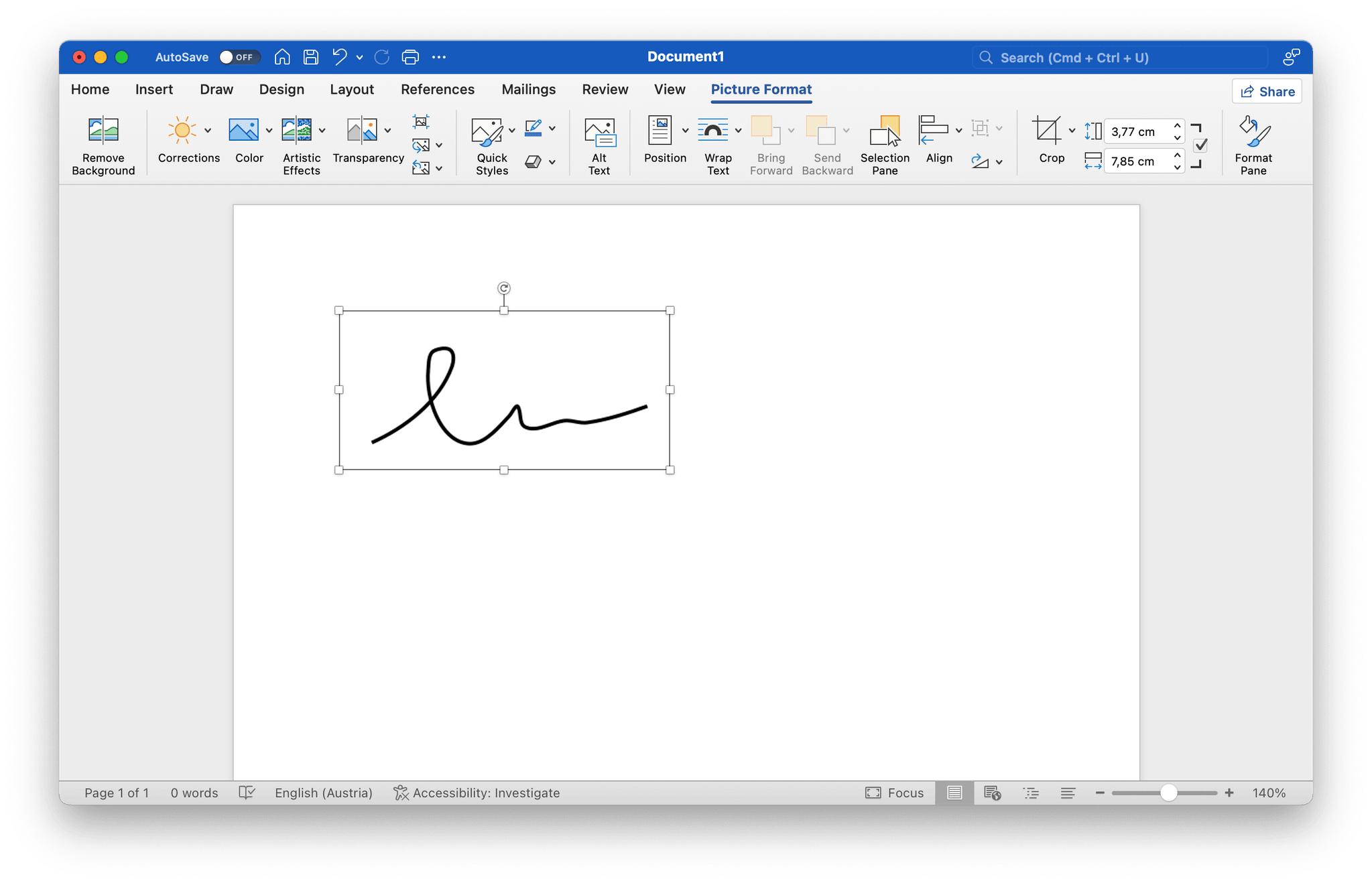
- Select the image and use Picture Format > Crop to trim the edges. To get rid of the white paper behind your signature, use Picture Format > Remove Background, mark anything Word got wrong and click Keep Changes.
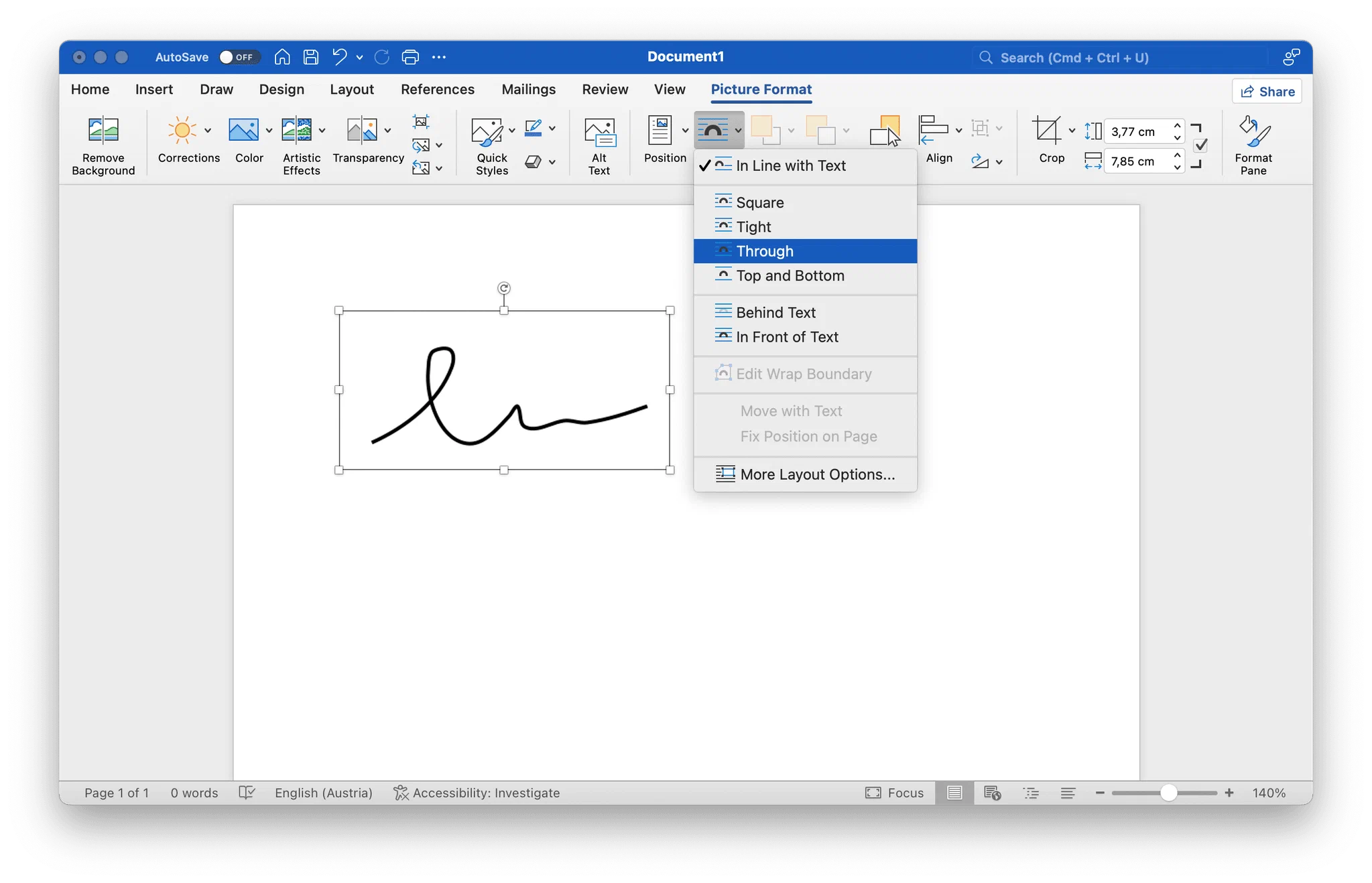
Pro Tip: To move the signature freely over the text and the signature line, select the image and go to Picture Format > Wrap Text > In Front of Text.
Save your signature for reuse with AutoText
If you sign Word documents often, save the image together with your typed name, title or phone number as an AutoText entry (Microsoft Support):
- Windows: Type the text below the image, select both, then go to Insert > Quick Parts > Save Selection to Quick Part Gallery. Give it a name, choose AutoText in the Gallery list and click OK. To use it later, go to Insert > Quick Parts > AutoText and pick your signature block.
- Mac: Select the image and text, then choose Insert > AutoText > New from the menu bar, name the entry and click OK. To use it, choose Insert > AutoText > AutoText and select the name.
Pros and cons of a signature image
Pros
- ✅ Looks like your real handwritten signature
- ✅ Reusable in seconds with AutoText
- ✅ Works in every desktop version of Word on Windows and Mac
Cons
- ❌ Anyone who receives the file can copy the image and paste it elsewhere, which makes signature forgery easy
- ❌ Doesn’t prove who inserted it, and the document can still be changed afterwards
- ❌ Needs a scanner or phone, plus some clean-up to look good
Remember: Before sending a signed Word file, save it as a PDF so the layout and signature stay in place. Or electronically sign the PDF directly.
Method 4: type your name in a signature font
Typing your name in a handwriting-style signature font is the fastest way to sign in any version of Word.
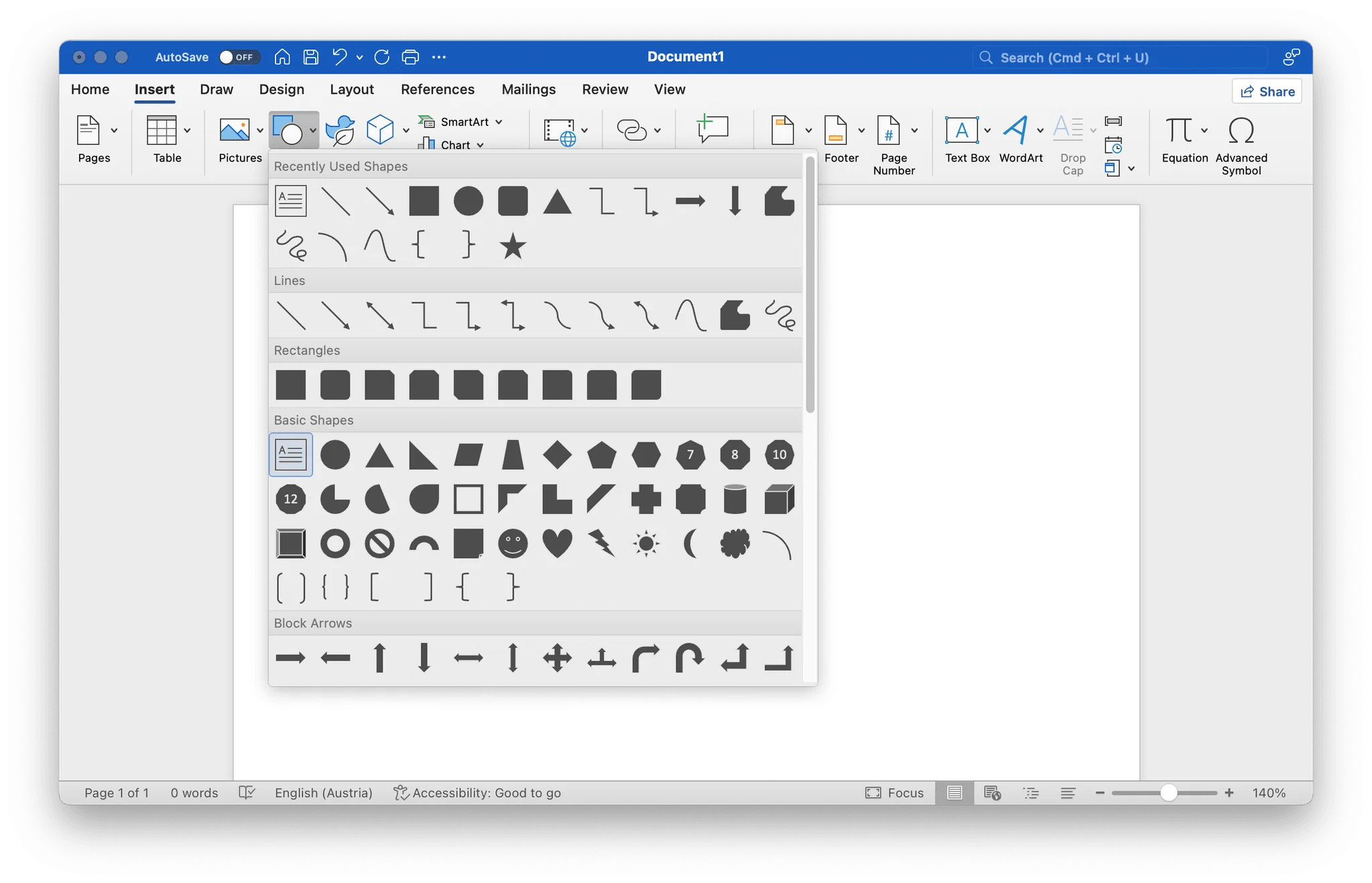
- Go to Insert > Text Box and draw a text box where the signature should go. You can also type directly on the signature line.
- Type your full name.
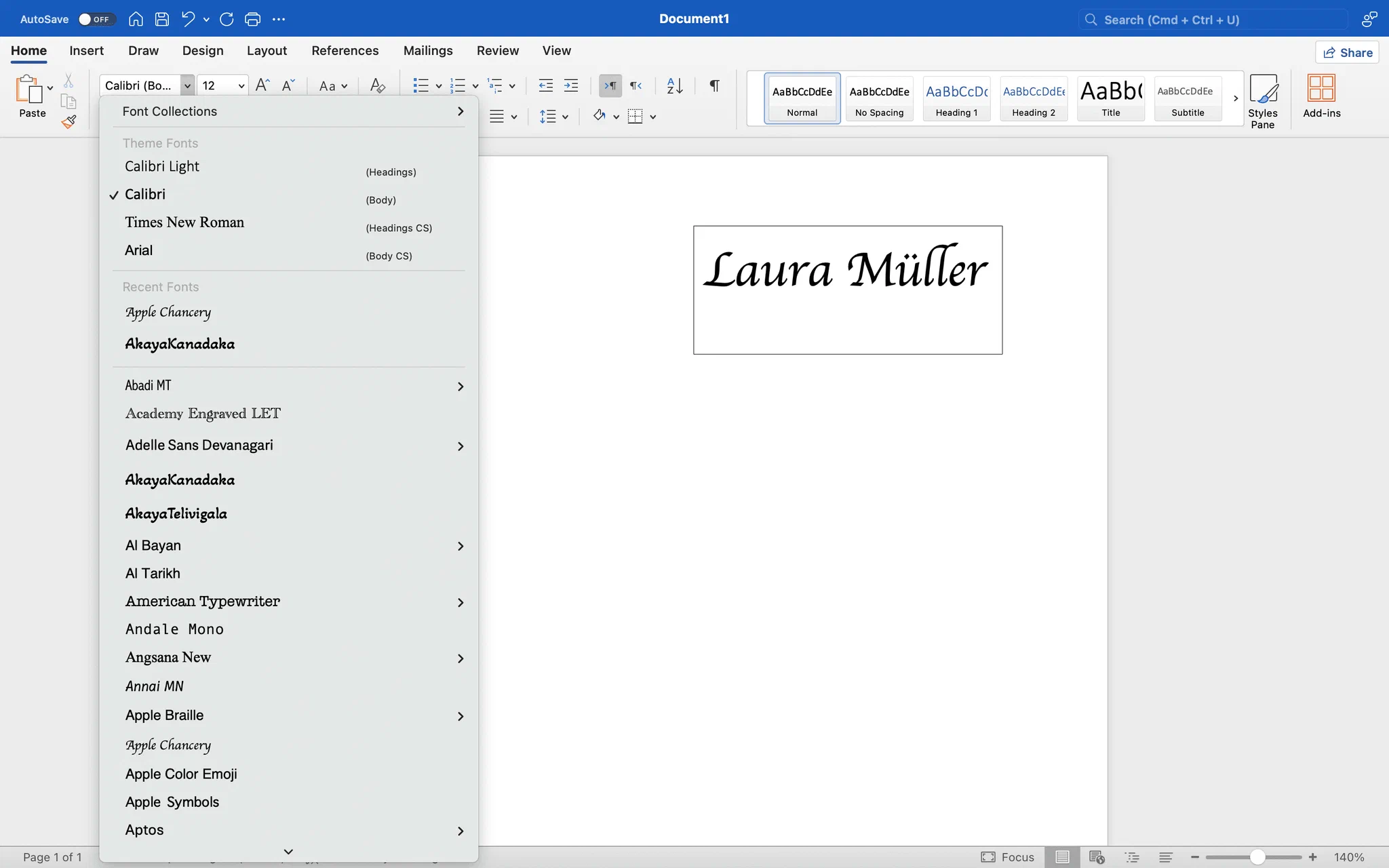
- Select it and choose a signature font, such as Brush Script MT.
- Drag the text box to where the signature belongs and remove its outline if you like.
Pros and cons of a typed signature
Pros
- ✅ The fastest method, nothing to scan or draw
- ✅ Works in every version of Word, including Word for the web
Cons
- ❌ The weakest evidence: anyone can type a name
- ❌ Looks less like a real signature
- ❌ If the recipient doesn’t have the font, Word replaces it; save as PDF to keep the look
A typed name can still count as an electronic signature if you clearly intended to sign, and so can the name block you get when you add an email signature in Outlook. Without that intent, courts may not treat either as one, as a 2023 California case about a printed name in an email shows (LCW).
Method 5: add an electronic signature with Microsoft 365 eSignature
Since 2025, Microsoft has offered its own eSignature service inside Word for business customers. You insert signature fields in Word and send the document for signature without converting it first. Recipients sign an automatically generated PDF copy, and the signed PDF is saved next to the original in SharePoint (Microsoft Learn). Google Workspace has a similar built-in tool to sign a Google Doc.
Requirements (as of October 2026)
- A subscription version of Word desktop
- The document is a .docx file, not encrypted, and saved in a SharePoint site where your admin has enabled eSignature
- Pay-as-you-go billing set up by your admin, around USD 2 per signature request (Microsoft)
How to request a signature in Word
- Open the document from the eSignature-enabled SharePoint site in Word desktop.
- Go to Insert > eSignature fields.
- In the side panel, select Add recipient and add the signers’ email addresses. They can be inside or outside your organisation.
- Place the cursor where each signer should sign and insert the fields from the side panel.
- Add an optional message and select Create request.
Signers get an email with a link, and both sides are notified along the way. The signed PDF contains an audit trail showing who signed and when.
Pros and cons of Microsoft 365 eSignature
Pros
- ✅ Signature fields and request directly in Word
- ✅ External signers, email notifications and an audit trail
- ✅ Signed copy stays in your Microsoft 365 environment
Cons
- ❌ Business accounts only: needs SharePoint, admin setup and pay-as-you-go billing
- ❌ Microsoft’s own service offers simple electronic signatures only; for AES or QES you connect Adobe Acrobat Sign or Docusign, which requires a licence from them
- ❌ Requests start from Word desktop
Method 6: electronically sign a Word document with an eSignature platform
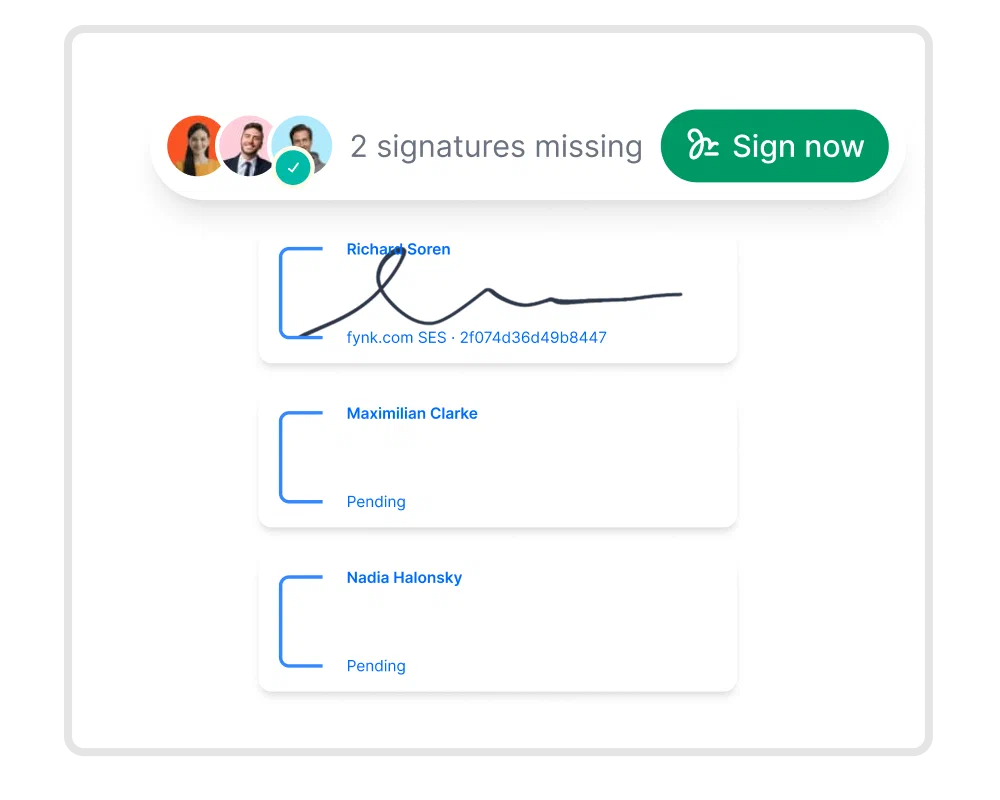
To electronically sign a Word document, or have others sign it, upload it to an eSignature platform. With fynk’s e-signature tool it takes three steps, and it is included in the Free plan:
- Sign in to fynk.
- Drag and drop your Word file. fynk takes Word, PDF and scanned contracts as they are, no conversion needed.
- Sign it, or send it to the other signers. Choose SES, AES with a phone code or a national eID, or QES; fynk sends reminders and keeps an audit trail.
Before fynk, we used Word, then converted to PDF, then sent via [a signing platform]. Three separate steps.

The same works for a spreadsheet when you add a signature in Google Sheets.
How to sign a Word document on Mac or your phone
To sign a Word document on a Mac or your phone, draw your signature on the Draw tab or insert a picture of it.
- Mac: use a signature image (Insert > Pictures > Picture from File), the Draw tab or a typed name (Methods 2 to 4). Turn on Draw with Trackpad to sign with your finger. Microsoft documents the signature line and digital signatures for Word for Windows only.
- iPhone, iPad and Android: open the file in the Word app, open the Draw tab and sign with your finger or stylus. You can also insert a photo of your signature via Insert > Pictures.
For a verifiable signature on a Mac or phone, use an eSignature platform (Method 6). Signers sign in the browser on any device.

Searching for a contract management solution?
Find out how fynk can help you close deals faster and simplify your eSigning process – request a demo to see it in action.
Frequently asked questions
Draw it with a mouse, trackpad or finger, type your name, or photograph your signature on paper. A signature generator turns any of these into a transparent PNG you can insert in Word, Excel or a PDF.
In Word for Windows, add a signature line via Insert > Signature Line and send the .docx file; the signer right-clicks the line and selects Sign. On a Mac, or for signers without a certificate, use Microsoft 365 eSignature fields or an eSignature platform, where you place signature fields and each signer fills them in the browser.
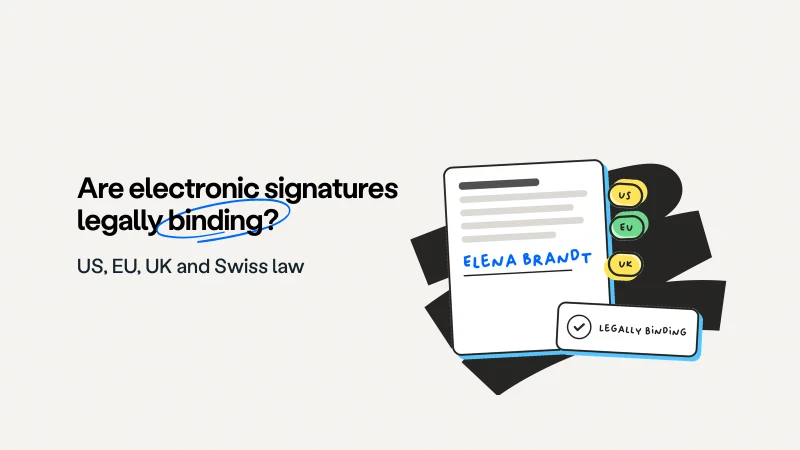
Usually yes. An image, drawing or typed name is a simple electronic signature, which the EU eIDAS regulation (Art. 25(1)) and the US ESIGN Act do not reject just because it is electronic. It is weak evidence, though, and where the law requires the written form, only a qualified electronic signature can replace a handwritten one. In Germany, a fixed-term employment contract with a scanned signature was held invalid (LAG Berlin-Brandenburg, 16 March 2022, 23 Sa 1133/21), so whether a scanned signature is legally binding depends on the document.
PDF is usually better. A signed Word file can still be edited unless it carries a digital signature, and layouts can shift on another computer. A PDF keeps the layout fixed and supports certificate-based signatures. Microsoft 365 eSignature and eSignature platforms like fynk let you start from the Word file and deliver a signed PDF.
Please keep in mind that none of the content on our blog should be considered legal advice. We understand the complexities and nuances of legal matters, and as much as we strive to ensure our information is accurate and useful, it cannot replace the personalized advice of a qualified legal professional.




Get a regular dose of insightful contract management content

Take control of your agreements. Move your business forward.
Run agreements the way they should run: fast, clear, and on your terms.
No setup headaches
Go live in days, not quarters
No lock-in
Full export anytime
No hidden fees
Signatures included, no envelope fee