
Rent concession
A rent concession is anything a landlord gives up to sign or keep a tenant: free months, a lower rent for a period, waived fees or other perks. The lease rent stays the same on paper, so the concession has to be written down precisely, including what happens to it if the tenant leaves early or defaults.
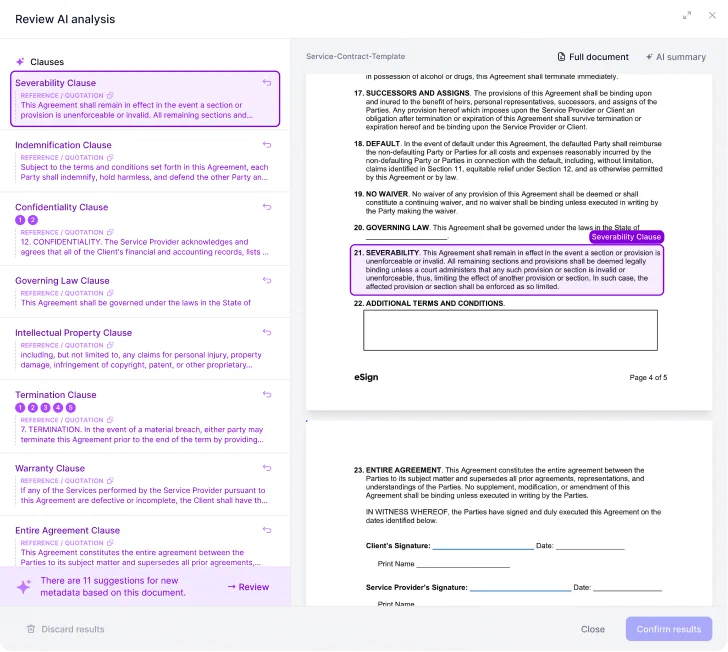
Analyze your contracts. Extract important clauses.
Try our AI contract analysis and extract important clauses and information from existing contracts.
Save your favourite clauses
Insert directly with a single click
Upload preferred precedents
Sample Rent concession clauses
Source
NVE CORP /NEW/ (NVEC)5.Free Rent. Notwithstanding any provision of this Lease to the contrary, but subject to the condition that Tenant is not in monetary default in the performance of any of its obligations under this Lease beyond the applicable cure period, Landlord hereby releases Tenant from the obligation to pay its Monthly Installment of Annual Base Rent for the period from April 1, 2026, through May 31, 2026 (“Free Rent Period”). During the said Free Rent Period, Tenant shall remain obligated to pay Landlord for all Additional Rent and other charges payable pursuant to the Lease, including, but not limited to, Real Estate Taxes and Operating Expenses.
3.02 Time of Payment. Upon execution of this Lease, Tenant shall pay the installment of Base Rent for the first month of the Term for which Base Rent is due (which may be later than the first month of the Term, if there is a free rent period). On or before the first day of the next month and each month thereafter, the installment of Base Rent and other sums due under this Lease will be due and payable, in advance, without off-set, deduction or prior demand. Tenant shall cause payments to be properly mailed or otherwise delivered so as to be actually received (and not merely deposited in the mail) by Landlord (or the party identified in Section 1.11, or any other third party designated by Landlord) on or before the due date. If the Term commences or ends on a day other than the first or last day of a calendar month, the rent for any partial calendar month following the Commencement Date or preceding the end of the Term will be prorated. Tenant shall pay any such prorated portion for a partial calendar month at the beginning of the Term on the Commencement Date. Tenant shall pay any such prorated portion for a partial calendar month at the end of the Term on the first day of that calendar month.
Source
NYIAX, INC.On September 1, 2021, the Company entered into an operating sub-lease for office space at 180 Maiden Lane, New York, NY 10005 that commenced on November 1, 2021, expires September 29, 2025, and on April 16, 2024 the lease was terminated early. Base rent is $14,814 per month, rent escalation is 2% per annum commencing on the first anniversary of lease commencement and there is a rent concession of three months following the Company’s possession of space. On the commencement date, the Company recorded a right-of-use asset and lease liability in the amount of $563,713.
On December 13, 2019, we entered into a sublease agreement (the “Sublease”) with Our Town pursuant to which Our Town subleases 2,245 square feet of office space from Sotherly for a period of 5 years, with a 5-year renewal subject to approval by Sotherly, on terms and conditions similar to the terms of the prime lease entered into by Sotherly and the third-party owner of the property. In December 2023, the Company granted Our Town a lease concession in the amount of $143,774 in proportion to the rent concession the Company received under the primary lease. For the years ended December 31, 2024 and 2023, the Company received rent income from Our Town of approximately $135,511 and $24,755, respectively.
What counts as a rent concession
A rent concession is a benefit the landlord grants on top of the lease terms, usually to win a tenant in a slow market or keep one at renewal. The headline rent stays where it is, and the concession reduces what the tenant actually pays.
Common forms:
- Free months: no base rent for a period, often at the start (“first month free”, or the three months in the NYIAX sublease above). This is the classic case of rent abatement agreed upfront.
- Reduced rent for a period: for example 50% for the first six months.
- Spread-out free rent: one free month a year instead of all upfront, which keeps the tenant from leaving after the free months.
- Waived or reduced fees: application, amenity, parking or move-in fees.
- Allowances and perks: a tenant improvement allowance in commercial leases, gift cards or upgraded appliances in residential ones.
- Concessions at renewal or in a crisis: a temporary reduction or deferral, like the concession Sotherly passed on to its subtenant in the same proportion as the one it received under its own lease.
Why landlords offer concessions instead of lowering the rent
A lower rent shows up in every comparable, every appraisal and every future renewal. A concession keeps the face rent intact. That matters for the landlord’s lender and valuation, and for the next rent increase, which is usually calculated from the face rent, not what the tenant actually paid.
For the tenant, that is the catch. If a 12-month lease at $2,400 comes with two free months, the tenant effectively pays $2,000 a month. At renewal, the landlord will quote a figure based on $2,400.
Net effective rent: the number to compare
Net effective rent spreads the concession over the term so offers can be compared:
Net effective rent = (monthly rent × months in term − value of concessions) ÷ months in term
| Offer A | Offer B | |
|---|---|---|
| Face rent | $2,400 a month | $2,250 a month |
| Term | 12 months | 12 months |
| Concession | 2 months free ($4,800) | none |
| Total paid | $24,000 | $27,000 |
| Net effective rent | $2,000 a month | $2,250 a month |
Offer A looks more expensive and is cheaper this year. The question is what happens next year, when Offer A renews from $2,400 and Offer B from $2,250.
Writing a concession into the lease
Most disputes about concessions come from vague wording such as “first month free” with nothing else. A clause that holds up says:
- What exactly is waived. Base rent only, or also additional rent? The NVE lease above waives base rent but keeps the tenant paying taxes and operating expenses during the free period.
- When. Specific months, or a number of months after a start date.
- The conditions. No default, or the concession stops. NVE grants its free rent “subject to the condition that Tenant is not in monetary default”.
- The clawback. Whether the tenant must repay the concession if it leaves early, is evicted or defaults. Without this, a tenant can take three free months and walk.
- How it interacts with renewal. Free months in year one shouldn’t become free months every year, and renewal rent should start from the face rent.
Residential concessions are often written into a separate concession addendum signed with the lease. The same points apply; the addendum just keeps them in one place.
Sample clause: Rent concession
Add this clause to a contract, send it and get it signed in fynk.
Use it in fynk for freeTracking concessions across a portfolio
A concession is a date-bound promise: two free months starting March 1, a clawback that lapses after 24 months, a renewal that starts from the face rent. Lost in a PDF, it either gets forgotten by accounting or argued about at move-out. In fynk you can capture the concession amount, period and clawback end date as metadata on the lease, and see them across all leases in one view.
Free templates with this clause
- Commercial lease agreement template (office, retail and warehouse space) Sets base rent and additional rent, the place to add free months or a reduced-rent period with its conditions. Use template
- Office sublease agreement template Runs rent from a sublease rent commencement date, which is where a free rent period for the subtenant is set. Use template
Related clauses
- Rent abatement Rent abatement is a period in which a tenant pays reduced rent or no rent while the lease continues. It is either negotiated upfront as an incentive, often in commercial leases, or triggered when the premises cannot be used, for example after a fire or a landlord's failure to make repairs.
- Tenant improvement allowance A tenant improvement allowance (TIA) is an amount a landlord agrees to pay toward building out or renovating a commercial space for a new tenant. It is usually set per square foot, paid against invoices once work is done, and limited to improvements described in the lease's work letter.
- Lease renewal A lease renewal clause outlines the terms and procedures for extending a lease agreement beyond its original expiration date, often specifying conditions such as rental rate adjustments, renewal notice periods, and any changes to the original lease terms. This clause provides both the landlord and tenant with a framework for continuing the lease relationship under mutually agreed-upon terms.
- Additional rent The "Additional Rent" clause outlines any extra charges a tenant may be responsible for beyond their base rent, such as utilities, maintenance fees, or taxes. This clause ensures transparency and clarifies the tenant's total financial obligations under the lease agreement.
- Holdover A holdover clause in a contract specifies the conditions and obligations of the parties if a tenant or lessee continues to occupy the property beyond the expiration of the lease term. It typically outlines the changes in rental terms, such as an increase in rent, and the landlord's rights and remedies during the holdover period.
- Security deposit A security deposit clause outlines the amount of money a tenant must pay to the landlord before moving in, which serves as protection against potential damages beyond normal wear and tear or unpaid rent. This deposit is typically refundable at the end of the lease term, provided the tenant meets all the conditions of the contract.
Frequently asked questions
A benefit the landlord gives the tenant on top of the lease terms, such as free months, a temporary rent reduction or waived fees, without lowering the official rent.
That the tenant pays no rent for the concession period. Check whether that covers base rent only or also utilities, taxes and other charges.
Only if the lease or concession addendum says so. Many do, usually requiring the unused or unamortized part of the concession to be repaid on early termination.
Not necessarily. They are common when vacancy is high or a building is new. Compare offers on net effective rent and check what rent the renewal will start from.
Abatement is one kind of concession: a period of reduced or no rent. Concessions also include waived fees, allowances and other perks, and can be agreed at signing or later.
More clauses from the library
See allRent coverage ratio
The rent coverage ratio clause typically specifies the minimum ratio of a tenant's income or revenue to their rent obligations that must be maintained to ensure financial stability and mitigate default risk. This clause serves to protect landlords by ensuring that tenants consistently generate sufficient income to cover their rental payments.
5 example clauses
Rent escalation
A rent escalation clause is a provision in a lease agreement that allows for periodic increases in the rental amount, often tied to specific benchmarks like inflation indices, market rates, or predetermined schedules. This clause ensures that rental income keeps pace with rising costs or market conditions over the lease term.
11 example clauses
Representations and warranties
"Representations and warranties are contractual statements made by one or both parties, asserting certain facts and conditions as true at the time of the agreement. These affirmations serve to allocate risk and establish grounds for potential legal remedies if the assertions prove to be false or misleading."
13 example clauses
Analyze your contracts. Extract important clauses.
Try our AI contract analysis and extract important clauses and information from existing contracts.
Save your favourite clauses
Insert directly with a single click
Upload preferred precedents