
Morals clause
A morals clause, or morality clause, lets one party terminate or suspend a contract if the other party's conduct brings it into public disrepute, scandal or contempt. It is standard in endorsement, talent and executive contracts, and a reverse morals clause gives the talent the same right against the company.
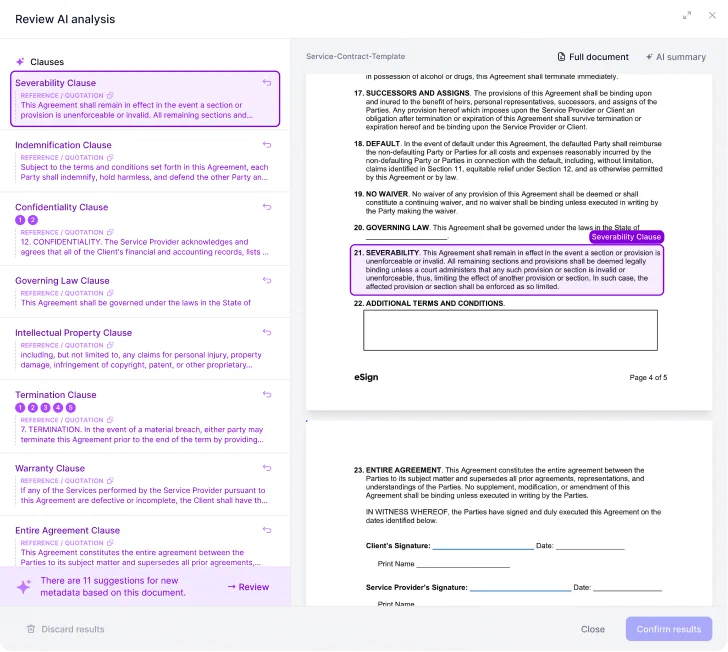
Analyze your contracts. Extract important clauses.
Try our AI contract analysis and extract important clauses and information from existing contracts.
Save your favourite clauses
Insert directly with a single click
Upload preferred precedents
Sample Morals clause clauses
(a) the Supplier fails to apply for, obtain or maintain any licence from any Gaming Authority necessary for the performance of this Agreement or compliance with any laws; or (b) any Gaming Authority makes an order or recommendation requiring or recommending the termination of this Agreement; or (c) any member of the Aristocrat Group reasonably believes that the continuation of this Agreement will have a detrimental impact on the ability of the Aristocrat Group (or any one or more members of it) to hold, maintain or obtain any licence issued or to be granted by any Gaming Authority; or (d) the Supplier commits any act, or fails to commit an act, in such a manner as constitutes an offence involving moral turpitude under any laws, or which in the opinion of Aristocrat brings any member of the Aristocrat Group into public disrepute, contempt, scandal or ridicule, or which insults or offends the community; or (e) any Gaming Authority disapproves of this Agreement or any part of it.
(v) willful engaging by the Executive in any act that brings the Company into public disrepute or disgrace or causes material harm to the customer relations, operations or business prospects of the Company; or (vi) the Executive’s failure to cooperate with a bona fide internal investigation or an investigation by regulatory or law enforcement authorities, after being instructed by the Company to cooperate, or the willful destruction or failure to preserve documents or other materials known to be relevant to such investigation or the inducement of others to fail to cooperate or to produce documents or other materials in connection with such investigation.
2.7Conduct by the Executive which brings or may be reasonably expected to bring public disrepute or discredit to Corporation or Bank and/or which results in or may be reasonably expected to result in material financial, reputational or other harm to the Corporation or Bank generally or with any of their respective customers, depositors, business associates, Executives, contractors or vendors;
Source
ID Perfumes, Inc.g. Notwithstanding anything to the contrary contained herein , Licensor shall not be required to cause Artist to participate in any activities (i)which are subject to Federal or state security laws, (ii) which would impose a fiduciary duty upon Licensor to Licensee’s shareholders, (iii) which would cause Licensor to violate any laws, (iv) which would cause injury to Licensor or (v) which may subject Licensor to public disrepute, scorn or ridicule. Licensee further understands that Licensee’s unilateral failure to utilize services of Licensor hereunder shall not result in any reduction in payments to Licensor hereunder, nor may unused appearances from one Annual Period be carried forward to another Annual Period. The obligations of Licensor to provide the services hereunder are subject to the condition that payments to Licensor are current and up to date and Licensee is not otherwise in breach of any provisions of the Agreement. If Licensor confirms Artist ’s availability for any In Store Appearance or Production Appearance and Artist is unable to appear due to a certifiable illness or injury of the kind that would reasonably prevent Artist from being able to perform or other certifiable emergency , such non-appearance is not a breach of this Agreement and neither Licensor nor Artist shall be responsible for any expenses incurred due to such non-appearance. In such event, Licensor and Licensee shall attempt in good faith to reschedule the appearance date which should not be unreasonably withheld.
6.2 Scotts agrees that it will not, during the Term or thereafter, challenge the title or any rights of Monsanto in and to the Licensed Marks or challenge the validity of this Agreement or do anything either by an act of omission or commission which might impair, violate or infringe any of the Licensed Marks and will not claim adversely to Monsanto or anyone claiming through Monsanto any right, title or interest in or to the Licensed Marks and will not misuse or harm or bring the Licensed Marks into public disrepute. In the event Scotts challenges any of the foregoing, such challenge shall immediately be deemed a Material Breach subject to the dispute resolution process set forth in Section 16 herein, and Scotts shall cooperate with Monsanto to dismiss with prejudice any such challenge. Scotts agrees that it has not and during the Term and thereafter will not for its benefit, directly or indirectly, register(ed) or apply(ied) for or maintain registration of any of the Licensed Marks or any mark which is, in Monsanto’s reasonable opinion, the same as or confusingly similar to any of the Licensed Marks.
(c) Neither Licensor nor Dragonfly shall knowingly take, omit to take, or permit any action which will dilute the Licensed Mark or tarnish or bring into disrepute the reputation of or goodwill associated with the Licensed Mark, or which will invalidate or jeopardize any registration of the Licensed Mark.
What is a morals clause?
A morals clause, also called a morality clause, lets one party end a contract, or take other action, if the other party behaves in a way that damages its reputation. It is a reputation clause: the trigger is conduct, often outside the work itself, that brings scandal, public contempt or embarrassment.
Example: a sports brand signs an athlete to promote its shoes. A year later, the athlete is charged with a serious crime and the story is everywhere. The morals clause lets the brand terminate the endorsement at once and stop paying, instead of being tied to someone its customers now associate with the scandal.
The clause dates back to the early 1920s in Hollywood, when studios began adding conduct clauses to performers’ contracts after a highly publicized scandal. Today it appears far beyond entertainment.
Where morals clauses appear
| Contract | Who is bound | Typical trigger |
|---|---|---|
| Endorsement, sponsorship and influencer agreements | The athlete, celebrity or creator | Conduct that brings them, or the brand, into public disrepute |
| Executive employment agreements | The executive | Conduct harming the company’s reputation, as a ground for termination for cause |
| Brand and trademark licenses | The licensee | Use of the brand that tarnishes it |
| Franchise agreements | The franchisee and its owners | A conviction for a crime of moral turpitude |
| Supply and service agreements in regulated industries | The supplier | Conduct that could cost the customer its license or reputation |
What triggers a morals clause
Clauses use a range of triggers, from narrow to very broad:
- A criminal conviction, sometimes only a felony or a “crime involving moral turpitude”.
- An indictment or charge, which acts before any conviction.
- Conduct bringing the party into public disrepute, contempt, scandal or ridicule.
- Conduct that offends the community or a significant part of the public.
- Conduct that is contrary to the company’s interests or “reflects unfavorably” on it.
- Past conduct coming to light, not only new conduct after signing.
The broader the trigger, the more discretion the protected party has. A clause that lets the brand terminate “if, in its sole judgment, the talent’s conduct may reflect unfavorably on the brand” is close to a termination right at will.
Reverse morals clauses
A reverse morals clause works the other way: it lets the talent or partner walk away if the company becomes involved in a scandal. Reverse clauses are less common and depend on the talent’s bargaining power, but they are increasingly asked for by athletes and creators who do not want their name tied to a brand in trouble. One of the sample clauses above takes a related approach, protecting the artist from activities that could bring him into public disrepute.
Are morality clauses enforceable?
Generally yes: US courts treat a morals clause as an ordinary contract term, so the fight is usually over whether the conduct falls within its wording. The leading example is Nader v. ABC Television, decided by the federal court in Manhattan in 2004. ABC fired a soap opera actor after his arrest on a cocaine charge drew press coverage, relying on a clause that let it terminate if, “in the opinion of ABC”, he did anything that “might tend to bring Artist into public disrepute, contempt, scandal, or ridicule”. The court held that the clause was not so vague or overbroad as to be void, that the publicity brought the arrest within it, and that ABC did not have to act at once: it suspended him first and terminated about three weeks later.
That case also shows where the risk sits for the talent. A clause written from the company’s point of view (“in the opinion of ABC”, “might tend to”) gives the company wide room, and a court will usually hold both sides to it. Narrowing the trigger has to happen before signing, not after the scandal.
How to draft and negotiate a morals clause
If you are the brand or company:
- Define the trigger clearly and decide whether a charge, a conviction, or public reaction is enough.
- Cover past conduct that was not disclosed before signing.
- Spell out the remedies: termination, suspension of the campaign, stopping payments, and repayment of advances or fees for the unperformed term.
- Keep the right to decide quickly, for example on written notice with immediate effect.
If you are the talent, executive or partner:
- Narrow the trigger to convictions or proven conduct, not allegations, and to conduct that actually harms the company.
- Use an objective standard, “a reasonable person would conclude”, not the company’s sole judgment.
- Exclude political views, religious beliefs and lawful private conduct, where you want that protection.
- Ask for a reverse morals clause and a cure or response period before termination.
- Protect payments already earned and limit any repayment.
Morals clause example
Sample clause: Morals clause
Add this clause to a contract, send it and get it signed in fynk.
Use it in fynk for freeWhen a scandal breaks
The first hours matter: who has a contract with this person, what can we do, and how fast? In fynk, every agreement sits in the document hub, searchable by counterparty and content, so legal can pull up every contract with the person in minutes and see which ones carry a conduct clause. Because endorsement and executive contracts are sensitive, user roles limit who can open them while that review runs.
Which contracts include a morals clause?
Endorsement, sponsorship and influencer agreements, talent and booking agreements, executive employment agreements, brand licenses and franchise agreements. These free templates include one:
Free templates with this clause
- Endorsement agreement template for athlete brand sponsorship The company can act if the athlete engages in conduct that offends a significant part of the population or could bring the athlete into public disrepute. Use template
- Booking agreement template for professional wrestling A classic morals clause covering offenses involving moral turpitude and acts that bring the wrestler into public disrepute, contempt, scandal or ridicule. Use template
- Franchise agreement template The franchisor may terminate if the franchisee or its owners are convicted of a felony or crime involving moral turpitude. Use template
Family law also uses the term: “morality clauses” in custody and divorce orders restrict conduct around children. That is a different instrument with its own rules, and it is not covered here.
Related clauses
- Objectionable conduct The "Objectionable Conduct" clause typically outlines behaviors or actions deemed unacceptable by a party within a contractual agreement. It serves to protect parties by allowing for the termination or renegotiation of the contract if such conduct is exhibited.
- Ethics An ethics clause in a contract outlines the expected standard of moral conduct and principles that parties are obliged to adhere to during the execution and fulfillment of the agreement. It often includes stipulations related to integrity, compliance with laws, anti-corruption measures, and maintaining transparency to foster trust and ethical behavior in business dealings.
- Mutual nondisparagement A mutual nondisparagement clause is an agreement between parties where each agrees not to make negative or disparaging statements about the other. This clause is designed to protect the reputation of both parties by preventing harmful public comments or criticisms.
- Termination with cause "Termination with cause" refers to a contract provision that allows one party to end the agreement if the other party engages in specific misconduct or breaches the contract's terms. This clause typically outlines what constitutes "cause," such as failure to meet obligations, illegal activity, or unethical behavior.
- Waiver of moral rights A waiver of moral rights clause is an agreement where the creator of a work relinquishes their right to claim authorship and object to any derogatory treatments or modifications of their work. This clause allows the rights holder more flexibility in altering, using, or commercializing the work without the need for the creator's consent or potential claims of harm to the creator's reputation.
Frequently asked questions
A provision that lets one party terminate or suspend the contract if the other party's conduct brings it into public disrepute or damages its reputation. It is common in endorsement, talent and executive contracts.
None. Both names are used for the same kind of conduct and reputation clause.
A clause that lets the talent or partner terminate if the company itself becomes involved in a scandal that could damage the talent's reputation.
Only if the clause says so. Many morals clauses are triggered by conduct that brings someone into disrepute, which can include public allegations; others require a charge or a conviction.
Yes. Courts treat them as ordinary contract terms. In Nader v. ABC Television (S.D.N.Y. 2004), a federal court upheld a network's termination of an actor under a broad morals clause after a publicized arrest, holding the clause was not too vague to enforce. Disputes usually turn on whether the conduct falls within the clause's wording.
More clauses from the library
See allmortgagee
The mortgagee clause is a provision in a mortgage agreement that protects the lender's interest in the property by ensuring they are named as a beneficiary of insurance policies on the property. This clause guarantees that the lender will receive compensation for damages or losses to the property in cases covered by insurance, even if the homeowner commits fraud or other offenses.
20 example clauses
Most favored customer
A "most favored customer" clause is a contractual provision ensuring that the customer receives terms as favorable as those granted to any other customer. This clause typically requires the seller to extend the same benefits or prices to the favored customer whenever offering better terms to others.
5 example clauses
Most favored nation
The "Most Favored Nation" clause is a contractual provision that ensures a party receives terms that are at least as favorable as those given to any other party in similar agreements. This clause is commonly used to prevent discrimination and to maintain competitive equal footing among contracting parties.
15 example clauses
Analyze your contracts. Extract important clauses.
Try our AI contract analysis and extract important clauses and information from existing contracts.
Save your favourite clauses
Insert directly with a single click
Upload preferred precedents