
Capital call
A capital call is a demand by a company, joint venture or fund that its members or investors pay in additional capital they have committed or agreed to contribute.
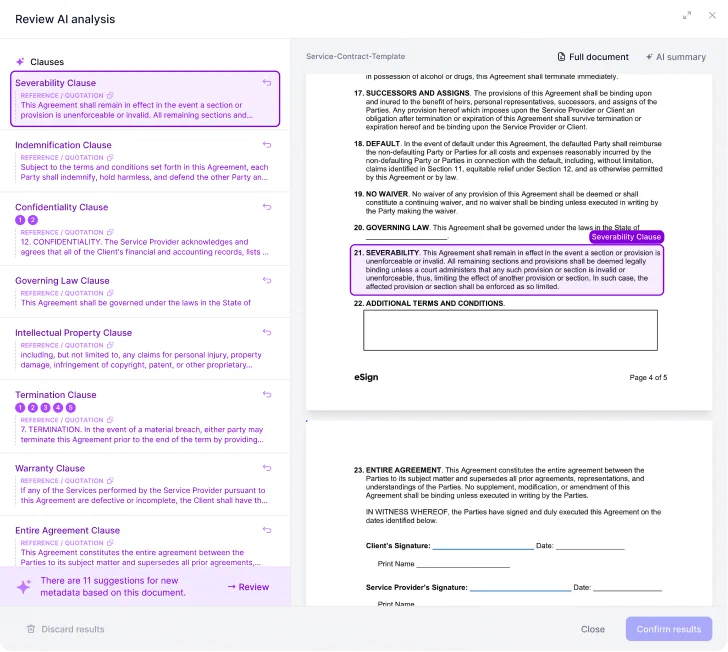
Analyze your contracts. Extract important clauses.
Try our AI contract analysis and extract important clauses and information from existing contracts.
Save your favourite clauses
Insert directly with a single click
Upload preferred precedents
Sample Capital call clauses
4.1.4 Capital Calls. If at any time after the Effective Date, either Member determines that additional cash (a “Shortfall”) is required by the Company for Necessary Expenditures, such Member may (but shall not be obligated to), require that each of the Members contribute its pro rata share (based upon the Percentage Interests of the Members at the time of such request) of such Shortfall. In the event of a capital call, such Member shall give written notice (a “Cash Needs Notice”) to the other Member of the amount of the Shortfall. Each Cash Needs Notice shall also set forth a date, no less than fifteen (15) Business Days following the date of the Cash Needs Notice, by which the Shortfall must be delivered to the Company (the “Cash Needs Date”). In the event that a Cash Needs Notice is delivered to the Members, each Member shall, on or before the Cash Needs Date, make a Capital Contribution to the Company in an amount equal to its then current Percentage Interest multiplied by the applicable amount of the Shortfall.
(a) Capital Calls. Additional Capital Contributions may be (1) called at the sole discretion of the Manager for the benefit of the Company if and only if the Company requires additional capital to meet a liability with respect to the Property or the Project such that, without the additional Capital Contributions, the success of the Project would be in jeopardy (each a “Capital Call”) or (2) made voluntarily by a Member with the express written consent of the Manager, provided, however that the Manager may only require that the Sponsors alone participate (“Sponsor Call Contributions”). Unless otherwise determined by the Manager in its sole discretion, all Members shall be required to participate in a Capital Call on a pro rata basis of their Capital Contributions in proportion to the aggregate Capital Contributions of all Members (each Member’s “Call Amounts”). A Capital Call, when issued, shall be issued by the Manager in writing to all the Members and shall provide for a funding/participation deadline of at least THIRTY (30) days from the date of the notice (the “Capital Call Notice”).
Source
INLAND REAL ESTATE CORP(f) Capital Call by Member. If the Manager fails to cause the Company to make a Capital Call when required to do so pursuant to Sections 5.2(b), (c), (d) or (e) above, and said failure shall continue for ten (10) days or more following written notice to the Manager from either Member, either Member shall have the right to cause the Company to make the Capital Call in question.
Section 6.5 Notice of Additional Capital Contributions.
Additional Capital Contributions contemplated by Section 6.4 hereof may be called for only in the amounts, at the times and for the purposes set forth in this Article 6, by written notice to the Members by the Manager and shall be due twenty (20) Business Days after the date of such notice. Any Member not meeting such capital call in full within said twenty (20)-Business Day period shall be a “Non-Contributing Member” hereunder, but the other Member (the “Contributing Member”) shall not exercise its remedies under Section 6.6 hereof unless such failure to meet a capital call remains uncured by the close of business on the tenth (10th) Business Day following the expiration of such twenty (20)-Business Day period.
Source
LIGHTBRIDGE Corp (LTBR)Section 4.3 Nonpayment of Additional Capital Contributions. If a Member fails to make any Additional Capital Contributions required in accordance with this Article IV (“Non-contributing Member”) within thirty (30) Days after it is due, interest shall accrue on the unpaid portion at the lesser of (a) the Prime Rate plus [] percent ([]%) per annum (calculated and accrued on a monthly basis) and (b) the maximum rate permitted by Applicable Law. Additionally, the Company, subject to approval of the matter as a Related Party Transaction of the Non-contributing Member, may withhold any Distribution otherwise payable to such Non-contributing Member pursuant to the terms of this Agreement and offset any such Distribution against such delinquent Additional Capital Contribution, and obtain bank financing to fund such Additional Capital Contribution, the cost of such financing to be chargeable against the Non-contributing Member.
What is a capital call?
A capital call, also called a drawdown or cash call, is a formal demand that members, partners or investors contribute money to a company, joint venture or fund. It is made under the rules set in the operating agreement, joint venture agreement or fund agreement, which say who can call capital, for what, how much notice is needed, and what happens to anyone who does not pay.
Capital calls work differently in two settings:
- Private equity, venture and private credit funds: investors commit an amount upfront, and the general partner draws it down over several years as investments are made. Capital calls are routine.
- LLCs and joint ventures: members contribute capital at formation, and additional capital is called only if the business needs it, for example to cover a shortfall, fund development or repay debt. These calls are often contested.
Example: two members own a hotel joint venture 60/40. A renovation runs over budget by $1,000,000. Under the operating agreement, either member may issue a cash needs notice, and each must contribute its pro rata share within 15 business days: $600,000 and $400,000. The 40% member does not pay. The other member funds the full amount, and the defaulting member’s percentage interest is reduced.
What a capital call notice contains
- the amount called from each member or investor, usually pro rata to their interests or commitments;
- the purpose of the call, where the agreement limits the purposes;
- the due date, commonly 10 business days to 30 days after the notice;
- payment instructions;
- for funds, how the call affects remaining unfunded commitments.
Several sample clauses above set these requirements, including minimum notice periods of 15 business days, 20 business days and 30 days.
Who can make a capital call?
| Arrangement | Typical rule |
|---|---|
| Fund | The general partner or manager, up to each investor’s unfunded commitment |
| Manager-managed LLC | The manager, often only for listed purposes or with member approval |
| Joint venture | Either member, for necessary expenditures, or only by joint decision |
| Fallback right | If the manager fails to call capital when required, a member may cause the call, as one sample allows |
Many operating agreements say no member is required to contribute more than its initial capital unless it agrees, so a mandatory capital call needs a clear basis in the agreement.
What happens if a member does not fund?
Remedies for a defaulting member, in rough order of severity:
- Interest on the unpaid amount, often at a rate above prime.
- Withholding distributions and setting them off against the missed contribution.
- Member loans: the other members fund the shortfall as a loan to the defaulting member or the company, at a high interest rate.
- Dilution: the defaulting member’s percentage interest is reduced, sometimes at a penalty rate.
- Loss of rights: voting, consent and management rights are suspended.
- Forced sale: in funds, a defaulting investor’s interest may be sold or forfeited.
One sample gives the defaulting member a cure period before remedies apply, and another lists interest, withheld distributions and outside financing at the defaulting member’s cost.
Capital calls and subscription lines
Funds often borrow against their investors’ unfunded commitments, using a subscription credit facility. Lenders then take security over the right to make capital calls and require the fund to notify them of each call, or let the lender issue calls itself after a default.
How to negotiate capital call provisions
If you are a member or investor:
- Limit the purposes for which capital can be called.
- Cap the total additional contributions.
- Get enough notice, at least 10 business days.
- Make remedies proportionate, with a cure period before dilution.
If you are the manager or majority member:
- Keep the right to call for necessary expenses and lender requirements.
- Make remedies effective, including dilution and member loans.
- Give non-defaulting members the option to fund the shortfall.
Capital call clause example
Sample clause: Capital calls
Add this clause to a contract, send it and get it signed in fynk.
Use it in fynk for freeSending notices to every member at once
A fund or a company with many members sends the same capital call notice dozens of times, each with a different amount. With bulk creation in fynk, all notices are generated from one template in a single step, with each member’s amount and details filled in, and routed for signing or acknowledgment automatically.
Which agreements include capital call provisions?
LLC operating agreements, joint venture agreements, limited partnership and fund agreements, subscription agreements, shareholders’ agreements of closely held companies, and subscription credit facilities. This free template addresses capital contributions:
Free templates with this clause
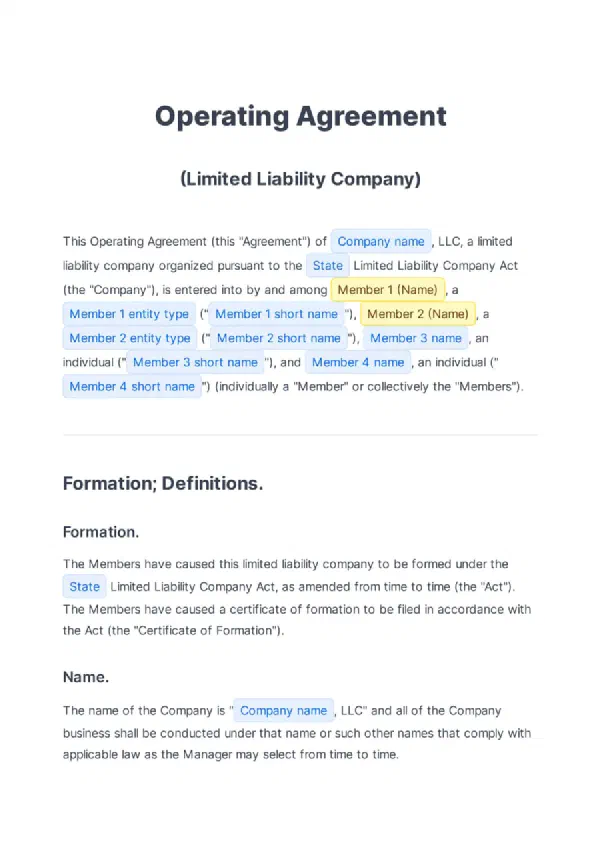 Operating agreement template for LLCs
The manager may close an accounting period when the company accepts a capital contribution that is not pro rata among all existing members.
Use the free template
Related clauses
- Deemed contribution and distribution The "Deemed Contribution and Distribution" clause outlines the scenario in which contributions and distributions between parties are considered to occur based on agreed-upon terms, even if actual physical transfer of assets or funds does not take place. This clause ensures that the financial and legal implications of contributions and distributions are recognized and enforceable as though they had occurred in reality.
- Drag along rights Drag-along rights are provisions in shareholder agreements that allow majority shareholders to compel minority shareholders to join in the sale of a company, ensuring that potential buyers can acquire 100% ownership. These rights help facilitate smoother transactions by aligning interests and reducing obstacles from minority shareholders who might otherwise block a sale.
- Liquidity covenant A liquidity covenant is a financial stipulation included in loan agreements requiring the borrower to maintain a specified minimum level of liquid assets or cash flow to ensure they can meet their short-term obligations. Non-compliance with this covenant can lead to penalties, increased interest rates, or even the loan being called in by the lender.
Frequently asked questions
A demand that members, partners or investors pay in capital they have committed or agreed to contribute, made under the rules of the operating, partnership or fund agreement.
If the agreement requires it and the call follows its rules, yes. If the agreement only allows voluntary contributions, a member can refuse, but may be diluted if others fund instead.
Depending on the agreement: interest, withheld distributions, a forced loan, dilution of your interest, loss of voting rights, or in funds the sale or forfeiture of your interest.
Whatever the agreement sets, typically around 10 business days for funds and 15 to 30 days for LLCs and joint ventures.
The capital contribution is the money paid in. The capital call is the demand that triggers an additional contribution.
More clauses from the library
See allCapitalized terms
Capitalized terms in a contract are specific words or phrases that have been given a distinct, defined meaning within that document. This convention helps ensure clarity and consistency throughout the contract by clearly identifying terms with special significance or particular definitions.
20 example clauses
Car allowance
A car allowance is a fixed amount an employer pays each month to an employee who uses their own car for work, to cover fuel, insurance, maintenance and wear. It is simple to run, but in the US it is usually taxed as wages unless it is paid under an accountable plan.
13 example clauses
CC&Rs
The "CCRs or "CC&Rs" refers to Covenants, Conditions, and Restrictions, which are rules and guidelines set by a homeowners' association (HOA) or a property developer that dictate how properties within a particular community can be used and what homeowners can and cannot do with their properties. These contractual obligations are designed to maintain the aesthetic and functional harmony of the community, ensuring that all residents adhere to agreed-upon standards to preserve property values and neighborhood appeal.
18 example clauses
Analyze your contracts. Extract important clauses.
Try our AI contract analysis and extract important clauses and information from existing contracts.
Save your favourite clauses
Insert directly with a single click
Upload preferred precedents