
What is a countersigned contract?

Rezvan Golestaneh
Published · 5 min read

A countersigned contract is a contract that one party signs and the other party then signs to confirm their agreement. That second, confirming signature is the countersignature. Once both parties have signed, the contract is countersigned and, in most cases, legally binding.
That’s the short version. Below is what countersigning actually means, how it differs from signing and co-signing, why it matters, and how to do it online.
A signature on a contract feels like the finish line. Then you notice the other side never signed, and your “done deal” turns out to be a nicely formatted offer. The thing that actually closes the gap is the countersignature: the second signature that says yes, we agree too.
So let’s clear it up. Here is what countersigning really means, how it differs from signing and co-signing, why the order matters more than people think, and how to handle it online without the print, sign, scan ritual.
What does “countersigned” mean?
To countersign is to add a second signature to a document someone has already signed. That second signature confirms the first and turns a one-sided commitment into a mutual one.
It usually runs in a set order. One side signs first, say a candidate signing an offer letter or a tenant signing a lease. The document then travels to the other side, the employer or the landlord, who signs it too. That confirming signature is the countersignature, and the finished document is a countersigned contract.
Countersigned contract, countersigned agreement, countersigned document. Same idea, different label. The countersignature is simply the confirming signature that comes second.
Countersign vs. sign vs. co-sign
These three get muddled constantly, so here is the clean version:
- Sign: to add your signature to a document, agreeing to its terms.
- Countersign: to sign a document after another party has already signed it, confirming their signature and finalizing the agreement.
- Co-sign: to sign alongside another person as a joint party, usually taking on shared responsibility. A co-signer on a loan, for instance, is equally on the hook for the debt.
The difference is order and role. A countersignature comes second and confirms. A co-signature is a joint signature that shares the liability. And whenever someone is signing on behalf of a company or another person, whether they are actually allowed to is a question of signing authority, separate from where they land in the signing order.
There is also a completely unrelated use of “countersign” on passport and ID applications, where a countersignatory vouches for who someone is. That is about verifying identity, not agreeing to a contract, so leave it out of the contract conversation.
How countersigning works
Countersigning follows a signing order, and each contract signatory has a defined turn:
- The first party signs. They review the terms and add their signature.
- The document goes to the second party. They see exactly what has been signed.
- The second party countersigns. Their signature confirms the first and completes the agreement.
- Both parties get a copy of the fully executed, countersigned contract.
Until that second signature lands, you usually have an offer, not a binding agreement. The countersignature is often the exact moment the contract takes effect.
Why countersigning matters
A countersignature is small, but it pulls real weight:
- It makes the agreement mutual. A contract signed by only one side is typically just an offer. Countersigning shows both parties agreed to the same terms.
- It confirms and validates. The second signature is a check on the first, which is the whole reason it comes last.
- It creates a clear record. A countersigned document, especially one signed with eIDAS compliance behind it, leaves a trail of who signed what and when. That record is your best defense in a dispute, and a real deterrent against signature forgery.
Examples of countersigned documents
Countersigning shows up wherever two sides make something official:
- Employment contracts and offer letters: the candidate signs, the employer countersigns. It is the same pattern whether it is a full employment contract or a shorter job offer letter.
- Leases and rental agreements: the tenant signs, the landlord countersigns. On a commercial lease agreement, that landlord countersignature is what people mean by “countersigned.”
- NDAs and DPAs: the recipient signs, your company countersigns. A non-disclosure agreement rarely means much until your side confirms it.
- Commercial and service agreements: the client signs, the provider countersigns, as on a cloud service agreement.
In every one of these, a single signature is not the finish. The countersignature is what turns the document into a done deal.
How to countersign a document online
Nobody should still be printing, signing, and scanning to add one signature. If you want the longer story on how contracts are usually signed, we cover that separately. Online, the whole thing collapses to a few clicks. With e-signatures, countersigning looks like this:
- The first party signs the document online.
- You get a heads-up that it is ready for your signature.
- You review and countersign in a click.
- Everyone receives the completed document, with a certificate and a full signing history attached.
This is where a tool like fynk earns its keep. fynk handles the signing order for you, so each party signs in the right sequence, and every signature comes with a valid certificate and a complete audit trail. No spreadsheet tracking who still owes a signature.
When you are always the one countersigning
Here is the part nobody admits: if your side is the second signer on the same contract over and over, countersigning is just repetitive admin. The tenth NDA of the week does not need your considered judgment. It needs your signature, again.
That is exactly what pre-signed documents are for. You sign the template once, and every document created from it goes out already signed on your side. The other party still reviews and signs their part exactly as usual. You just stop re-signing the same agreement dozens of times a week.
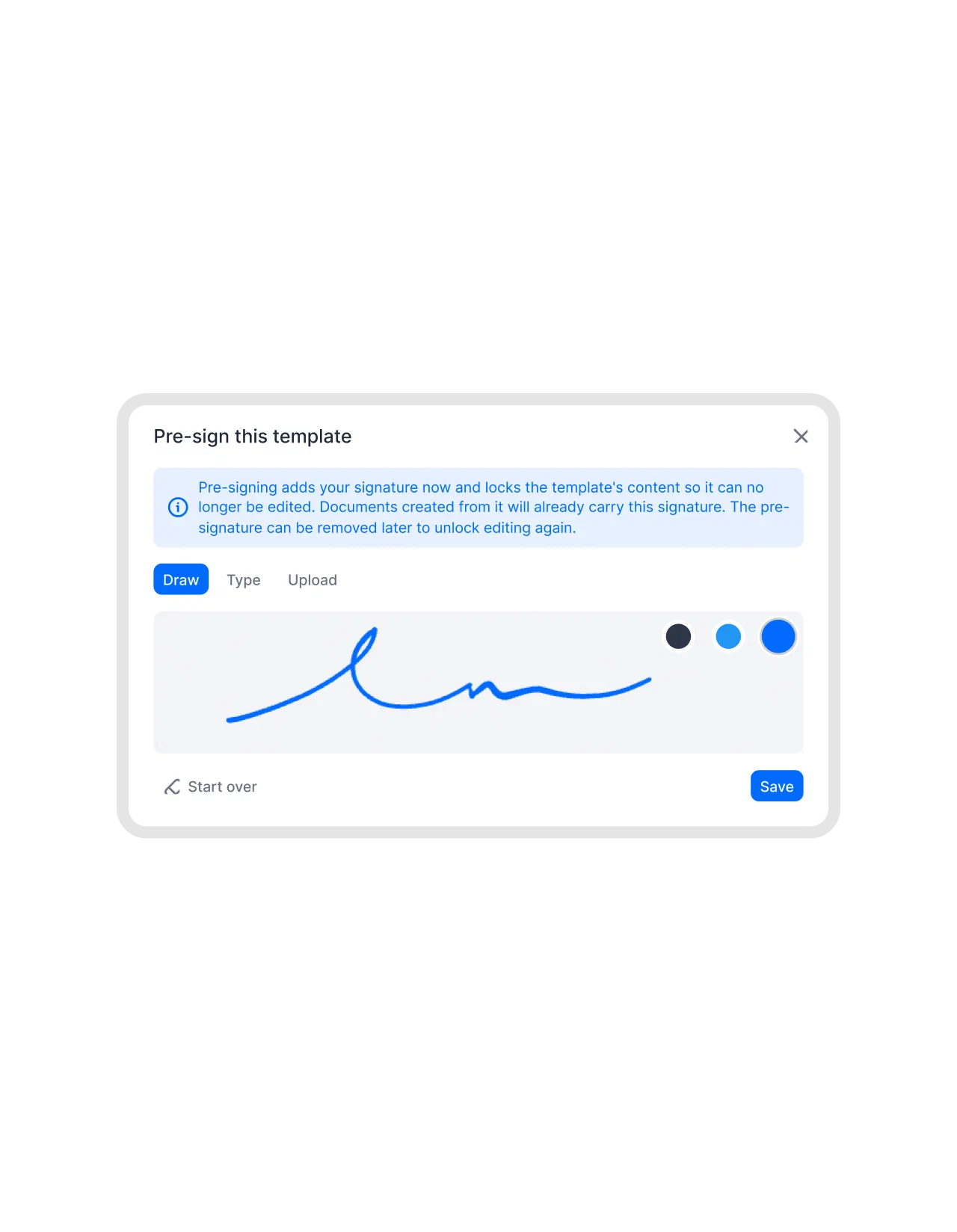


Pre-sign a template once, and every document made from it carries your signature automatically.
It is countersigning for the contracts that deserve your attention, and autopilot for the ones that do not.
Frequently asked questions
Is a countersignature legally binding?
Usually, yes. Once both parties have signed, a countersigned contract is generally binding, as long as the agreement meets the normal requirements of a valid contract. This is general information, not legal advice.
What is the difference between signing and countersigning?
Signing means adding your signature to a document. Countersigning means signing after another party has already signed, to confirm their signature and finalize the agreement.
Does a contract need to be countersigned to be valid?
Most contracts need signatures from all parties to be binding. If an agreement is meant to be signed by two sides, it typically is not fully in effect until the second party countersigns.
What does “countersigned” mean on a lease?
It means the landlord added their signature after the tenant signed. The tenant signs first, and the landlord’s countersignature confirms the lease.
Who countersigns a contract?
The party who signs second, usually the one that issued or received the agreement for final approval, such as an employer, landlord, or company representative.
Searching for a contract management solution?
Find out how fynk can help you close deals faster and simplify your eSigning process – request a demo to see it in action.
Please keep in mind that none of the content on our blog should be considered legal advice. We understand the complexities and nuances of legal matters, and as much as we strive to ensure our information is accurate and useful, it cannot replace the personalized advice of a qualified legal professional.




Get a regular dose of insightful contract management content




Take control of your agreements. Move your business forward.
Run agreements the way they should run: fast, clear, and on your terms.
No setup headaches
Go live in days, not quarters
No lock-in
Full export anytime
No hidden fees
Signatures included, no envelope fee