
Forging a signature: meaning, penalties and how to spot it
Updated · Published · 12 min read

Forging a signature is one of the oldest frauds there is, and it still works because most signatures are checked by eye, if at all. This guide explains what counts as forgery, what it costs the forger, how to spot a fake and what to do if someone has forged yours.
Forging a signature means writing or copying someone else’s signature without their authority, so that others accept it as genuine.
- Is it illegal? Yes. It is a crime in every US state, in the UK and in Germany, and using a forged document is usually a separate offence.
- Typical penalties: in the US, from a misdemeanor (up to about a year in jail) to a felony with several years in prison, depending on the state and the document. In England and Wales, up to 10 years. In Germany, a fine or up to 5 years, and up to 10 years in serious cases.
- Civil side: a forged signature does not bind the person whose name was used, and the forger can be sued for the damage.
- Not forgery: signing for someone with their genuine permission, clearly marked, for example with p.p. or “on behalf of”.
- Forgery
- Making a false document, or falsely signing or altering a real one, with the intent to deceive or defraud. A forged signature is the most common form: the document claims to be signed by someone who did not sign it and did not authorise it.
- Uttering
- Using a forged document: handing it over, filing it or presenting it as genuine. In many US states and in the UK this is a separate offence from making the forgery, so someone who only uses a forged document can still be prosecuted.
What does it mean to forge a signature?
To “forge” a signature means to fake it. The legal definition differs between countries, but three elements show up almost everywhere:
- A false signature or document. The signature claims to come from someone who did not make it, or the document was changed after it was signed.
- No authority. The person whose name appears did not authorise it.
- Intent to deceive. The forger wants someone to rely on it: a bank to pay out, a counterparty to perform, an authority to accept a filing.
The third element is why practising someone’s signature on a scrap of paper is not forgery, and why a child copying a parent’s signature on a school note is treated very differently from forging a cheque. It is the intended use that makes it criminal.
Is forging a signature illegal?
Yes. Forgery is a crime in essentially every legal system. What differs is how seriously it is graded. The table shows the rules in the jurisdictions our readers ask about most.
| Jurisdiction | Law | How it is classed | Maximum penalty |
|---|---|---|---|
| US (general) | State criminal codes | Misdemeanor or felony, depending on the document, the amount and the degree | Varies by state, from under a year in jail to many years in prison |
| California | Penal Code §§ 470, 473 | “Wobbler”: prosecuted as a misdemeanor or a felony | Up to 1 year in county jail, or 16 months, 2 or 3 years. Cheques and similar instruments under $950: generally up to 1 year |
| New York | Penal Law §§ 170.05 to 170.15 | Third degree: class A misdemeanor. Second degree (deeds, wills, contracts, cheques, public records): class D felony. First degree (money, stocks, bonds): class C felony | Up to 364 days in jail, 7 years or 15 years in prison |
| US (federal) | 18 U.S.C. § 510 | Forging an endorsement or signature on a US Treasury cheque or security | Up to 10 years, or up to 1 year if the face value is $1,000 or less |
| England and Wales | Forgery and Counterfeiting Act 1981, ss. 1 and 3 | Making a false instrument (s. 1) or using one (s. 3) | Up to 10 years on indictment (s. 6); lower limits in a magistrates’ court |
| Germany | § 267 StGB (Urkundenfälschung) | Making, altering or using a false document; attempt is punishable | Fine or up to 5 years. 6 months to 10 years in serious cases, 1 to 10 years for commercial gang forgery |
On top of the criminal penalty, courts usually order restitution, meaning the forger repays what the victim lost. First offenders with a small loss often get probation or a fine rather than prison, but that is a sentencing outcome, not a guarantee.
Forging a signature with permission is a different matter. If the person genuinely authorised you to sign for them, most legal systems do not treat it as forgery, because the authority element is missing. It is still risky: if they later deny the permission, it is your word against theirs. The safe way is to sign your own name with a marker such as p.p., “on behalf of” or “attorney-in-fact”, explained in our guides on signing on behalf of others and signing as power of attorney.
Civil consequences
The criminal case is only half of it. In civil law:
- The forged signature binds no one but the forger. For cheques and other negotiable instruments, the US Uniform Commercial Code (§ 3-403) treats an unauthorised signature as ineffective, except as the signature of the person who made it. Germany reaches the same result: the person whose name was forged made no declaration and is not bound.
- The victim can claim damages from the forger, including losses from transactions made on the strength of the forged document.
- Contracts built on a forgery unravel. A contract with a forged signature does not bind the purported signer, and anything paid or transferred under it may have to be returned.
- Employees who forge at work usually lose their job, and the employer can claim the damage from them.
Types of signature forgery
| Type | How it is done | What usually gives it away |
|---|---|---|
| Simple (freehand) forgery | The forger signs the name in their own handwriting, without trying to copy the real signature | Looks nothing like the genuine signature once you compare them |
| Simulated forgery | The forger practises the real signature and copies it freehand | Slow, careful strokes, tremor, blunt starts and stops, pen lifts in odd places |
| Traced forgery | The real signature is traced through thin paper, on a light box, or via carbon or pencil marks | Indentations or pencil traces under the ink, very even pressure, an overly exact match |
| Cut-and-paste or image forgery | A scan or photo of a real signature is pasted into a document, digitally or with a printer | Identical signatures on different documents, pixelated edges, a faint box around the signature |
| Electronic signature misuse | Someone uses another person’s email, login or phone to complete an e-signing process | The audit trail: unusual IP address, device or time, a signing link opened from an unexpected account |
| Autopen misuse | A machine that reproduces a stored signature in real ink is used without the owner’s authorisation | Identical signatures across many documents; the machine itself is legal when the owner authorises its use |
The simulated and traced types are what most people mean by “forging a signature”. The electronic types are growing, and they explain why an image of a signature proves very little on its own. If you just need a picture of your own signature, our free signature generator makes one in your browser. What makes a signature hold up in a dispute is the record around it, not the picture.
How to spot a forged signature
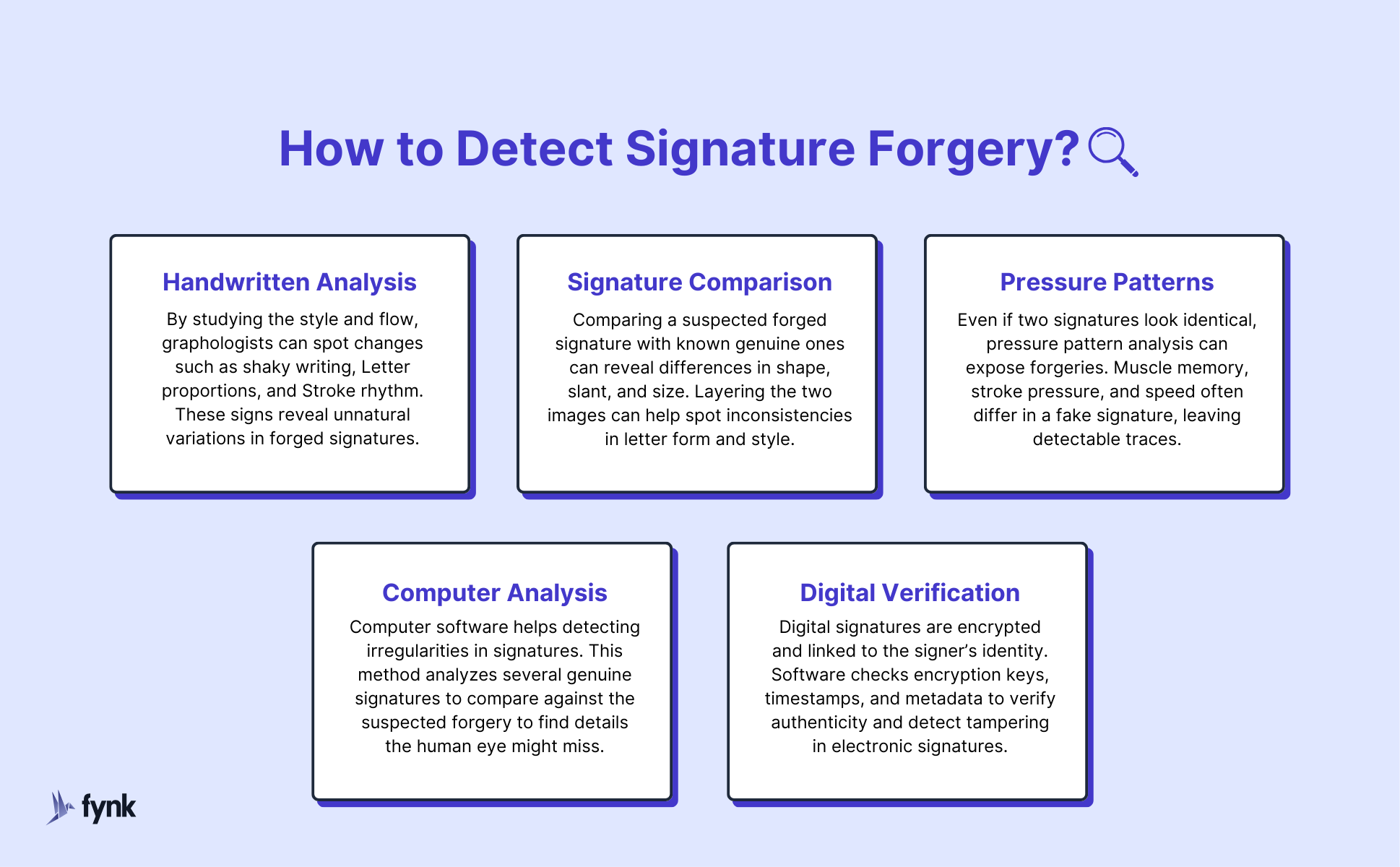

A genuine signature is written fast, from muscle memory. A forgery is written slowly, by someone concentrating on shape. Most tells come from that difference. Compare the questioned signature with several genuine ones from around the same time, ideally originals rather than copies, and work through this checklist:
- Line quality. Genuine strokes are fluid and confident. Shaky, wavering or hesitant lines suggest someone drawing rather than writing.
- Starts and ends. A fast signature begins and ends with tapered strokes. Blunt, heavy starts and stops show the pen was placed and lifted deliberately.
- Pen lifts. Look for breaks in the line where the real signer never lifts the pen, often where the forger paused to check the model.
- Pressure. Genuine signatures vary in pressure. Uniform pressure throughout, or deep indentation everywhere, points to tracing.
- Proportions and slant. Forgers copy the overall shape but often get the relative height of letters, the spacing and the slant subtly wrong.
- Retouching. Strokes that were gone over twice, or small corrections, are rare in genuine signatures.
- A perfect match. Nobody signs the same way twice. If two signatures overlay exactly, one of them is a copy.
- Traces underneath. Under a magnifier or raking light, look for pencil lines, indentations from tracing, or toner where there should be ink.
If the signature matters, for example in a court case, a disputed will or a large payment, do not rely on your own comparison. Hire a forensic document examiner. Note that graphology, which claims to read personality from handwriting, is not the same discipline and is not accepted as evidence of authenticity.
For electronic signatures, the checks are different. Open the signed PDF in a PDF reader and look at the signature panel: an advanced or qualified signature shows a certificate and whether the document has changed since signing. A pasted image shows nothing. For platform signatures, ask for the audit trail, which shows who received the link, when it was opened, from where and how the signer confirmed their identity.
What to do if your signature was forged
- Do not acknowledge the document. Do not sign anything that confirms it, pay under it or let it stand. Deny the signature promptly and in writing. In many systems a signature you do not dispute is treated as admitted.
- Secure the evidence. Get the original document if you can, or at least a copy. Do not write on it, fold it or punch holes in it, as that can destroy evidence an examiner needs.
- Collect genuine samples of your signature from around the same date: contracts, bank documents, ID.
- Tell your bank immediately if money is involved. In the US, you can lose your claim against the bank if you do not report a forged signature on a cheque within one year of the statement being made available (UCC § 4-406), and much shorter delays can already reduce what you recover.
- File a police report. It creates an official record and is often required by banks and insurers.
- Notify everyone relying on the document, such as the counterparty, a registry or a land office, so it is not acted on further.
- Talk to a lawyer about having the document declared invalid and about claiming damages.
- Close the gap. Find out how the forger got your signature and change the process, for example by moving important documents to electronic signing with identity checks.
A real case: Wells Fargo
In February 2020, Wells Fargo agreed to pay $3 billion to resolve criminal and civil investigations by the US Department of Justice and the SEC. From 2002 to 2016, employees under pressure from sales targets opened millions of accounts without customers’ consent, and the bank admitted that employees had forged signatures and falsified records to do it (US Department of Justice). The case shows how cheap a signature is to fake when nobody checks it, and how expensive it becomes when someone finally does.
How e-signatures with audit trails prevent forgery
A wet signature is checked by looking at it. A good electronic signature is checked by looking at the evidence behind it, which is much harder to fake:
- Identity checks: the signer is reached through their own email and, at the advanced level, confirms with a code sent to their phone or with a national eID.
- Audit trail: every step is logged with a timestamp: who was invited, who opened the document, who signed and when.
- Tamper seal: the document is sealed at the moment of signing, so a change afterwards is detectable.
- Certificates at the higher levels: an advanced or qualified electronic signature is cryptographically bound to the signer and to the exact content.
In fynk, contracts are sent and signed inside the platform with a simple, advanced or qualified signature. Advanced signatures are confirmed by SMS code or national eID such as BankID or MitID. Every view and signature is recorded in a tamper-proof audit trail, the document is sealed when signed, and the signed PDF states the signature level reached. Single sign-on, mandatory two-factor authentication and role permissions control who can get to a contract in the first place. For the legal side, see our guide on whether electronic signatures are legally binding.
This time, send and sign contracts
stress-free.
Signature forgery vs identity theft vs fraud
- Signature forgery fakes one signature on one document.
- Identity theft takes over a person’s identity more broadly, to open accounts, borrow money or sign contracts in their name. Forged signatures are often one of the tools.
- Fraud is the umbrella: deceiving someone to obtain money or an advantage. Forgery is often charged together with fraud when the forged document was used to get paid.
Related reading:
- What is a wet signature?, including how to tell ink from a printed signature
- Authority signatory: who, why and how to authorize, for setting signing rules inside a company
- Electronic signatures: the complete guide
Frequently asked questions
Yes. Forging a signature is a crime in every US state, in the UK and in Germany. Depending on the document and the amount, it is graded as a misdemeanor or a felony in the US, carries up to 10 years in England and Wales, and up to 5 years or a fine in Germany, with up to 10 years in serious cases.
It depends on where it happened and what was forged. In New York, forging a deed, will, contract or cheque is a class D felony with up to 7 years in prison. In California, forgery can be charged as a misdemeanor with up to 1 year in jail or as a felony with up to 3 years. Courts usually add restitution to the victim.
To forge a signature means to fake it: to write or copy someone else's signature without their authority, so that others believe they signed. The person who does it is called a forger.
Usually not, because forgery requires that the signer had no authority. It is still risky if the permission is later denied. The safe way is to sign your own name and mark the representation, for example with p.p. or ‘on behalf of’, and to keep the authorisation in writing.
Compare it with several genuine signatures from the same period. Typical signs of a forgery are shaky or slow lines, blunt starts and stops, pen lifts in unusual places, uniform pressure, retouched strokes and a match that is too perfect. For anything important, a forensic document examiner should check the original.
Deny the signature in writing straight away, secure the original document, collect genuine samples of your signature, tell your bank if money is involved, file a police report and speak to a lawyer. Act quickly, as banks and courts can limit your claim if you wait.
An image of a signature can be copied easily. A proper electronic signature is much harder to fake, because it relies on evidence such as access to the signer's email or phone, an audit trail and a tamper seal. Advanced and qualified signatures are also cryptographically tied to the signer and the document.
Please keep in mind that none of the content on our blog should be considered legal advice. We understand the complexities and nuances of legal matters, and as much as we strive to ensure our information is accurate and useful, it cannot replace the personalized advice of a qualified legal professional.




Get a regular dose of insightful contract management content



Take control of your agreements. Move your business forward.
Run agreements the way they should run: fast, clear, and on your terms.
No setup headaches
Go live in days, not quarters
No lock-in
Full export anytime
No hidden fees
Signatures included, no envelope fee