
EUDI wallet and QES: what changes in December 2026

Rezvan Golestaneh
Published · 5 min read
By December 2026, every EU citizen will have access to a government-verified digital identity wallet that makes qualified electronic signatures as easy as unlocking a phone.
If your contracts rely on QES, or should but don’t yet, here’s what you need to know:
- Cross-border Qualified Electronic Signatures (QES) are currently complex and fragmented, requiring repeated identity verification and multiple platforms
- The EU’s European Digital Identity Wallet (EUDI) (launching Dec 2026) will simplify this by letting users verify their identity once and sign documents directly from their phone
- QES will become much easier, faster, and more standardized across all EU countries
- By late 2027, QES will be mandatory/expected for sectors like finance, telecoms, and public services
If you’ve ever tried to get a contract signed with a Qualified Electronic Signature across borders, you know the drill. Different platforms for different countries, identity verification that starts from scratch every single time, signers bouncing between systems. A lot of friction for what should be a straightforward process.
That’s about to change. By December 2026, the EU is rolling out the European Digital Identity Wallet (EUDI), and for anyone dealing with contracts, legal documents, or compliance, it’s genuinely worth paying attention to.
In this guide, we’ll cover the full eIDAS-to-EUDI timeline, sector-specific implications, and practical steps to prepare. Don’t forget to download the full guide!
A quick primer on QES
Not all electronic signatures are created equal. Under eIDAS, there are three tiers:
- Simple: a typed name, checkbox, or scanned image
- Advanced: uniquely tied to the signer and traceable after the fact
- Qualified: the gold standard, carrying the same legal weight as a handwritten signature
A Qualified Electronic Signature is the most secure and legally robust option available under EU law. For certain documents, including fixed-term employment contracts, guarantees, and specific financial agreements, QES isn’t optional, it’s required.
So why isn’t everyone using it already? Because getting one has always been a bit of a process. You need to onboard with a qualified trust service provider, go through identity verification that varies by country, and manage a workflow that often spans multiple systems. It’s fragmented, repetitive, and not exactly smooth for the signers on the other end.
That’s the problem the EUDI Wallet is built to fix.
What the wallet actually is
Think of it as a government-verified digital identity app on your phone. EU citizens can store their national ID, driving licence, diplomas, and professional qualifications, and use all of that to authenticate or create legally binding signatures across borders, without starting over each time.
It’s free, voluntary, and built on open standards with privacy-by-design from the ground up. Once your identity is verified and stored, creating a QES becomes as simple as unlocking your phone. No separate accounts, no jumping between platforms, no repeating the same verification steps you completed six months ago with a different provider.
The dates that matter
The regulatory groundwork is already done. eIDAS 2.0 came into force in 2024, mandating that every EU Member State provide a wallet to every citizen. The technical Architecture Reference Framework covering interoperability, certification and data models was finalised in November 2024.
December 2026: Wallets go live across all 27 Member States. Any EU citizen will be able to create a QES directly from their phone.
Late 2027: Mandatory acceptance kicks in for banks, telecoms and public services. QES stops being optional and becomes the expected default.
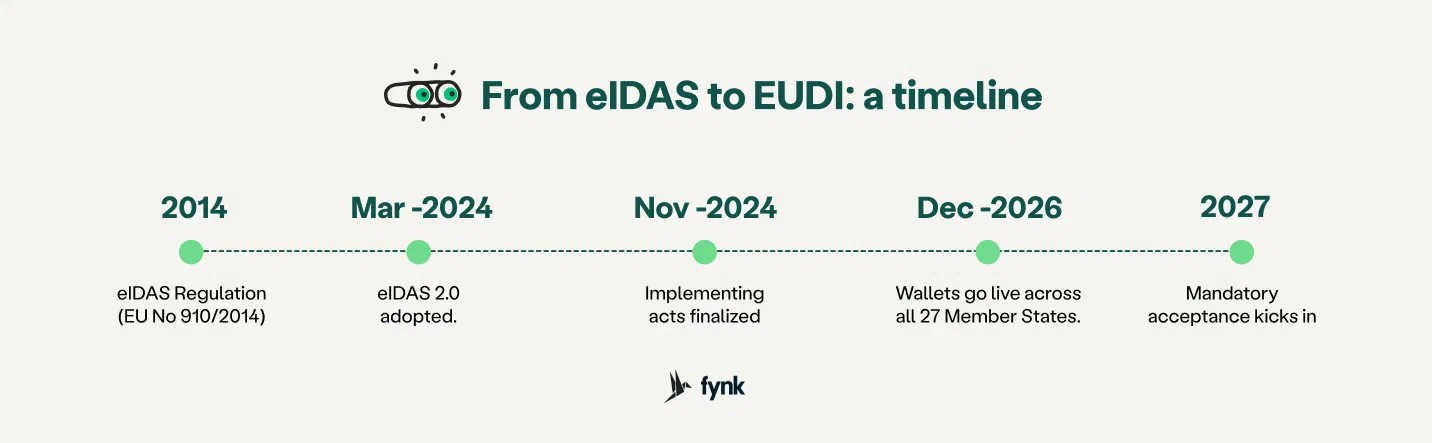


From eIDAS to EUDI: the regulatory timeline
If you’re in financial services, healthcare, telecoms or public procurement, the 2027 deadline is the one to build your roadmap around. Starting that conversation now, not six months before launch, puts you in a much more comfortable position.
You don’t have to wait for 2026
Here’s something worth knowing: you can start using QES today, without waiting for the wallet.
If you’re on fynk, you already have access to qualified electronic signatures, without any of the usual complexity. Drop your file, choose QES as the signature type, select your country and provider, verify your ID. That’s it.
fynk connects trusted identity providers and certified QES providers in the background, so your team doesn’t have to manage multiple systems or chase signers through clunky third-party flows. You get real-time status tracking, automatic signer reminders, flexible signing order, and a full audit trail from document creation to final signature.
fynk covers all the major QES providers across Europe, including ID Austria / HandySignatur, D-Trust sign-me, Evrotrust, Verimi, Swedish BankID, Swisscom Mobile ID, Danish MitID and more. When the EUDI Wallet rolls out, fynk will integrate with it directly. But the experience is already smooth today.
This time, send and sign contracts
stress-free.
Where this matters most for your business
The impact of the wallet depends on what you’re signing and where, but a few areas stand out.
HR and employment: In Germany, Austria and several other Member States, certain employment contracts legally require QES. With the wallet, HR teams will be able to offer QES signing at the moment of offer acceptance, from any device, in seconds, with no separate onboarding step.
Financial services: Loan agreements, investment mandates, and other regulated financial products will benefit from instant QES at the point of signature, without the enrollment barrier that currently slows things down. The finance and legal teams who spend time chasing qualified signatures today will see that friction disappear.
Cross-border agreements: Parties in different Member States will be able to execute leases, property agreements, and commercial contracts in minutes rather than scheduling in-person notarisation or coordinating across incompatible systems.
The common thread: QES is currently treated as a special-case process reserved for high-stakes documents. The wallet turns it into the default option. That changes how you think about your entire signing workflow.
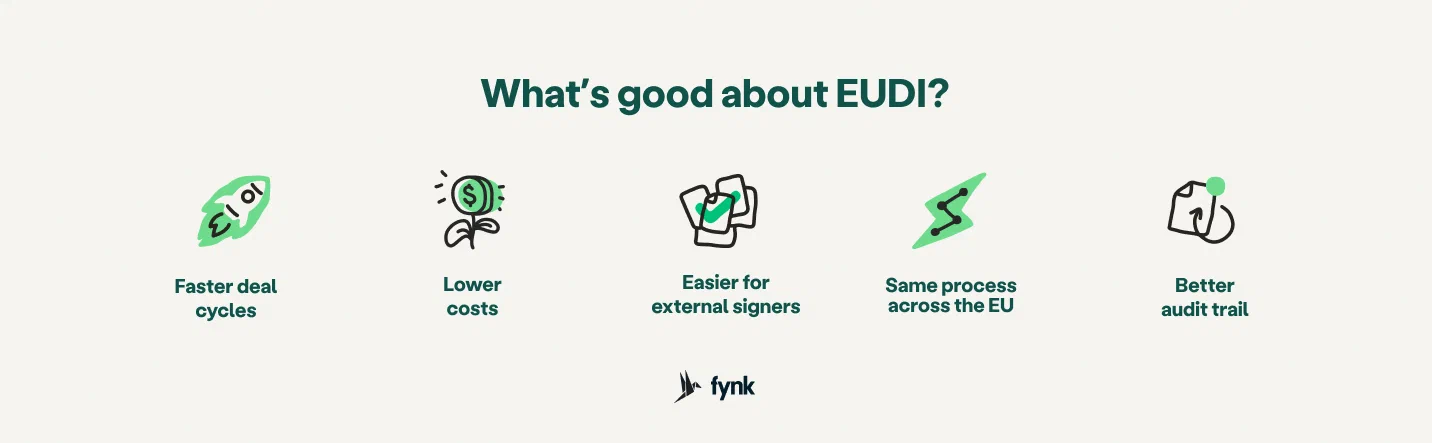
Key benefits of the EUDI Wallet for businesses
A few practical steps to take now
You don’t need to overhaul anything today, but a few things are worth doing.
Map where you use QES, and where you should. If you’re only applying it to a handful of critical documents, start thinking about what your workflow looks like once the friction is largely gone. There’s a good chance you’ll want to extend it further.
Check your platform’s flexibility. Make sure your signing setup can adapt to new identity standards without major rework. If the underlying complexity is already handled for you, you’re in good shape. If not, now is a reasonable time to evaluate your options. Our guide to electronic signature legality is a useful starting point.
Watch adoption in your key markets. The rollout will happen country by country. Knowing when your customers and partners start using the wallet helps you move at the right moment rather than scrambling to catch up.
Get the full guide
Our comprehensive guide covers the complete eIDAS-to-EUDI timeline, a before/after breakdown of how QES changes, sector-specific implications for financial services, healthcare, HR and public sector, and a practical checklist for businesses to prepare. It’s free.
Get the free EUDI wallet & QES guide
Everything you need to know about the European Digital Identity Wallet, how it changes qualified electronic signatures, and how to prepare your business.

We will collect, use and protect your data in accordance with our privacy policy.
Please keep in mind that none of the content on our blog should be considered legal advice. We understand the complexities and nuances of legal matters, and as much as we strive to ensure our information is accurate and useful, it cannot replace the personalized advice of a qualified legal professional.



Get a regular dose of insightful contract management content


Take control of your agreements. Move your business forward.
Run agreements the way they should run: fast, clear, and on your terms.
No setup headaches
Go live in days, not quarters
No lock-in
Full export anytime
No hidden fees
Signatures included, no envelope fee