
Signatory vs signer vs signee: contract signing roles

Rezvan Golestaneh
Updated · Published · 8 min read

Signatory, signer, signee, party, counterparty, witness: contracts use a handful of overlapping words for the people involved in signing. Here is what each one means and how they fit together.
- A one-table comparison of every signing role
- Why the party and the signatory are usually not the same
- Who signs first, and what happens when several people must sign
- How signatories, signing order and signature fields work in an e-signature workflow
Contracts are signed by people, but they usually bind someone else: a company, a partnership, a client. That is why the vocabulary gets confusing. This guide sorts out the terms, then covers signing order, multiple signatories and how the roles map to an e-signature workflow.
A signatory is a person who signs a contract and, by doing so, binds themselves or the party they represent. A signer is anyone who physically or electronically signs. Signee means the same as signer in dictionaries, though some people use it for the recipient, so it is best avoided.
- The party is who is bound by the contract (often a company). The signatory is the person who signs for it.
- The counterparty is the party on the other side.
- A witness signs only to confirm they saw the signatory sign. They are not bound by the contract.
Whether a signatory is actually allowed to sign for a company is a separate question, covered in our guide to authorized signatories and signing authority.
- Contract signatory
- A person who signs a contract to make it binding, either on themselves (when they sign in their own name) or on the party they represent (when they sign as a director, officer or agent). In a contract between two companies, there are two parties but often three or four signatories.
Signatory vs signer vs signee and other signing roles
| Term | What it means | Example | Bound by the contract? |
|---|---|---|---|
| Party | A person or organisation that takes on rights and obligations under the contract | ACME Inc. and Beta GmbH | Yes |
| Counterparty | The party on the other side, seen from your perspective | For ACME, it is Beta GmbH | Yes |
| Signatory | A person who signs to bind themselves or the party they represent | ACME’s CFO, signing for ACME | Yes, or their party is |
| Authorized signatory | A signatory who has the legal power to bind the party they sign for | A managing director with sole representation | Their party is |
| Signer | Anyone who signs the document, in any capacity | Signatories, witnesses, notaries | Depends on the capacity |
| Signee | In dictionaries, the same as signer. Some use it for the recipient of a signed document | Avoid in contracts | As signer |
| Signer of record | The person whose signature is officially recorded or kept on file for a document or account | The signer on a bank signature card or a regulatory filing | Depends on the document |
| Co-signatory | One of several signatories who sign together, often for the same party | CEO and CFO both signing a loan | Yes, jointly |
| Witness | A person who watches the signatory sign and signs to confirm it | A colleague attesting a deed | No |
| Notary | A public official who verifies identity and certifies the signature or the document | A notary certifying a power of attorney | No |
Signatory vs signer
Every signatory is a signer, but not every signer is a signatory. A witness and a notary both sign the document, but neither takes on any obligation under it. “Signatory” is the more formal word and the one used in legal drafting (“the signatories warrant that they are authorised to sign”). “Signer” is the everyday word and the one most e-signature tools use in their interface.
Signee vs signer
Dictionaries such as Dictionary.com and Collins define a signee as a person who signs, the same as a signer. In practice, “signee” is sometimes used for the person a document is sent to, which is exactly why it causes confusion. Use “signer” or “signatory” in contracts and workflows, and you avoid the question.
Party vs signatory
This is the distinction that matters legally. When a company enters a contract, the company is the party and the person who signs is its signatory. If the signature block does not make that capacity clear, the signatory risks being treated as a party personally. That is why company signature blocks name the company first and the signatory’s name and title underneath. Our guide to signing authority has a sample block, and how to sign on behalf of others covers p.p., “for and on behalf of” and similar designations.
Who can be a contract signatory?
Two conditions have to be met:
- Capacity. The signatory must have legal capacity: of legal age (18 in most US states, in England and Wales and in Germany) and of sound mind when signing. Contracts signed by minors or by someone who lacked capacity can generally be challenged.
- Authority, when signing for someone else. To bind a company or another person, the signatory needs authority from the law, the company’s bylaws, a board resolution, a delegation policy or a power of attorney. How that works, and how to check it, is covered in authorized signatory: who can sign for a company.
The order of signatures
Does the signing order matter legally?
Usually not. A contract becomes binding once every required signatory has signed, regardless of who went first. The date of the last signature is normally the date the contract is fully executed, unless it states a different effective date.
The order still matters in practice, for three reasons:
- Control over the final version. The party that signs last sees the version the other side committed to before it commits itself. Many companies ask the counterparty to sign first and then countersign.
- Internal approvals. Internal reviewers and approvers should finish before the authorized signatory signs, so the most senior signature comes last.
- Witnesses and notaries. A witness signs immediately after the signatory they are witnessing, and in the same session. A notary acts when the signatory signs or acknowledges the signature in front of them.
A typical order for a B2B contract
- Internal approvals (legal, finance, the budget owner)
- Counterparty signatory or signatories
- Your own authorized signatory or signatories
- Distribution of the fully signed copy to everyone involved
Multiple signatories
Contracts often need more than one signature per party. The common cases:
- Joint representation. The company’s rules or the commercial register require two signatures, for example two directors, or a director and a Prokurist in a German GmbH. One signature alone is not enough.
- Four-eyes principle. Internal policy requires a second signatory for high-value contracts, such as the CEO and the CFO.
- Several parties. Multi-party agreements (consortium agreements, shareholder agreements) need a signatory for each party.
- Guarantors and co-signers. In loans and leases, a co-signer or guarantor signs to take on liability if the main party does not pay.
Two drafting points help when several people sign:
- A counterparts clause lets each signatory sign a separate copy, and all copies together form one agreement. It saves passing one paper copy around, and it is standard in contracts signed electronically.
- A clear list of required signatories. If the contract says it takes effect “when signed by all Parties”, a missing signature means it is not yet binding. Make sure everyone knows who still has to sign.
Signatories and signature fields in e-signature workflows
E-signature tools follow the same logic, with different names for the pieces. In fynk:
- Parties are the contracting entities, usually companies. Signatories are the people who sign for them, and one party can have several signatories.
- Signature blocks are placed in the document and assigned to a specific signatory. One signer can have several blocks, for an initial on one page and a full signature on the last.
- Signing order can be sequential (each person is notified only when it is their turn) or simultaneous (everyone signs at once). An approval step can be added before signing starts, so external signatories never see a contract that has not been approved.
- External signatories sign through a secure link without a fynk account. Reminders go out automatically, and the audit trail logs each signature with a timestamp, the signer’s identity and the method.
- Signature levels depend on the risk: simple, advanced (confirmed with a code sent to the signer’s phone or a national eID) or qualified electronic signatures, all under the EU eIDAS framework.
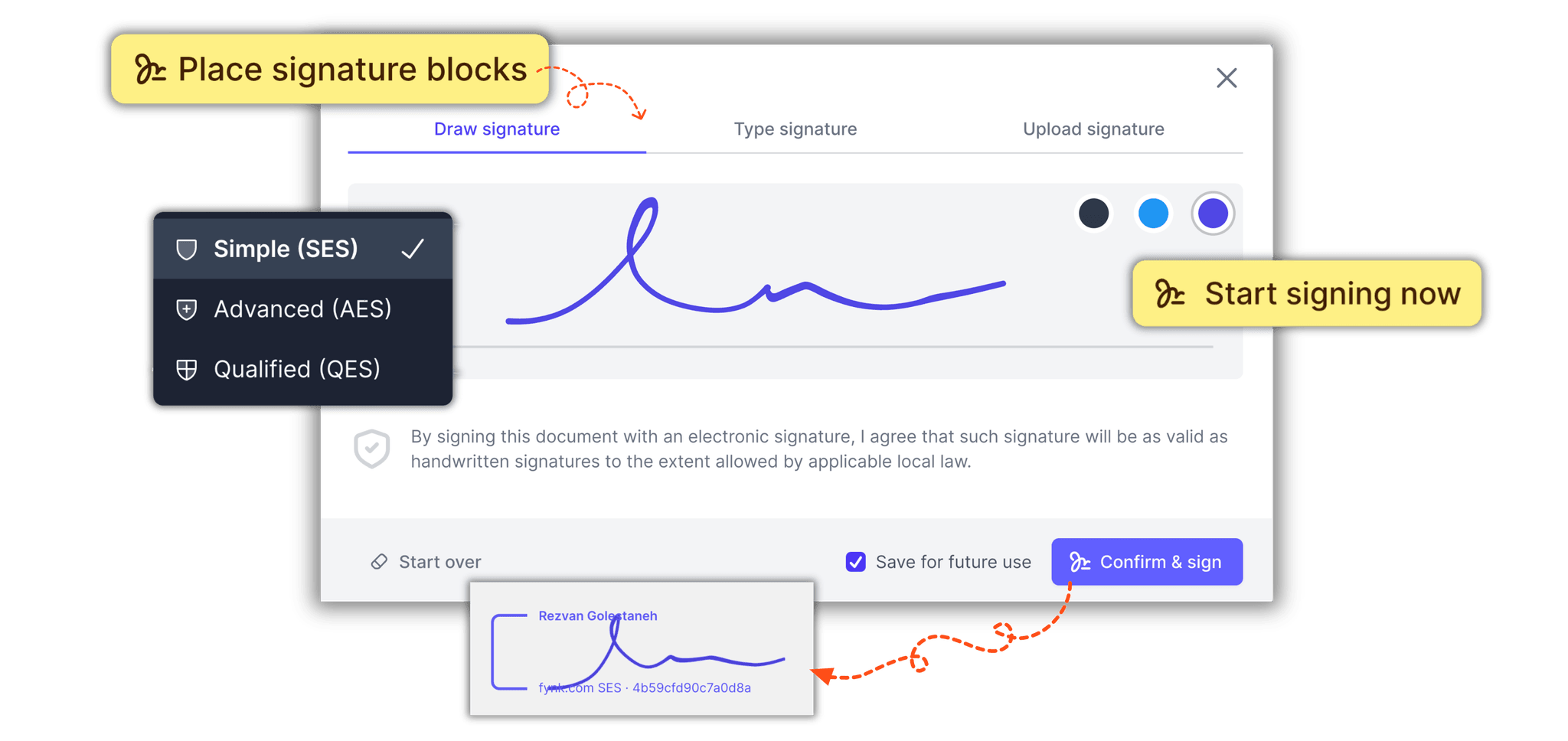


Electronic signatures in fynk
Electronic signatures are legally valid for most commercial contracts in the EU, the US and the UK. Some documents still need a handwritten signature or a specific form. See are electronic signatures legally binding for the details.
This time, send and sign contracts
stress-free.
What a signatory is responsible for
Signing is the moment of commitment, so the checks belong before it:
- Read the final version. Make sure what you sign is the version that was negotiated and approved.
- Confirm your capacity. Sign in your own name only when you are the party. When you sign for a company, put the company name and your title in the signature block.
- Stay within your authority. If the contract is above your limit or outside your remit, it needs another signatory or a prior approval.
- Keep the signed copy. The fully signed version, with the audit trail if it was signed electronically, is your evidence if the contract is ever disputed.
Frequently asked questions
Dictionaries define both as a person who signs a document. Some people use signee for the person who receives a signed document, which causes confusion. In contracts and signing workflows, use signer or signatory.
Signers is the more common and less ambiguous word, and it is what most e-signature tools use. Signees is not wrong, but because some people read it as the recipients of a document, signers or signatories is clearer.
Both are correct. Signatory is the formal word used in contracts for a person who signs to bind themselves or a party. Signer is the everyday word for anyone who signs, including witnesses.
The party is the person or company bound by the contract. The signatory is the person who signs it. When a company signs, the company is the party and its director or officer is the signatory.
No. A witness signs only to confirm they saw the signatory sign. The witness takes on no obligations under the contract.
Legally, the order rarely matters: the contract binds once everyone has signed. In practice, internal approvals come first, then the counterparty signs, and your own authorized signatory signs last so they see exactly what the other side committed to.
Yes. A party may need two signatures under its own rules or the commercial register, and multi-party contracts need a signatory for each party. If the contract requires all signatures, it is not binding until the last one is in.
One of two or more people who sign together. They may sign jointly for the same company, such as a CEO and CFO, or take on shared liability, such as a co-signer on a loan or lease.
Please keep in mind that none of the content on our blog should be considered legal advice. We understand the complexities and nuances of legal matters, and as much as we strive to ensure our information is accurate and useful, it cannot replace the personalized advice of a qualified legal professional.




Get a regular dose of insightful contract management content



Take control of your agreements. Move your business forward.
Run agreements the way they should run: fast, clear, and on your terms.
No setup headaches
Go live in days, not quarters
No lock-in
Full export anytime
No hidden fees
Signatures included, no envelope fee