divestiture
A divestiture clause outlines the conditions under which a party must sell or dispose of certain assets, typically to comply with regulatory requirements or to maintain competitive balance. This clause ensures that the involved entities act in accordance with antitrust laws and helps prevent monopoly practices.
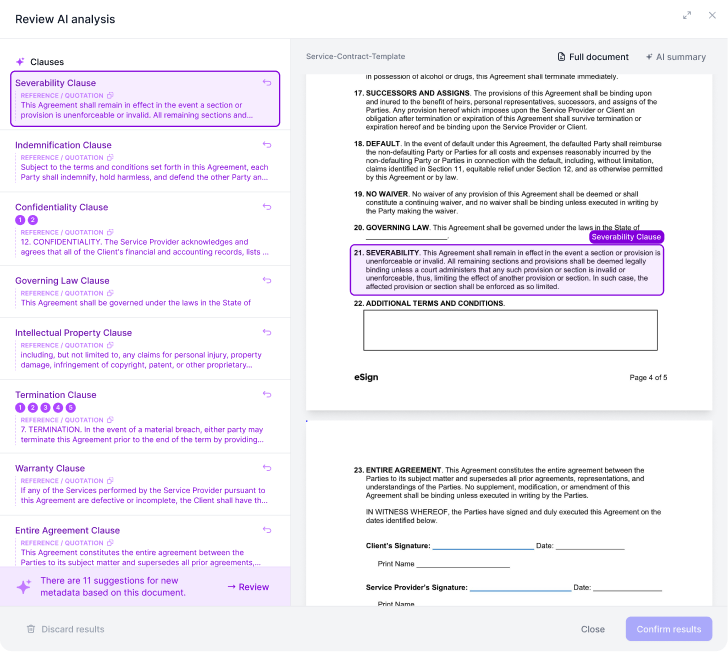
Analyze your contracts. Extract important clauses.
Try our AI contract analysis and extract important clauses and information from existing contracts.
Save your favourite clauses
Insert directly with a single click
Upload preferred precedents
Sample divestiture clauses
Source
L3 TECHNOLOGIES, INC.Defendants shall not take any action that will impede in any way the permitting, operation, or divestiture of the Divestiture Assets.
Source
USD Partners LP (USDP)The Transaction contemplated by the Purchase Agreement is referred to herein as the “Divestiture.”…The Divestiture is considered a disposition of a significant business under Item 2.01 of Form 8-K…The Divestiture does not meet the criteria requiring discontinued operations presentation in accordance with accounting principles generally accepted in the United States of America (“U.S. GAAP”) because it does not represent a strategic shift that will have major effect on the Partnership’s operations or financial results.
On April 14, 2022, [Company A], pursuant to a stock purchase agreement (the “Purchase Agreement”), dated as of March 6, 2022, with [Company B], a Delaware corporation…completed the divestiture of [Company C], a Florida corporation and wholly-owned subsidiary of [Company A]…with the sale of all of the issued and outstanding capital stock of [Company C] to [Company B]. The transactions contemplated by the Purchase Agreement are referred to herein as the “Divestiture.”
This amended package modifies and builds on the initial divestiture package that was announced on September 8, 2023. The amended divestiture package responds to concerns raised by federal and state antitrust regulators regarding the original agreement. The enhanced divestiture package includes a modified and expanded store set and additional non-store assets to further enable C&S to operate competitively following the completion of the proposed merger.
The Divestiture must occur within 180 days after the consummation of the Merger and, if not complete by such time, the Divestiture Branches will be transferred to an independent trustee for sale. The Divestiture is designed to resolve any competitive concerns raised by the DOJ concerning the Merger.
This comprehensive divestiture plan marks a key next step toward the completion of the merger by extending a well-capitalized competitor into new geographies. The divestiture plan ensures no stores will close as a result of the merger and that all frontline associates will remain employed, all existing collective bargaining agreements will continue, and associates will continue to receive industry-leading health care and pension benefits alongside bargained-for wages.
Source
GENESEE & WYOMING INCUnder the Merger Agreement, G&W has agreed to use reasonable best efforts to reasonably assist and reasonably cooperate with Parent in Parent’s efforts to consummate any planned divestiture by Parent of G&W’s interests in [GWA] to a third party (the “GWA Divestiture”) so long as (1) such cooperation would not unreasonably interfere with G&W’s business or operations and (2) G&W would not be required to take any action that would subject it to actual or potential liability, to bear any cost or expense or to pay any fee or make any other payment or agree to provide any indemnity in connection with the GWA Divestiture prior to the effective time of the Merger.
Source
Western Union CO (WU)The decline in adjusted earnings per share was primarily due to divestitures completed in the second quarter of 2019 and a higher adjusted effective tax rate in the current quarter, partially offset by lower shares outstanding.
The parties will also enter into a brand license agreement which will set forth the parties’ rights in certain brand names for a transition period after the closing date of the Divestiture.
Source
Net Element, Inc. (MULN)The Parties to the Restated Merger Agreement intend that, prior to the Merger effective time but, subject to and after the Company’s stockholders’ approval, the Company will divest itself of its existing business operations to another party, and will cause such party to assume all liabilities of the Company directly related to its operations of its existing business immediately prior to the closing of such divestiture (the “Divestiture”).
What is Divestiture?
Divestiture refers to the process of a company selling off a portion of its assets, subsidiaries, or business units. This strategic action is often taken to streamline operations, focus on a company’s core business units, raise capital, or comply with regulatory requirements. Divestitures can occur through various mechanisms, such as selling to another company, initiating a spinoff, or even liquidation.
When Should I Use Divestiture?
A company might consider a divestiture in several scenarios, including:
- Non-core Business Units: If a unit no longer aligns with the company’s long-term strategic goals.
- Underperformance: To remove divisions or subsidiaries that are underperforming and affecting overall profitability.
- Debt Reduction: To generate cash and reduce debt burden.
- Regulatory Requirements: In response to antitrust concerns or merger conditions imposed by regulatory authorities.
- Strategic Realignment: To focus on core competencies and enhance competitive position.
How Do I Write a Divestiture Agreement?
Writing a divestiture agreement involves detailing the terms and conditions under which the divestiture will occur. This typically includes:
- Asset Description: Clearly describe the assets, business units, or subsidiaries being divested.
- Transaction Structure: Define whether the divestiture is a sale, spinoff, or transfer of ownership.
- Financial Terms: Outline the purchase price, payment terms, and any adjustments.
- Timeline: Specify closing dates and any milestones for transaction completion.
- Representations and Warranties: Detail the assurances made by both the seller and buyer regarding the condition of the assets and the transaction’s validity.
- Covenants: Include any promises regarding the operation of the business pre-closure.
- Closing Conditions: List the conditions that must be met before the transaction can close.
- Indemnification: Outline protection for both parties against potential losses or claims.
**Example:**

"Company A agrees to sell its Subsidiary B to Company C for a cash consideration of $10 million, subject to customary closing conditions. The transaction is expected to close by December 31, 20XX."
Which Contracts Typically Contain Divestiture?
Divestiture clauses and terms can be found in several types of contracts, including:
- Merger and Acquisition Agreements: These often include provisions for the divestiture of certain business units or assets as a condition of the deal.
- Joint Venture Agreements: In situations where partnering entities decide to divest joint assets or interests.
- Supplier or Distribution Agreements: Where certain rights or territories may be sold or reassigned.
- Franchise Agreements: Where certain franchise units or locations are sold off by the parent company.
These contracts not only facilitate the divestiture process but also ensure that both parties are legally protected and clear about their rights and obligations.
More clauses from the library
See allDouble trigger acceleration
Double trigger acceleration is a contractual provision commonly found in employee stock or option agreements, which accelerates vesting based on the occurrence of two specific events, typically a change in company control followed by an employee's involuntary termination or departure for 'good reason.' This clause is designed to provide financial security to key employees in the event of company acquisition while also protecting the acquiring company from immediate mass vesting.
11 example clauses
Down payment
A down payment clause specifies the initial, non-refundable portion of the total cost that a buyer must pay upfront to secure the purchase of a product or service. This clause outlines the amount, timing, and any conditions associated with the down payment, providing assurance to both parties involved in the transaction.
20 example clauses
Drag along rights
Drag-along rights are provisions in shareholder agreements that allow majority shareholders to compel minority shareholders to join in the sale of a company, ensuring that potential buyers can acquire 100% ownership. These rights help facilitate smoother transactions by aligning interests and reducing obstacles from minority shareholders who might otherwise block a sale.
11 example clauses
Analyze your contracts. Extract important clauses.
Try our AI contract analysis and extract important clauses and information from existing contracts.
Save your favourite clauses
Insert directly with a single click
Upload preferred precedents